

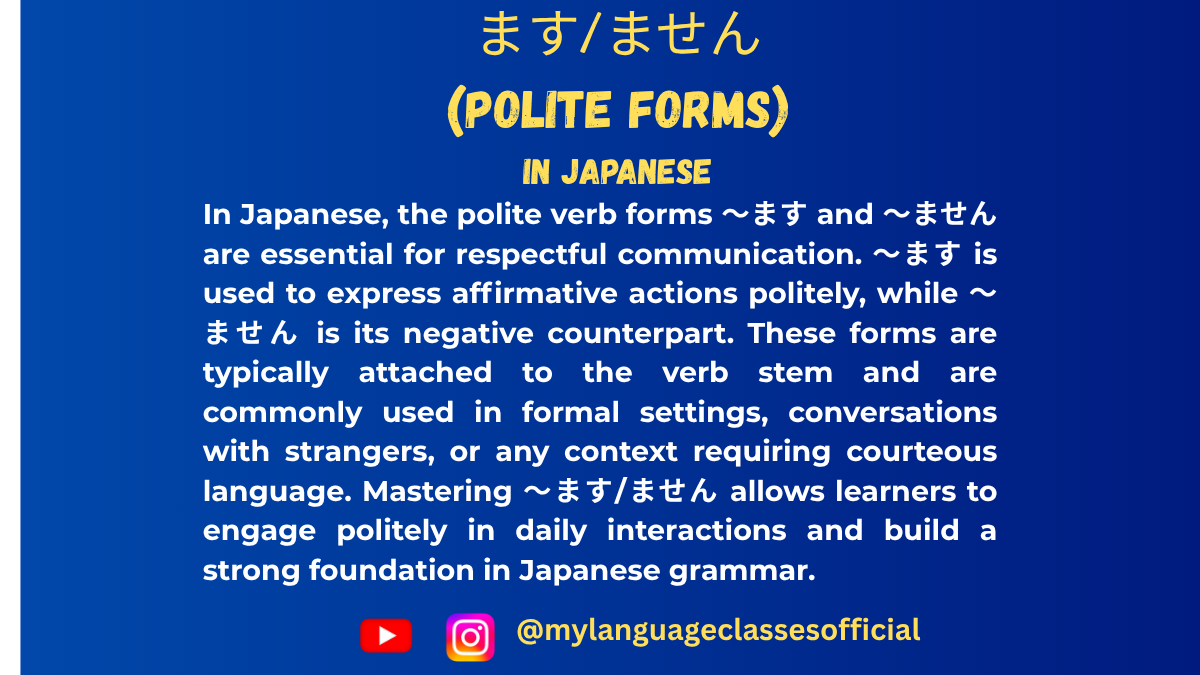
Mastering Polite Forms in Japanese:ます/ません
Politeness is a core aspect of the Japanese language, and the ます/ません forms are fundamental tools for expressing yourself respectfully. These polite forms are used to conjugate verbs in both affirmative and negative forms. To help you understand, we’ll break down the process of creating ます (affirmative polite) and ません (negative polite) forms for all three verb groups in Japanese.
Verb Groups in Japanese
Japanese verbs are classified into three groups based on their conjugation patterns:
- Group 1 (う-verbs): Verbs that end with a syllable from the う row (like かく, のむ, はなす).
- Group 2 (る-verbs): Verbs that end in る, with their stem typically ending in an e or i sound (like たべる, みる).
- Group 3 (Irregular verbs): Two irregular verbs, する (to do) and くる (to come).
1. Making Affirmative Polite Forms (ます)
The ます form is the polite, affirmative form of the verb. Here’s how you conjugate verbs for each group:
Group 1 (う-verbs):
- Replace the final う sound with its corresponding い sound.
- Add ます.
Examples:
- 書く (かく) → 書き → 書きます = “I write.”
- 飲む (のむ) → 飲み → 飲みます = “I drink.”
- 話す (はなす) → 話し → 話します = “I speak.”
Group 2 (る-verbs):
- Remove る to get the stem.
- Add ます.
Examples:
- 食べる (たべる) → 食べ → 食べます = “I eat.”
- 見る (みる) → 見 → 見ます = “I see.”
Group 3 (Irregular verbs):
- Memorize these forms, as they do not follow typical patterns.
- する → します = “I do.”
- くる → きます = “I come.”
2. Making Negative Polite Forms (ません)
The ません form is the polite, negative form of the verb. The process is similar to ます, but you replace ます with ません to express negation.
Group 1 (う-verbs):
- Replace the final う sound with its corresponding い sound.
- Add ません.
Examples:
- 書く (かく) → 書き → 書きません = “I do not write.”
- 飲む (のむ) → 飲み → 飲みません = “I do not drink.”
- 話す (はなす) → 話し → 話しません = “I do not speak.”
Group 2 (る-verbs):
- Remove る to get the stem.
- Add ません.
Examples:
- 食べる (たべる) → 食べ → 食べません = “I do not eat.”
- 見る (みる) → 見 → 見ません = “I do not see.”
Group 3 (Irregular verbs):
- Memorize these forms.
- する → しません = “I do not do.”
- くる → きません = “I do not come.”
3. Examples for Practice
Let’s see these forms in action with full sentences:
Affirmative:
- あした、図書館に行きます。
Ashita, toshokan ni ikimasu.
“I will go to the library tomorrow.” - 毎日日本語を勉強します。
Mainichi nihongo o benkyou shimasu.
“I study Japanese every day.”
Negative:
- お酒は飲みません。
Osake wa nomimasen.
“I do not drink alcohol.” - 学校へ来ませんでした。
Gakkou e kimasen deshita.
“I did not come to school.”
Key Points to Remember
- Polite Speech: Always use ます and ません when addressing someone respectfully.
- Group Identification: Correctly identifying verb groups is critical for accurate conjugation.
- Consistency: Stick to one level of politeness throughout a conversation.
Practice Makes Perfect
Try conjugating these verbs into ます and ません forms:
- 読む (よむ)
- 起きる (おきる)
- 遊ぶ (あそぶ)
- する
Create your own sentences using these forms to solidify your understanding. Consistent practice is the key to mastering Japanese polite forms!
With these steps, you’re well on your way to speaking Japanese with confidence and respect. Keep practicing, and remember: small steps lead to big progress. 頑張ってください!

Vikas Kumar is the founder of My Language Classes, a language learning platform dedicated to helping learners develop practical communication skills in Spanish, Japanese, and English through comprehensive grammar guides, structured learning resources, books, and evidence-informed educational content.
At My Language Classes, we believe that successful language learning is built on clarity, consistency, meaningful practice, and a deep understanding of how languages work. Every article is carefully researched and created to simplify complex concepts, provide practical guidance, and help learners develop confidence through real-world communication.
Inspired by the principles behind How Language Learning Really Works, our mission is to make high-quality language learning accessible to learners around the world by providing accurate, trustworthy, and comprehensive resources that support lasting progress, lifelong learning, and meaningful communication.
Leave a Reply