
How Language Learning Really Works
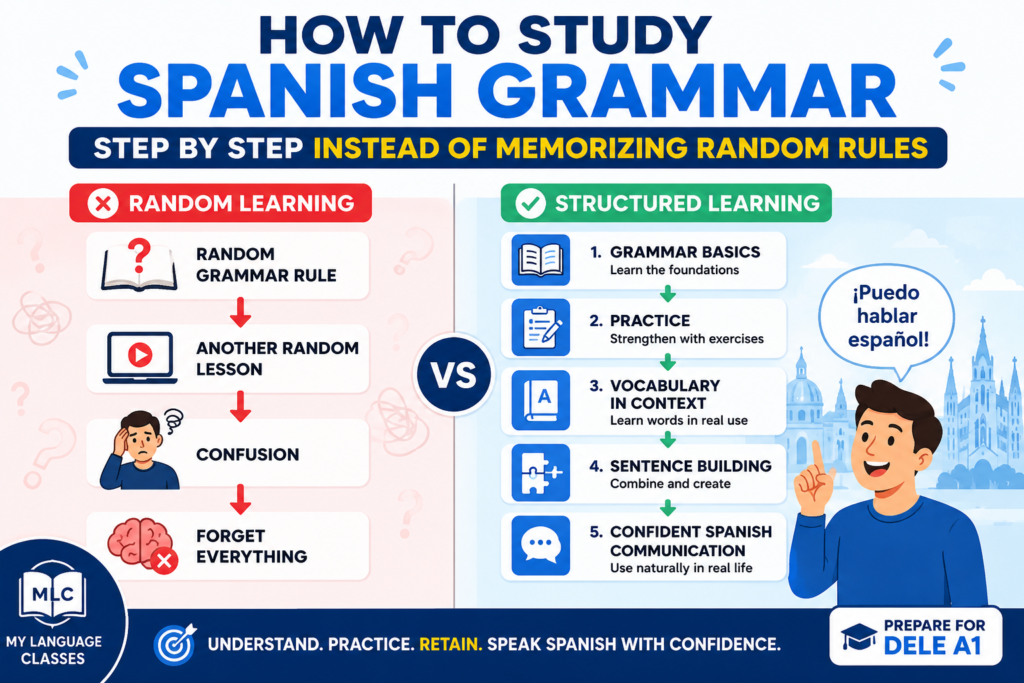
- How Can I Study Spanish Grammar Step by Step Instead of Memorizing Random Rules?

- Which Spanish grammar topics should I learn first as a complete beginner?
- What Is the Best Way to Build a Strong Foundation in Spanish Grammar as a Beginner?

- How can I learn Spanish grammar from scratch without feeling overwhelmed?
- Why Language Learning Fails for Adults
- 5 Stages of Language Learning Every Learner Goes Through

- How Neuroscience Explains Language Learning
- 10 Best Practices for Language Learning That Actually Work
- How to Really Learn a Language in the AI Era
- 11 Best Strategies for Language Learning That Deliver Real Results
- 7 Key Phases of Language Learning Explained Clearly
- 7 Core Principles of How Languages Are Learned
- Is It Efficient to Learn a Language Alone
- ChatGPT Translate: What It Is and How It Works
- Why You Can Understand a Language but Freeze When You Speak
- Why Learning A Language Should Be Your Goal for 2026
- Why Future Global Leaders Will Be Multilingual Decision-Makers
- The Personal Growth Benefits of Learning a Language After Age 30
- How to Start Learning a New Language (and Actually Stay Consistent)
- JLPT CEFR Mapping from December 2025: Everything you need to know
- How Language Learning Boosts Prompt Engineering Skills in AI World
- You Are Never Too Late to Learn a Language

- Why Learning Spanish Is More Useful Than You Think
- What Is the DELE Exam in Spanish: Everything You Need to Know
- Why You Should Learn Japanese
- Why Everyone Should Learn a Language
- Why You Understand a Language but Can’t Speak It
- Do You Need to Live Abroad to Be Fluent in a Language
- Can You Learn a Language Without Grammar
- How to Remember New Words in a Foreign Language easily
- How to Stay Motivated While Learning a Language
- How to Use the Pomodoro Technique for Language Learning
- SMART Language Learning Goals That Work
- Language Learning Plateaus: Causes & Fixes
- How to Overcome the Fear of Speaking a New Language
- Why People Fail at Language Learning & How to Fix It
- Best Time of Day to Learn a Language
- How to Stay Consistent and Avoid Burnout in Language Learning
- Best Daily Routine for Language Learning
- How to Learn a Language Fast: Tips That Work
- How to Learn a Language Effectively: Science-Based Strategies for Faster Fluency






































What Does “How Language Learning Really Works” Mean?
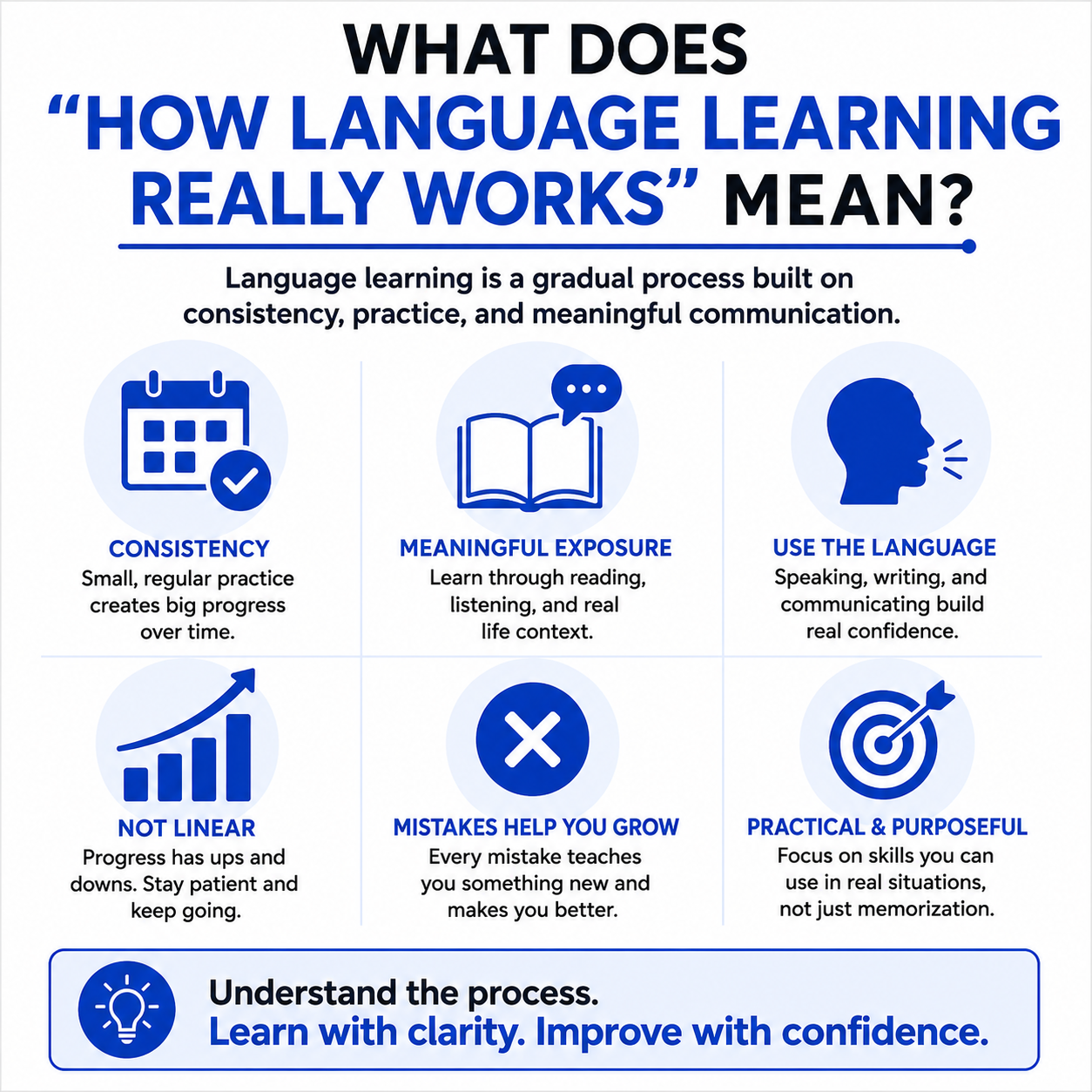
How language learning really works has very little to do with finding the perfect textbook, memorizing thousands of words, or completing a language course as quickly as possible. While these things can contribute to progress, they are not the foundation of long-term success. Real language learning is the result of consistent practice, meaningful exposure, gradual improvement, and the willingness to communicate, even before you feel completely ready.
Many learners begin their journey believing there is a single method, app, or shortcut that will make them fluent in a matter of weeks or months. The internet is filled with promises of effortless fluency, secret techniques, and unrealistic timelines. Although these ideas are appealing, they often create false expectations that lead to disappointment when progress naturally takes time.
The reality is much simpler. Learning a language is a skill that develops through regular use. Just as musicians improve by practicing their instrument and athletes improve through training, language learners improve by reading, listening, speaking, writing, reviewing, and using the language consistently over time. Every meaningful interaction with the language strengthens your understanding and gradually builds confidence.
Another common misunderstanding is that language learning follows a straight path. In reality, progress is rarely linear. Some weeks you may notice significant improvement, while at other times it may feel as though you have stopped making progress altogether. These periods are a natural part of the learning process rather than a sign that something is wrong. Every learner experiences moments of rapid growth, slower progress, and temporary plateaus.
Successful learners also understand that mistakes are not obstacles to avoid. They are one of the most valuable parts of learning. Every incorrect sentence, forgotten word, or awkward conversation provides information that helps your brain adjust and improve. Confidence grows not by avoiding mistakes but by learning from them.
At My Language Classes, we believe that language learning should be practical, purposeful, and enjoyable. Our approach is built on helping learners develop skills that can be used in real situations rather than simply completing lessons or memorizing rules. Grammar, vocabulary, pronunciation, reading, listening, speaking, and writing all have an important role, but they become meaningful only when they work together to help you communicate.
Throughout this guide, you will explore the principles that shape successful language learning. You will learn why consistency matters more than intensity, why understanding is more valuable than memorization, how effective study habits produce lasting results, and how small daily improvements can lead to remarkable progress over time.
Whether you are learning Spanish, Japanese, English, or any other language, the principles remain the same. The goal is not to find the fastest path. The goal is to build a learning process that is realistic, sustainable, and effective. Once you understand how language learning really works, every study session becomes more purposeful, every challenge becomes easier to understand, and every step moves you closer to genuine confidence and lasting fluency.
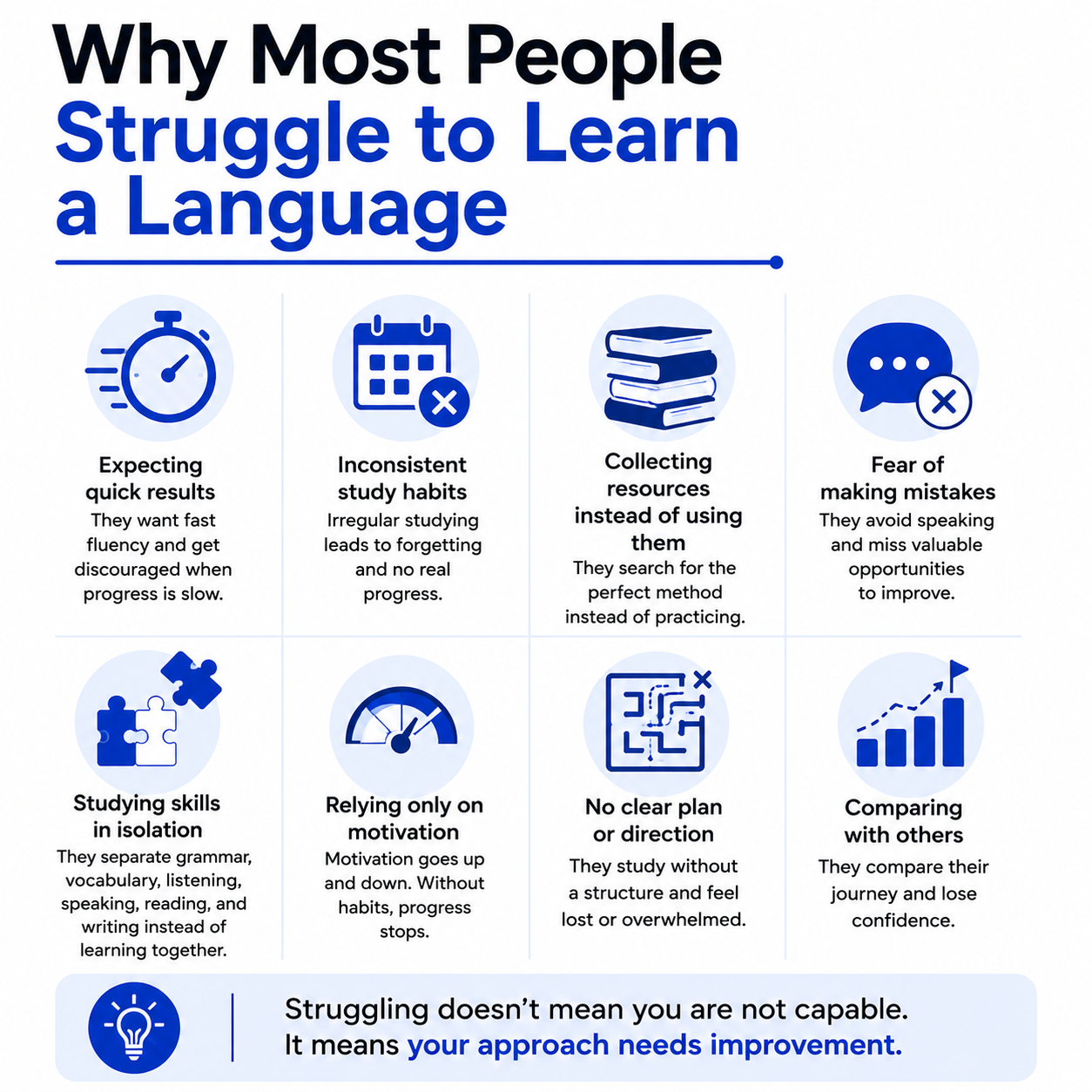
Why Most People Struggle to Learn a Language
Many people believe they are simply “bad at languages.” After struggling to remember vocabulary, understand grammar, or hold a conversation, they conclude that language learning is a talent they do not possess. In reality, very few people fail because they lack the ability to learn a language. More often, they struggle because they follow methods that create unrealistic expectations and ineffective study habits.
One of the biggest challenges is expecting rapid results. Modern learners are surrounded by advertisements promising fluency in a few weeks or a few months. These claims encourage people to measure success by speed instead of progress. When they do not see immediate improvement, they become discouraged and often stop learning altogether.
Another common problem is inconsistency. Studying for several hours on one day and then taking a week off is far less effective than studying for a shorter period every day. Language learning depends on regular exposure. Small, consistent study sessions allow the brain to reinforce what it has already learned while gradually introducing new information. Consistency creates momentum, while irregular study often leads to repeated forgetting and unnecessary frustration.
Many learners also spend too much time collecting resources instead of using them. They download multiple apps, purchase several courses, bookmark dozens of videos, and search for the perfect learning method. While having good resources is helpful, progress comes from using them consistently rather than constantly replacing one resource with another.
Fear of making mistakes is another obstacle. Some learners hesitate to speak because they worry about using incorrect grammar or mispronouncing words. As a result, they avoid conversations that would otherwise help them improve. Mistakes are not signs of failure. They are an essential part of learning. Every conversation, even an imperfect one, provides valuable feedback that strengthens language skills.
Many people also separate grammar, vocabulary, listening, speaking, reading, and writing into isolated activities. In reality, these skills develop together. Learning vocabulary becomes more effective when words are encountered in meaningful sentences. Grammar becomes easier to understand when it supports real communication. Listening improves speaking, and reading strengthens writing. Language is an integrated skill, not a collection of independent subjects.
Motivation is another area that is often misunderstood. It naturally rises and falls over time. Learners who depend entirely on motivation usually struggle to maintain long-term progress. Successful learners rely on routines, habits, and realistic goals that keep them moving forward even on days when motivation is low.
At My Language Classes, we believe that language learning becomes much more effective when learners understand these challenges and adjust their approach. Progress is not determined by talent or intelligence. It is shaped by consistent practice, meaningful communication, realistic expectations, and a willingness to continue learning through both successes and mistakes.
If you find language learning difficult, remember that struggling does not mean you are incapable of learning. More often, it means your learning strategy needs improvement. Once you build effective habits and focus on steady progress instead of quick results, language learning becomes more enjoyable, more sustainable, and ultimately more successful.
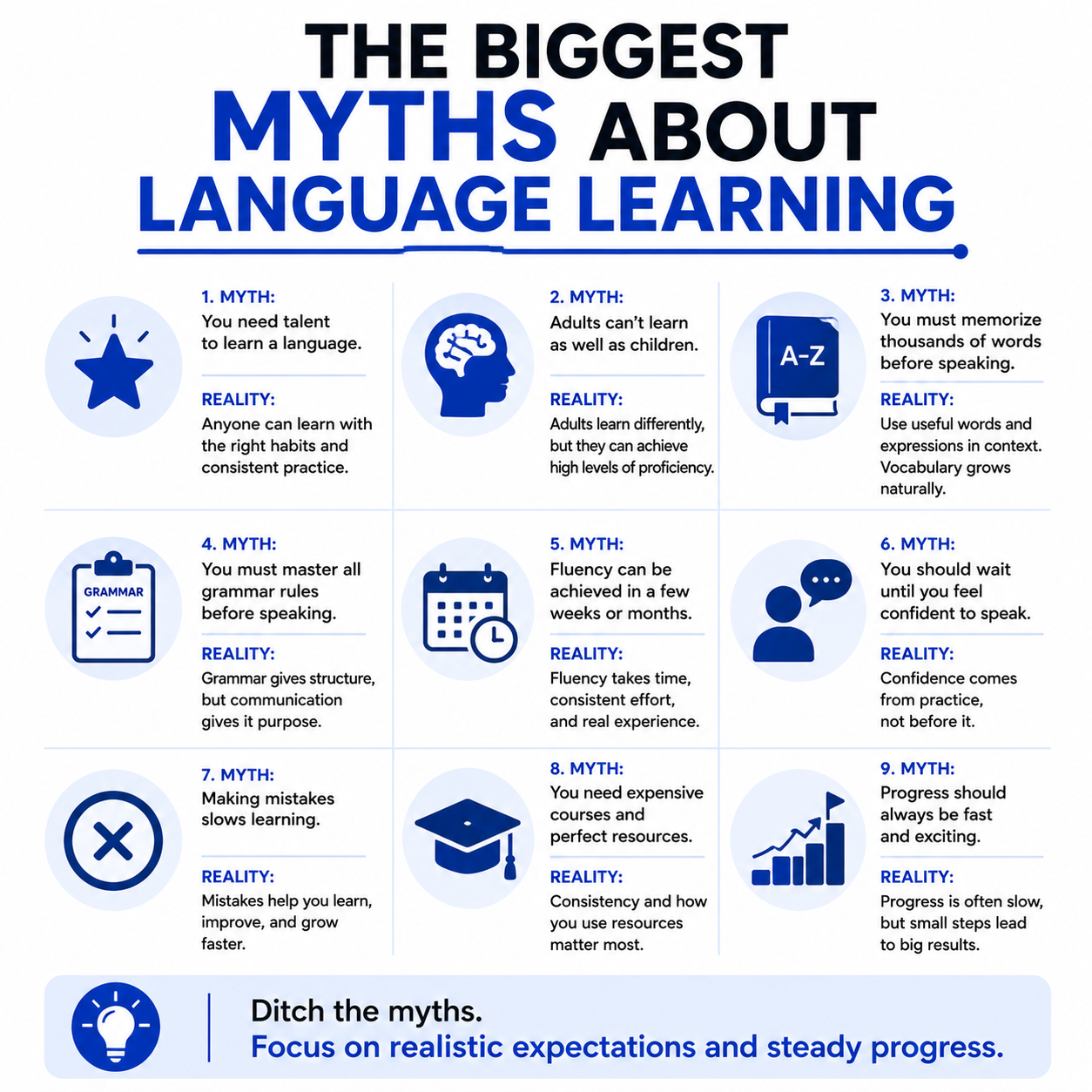
The Biggest Myths About Language Learning
Many language learners begin their journey with ideas that seem reasonable but often slow their progress. These misconceptions are repeated so frequently that they become accepted as facts, even though they do not reflect how languages are actually learned. Replacing these myths with realistic expectations is one of the most important steps toward becoming a confident and successful language learner.
One of the most common myths is that learning a language requires a special talent. While some people may learn certain skills more quickly than others, language learning is not reserved for a gifted few. Every healthy brain has the ability to acquire new languages through regular exposure, meaningful practice, and consistent effort. Success is determined far more by learning habits than by natural ability.
Another widespread belief is that adults cannot learn languages as effectively as children. Children often learn differently because they are surrounded by the language, have fewer inhibitions, and spend years practicing every day. Adults, however, bring advantages of their own, including stronger analytical skills, better study habits, and greater life experience. With an effective learning strategy, adults can achieve high levels of proficiency.
Many learners also believe they must memorize thousands of vocabulary words before they can begin speaking. In reality, communication develops gradually. Learning useful words and expressions in context allows learners to begin understanding and participating in conversations much earlier than they expect. Vocabulary grows naturally through repeated exposure rather than isolated memorization.
Grammar is another area surrounded by misconceptions. Some learners believe they must master every grammar rule before speaking, while others believe grammar is completely unnecessary. Neither approach reflects how language learning works. Grammar provides structure, but communication gives grammar purpose. Learning both together creates a stronger foundation than focusing entirely on one while ignoring the other.
The idea of achieving fluency in an extremely short period is another misconception that discourages many learners. Meaningful language learning takes time. Progress is built through hundreds of small learning experiences that gradually become lasting knowledge. Setting realistic expectations makes the learning process more enjoyable and reduces unnecessary frustration.
Some learners also wait until they feel completely confident before speaking. Unfortunately, confidence rarely appears before practice. It develops because of practice. Every conversation, every attempt, and every correction helps reduce hesitation and increases confidence over time.
Finally, many people believe that making mistakes slows learning. The opposite is true. Mistakes reveal what needs improvement and provide opportunities for growth. Learners who accept mistakes as a natural part of the process generally improve faster than those who avoid using the language until they believe they are perfect.
Understanding these myths allows learners to replace unrealistic expectations with practical strategies. Instead of searching for shortcuts or perfect methods, they can focus on building consistent habits, using the language regularly, and measuring success through steady improvement. That is how lasting progress is achieved, regardless of the language being learned.
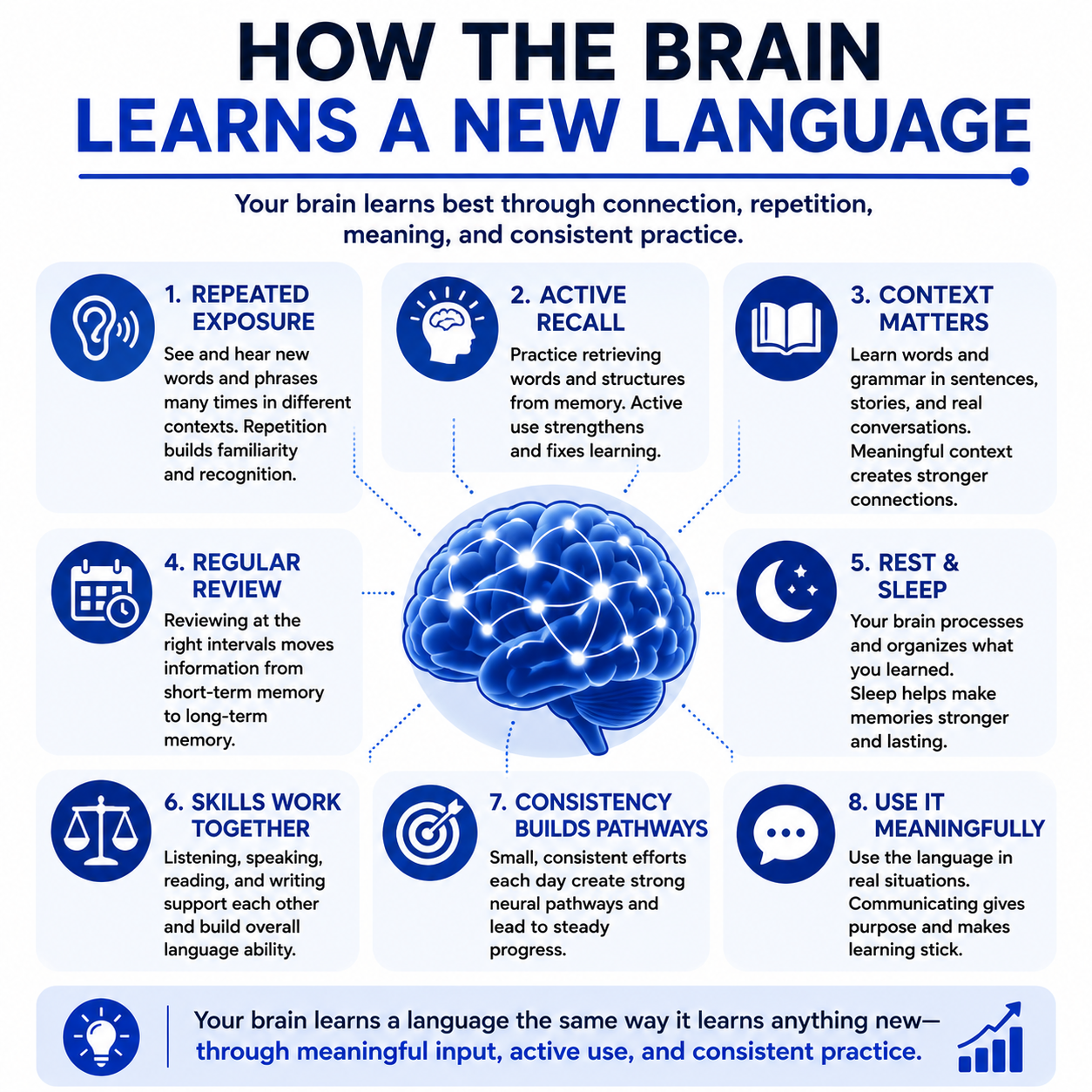
How the Brain Learns a New Language
Learning a language is not about storing isolated words and grammar rules in your memory. It is about gradually building a network of connections that allows your brain to understand, process, and produce the language naturally. Every time you read a sentence, listen to a conversation, recall a word, or speak aloud, your brain strengthens these connections and makes future recall easier.
One of the most effective ways the brain learns is through repeated exposure. Seeing or hearing a word once is rarely enough for long-term retention. Instead, your brain needs to encounter the same word or structure multiple times in different contexts before it becomes familiar. This is why reading, listening, and engaging with authentic content play such an important role in language learning.
Memory also improves when learning is active rather than passive. Simply reading a vocabulary list or watching a lesson may help you recognize information, but recognition is only the first step. Real learning happens when you actively recall words, form sentences, answer questions, write short passages, or use new expressions in conversation. The effort required to retrieve information strengthens memory and makes future recall more reliable.
Context is another essential part of language acquisition. Individual words are easier to remember when they appear in meaningful sentences, stories, or conversations. Instead of learning vocabulary as isolated items, learners benefit from seeing how words interact with grammar, pronunciation, and real communication. This approach creates stronger mental associations and makes the language easier to use naturally.
The brain also benefits from regular review. Forgetting is a normal part of learning, but reviewing information at appropriate intervals helps move knowledge from short-term memory into long-term memory. Revisiting previously learned material is not a sign of poor learning. It is one of the most effective ways to reinforce knowledge and improve retention.
Sleep and rest also contribute to language learning. During sleep, the brain processes and organizes information gathered throughout the day. Consistent study combined with adequate rest allows new knowledge to become more stable over time. Studying for long hours without giving the brain time to recover is often less effective than shorter, focused sessions spread across several days.
Another important principle is that language skills develop together. Listening improves pronunciation, reading expands vocabulary, writing strengthens grammar, and speaking reinforces all of these skills through active communication. A balanced learning routine allows different parts of the brain to work together, resulting in stronger overall language ability.
At My Language Classes, we encourage learners to work with their brain rather than against it. Instead of relying on memorization alone, focus on meaningful exposure, active practice, regular review, and consistent use of the language. These principles align with how the brain naturally acquires and strengthens new skills, making language learning more effective, enjoyable, and sustainable over the long term.
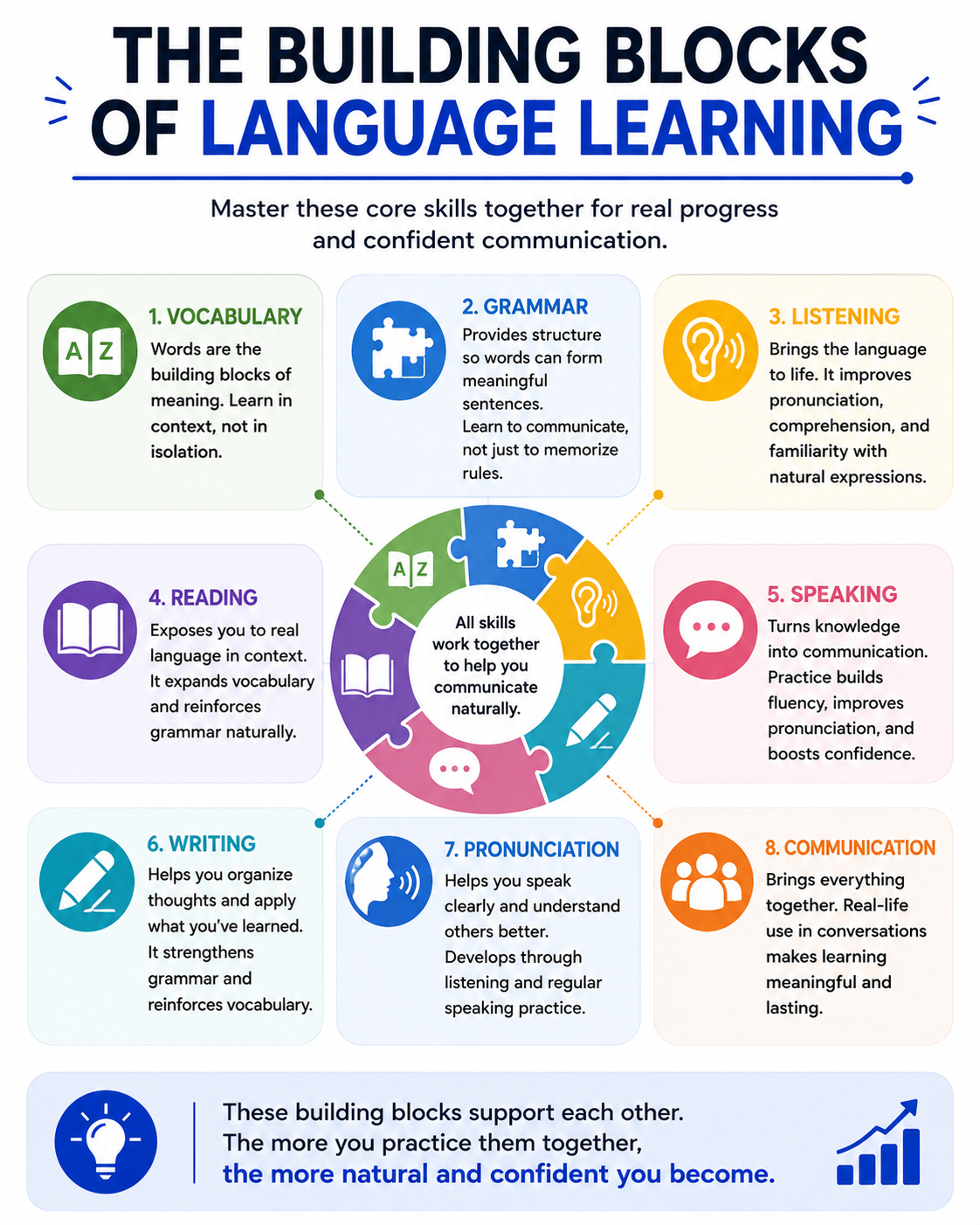
The Building Blocks of Language Learning
Every language is unique, but the skills required to learn one are remarkably similar. Whether you are studying Spanish, Japanese, English, or another language, successful learning depends on developing several core skills together rather than focusing on just one. These building blocks support one another, and steady improvement comes from maintaining a healthy balance between them.
Vocabulary is often the first building block learners think about. Words are essential because they carry meaning, but learning vocabulary is more effective when words are connected to real situations instead of being memorized as isolated lists. Learning words through sentences, conversations, stories, and everyday examples makes them easier to understand, remember, and use naturally.
Grammar provides the structure that allows vocabulary to form meaningful sentences. It helps learners understand how words work together to express ideas clearly. However, grammar should be viewed as a tool for communication rather than an end in itself. Memorizing rules without applying them in real situations often leads to frustration. Grammar becomes far more meaningful when it is learned alongside listening, reading, speaking, and writing.
Listening is one of the most important sources of language input. It helps learners become familiar with pronunciation, rhythm, sentence patterns, and natural expressions. Regular listening also improves comprehension and prepares learners to participate in conversations with greater confidence. Even short periods of listening each day gradually strengthen overall language ability.
Reading exposes learners to authentic language in context. Books, articles, dialogues, stories, and graded readers introduce vocabulary and grammar in meaningful ways while reinforcing what has already been learned. Reading also helps learners recognize common patterns that appear repeatedly across the language.
Speaking transforms knowledge into communication. Many learners delay speaking because they want to avoid mistakes, but conversation is one of the most effective ways to develop fluency. Every conversation encourages faster recall, improves pronunciation, and builds confidence. Speaking does not require perfection. It requires regular practice.
Writing encourages learners to organize their thoughts and actively apply grammar and vocabulary. Writing short sentences, journal entries, summaries, or conversations reveals gaps in understanding and provides opportunities for improvement. It also reinforces vocabulary and sentence structures that learners have recently studied.
Pronunciation is another essential building block. Clear pronunciation improves communication and listening comprehension. It develops gradually through repeated exposure, careful listening, and regular speaking practice rather than through isolated drills alone.
These building blocks are not independent subjects that should be mastered one after another. They work together continuously throughout the learning process. Reading expands vocabulary, vocabulary strengthens speaking, listening improves pronunciation, writing reinforces grammar, and communication brings every skill together. The more these skills support one another, the more natural language learning becomes.
At My Language Classes, we encourage learners to build all of these skills steadily over time instead of searching for a single shortcut. Balanced learning creates stronger foundations, develops practical communication skills, and leads to lasting progress that continues well beyond the beginner stage.
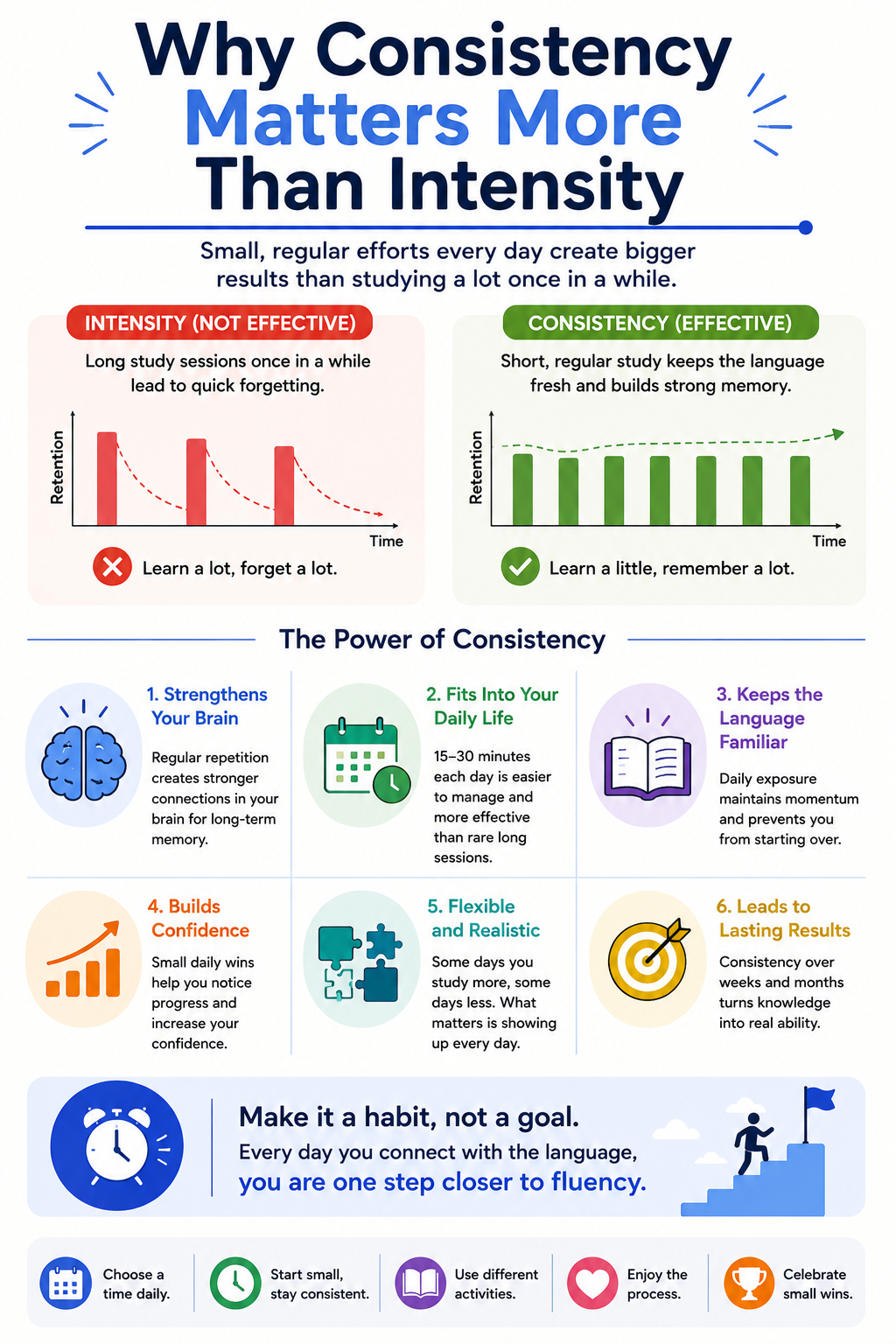
Why Consistency Matters More Than Intensity
One of the most common reasons learners stop making progress is that they confuse intensity with effectiveness. Studying for five or six hours in a single day may feel productive, but if that effort is followed by several days without practice, much of what was learned begins to fade. Language learning is not measured by how much you study in one session. It is measured by how consistently you engage with the language over time.
The human brain learns through repetition and reinforcement. Every time you review vocabulary, listen to a conversation, read a short article, or practice speaking, you strengthen the connections that support long-term memory. These connections become stronger when learning happens regularly. Small, consistent study sessions give the brain repeated opportunities to reinforce existing knowledge while gradually introducing new information.
Consistency also reduces the feeling of being overwhelmed. Many learners postpone studying because they believe they need a large block of free time before they can make meaningful progress. As a result, days or even weeks pass without any exposure to the language. In contrast, learners who dedicate fifteen to thirty minutes each day often achieve better long-term results than those who study for several hours only once a week.
Daily exposure keeps the language familiar. Reading a few paragraphs, listening to a short podcast, reviewing flashcards, writing a few sentences, or practicing a conversation for a few minutes helps maintain momentum. These small activities may seem insignificant on their own, but together they create a powerful habit that leads to steady improvement.
Consistency also builds confidence. When learners interact with the language every day, they become more comfortable recognizing words, understanding sentence patterns, and expressing their thoughts. Progress becomes easier to notice because each study session builds naturally on the previous one instead of starting again after a long break.
This does not mean every study session needs to be identical. Some days you may have time for a full lesson, while on other days you may only be able to review vocabulary or listen to a short audio clip. Both contribute to your progress because they maintain regular contact with the language. The goal is not perfection. The goal is continuity.
At My Language Classes, we encourage learners to create study routines that are realistic and sustainable. Language learning should fit into your daily life rather than compete with it. A manageable routine that you can maintain for months will always produce better results than an ambitious schedule that becomes difficult to sustain.
The most successful language learners are not necessarily those who study the hardest on a single day. They are the ones who continue showing up, day after day, allowing small improvements to accumulate into lasting knowledge and genuine confidence. Over time, consistency becomes the foundation on which every other language skill is built.
Why Making Mistakes Accelerates Learning
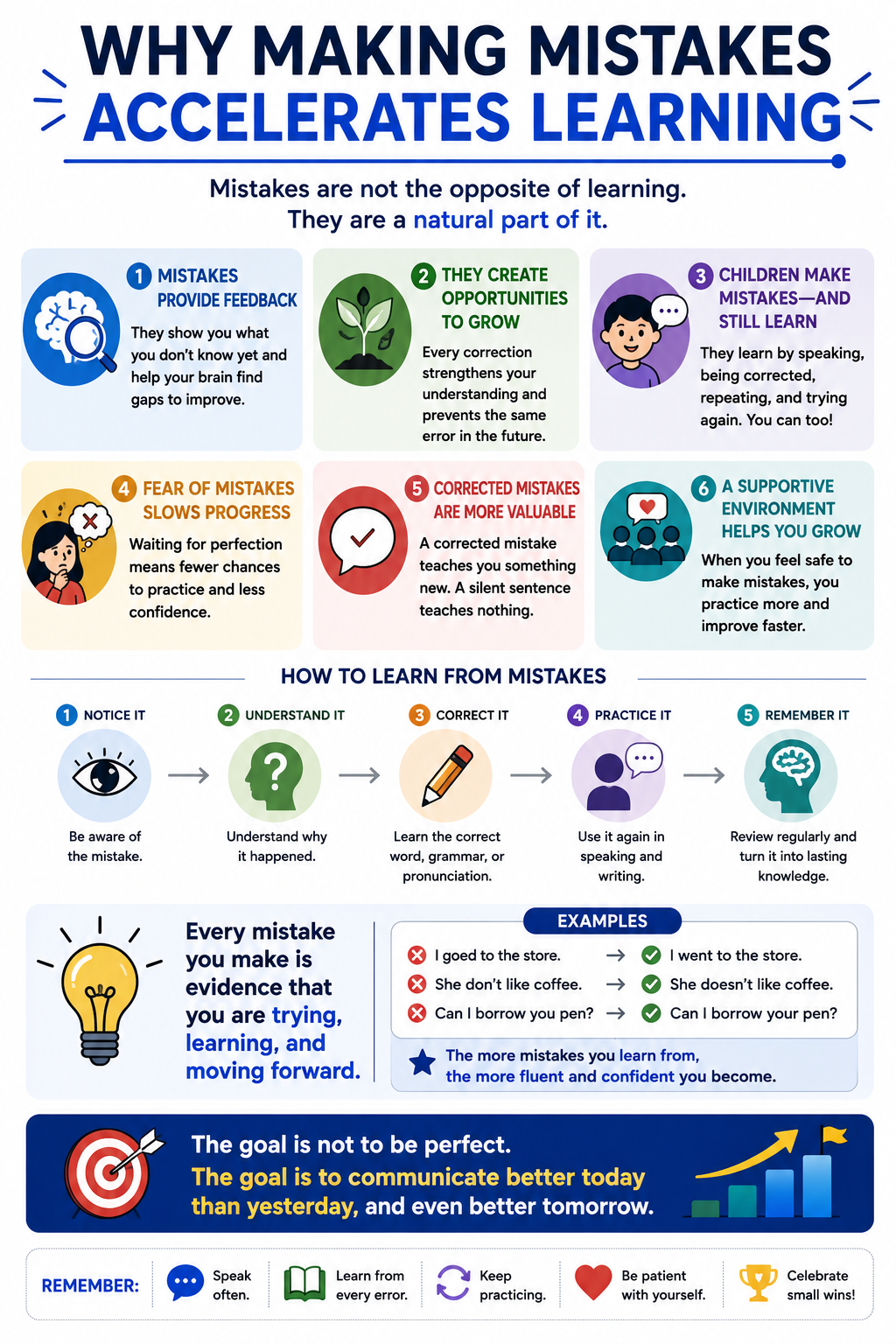
Many learners see mistakes as something to avoid. They hesitate before speaking, spend too much time checking grammar, or remain silent because they fear saying something incorrectly. Although this reaction is understandable, it often slows progress. Mistakes are not barriers to language learning. They are one of the most valuable sources of improvement.
Every mistake provides feedback. When you use the wrong word, choose an incorrect grammar structure, or mispronounce a sentence, your brain compares what you intended to say with what actually happened. This process helps identify gaps in your knowledge and creates an opportunity to strengthen your understanding. Without making mistakes, it becomes much more difficult to recognize what needs attention.
Children provide a clear example of this principle. They make thousands of mistakes while learning their first language, yet they continue speaking without worrying about perfection. Every correction, repetition, and successful interaction gradually improves their language ability. Adult learners benefit from the same process, even though they are often much more self-conscious about making errors.
Fear of making mistakes also reduces opportunities for practice. Some learners wait until they believe their grammar is perfect before joining conversations. Others avoid writing because they worry about spelling or sentence structure. Unfortunately, confidence rarely develops through preparation alone. It grows through repeated use of the language in real situations, where mistakes become stepping stones rather than obstacles.
This does not mean mistakes should be ignored. The goal is to notice them, understand why they happened, and continue communicating. A corrected mistake is far more valuable than a sentence that was never spoken. Each correction strengthens your knowledge and makes similar errors less likely in the future.
Creating a supportive learning environment is equally important. Learners make faster progress when they feel comfortable experimenting with new vocabulary and grammar without fear of embarrassment. Constructive feedback encourages improvement while maintaining motivation. A positive learning experience makes it easier to continue practicing consistently.
One practical way to benefit from mistakes is to review them regularly. Keeping a notebook of common errors, rewriting incorrect sentences, or repeating corrected phrases helps transform temporary mistakes into lasting knowledge. Over time, patterns begin to emerge, allowing learners to focus on the areas that will have the greatest impact on their communication.
At My Language Classes, we encourage learners to see mistakes as evidence of progress rather than failure. Every conversation, every written sentence, and every attempt to communicate moves you one step closer to fluency. The learners who improve the fastest are not those who avoid mistakes completely. They are the ones who continue learning from them, refining their skills with every interaction, and building confidence through consistent practice.
The goal of language learning is not to speak perfectly from the beginning. It is to communicate more effectively today than yesterday, and better tomorrow than today. Every mistake made along the way is part of that progress.
The Role of Grammar, Vocabulary, and Communication
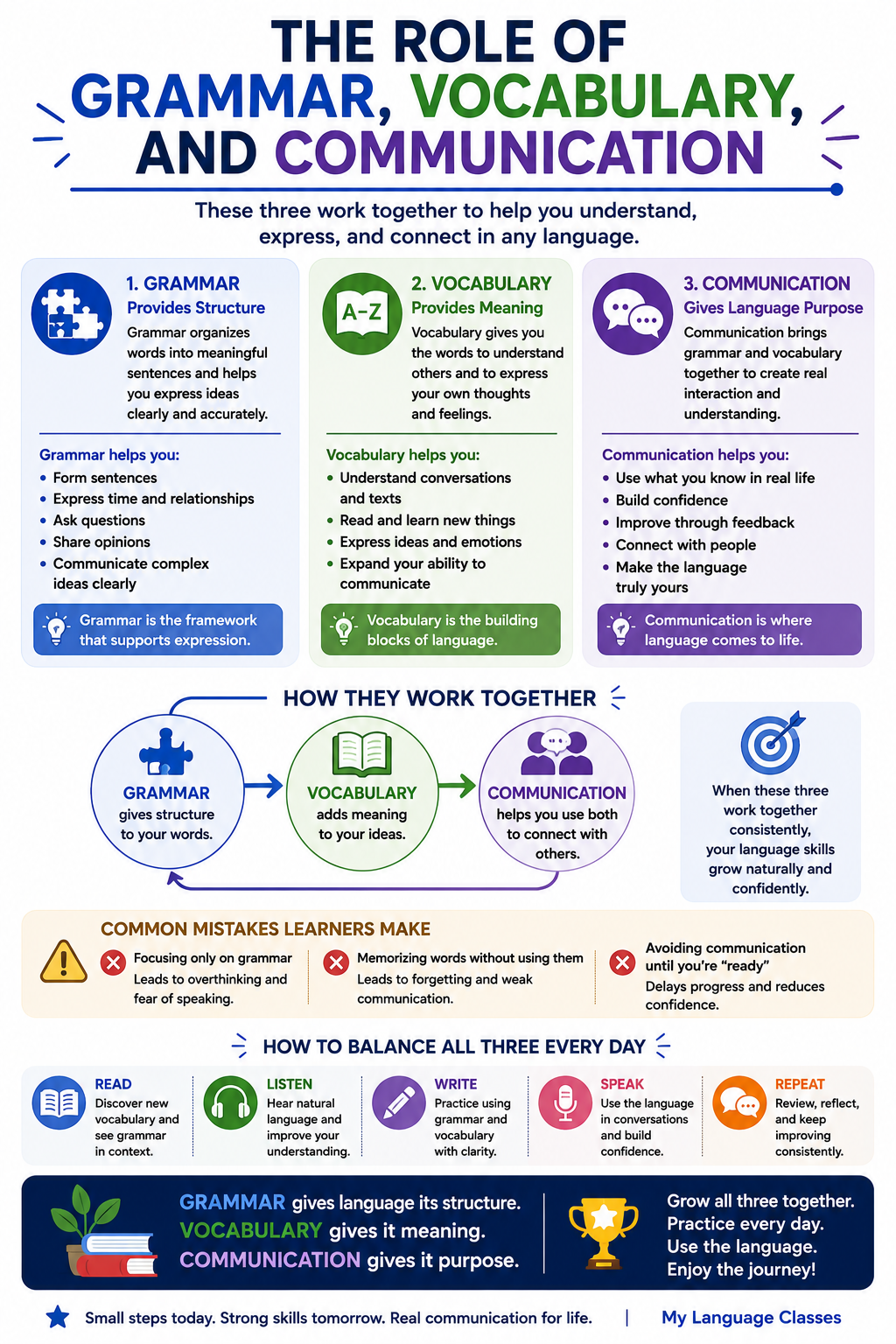
Many learners spend a great deal of time wondering what they should study first. Some believe vocabulary is the key to fluency. Others focus almost entirely on grammar, while some avoid grammar altogether and rely only on conversation practice. In reality, language learning is most effective when grammar, vocabulary, and communication develop together. Each plays a different role, and none can reach its full potential in isolation.
Vocabulary gives you the words to express ideas. Every new word expands your ability to understand conversations, read texts, and communicate with others. However, vocabulary alone is not enough. Knowing hundreds or even thousands of individual words does not automatically allow you to form clear, meaningful sentences. Words become useful when you understand how they work together.
Grammar provides the structure that organizes vocabulary into communication. It helps learners express time, relationships, questions, opinions, and complex ideas with clarity. Rather than thinking of grammar as a collection of rules to memorize, it is more helpful to see it as a framework that supports meaningful expression. Good grammar makes communication clearer, but its purpose is always to help people understand one another.
Communication is where language truly comes to life. Reading about grammar or memorizing vocabulary creates knowledge, but using the language transforms that knowledge into practical skill. Every conversation, written message, or spoken sentence strengthens the connection between what you know and what you can actually use. Communication also reveals areas that need improvement, allowing learners to refine both their vocabulary and grammar through real experience.
These three elements continuously reinforce one another. Learning new vocabulary becomes easier when words are encountered in meaningful conversations. Grammar is easier to understand when it explains language that learners have already seen or heard. Communication becomes more confident as vocabulary grows and grammar becomes more familiar. Instead of competing for attention, these skills work together to build overall language proficiency.
Many learners make the mistake of delaying communication until they believe they have mastered grammar or memorized enough vocabulary. Unfortunately, there is no point at which anyone knows everything before they begin speaking. Communication itself is part of the learning process. Even simple conversations provide valuable practice that strengthens grammar, expands vocabulary, and improves confidence.
An effective study routine should include opportunities to develop all three areas regularly. Reading introduces new vocabulary and grammar in context. Listening demonstrates how language is used naturally. Writing encourages careful application of new knowledge. Speaking transforms learning into communication. Together, these activities create balanced progress that reflects how languages are used in everyday life.
At My Language Classes, we encourage learners to view grammar, vocabulary, and communication as partners rather than separate subjects. Grammar gives language its structure, vocabulary gives it meaning, and communication gives it purpose. When these three elements grow together through consistent practice, learners develop not only greater accuracy but also the confidence to use the language naturally in real-world situations.
Building an Effective Study Routine
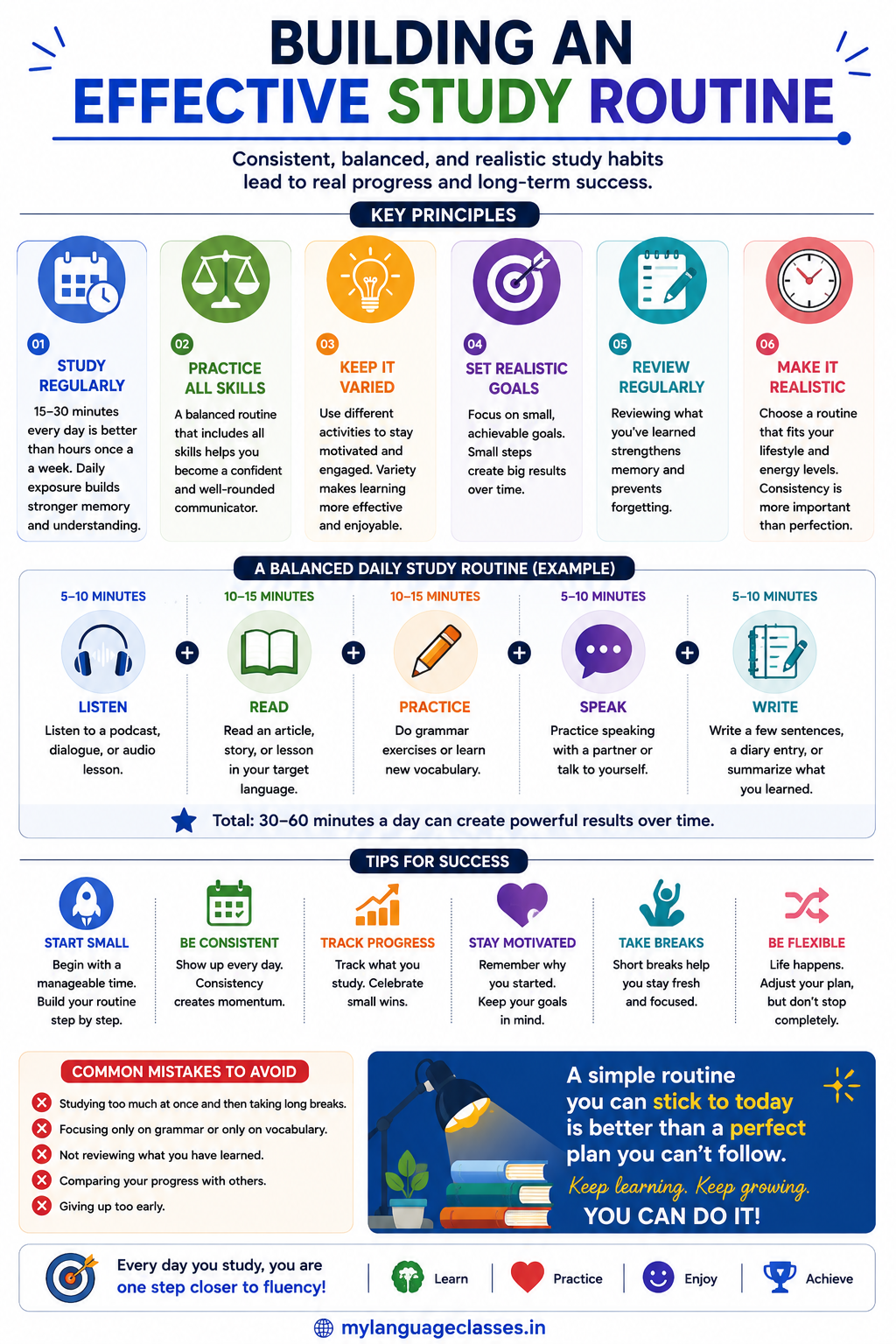
A successful language learning routine is not defined by how many hours you study each day. It is defined by how consistently you engage with the language and how well your study activities support one another. An effective routine should be realistic, flexible, and sustainable. The best study plan is the one you can maintain over weeks, months, and years rather than one that feels overwhelming after only a few days.
One of the most important principles is to study regularly instead of occasionally. Even fifteen to thirty minutes of focused practice each day is often more beneficial than several hours once a week. Daily exposure helps your brain strengthen existing knowledge, retain vocabulary, recognize grammar patterns, and become more familiar with the language over time.
A balanced routine should include a combination of language skills. Reading introduces new vocabulary and reinforces grammar in context. Listening improves comprehension and pronunciation. Speaking develops confidence and fluency through active communication. Writing encourages careful application of grammar and vocabulary while revealing areas that need further practice. When these skills are practiced together, they reinforce one another and create more meaningful learning experiences.
Variety also helps maintain motivation. Repeating the same activity every day can become monotonous and reduce engagement. Instead, alternate between reading articles, listening to podcasts, completing grammar exercises, writing short journal entries, reviewing vocabulary, and participating in conversations. This keeps learning interesting while allowing different language skills to develop naturally.
Setting realistic goals is equally important. Rather than aiming to master an entire textbook in a short period, focus on achievable objectives such as learning a small group of new words, completing one lesson, reading a short article, or having a brief conversation. Reaching these smaller goals creates a sense of accomplishment and encourages continued progress.
Regular review should be part of every study routine. New information becomes more reliable when it is revisited over time. Reviewing previously learned vocabulary, grammar points, and notes prevents forgetting and strengthens long-term retention. Progress is not measured only by learning something new but also by remembering and applying what has already been learned.
A study routine should also fit naturally into everyday life. Some learners prefer studying early in the morning, while others learn more effectively during the evening. There is no universally perfect schedule. The most effective routine is one that matches your lifestyle and allows you to practice consistently without creating unnecessary stress or unrealistic expectations.
It is also important to accept that not every study session will feel equally productive. Some days you will make noticeable progress, while other days may feel slower. This is a normal part of learning. What matters most is continuing the routine and trusting that steady effort produces lasting results over time.
At My Language Classes, we encourage learners to build routines that are practical rather than perfect. A simple, consistent study habit will always outperform an ambitious plan that is difficult to maintain. Language learning is a long-term investment, and every focused study session, no matter how short, contributes to stronger skills, greater confidence, and meaningful progress.
Choosing the Right Resources
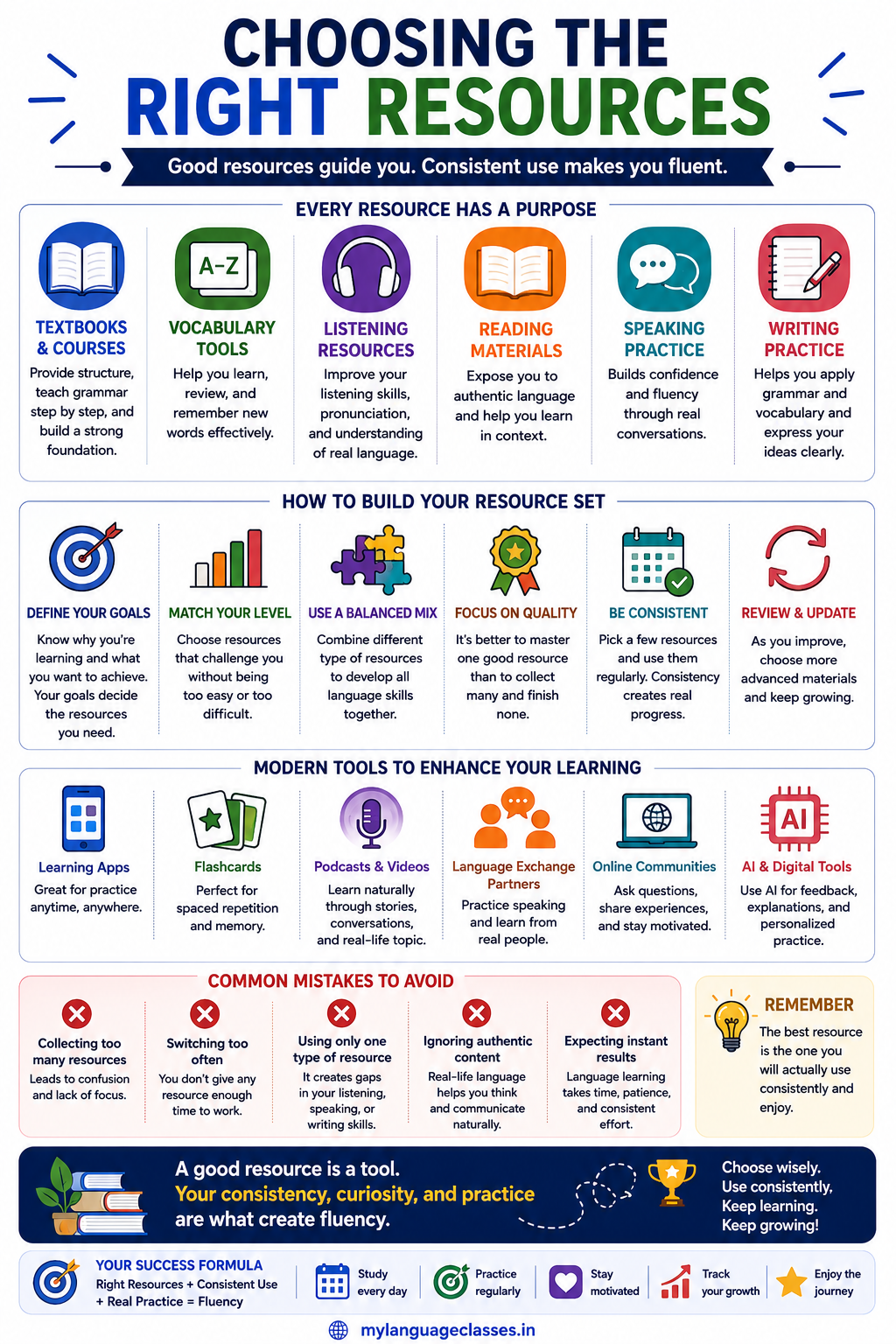
One of the most common mistakes language learners make is believing that success depends on finding the perfect resource. As a result, they spend more time searching for new courses, apps, videos, books, and study methods than actually learning the language. While choosing good resources is important, no single resource can make someone fluent. Progress comes from how consistently and effectively those resources are used.
Every language resource has a specific purpose. A textbook provides structured lessons and introduces grammar in a logical sequence. Vocabulary tools help reinforce new words. Reading materials expose learners to authentic language in context. Audio lessons and podcasts improve listening comprehension. Conversation practice develops confidence and speaking ability. Each resource contributes something valuable, but none of them is designed to do everything.
The most effective learners build a small collection of complementary resources rather than constantly replacing one with another. For example, a beginner might use one structured course, one vocabulary review system, one source of listening practice, and one opportunity to speak or write regularly. This balanced approach provides variety without creating unnecessary complexity.
It is also important to choose resources that match your current level. Material that is too easy may become repetitive, while content that is far beyond your ability can lead to frustration. Learning is most effective when resources are challenging enough to introduce new ideas while still allowing you to understand the overall message. As your skills improve, your learning materials should gradually become more advanced.
Quality is far more important than quantity. Owning ten textbooks but completing none of them is less valuable than thoroughly studying one well-designed course. Similarly, downloading multiple language learning apps does not improve proficiency unless they become part of a consistent study routine. Learning happens through active engagement, not through collecting resources.
Modern learners also have access to technologies that previous generations could only imagine. Artificial intelligence, interactive learning platforms, digital flashcards, online communities, language exchange partners, podcasts, videos, and electronic books have made quality learning materials more accessible than ever before. These tools can significantly enhance the learning experience when they support a clear study plan rather than replace it.
Free resources can be just as valuable as paid ones when they are accurate, well-structured, and used consistently. Likewise, investing in high-quality books or courses can save time by providing a clear learning path. The best choice depends on your goals, your learning style, and your ability to remain consistent.
As you gain experience, avoid the temptation to switch resources every time learning becomes difficult. Progress naturally becomes slower as concepts become more advanced. Changing courses too frequently often means repeating beginner material instead of developing new skills. Give your chosen resources enough time to produce results before deciding whether a change is necessary.
At My Language Classes, we encourage learners to focus on building a learning system rather than searching for a perfect resource. A well-balanced combination of structured lessons, meaningful practice, authentic content, and regular communication will always outperform an endless search for the next new method. The resource itself is only part of the equation. Your consistency, curiosity, and willingness to apply what you learn are what ultimately determine your success.
Measuring Progress the Right Way
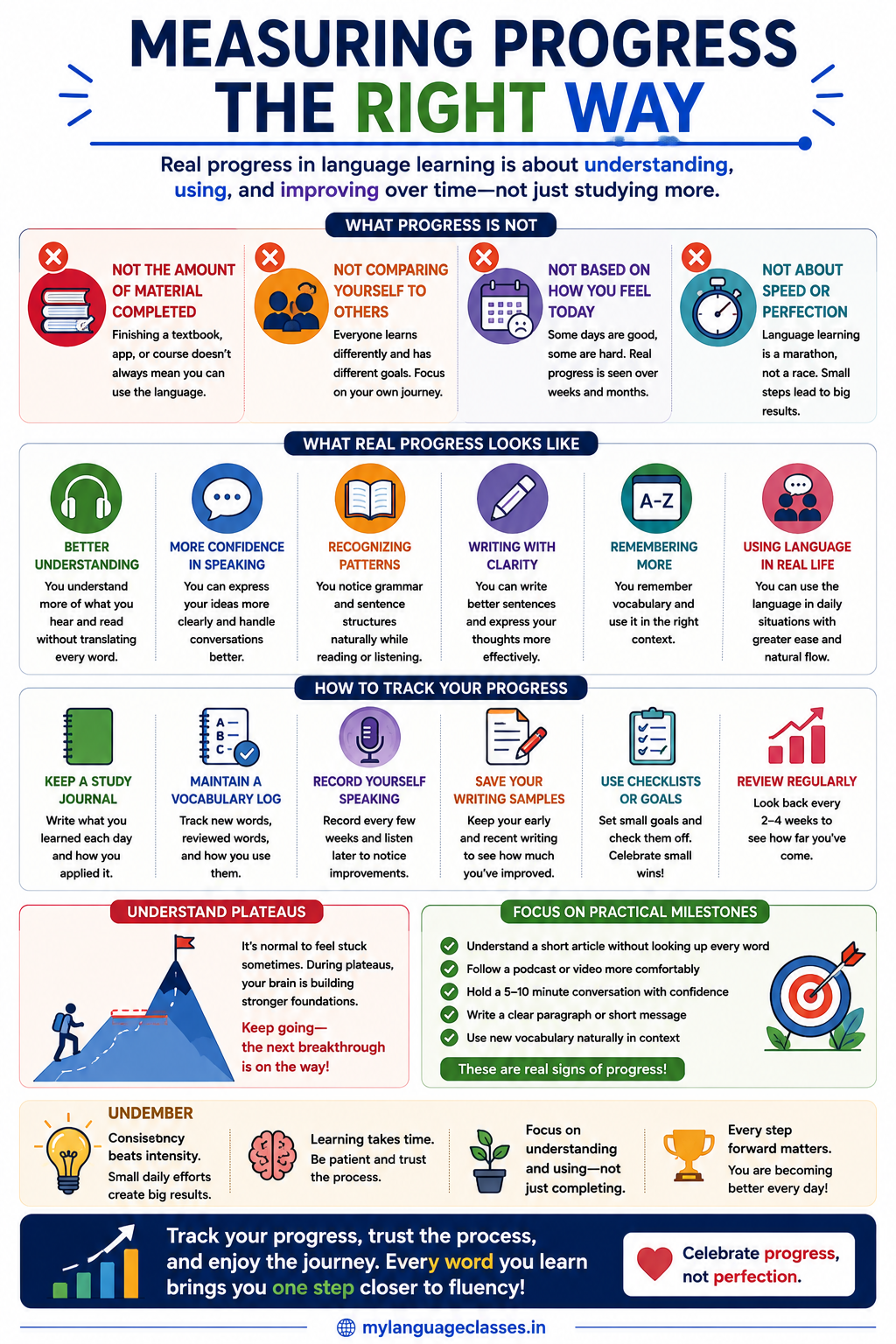
One of the biggest challenges in language learning is knowing whether you are actually improving. Many learners judge their progress based on how confident they feel on a particular day. If they forget a few words or struggle during a conversation, they assume they are not making progress. In reality, language learning is rarely measured accurately through daily experiences. Meaningful progress is revealed over weeks and months, not from one study session to the next.
A common mistake is measuring success by the amount of material completed. Finishing a textbook, completing an app, or watching dozens of lessons does not necessarily mean you have developed practical language skills. What matters is your ability to understand, remember, and use what you have learned in real situations.
Another misleading measure is comparing yourself with other learners. Everyone begins with different experiences, learning styles, available study time, and personal goals. Comparing your progress with someone else’s often creates unnecessary frustration. The most meaningful comparison is with your own past performance. If you can understand more than you did a month ago, communicate more clearly than before, or remember vocabulary that once seemed impossible, you are making genuine progress.
Small improvements often go unnoticed because they happen gradually. You may suddenly realize that you understand a podcast without reading subtitles, recognize grammar patterns while reading, or respond more naturally during a conversation. These moments are not accidents. They are the result of many small learning experiences building upon one another over time.
Keeping a record of your learning can make progress more visible. A simple study journal, vocabulary log, writing samples, or recordings of yourself speaking every few weeks provide clear evidence of improvement. Looking back at earlier work often reveals how much your skills have developed, even when day-to-day progress feels slow.
Language learning also includes temporary plateaus. There may be periods when improvement seems to stop despite regular study. These plateaus are a normal part of acquiring any complex skill. During these phases, your brain is strengthening existing knowledge and preparing for future growth. Continuing your routine during these slower periods is often what leads to the next noticeable breakthrough.
Rather than chasing perfection, focus on practical milestones. Understanding a short article without translating every word, participating in a conversation with greater confidence, writing a clear paragraph, or following a podcast more comfortably are all meaningful indicators of progress. These achievements reflect real language ability rather than simply completed lessons.
At My Language Classes, we encourage learners to measure success by consistency, understanding, and practical communication rather than speed. Every study session, every conversation, and every new concept contributes to long-term growth. Language learning is not a race with a finish line. It is a continuous process of building knowledge, strengthening skills, and becoming more confident with every step forward.
The Role of Motivation and Discipline
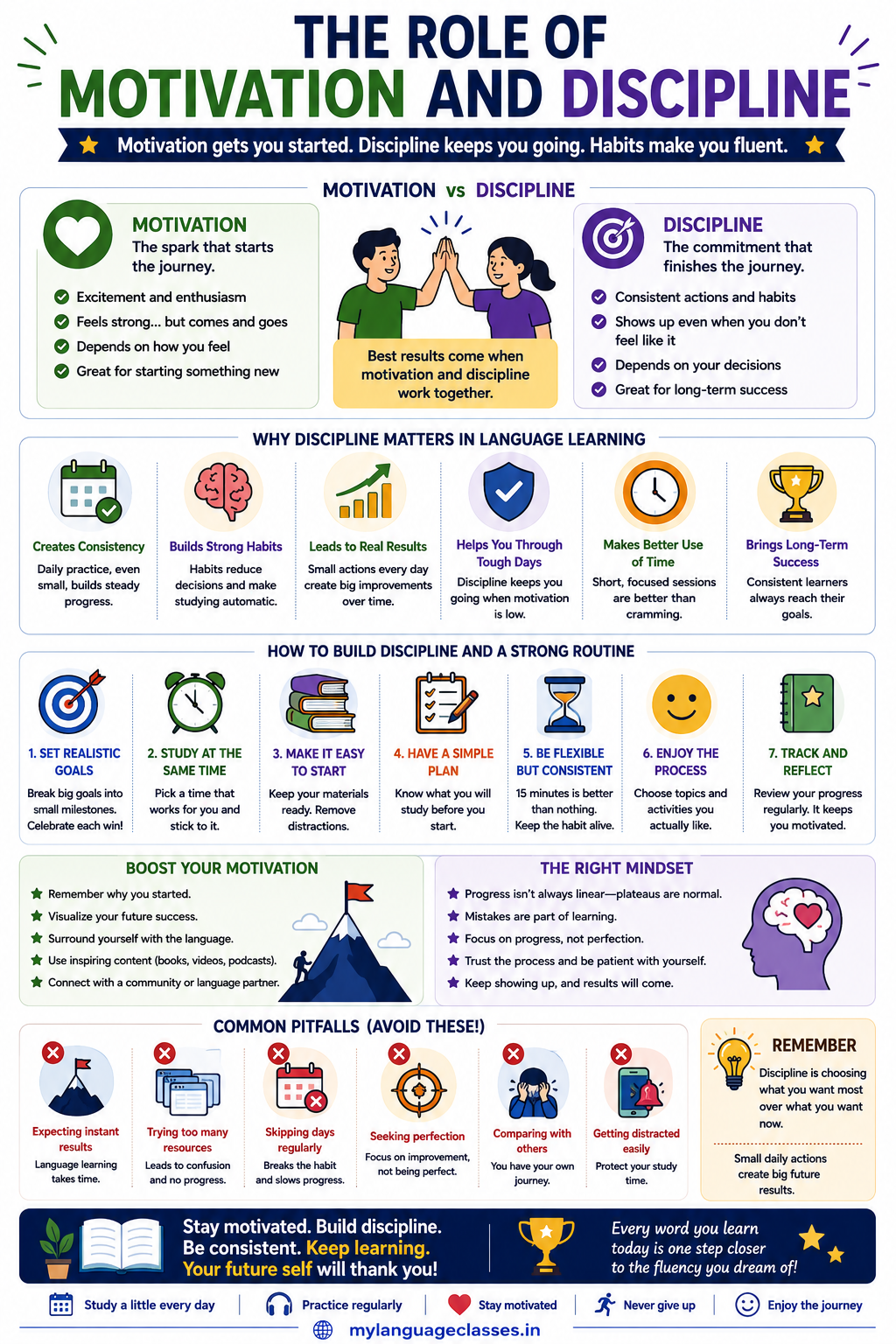
Many people begin learning a language with a great deal of enthusiasm. They set ambitious goals, purchase learning materials, and imagine themselves speaking confidently within a short period. While this initial excitement is valuable, it rarely lasts forever. Motivation naturally rises and falls, which is why relying on motivation alone often leads to inconsistent learning and unfinished goals.
Discipline is what keeps the learning process moving when motivation fades. It is the habit of showing up even on days when you do not feel particularly inspired. Successful language learners are not always the most motivated. They are the ones who have built routines that make learning a regular part of their daily lives.
One of the biggest misconceptions is that motivated people study every day because they enjoy it. In reality, even experienced learners have busy schedules, distractions, and days when they would rather do something else. What separates them from others is not constant enthusiasm but a commitment to their routine. They understand that small actions performed consistently produce better results than occasional bursts of intense effort.
Setting realistic goals also helps maintain long-term commitment. Large goals such as becoming fluent can feel distant and overwhelming. Breaking them into smaller milestones makes progress easier to see and provides regular opportunities to celebrate achievements. Completing a lesson, finishing a chapter, learning a group of new words, or successfully holding a short conversation all contribute to long-term success.
It is equally important to build habits that reduce the effort required to begin studying. Keeping your learning materials easily accessible, studying at the same time each day, and preparing a simple daily routine remove many of the decisions that often delay action. When studying becomes part of your normal schedule, it requires less willpower and becomes easier to maintain.
Another effective strategy is to accept that not every study session needs to be perfect. Some days you may have an hour available, while on others you may only have fifteen minutes. Both are valuable. Continuing your routine, even with a shorter session, preserves momentum and strengthens the habit of regular learning.
Celebrating progress also plays an important role in maintaining motivation. Looking back at what you have already achieved reminds you that your efforts are producing results, even if progress sometimes feels slow. Recording milestones, reviewing older writing samples, or listening to earlier speaking recordings often reveals improvements that are easy to overlook in everyday learning.
Discipline should never make language learning feel like a burden. A healthy routine includes variety, enjoyable activities, and opportunities to use the language in meaningful ways. Reading stories, watching videos, listening to music, joining conversations, or exploring topics that genuinely interest you keeps learning engaging while reinforcing your skills.
At My Language Classes, we believe that motivation may inspire you to begin, but discipline helps you continue. When consistent habits replace the need for constant motivation, language learning becomes a natural part of your life rather than a temporary project. Over time, these daily habits create lasting knowledge, growing confidence, and the ability to communicate with increasing ease.
The Power of Immersion Without Living Abroad
Many people believe that becoming fluent in a language is only possible by living in a country where the language is spoken. While studying or working abroad certainly provides valuable opportunities, it is not a requirement for achieving proficiency. Thousands of learners around the world develop strong language skills without ever leaving their home country. What matters most is not your location but the amount of meaningful exposure you create in your daily life.
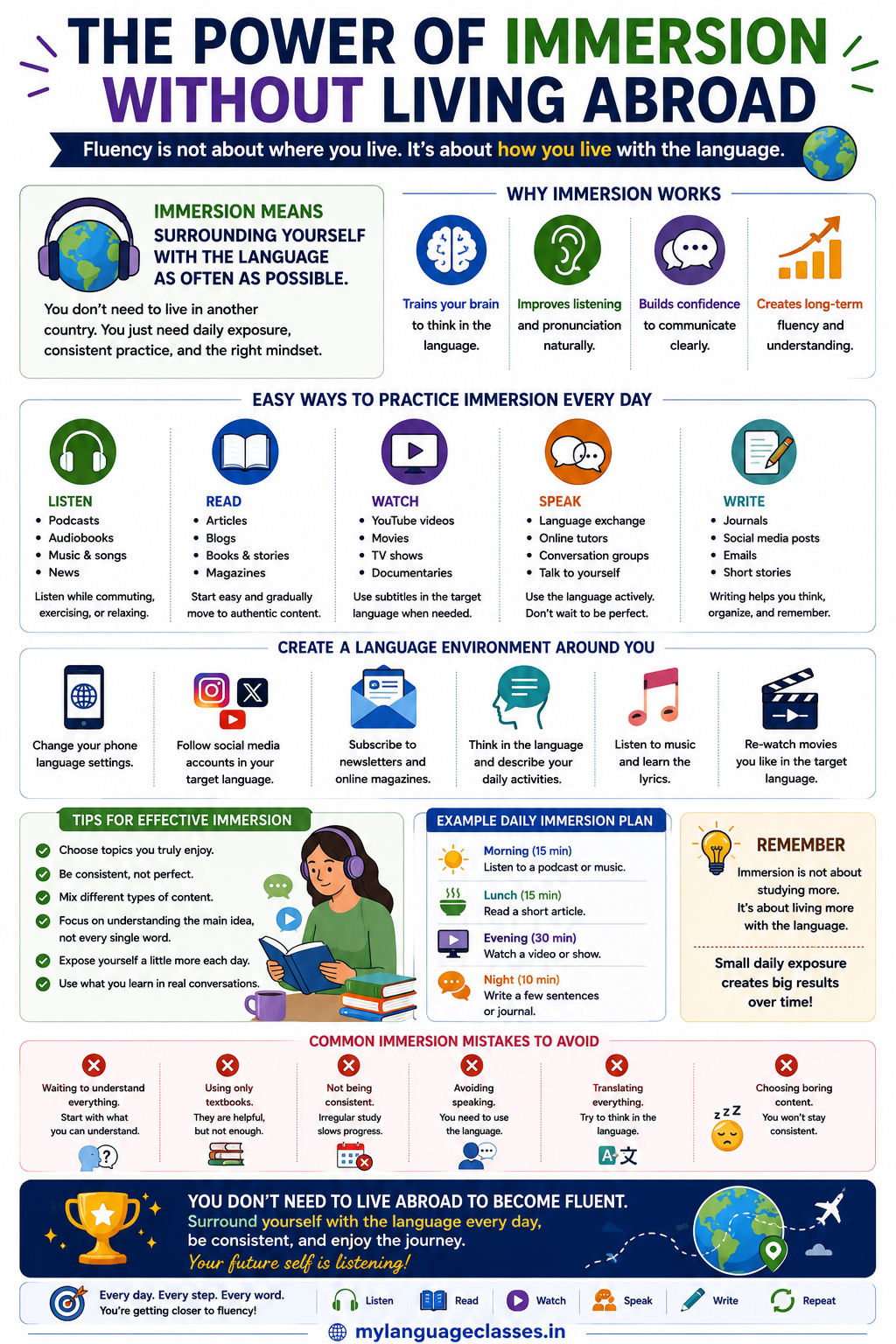
Immersion simply means surrounding yourself with the language as often as possible. Today, technology makes this easier than ever. Books, podcasts, videos, music, online courses, news websites, social media, language exchange platforms, and artificial intelligence tools provide constant access to authentic language from anywhere in the world. With the right approach, you can create an effective language environment without purchasing a plane ticket.
One of the simplest ways to increase immersion is to make the language part of your everyday routine. Listen to a podcast while commuting, read a short article during lunch, watch a video in your target language during the evening, or write a few sentences before going to bed. These small moments of exposure accumulate over time and significantly strengthen comprehension.
Reading authentic content is another effective form of immersion. Beginners may start with graded readers or simple articles, while more advanced learners can gradually move to newspapers, novels, blogs, and professional content. Reading exposes learners to natural vocabulary, sentence structures, and expressions that are difficult to learn through isolated word lists alone.
Listening is equally important because it trains the brain to recognize pronunciation, rhythm, and natural speech patterns. At first, learners may understand only a few words, but regular listening gradually improves comprehension. The goal is not to understand every word immediately but to become increasingly comfortable with the sounds and patterns of the language.
Speaking should also become part of your immersion strategy. Language exchange partners, tutors, online communities, and conversation groups provide opportunities to use the language actively. Even speaking to yourself, describing your surroundings, or thinking in your target language helps transform passive knowledge into practical communication skills.
Another effective technique is gradually replacing small parts of your daily environment with the language you are learning. Changing your phone settings, following social media accounts in the target language, subscribing to newsletters, or watching familiar films with subtitles in the target language creates additional exposure without requiring extra study time.
Immersion should also be enjoyable. Choosing topics that genuinely interest you makes it easier to remain consistent. Whether you enjoy cooking, sports, business, travel, history, technology, or entertainment, consuming content related to your interests keeps learning engaging while naturally expanding your vocabulary.
At My Language Classes, we encourage learners to think of immersion as a daily habit rather than a destination. You do not need to live abroad to make meaningful progress. By intentionally surrounding yourself with the language every day, you create continuous opportunities for learning, reinforce what you already know, and build the confidence to communicate naturally in real-life situations.
Common Language Learning Mistakes to Avoid
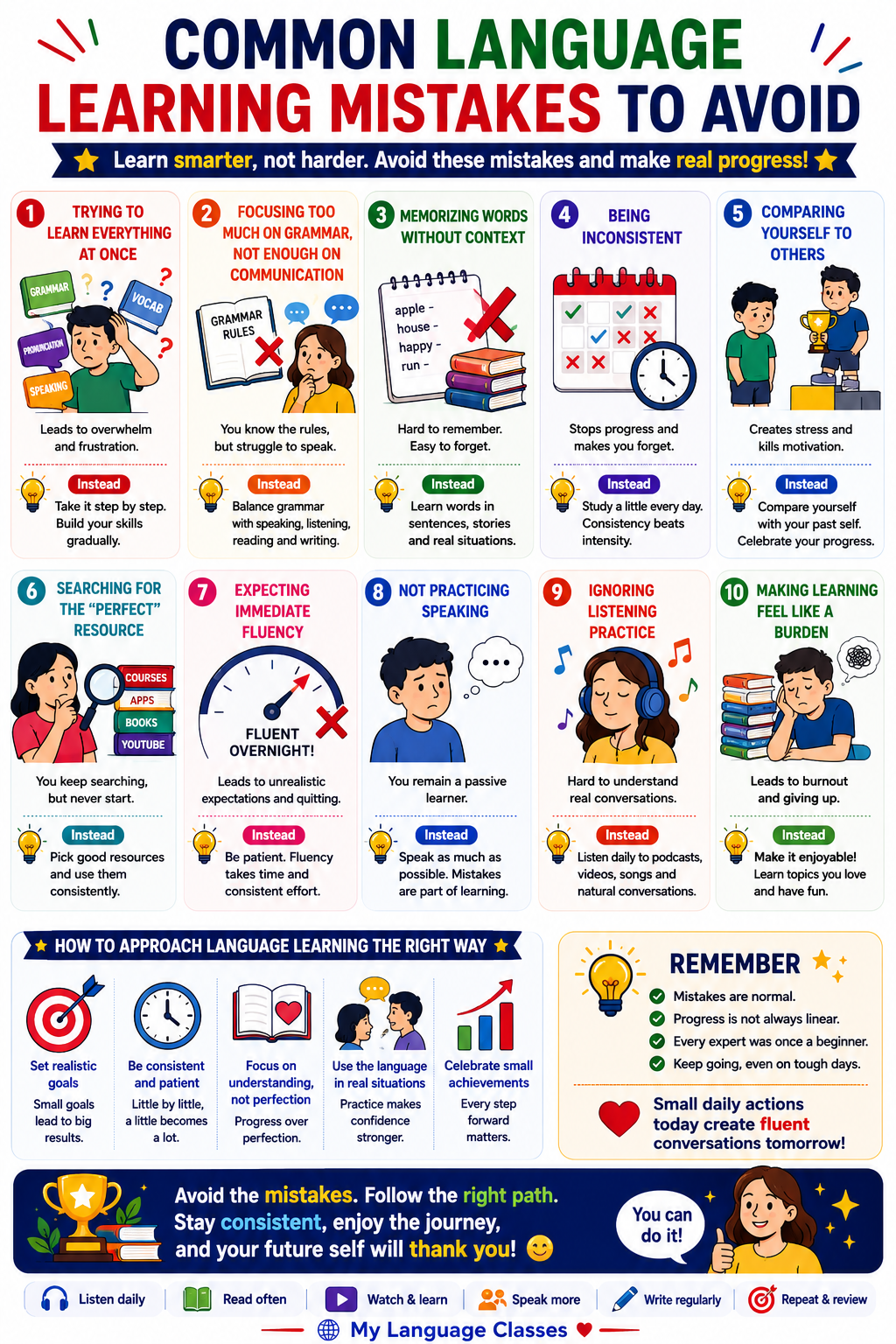
Learning a language is a long-term process, and making mistakes is a natural part of that journey. However, some mistakes occur not because of the language itself, but because of the way people approach learning. Recognizing these common pitfalls early can help you save time, stay motivated, and make more consistent progress.
One of the most common mistakes is trying to learn everything at once. Many learners attempt to memorize hundreds of words, study complex grammar, improve pronunciation, and become fluent simultaneously. This often leads to information overload and frustration. Language learning is more effective when knowledge is built gradually, allowing each new concept to reinforce what has already been learned.
Another frequent mistake is focusing too heavily on grammar while neglecting communication. Grammar is essential because it provides structure, but language exists to help people communicate. Learners who spend months studying rules without speaking, listening, reading, or writing often struggle to use the language in real situations. The opposite approach is equally ineffective. Ignoring grammar completely can make communication unclear and limit long-term progress. A balanced approach always produces better results.
Many learners also become obsessed with memorizing vocabulary lists without understanding how words are used in context. Individual words are easier to forget than words learned through conversations, stories, articles, and practical examples. Vocabulary becomes meaningful when it is connected to real communication rather than isolated memorization.
Inconsistency is another major obstacle. Studying intensively for a few days and then taking long breaks makes it difficult to retain information. The brain strengthens language skills through regular exposure. Even short daily study sessions are generally more effective than occasional marathon sessions.
Comparing yourself with other learners can also become discouraging. Every learner has different goals, backgrounds, available study time, and learning experiences. Measuring your progress against someone else’s achievements often creates unnecessary pressure. Instead, compare yourself with where you were last month or last year. Consistent personal improvement is a much more meaningful measure of success.
Some learners spend so much time searching for the perfect course, textbook, or application that they never commit to using any of them consistently. While good learning materials are important, there is no perfect resource that can replace regular practice. Progress comes from using quality resources consistently rather than constantly switching between them.
Another common mistake is expecting immediate fluency. Language learning takes time because the brain needs repeated exposure to develop lasting knowledge. Setting unrealistic expectations often causes learners to quit just before they begin seeing meaningful results. Patience is not simply helpful. It is an essential part of the learning process.
Finally, many learners underestimate the importance of enjoying the process. When every study session feels like an obligation, maintaining consistency becomes difficult. Choosing interesting topics, celebrating small achievements, and appreciating gradual improvement make language learning more sustainable and rewarding.
At My Language Classes, we encourage learners to focus on steady progress instead of perfection. Avoiding these common mistakes does not require extraordinary talent or endless study hours. It requires realistic expectations, balanced learning, consistent practice, and a willingness to keep moving forward. The goal is not to become perfect overnight. The goal is to become a little better every day, knowing that lasting fluency is built through thousands of small, meaningful steps.
The My Language Classes Philosophy
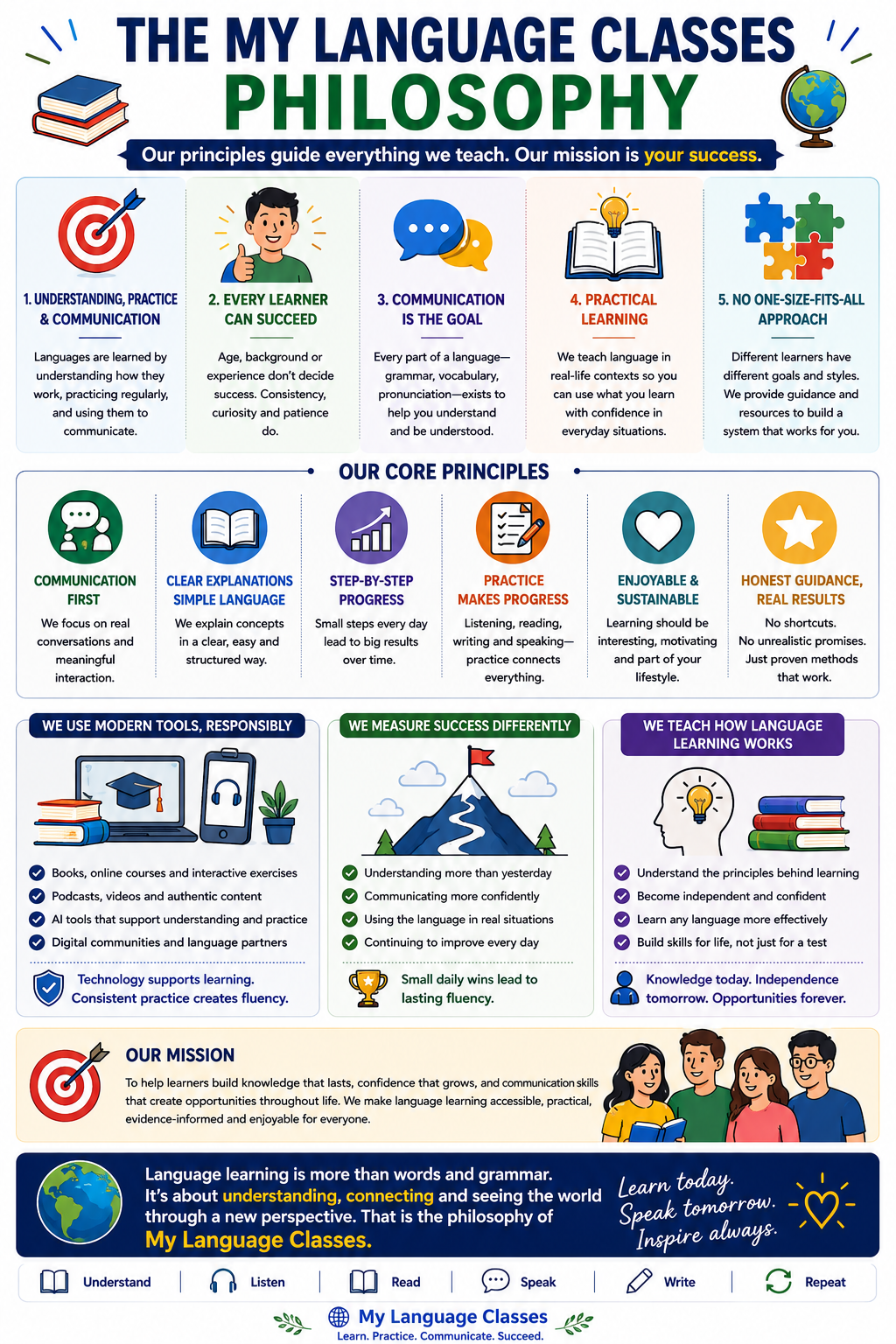
Every educational institution has a teaching method. At My Language Classes, we believe it should also have a learning philosophy. Methods and resources may change over time, but the principles behind effective language learning remain remarkably consistent. Our philosophy is built on these principles, and they guide every lesson, article, book, course, exercise, and resource we create.
We believe that languages are learned through understanding, practice, and meaningful communication. Memorizing rules without using them rarely leads to confidence, just as speaking without understanding eventually limits progress. Lasting language skills develop when grammar, vocabulary, listening, reading, writing, and speaking grow together through regular practice.
We also believe that every learner is capable of learning a new language. Age, background, profession, nationality, or previous learning experiences do not determine success. The most important factors are consistency, patience, curiosity, and a willingness to continue learning. Language learning is not reserved for people with exceptional talent. It is a skill that becomes stronger with regular use.
Our approach places communication at the heart of learning. Grammar is important because it brings clarity to communication. Vocabulary is important because it allows ideas to be expressed. Pronunciation is important because it improves understanding. Every element of language has value, but its true purpose is to help people connect with others.
We believe that learning should be practical. Instead of encouraging learners to memorize isolated information, we focus on helping them understand how language works in real situations. Examples, conversations, stories, exercises, and everyday contexts make learning more meaningful and easier to remember. Knowledge becomes valuable only when it can be applied with confidence.
We also reject the idea that there is a single perfect method for learning a language. Different learners have different goals, interests, schedules, and learning styles. Our role is not to promote shortcuts or unrealistic promises. It is to provide clear explanations, structured guidance, practical resources, and proven learning principles that help every learner build a system they can maintain.
Technology has transformed language education, and we embrace it responsibly. Books, online courses, artificial intelligence, interactive exercises, podcasts, videos, and digital communities all have an important place in modern language learning. These tools are most effective when they support genuine understanding and consistent practice rather than replacing the learning process itself.
We measure success differently. Success is not completing a course as quickly as possible or memorizing the largest number of words. Success is understanding more than yesterday, communicating more confidently than before, and continuing to improve through steady practice. Every conversation held with confidence, every article read with greater understanding, and every lesson completed with curiosity represents meaningful progress.
Our commitment extends beyond teaching individual languages. We aim to help learners understand how language learning itself works. Once learners understand the principles behind effective learning, they become more independent, more confident, and better prepared to learn not only one language but any language they choose in the future.
At My Language Classes, our mission is simple: to help learners build knowledge that lasts, confidence that grows, and communication skills that create opportunities throughout life. We believe language learning should be accessible, practical, evidence-informed, and enjoyable. Most importantly, we believe that every learner deserves honest guidance, realistic expectations, and the confidence to discover what they are truly capable of achieving through consistent effort.
This philosophy is reflected in everything we create because learning a language is about far more than mastering words and grammar. It is about building the ability to understand, communicate, connect with people, and experience the world through a new perspective. That is what language learning really means, and that is the principle that defines My Language Classes.
Frequently Asked Questions
Is language learning difficult?
Language learning can be challenging at times, but it is not beyond the reach of most people. Like any skill, it becomes easier with regular practice, realistic expectations, and effective study methods. The difficulty often comes from inconsistent learning habits rather than the language itself.
How long does it take to learn a new language?
There is no single timeline that applies to everyone. The time required depends on factors such as your native language, the language you are learning, your study routine, and how often you use the language. Consistent daily practice is far more important than trying to reach fluency within a fixed number of months.
Can adults become fluent in a new language?
Yes. Adults successfully learn new languages every day. Although adults and children learn differently, adults have advantages such as stronger analytical skills, greater discipline, and more effective learning strategies. Age is rarely the factor that determines success.
Is grammar more important than vocabulary?
Both are essential. Vocabulary provides the words needed to express ideas, while grammar helps organize those words into meaningful sentences. Developing both skills together leads to clearer and more confident communication.
Should I speak even if I make mistakes?
Absolutely. Speaking is one of the fastest ways to improve. Mistakes provide valuable feedback and help strengthen your understanding of the language. Waiting until you feel perfect often delays progress unnecessarily.
How much should I study each day?
Even fifteen to thirty minutes of focused practice every day can produce excellent long-term results. Consistency is generally more effective than studying for several hours only once or twice a week.
Do I need to live abroad to become fluent?
No. While living abroad provides additional opportunities for immersion, modern technology allows learners to create rich language environments anywhere in the world. Reading, listening, speaking, writing, and interacting with authentic content regularly can lead to significant progress.
What is the best way to memorize vocabulary?
Learning vocabulary in context is usually more effective than memorizing isolated word lists. Reading stories, listening to conversations, and using new words in your own sentences help improve long-term retention.
How do I stay motivated to keep learning?
Motivation naturally changes over time, so building a consistent study routine is more reliable than depending on motivation alone. Setting realistic goals, tracking your progress, and choosing interesting learning materials also help maintain long-term commitment.
What is the biggest mistake language learners make?
One of the biggest mistakes is expecting quick results while studying inconsistently. Language learning is a gradual process that rewards regular practice, balanced skill development, and patience.
What is the best language learning method?
There is no single method that works for everyone. The most effective approach combines structured learning, meaningful communication, regular review, authentic content, and consistent daily practice. The best method is the one you can maintain over the long term.
How can I measure my language learning progress?
Measure progress by what you can understand and communicate, not by how many lessons you have completed. Reading more comfortably, understanding conversations, speaking with greater confidence, and writing more clearly are all meaningful signs of improvement.
Final Thoughts
Learning a language is one of the most rewarding skills you can develop. It opens doors to new cultures, meaningful relationships, professional opportunities, and ways of thinking that would otherwise remain beyond your reach. Although the journey requires patience and consistent effort, every small step contributes to lasting progress.
Throughout this guide, you have seen that successful language learning is not built on shortcuts, talent, or perfect resources. It is built on understanding how learning works, developing effective habits, embracing mistakes, communicating regularly, and remaining consistent over time. These principles apply whether you are learning Spanish, Japanese, English, or any other language.
At My Language Classes, our goal is not simply to teach languages. We want to help learners understand the learning process itself so they can become confident, independent, and lifelong language learners. When you understand how language learning really works, every lesson becomes more meaningful, every challenge becomes easier to overcome, and every achievement becomes part of a much larger journey.
No matter where you are starting today, remember that fluency is not reached through one extraordinary effort. It is built through thousands of ordinary moments of learning, practicing, listening, reading, speaking, writing, and improving. Stay curious, stay consistent, and trust the process. Your future self will thank you for every step you take today.
At My Language Classes, we look forward to being part of that journey.
© 2026 My Language Classes · Privacy Policy