

How to Show Intention in Japanese
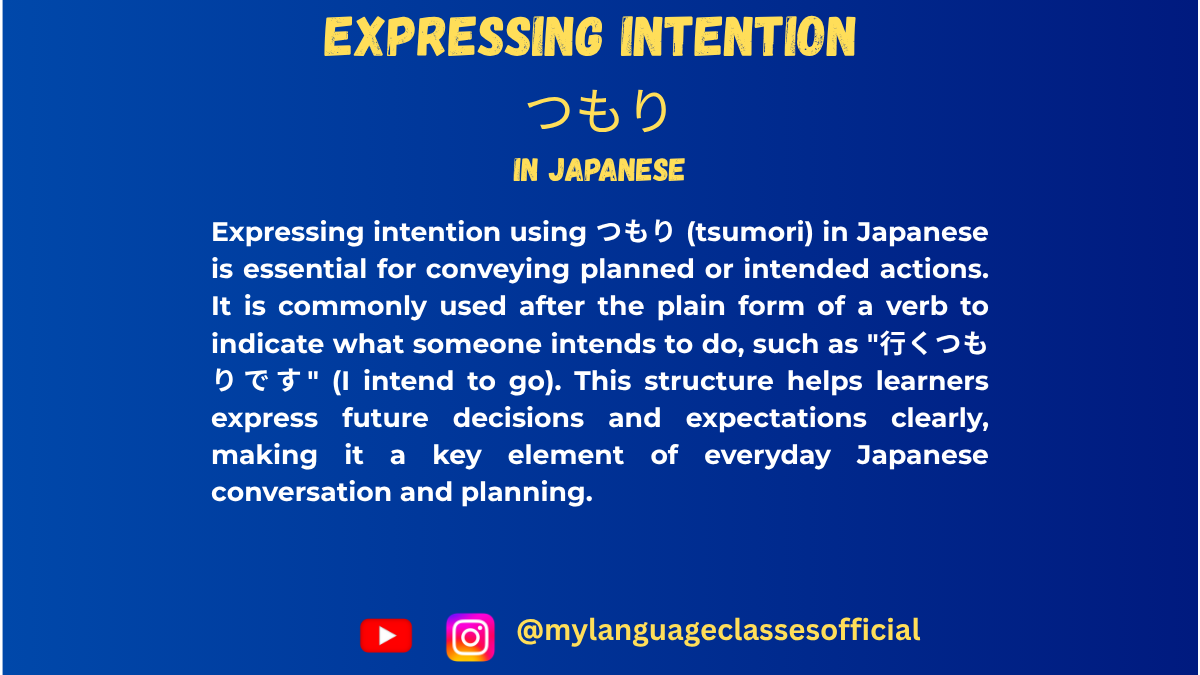
When learning Japanese, understanding how to articulate intentions or plans is crucial. One of the most common and versatile expressions for this purpose is 〜つもり (tsumori). This post explores the usage of 〜つもり, its nuances, and the various situations where it can be employed.
What is 〜つもり?
〜つもり is a grammatical structure used to express one’s intention, determination, or a plan to do something. It can also convey assumptions or beliefs in certain contexts. The term “tsumori” itself translates to “intention” or “plan.”
The construction is relatively simple:
[Verb in dictionary form] + つもりです – Intend to do something.
[Verb in nai-form] + つもりです – Intend not to do something.
How to Use 〜つもり?
1. Expressing Future Intentions
You can use 〜つもり to clearly state your plans for the future:
- 私は明日学校に行くつもりです。 – I intend to go to school tomorrow.
- 私は歌をうたわないつもりです。 – I intend not to sing a song.
2. Talking About Assumptions
〜つもり can also indicate a belief or assumption about a situation, often with an implied contrast to reality:
- 私は深く理解しているつもりでした。しかし…。 – I thought I understood it deeply, but…
This usage typically involves a past-tense verb and often reflects a misunderstanding.
3. Expressing Unintentional Actions
Although rare, 〜つもり is used to deny responsibility when you didn’t intentionally perform an action:
- それを言うつもりはなかった。 – I didn’t mean to say that.
Politeness Levels
〜つもりです is a polite expression suitable for formal and semi-formal settings. In casual conversations, you can drop です:
- 明日行くつもり。 – I plan to go tomorrow.
Adding 「つもりだよ」 or 「つもりだけど」 softens the tone even further.
Key Situations for Using 〜つもり
Here’s a comprehensive list of contexts where 〜つもり is commonly used:
- Future Plans:
- 私は明日山に行くつもりです。 – I intend to go to the mountains tomorrow.
- Negating Intentions:
- 今年は流行の服を買わないつもりです。 – I don’t plan to buy trendy clothes this year.
- Explaining Changes in Plans:
- 行くつもりだったけど、天気が悪くなりました。 – I intended to go, but the weather turned bad.
- Making Assumptions:
- 自分は結婚しないつもりでしたが…。 – I assumed I wouldn’t get married, but…
- Unintentional Actions:
- あなたを傷つけるつもりはありません。 – I didn’t intend to hurt you.
- Future Determination:
- もっと勉強するつもりです。 – I am determined to study harder.
Common Mistakes to Avoid
- Misinterpreting 〜つもり as a Promise: While 〜つもり expresses intention, it doesn’t guarantee that the action will happen. Avoid confusing it with words like やくそく (yakusoku – promise).
- Using 〜つもり in Commands or Requests: 〜つもり cannot be used to make requests or issue commands.
- Overusing in Formal Writing: In highly formal contexts, more precise expressions like 計画しています (“I am planning”) may be more appropriate.
Practice Examples
Try constructing sentences using 〜つもり in different situations. For instance:
- 私は今年日本語を終わらせるつもりです。
- 私はその話を聞いたつもりですが…
By practicing various scenarios, you’ll gain confidence in using this versatile expression.
Understanding 〜つもり is a valuable step in mastering Japanese. It allows you to articulate intentions, beliefs, and assumptions effectively. Whether planning a trip, expressing a future goal, or clarifying misunderstandings, this structure adds depth to your language skills. Happy studying!

Vikas Kumar is the founder of My Language Classes, a language learning platform dedicated to helping learners develop practical communication skills in Spanish, Japanese, and English through comprehensive grammar guides, structured learning resources, books, and evidence-informed educational content.
At My Language Classes, we believe that successful language learning is built on clarity, consistency, meaningful practice, and a deep understanding of how languages work. Every article is carefully researched and created to simplify complex concepts, provide practical guidance, and help learners develop confidence through real-world communication.
Inspired by the principles behind How Language Learning Really Works, our mission is to make high-quality language learning accessible to learners around the world by providing accurate, trustworthy, and comprehensive resources that support lasting progress, lifelong learning, and meaningful communication.
Leave a Reply