

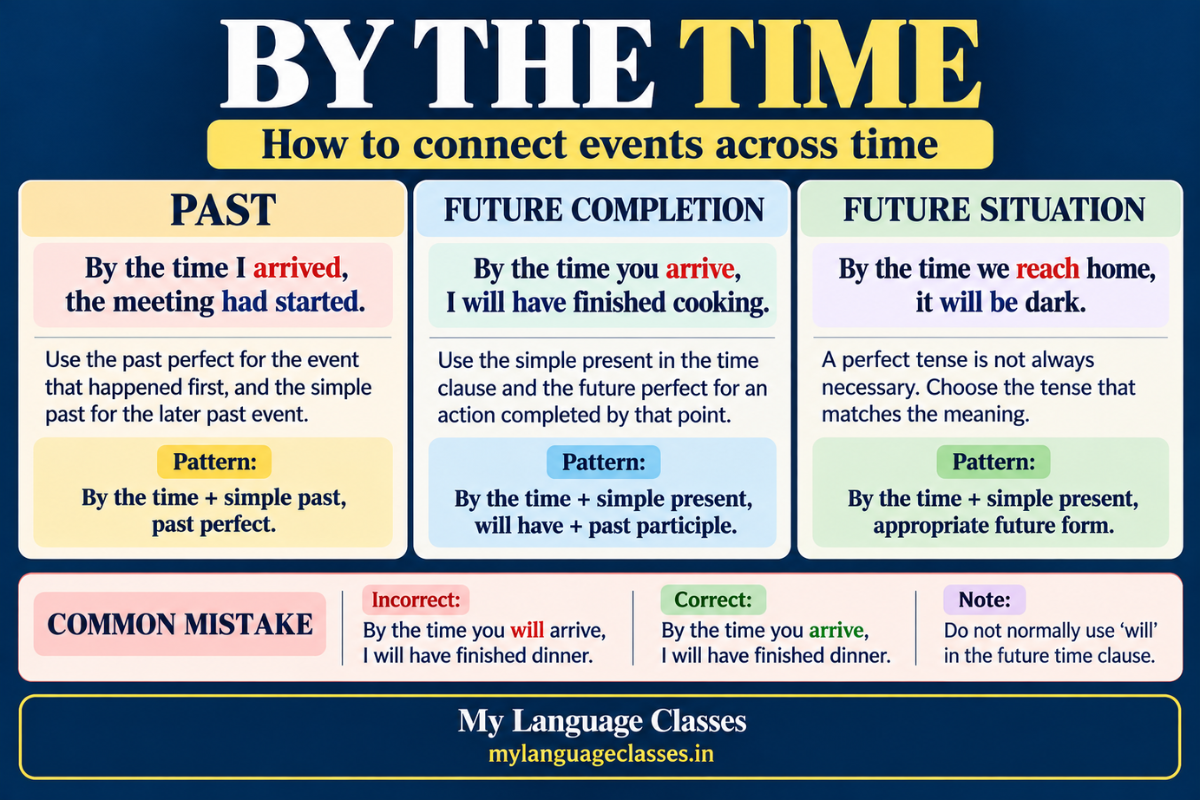
The by the time grammar rule in English helps us explain when one event happens before another event or a particular moment. We use this expression to connect two events and show their relationship in time. For example, we can say, “By the time I arrived, the meeting had started.” This sentence tells us that the meeting started before I arrived.
Understanding the by the time grammar rule in English is important because it helps you choose the correct tense when discussing past events, present situations, and future plans. Although the expression itself is simple, the verb tense that follows it can sometimes confuse English learners.
The good news is that you can understand this rule by learning a few common patterns. Once you know how these patterns work, you can use “by the time” naturally in everyday English.
What Does “By the Time” Mean in English?
The expression “by the time” means before or no later than the moment when something else happens.
We use it to connect two events or describe what will be true at a particular point in time. One event may finish before another event occurs, or a situation may already exist when a specific moment arrives.
Consider these examples:
→ By the time I reached the station, the train had left.
→ By the time she gets home, dinner will be ready.
→ By the time he was twenty, he had visited several countries.
In the first sentence, the train left before I reached the station. In the second sentence, dinner will be ready before or when she gets home. In the third sentence, he visited several countries before reaching the age of twenty.
Notice that each sentence contains two connected ideas. The expression “by the time” helps establish the relationship between them.
It is also important to understand that “by the time” does not always require the same tense. The correct tense depends on whether you are talking about the past, the present, or the future.
How Does the By the Time Grammar Rule Work?
The basic structure contains a clause beginning with “by the time” and another clause that explains what happens before or at that point.
A clause is a group of words containing a subject and a verb.
For example:
By the time I arrived, the class had started.
The sentence contains two clauses:
→ By the time I arrived: This identifies the moment when I arrived.
→ The class had started: This explains what had already happened before that moment.
The first clause establishes a reference point. The second clause explains the event in relation to that point.
However, the tense used in each clause depends on the meaning you want to express.
1. By the Time With the Past Perfect Tense
We commonly use the past perfect tense in the main clause when an event happened before another event in the past.
The basic structure is:
By the time + simple past, subject + past perfect.
You can also reverse the clauses without changing the essential meaning.
Subject + past perfect + by the time + simple past.
Examples:
→ By the time I arrived at the office, my manager had left.
→ By the time we reached the cinema, the movie had started.
→ By the time she called me, I had finished my work.
→ By the time the teacher entered the classroom, the students had opened their books.
→ I had eaten dinner by the time my friends arrived.
In these examples, the past perfect describes the earlier event. The simple past identifies the later event that provides the reference point.
For instance, “My manager had left” describes an event that happened before “I arrived at the office.”
The past perfect tense follows this structure:
Subject + had + past participle.
Examples include:
→ She had finished.
→ They had arrived.
→ He had written.
→ We had completed the task.
Remember that the past perfect does not simply mean that an event happened a long time ago. It connects an earlier past event to another point in the past.
2. By the Time With the Simple Present Tense
We use the simple present tense in the “by the time” clause when referring to a future event.
This is a common rule that English learners need to remember. Although the sentence refers to the future, the clause beginning with “by the time” normally uses the simple present tense.
A common structure is:
By the time + simple present, subject + future perfect.
Examples:
→ By the time you arrive, I will have finished cooking.
→ By the time she gets home, we will have completed the project.
→ By the time they reach the airport, the check-in desk will have closed.
→ By the time the meeting starts, everyone will have received the documents.
→ By the time you read this message, I will have left the office.
In these sentences, the simple present describes the future reference point. The future perfect describes an event that will be complete by that point.
The future perfect follows this structure:
Subject + will have + past participle.
For example:
→ I will have finished.
→ She will have arrived.
→ They will have completed the work.
→ We will have reached our destination.
Consider this example:
“By the time you arrive, I will have finished cooking.”
The speaker is talking about a future situation. The cooking will be complete before or by the time the other person arrives.
However, the future perfect is not compulsory in every sentence with “by the time.” The appropriate tense depends on the meaning.
For example:
“By the time you arrive, I will be at home.”
This sentence uses the future simple form of “be.” It describes the speaker’s expected location rather than emphasizing the completion of an activity.
Therefore, focus on the relationship between the events instead of memorizing one sentence pattern as an absolute rule.
3. By the Time With the Simple Past Tense
Sometimes, we use the simple past in both clauses. This happens when the sentence describes two past events without needing the past perfect to emphasize the earlier event.
For example:
→ By the time I arrived, everyone else left.
This sentence can suggest that everyone left at or around the time I arrived. However, it does not clearly express the same sequence as “By the time I arrived, everyone else had left.”
Compare these examples:
→ By the time I arrived, everyone else had left.
→ By the time I arrived, everyone else left.
The first sentence clearly indicates that everyone had already left before I arrived. The second may describe a different sequence or a less precise relationship, depending on context.
For learners, the past perfect is generally the clearest choice when you want to emphasize that one past event was already complete before another past event occurred.
For example:
“By the time we reached the restaurant, our friends had ordered the food.”
The past perfect makes the sequence clear. Your friends ordered the food before you reached the restaurant.
4. By the Time With the Future Simple Tense
The future simple can also appear in the main clause when the sentence describes a future situation or result.
Consider these examples:
→ By the time you finish your work, it will be late.
→ By the time we reach the hotel, it will be dark.
→ By the time the children return, their parents will be home.
These sentences do not necessarily emphasize that an action will have been completed. Instead, they describe the situation expected at a future point.
Compare:
→ By the time you arrive, I will finish the report.
→ By the time you arrive, I will have finished the report.
The second sentence clearly emphasizes that the report will be complete before or by the time you arrive.
The first sentence can be understood in context, but it does not express that completed-by-a-deadline meaning as clearly. Depending on the intended meaning, another construction may be more natural.
When you want to emphasize completion before a future reference point, the future perfect is usually the better choice.
What Is the Difference Between “By the Time” and “When”?
English learners sometimes confuse “by the time” with “when.” Both expressions refer to time, but they do not always communicate the same meaning.
We use “when” to identify the time at which something happens. In contrast, “by the time” often emphasizes what has already happened or what will be true at a particular point.
Compare these sentences:
→ When I arrived, the meeting started.
→ By the time I arrived, the meeting had started.
In the first sentence, the meeting started when I arrived or around that moment.
In the second sentence, the meeting had already started before I arrived.
Here is another comparison:
→ When you get home, I will cook dinner.
→ By the time you get home, I will have cooked dinner.
The first sentence suggests that cooking will happen when you get home. The second suggests that dinner will already be cooked by then.
Notice how changing the expression changes the relationship between the events.
Here are a few more examples:
→ When she called, I answered the phone.
→ By the time she called, I had already gone to bed.
→ When the guests arrive, we will welcome them.
→ By the time the guests arrive, we will have prepared everything.
The difference is not simply grammatical. It also affects the meaning of the sentence.
Use “when” when you want to identify the time of an event. Use “by the time” when you want to emphasize what happens before or what is true at that reference point.
What Is the Difference Between “By the Time” and “Until”?
Another common source of confusion is the difference between “by the time” and “until.”
We use “until” to describe how long a situation continues. In contrast, “by the time” connects an event or situation to a particular reference point.
Consider these examples:
→ I waited until she arrived.
→ By the time she arrived, I had waited for two hours.
The first sentence tells us how long the waiting continued. The waiting ended when she arrived.
The second sentence describes the situation at the moment she arrived. It tells us that two hours of waiting had already passed.
Here are more examples:
→ He worked until midnight.
→ By the time he finished work, it was midnight.
→ They stayed at home until the rain stopped.
→ By the time the rain stopped, they had spent the entire afternoon at home.
These expressions serve different purposes, even though both can refer to the same event.
Use “until” when emphasizing the duration or endpoint of an action or situation. Use “by the time” when connecting an event to another point in time.
Common Mistakes When Using “By the Time”
Learning the basic structure is important, but you should also understand the mistakes that can make your sentences unclear or grammatically incorrect.
Mistake 1: Using “Will” in the By the Time Clause
One of the most common mistakes is using “will” in the clause beginning with “by the time” when referring to a future event.
Incorrect: By the time you will arrive, I will have finished dinner.
Correct: By the time you arrive, I will have finished dinner.
The clause “by the time you arrive” uses the simple present tense, even though the sentence refers to the future.
This is because English normally uses a present-tense form in this type of future time clause.
Remember this pattern:
By the time + simple present, subject + appropriate future form.
Mistake 2: Using the Simple Past Instead of the Past Perfect
The simple past is not always wrong, but it may fail to express the intended sequence clearly.
Less precise: By the time I arrived, the train left.
Clearer: By the time I arrived, the train had left.
The second sentence clearly communicates that the train left before I arrived.
When two events happened in the past and one was already complete before the other, the past perfect often makes the relationship easier to understand.
Mistake 3: Confusing the Past Perfect and Future Perfect
These tenses refer to different time relationships.
The past perfect connects an earlier event to a later point in the past.
The future perfect describes an event that will be complete by a future point.
Compare:
→ By the time I arrived, she had finished the work.
→ By the time I arrive, she will have finished the work.
The first sentence describes a past situation. The second describes an expected future situation.
Pay attention to the time reference before choosing the tense.
Mistake 4: Assuming Every Sentence Requires the Perfect Tense
Although the past perfect and future perfect are common with “by the time,” they are not mandatory in every sentence.
For example:
→ By the time we reach the station, it will be dark.
→ By the time she arrived, everyone was ready.
The first sentence describes an expected future condition. The second describes a past condition.
Neither sentence needs a perfect tense to communicate its intended meaning.
Choose the tense according to the relationship between the events and the meaning you want to express.
Mistake 5: Forgetting That the Clauses Can Change Places
You can usually place the “by the time” clause at the beginning or end of the sentence.
For example:
→ By the time I arrived, the meeting had started.
→ The meeting had started by the time I arrived.
Both sentences communicate the same basic idea.
When the “by the time” clause comes first, we normally place a comma between the clauses. When it comes after the main clause, a comma is generally unnecessary.
This flexibility allows you to vary your sentence structure without changing the essential meaning.
How Can You Use “By the Time” Naturally in English?
The expression is useful in everyday conversations, workplace communication, storytelling, and written English.
You can use it when describing completed actions, deadlines, plans, and changes that occur before a particular moment.
For example, in everyday conversation:
→ By the time I woke up, my family had already left.
→ By the time you get here, I will be ready.
In workplace communication:
→ By the time the manager arrived, the team had prepared the report.
→ By the time the deadline arrives, we will have completed the project.
When talking about travel:
→ By the time we reached the airport, our flight had departed.
→ By the time we arrive at the hotel, the restaurant will be closed.
When discussing learning and progress:
→ By the time she finished the course, she had learned several new grammar rules.
→ By the end of this month, I will have studied English for six months.
The last example uses “by the end of this month” rather than “by the time,” but it follows a related idea: an event or period is viewed in relation to a deadline.
These examples show how the expression helps establish a clear timeline. It tells the reader or listener what has happened, what will happen, or what situation will exist at a particular point.
As you become more familiar with the expression, pay attention to how writers and speakers use it to connect events. Notice which tense appears in each clause and how that choice affects the meaning.
Key Takeaways
→ The expression “by the time” connects two events and shows what happens before or at a particular point in time.
→ For past events, use the past perfect to show that one event was completed before another past event. Example: By the time I arrived, the meeting had started.
→ For future events, use the simple present in the clause beginning with “by the time.” Example: By the time you arrive, I will have finished cooking.
→ Use the future perfect when you want to emphasize that an action will be completed before or by a future point. The structure is subject + will have + past participle.
→ You do not need a perfect tense in every sentence with “by the time.” Choose the tense according to the meaning you want to express.
→ Do not normally use “will” in a future time clause beginning with “by the time.” Say “By the time you arrive,” not “By the time you will arrive.”
→ “By the time” emphasizes what has happened or what will be true at a particular point, while “when” identifies the time an event happens.
→ “Until” emphasizes how long a situation continues, while “by the time” connects events to a particular moment.
→ You can place the “by the time” clause at the beginning or end of a sentence. Use a comma when the clause comes first.
→ To use “by the time” correctly, focus on the relationship between events and choose the tense that expresses that relationship clearly.
Conclusion
The by the time grammar rule in English becomes easier when you focus on the relationship between two events rather than memorizing isolated formulas.
Use the past perfect when you want to show that an event was already complete before another past event. Use the simple present in a future time clause beginning with “by the time,” and use the future perfect when emphasizing completion before a future reference point.
Remember these key patterns:
→ Past: By the time I arrived, the meeting had started.
→ Future completion: By the time you arrive, I will have finished the work.
→ Future situation: By the time we reach home, it will be dark.
Also, remember that the perfect tenses are not compulsory in every sentence with “by the time.” The correct choice depends on the meaning and the relationship between the events.
With regular exposure to examples and careful attention to tense usage, you can use this expression more accurately in both spoken and written English.

Vikas Kumar is the founder of My Language Classes, a language learning platform dedicated to helping learners develop practical communication skills in Spanish, Japanese, and English through comprehensive grammar guides, structured learning resources, books, and evidence-informed educational content.
At My Language Classes, we believe that successful language learning is built on clarity, consistency, meaningful practice, and a deep understanding of how languages work. Every article is carefully researched and created to simplify complex concepts, provide practical guidance, and help learners develop confidence through real-world communication.
Inspired by the principles behind How Language Learning Really Works, our mission is to make high-quality language learning accessible to learners around the world by providing accurate, trustworthy, and comprehensive resources that support lasting progress, lifelong learning, and meaningful communication.
Leave a Reply