

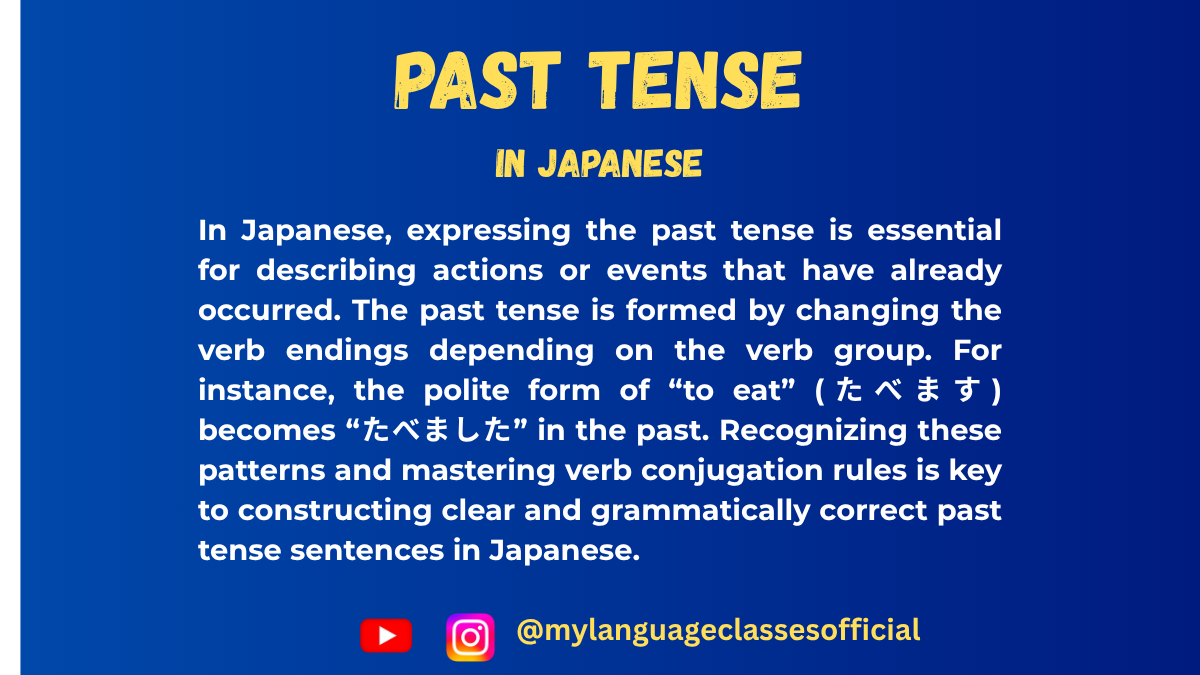
Mastering Japanese Past Tense
If you’re learning Japanese, understanding how to express actions in the past is essential for communication. Japanese verbs are logically structured, and once you master their conjugations, you’ll be ready to share stories, describe events, and more.
In this post, we’ll focus on the positive past tense and the negative past tense, with step-by-step explanations for verbs ending in different sounds (like -ku, -ru, -mu, and more). By the end, you’ll feel confident using these forms in your Japanese conversations.
The Basics of Japanese Past Tense
Japanese verbs don’t conjugate based on the subject, so there’s no distinction between “I ate” and “she ate.” The conjugation only reflects tense (past, present, etc.) and polarity (positive or negative).
The two forms we’ll focus on are:
- Positive Past Tense – For actions that happened.
- Negative Past Tense – For actions that didn’t happen.
1. Positive Past Tense: 食べた (tabeta) – “ate”
The positive past tense is based on the た-form of the verb. To create it, we modify the ending of the verb according to its type.
Group 1 (U-verbs)
For U-verbs, the conjugation depends on the final -u sound. Each sound (-ku, -ru, -mu, etc.) follows a specific rule:
| Ending | Change | Example |
|---|---|---|
| -う (u) | Replace う with った | 会う (au, “to meet”) → 会った (atta, “met”) |
| -つ (tsu) | Replace つ with った | 待つ (matsu, “to wait”) → 待った (matta, “waited”) |
| -る (ru) | Replace る with った | 走る (hashiru, “to run”) → 走った (hashitta, “ran”) |
| -む (mu) | Replace む with んだ | 飲む (nomu, “to drink”) → 飲んだ (nonda, “drank”) |
| -ぶ (bu) | Replace ぶ with んだ | 遊ぶ (asobu, “to play”) → 遊んだ (asonda, “played”) |
| -ぬ (nu) | Replace ぬ with んだ | 死ぬ (shinu, “to die”) → 死んだ (shinda, “died”) |
| -く (ku) | Replace く with いた | 書く (kaku, “to write”) → 書いた (kaita, “wrote”) |
| -ぐ (gu) | Replace ぐ with いだ | 泳ぐ (oyogu, “to swim”) → 泳いだ (oyoida, “swam”) |
| -す (su) | Replace す with した | 話す (hanasu, “to speak”) → 話した (hanashita, “spoke”) |
Examples:
- 待つ → 待った (matsu → matta): waited
- 書く → 書いた (kaku → kaita): wrote
- 泳ぐ → 泳いだ (oyogu → oyoida): swam
- 遊ぶ → 遊んだ (asobu → asonda): played
Group 2 (RU-verbs)
For RU-verbs, simply drop the る and add た.
Examples:
- 食べる (taberu, “to eat”) → 食べた (tabeta, “ate”)
- 見る (miru, “to see”) → 見た (mita, “saw”)
Irregular Verbs
There are two irregular verbs in Japanese with unique conjugations:
- する (suru, “to do”) → した (shita, “did”)
- 来る (kuru, “to come”) → 来た (kita, “came”)
2. Negative Past Tense: 食べなかった (tabenakatta) – “did not eat”
To express that something did not happen, we use the negative past tense, which builds off the ない-form of the verb.
How to Form the Negative Past Tense
- Convert the verb to its ない-form (present negative).
- Replace ない with なかった.
Group 1 (U-verbs)
The process for creating the ない-form depends on the ending of the verb:
- Change the final -u to its corresponding -a sound, then add ない.
Example: 飲む (nomu, “to drink”) → 飲まない (nomanai, “do not drink”). - Finally, replace ない with なかった for the past tense: 飲まなかった (nomanakatta, “did not drink”).
Examples:
- 書く (kaku, “to write”) → 書かない → 書かなかった (kakanakatta, “did not write”)
- 泳ぐ (oyogu, “to swim”) → 泳がない → 泳がなかった (oyoganakatta, “did not swim”)
- 話す (hanasu, “to speak”) → 話さない → 話さなかった (hanasanakatta, “did not speak”)
Group 2 (RU-verbs)
For RU-verbs, simply drop る and add ない, then conjugate to なかった.
Examples:
- 食べる → 食べない → 食べなかった (taberu → tabenai → tabenakatta): did not eat
- 見る → 見ない → 見なかった (miru → minai → minakatta): did not see
Irregular Verbs
The two irregular verbs follow special patterns:
- する → しない → しなかった (suru → shinai → shinakatta): did not do
- 来る → 来ない → 来なかった (kuru → konai → konakatta): did not come
Examples in Context
Positive Past Tense
- 昨日、本を読んだ。
(Kinō, hon o yonda.)
I read a book yesterday. - 友達に会った。
(Tomodachi ni atta.)
I met a friend.
Negative Past Tense
- 昨日、本を読まなかった。
(Kinō, hon o yomanakatta.)
I didn’t read a book yesterday. - 友達に会わなかった。
(Tomodachi ni awanakatta.)
I didn’t meet a friend.
Tips for Mastery
- Group Drill Practice: Practice conjugating verbs in groups based on their endings (-ku, -su, -mu, etc.) to build muscle memory.
- Daily Use: Write about your day using past tense. Did you eat? Watch a movie? Think about what you didn’t do as well.
- Flashcards: Use flashcards for common verbs in their dictionary, positive past, and negative past forms.
Understanding Japanese past tense empowers you to share your experiences and engage in deeper conversations. With regular practice, you’ll master these forms in no time. がんばって (Ganbatte, “Good luck!”)!

Vikas Kumar is the founder of My Language Classes, a language learning platform dedicated to helping learners develop practical communication skills in Spanish, Japanese, and English through comprehensive grammar guides, structured learning resources, books, and evidence-informed educational content.
At My Language Classes, we believe that successful language learning is built on clarity, consistency, meaningful practice, and a deep understanding of how languages work. Every article is carefully researched and created to simplify complex concepts, provide practical guidance, and help learners develop confidence through real-world communication.
Inspired by the principles behind How Language Learning Really Works, our mission is to make high-quality language learning accessible to learners around the world by providing accurate, trustworthy, and comprehensive resources that support lasting progress, lifelong learning, and meaningful communication.
Leave a Reply