

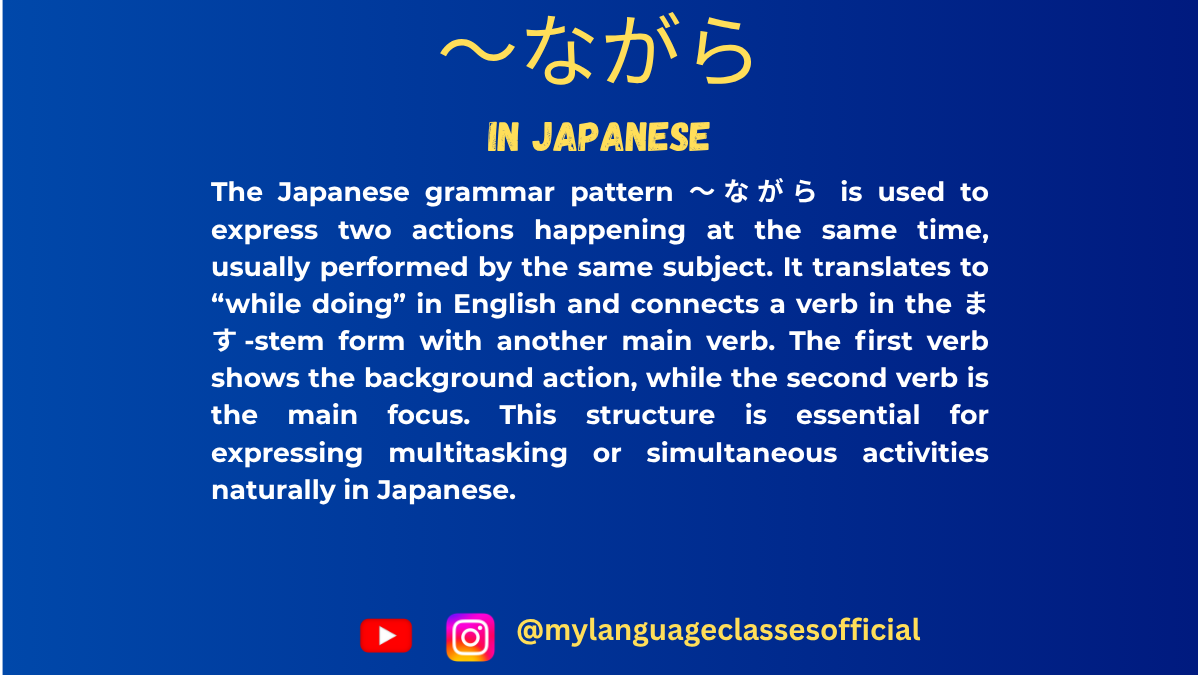
〜ながら Form in Japanese
The 〜ながら (nagara) form is an essential Japanese grammar structure used to describe two actions happening simultaneously. It is widely used in both casual and formal conversations to indicate multitasking or actions occurring at the same time.
In this blog, we will explore the formation of 〜ながら for all three verb groups, its various usages, and a comprehensive list of verbs with example sentences. Additionally, we will provide a section with more example sentences, fill-in-the-blank exercises, key points to remember, and a conclusion.
Formation of 〜ながら for Different Verb Groups
Japanese verbs are categorized into three groups: Group 1 (Godan verbs), Group 2 (Ichidan verbs), and Group 3 (Irregular verbs). Each group follows a specific rule for forming 〜ながら.
1. Group 1 (Godan Verbs)
For Godan verbs, take the ます-stem of the verb and add ながら.
- Example Formation
- 話す (hanasu – to speak) → 話しながら (hanashinagara – while speaking)
- 書く (kaku – to write) → 書きながら (kakinagara – while writing)
2. Group 2 (Ichidan Verbs)
For Ichidan verbs, remove る from the dictionary form and add ながら.
- Example Formation
- 食べる (taberu – to eat) → 食べながら (tabenagara – while eating)
- 見る (miru – to see) → 見ながら (minagara – while watching)
3. Group 3 (Irregular Verbs)
There are only two irregular verbs in Japanese: する and くる.
- Example Formation
- する (suru – to do) → しながら (shiinagara – while doing)
- くる (kuru – to come) → きながら (kinagara – while coming)
Situations Where 〜ながら Form is Used
- Describing Two Simultaneous Actions
- 音楽を聞きながら勉強する (Ongaku o kikinagara benkyou suru) – Study while listening to music.
- Multitasking in Daily Life
- テレビを見ながらご飯を食べる (Terebi o minagara gohan o taberu) – Eat while watching TV.
- Speaking While Performing Another Action
- 笑いながら話す (Warainagara hanasu) – Talk while laughing.
- Contrasting Two Simultaneous Actions
- 悲しみながら笑う (Kanashiminagara warau) – Laugh while feeling sad.
- Working or Performing a Task While Doing Something Else
- 仕事をしながらコーヒーを飲む (Shigoto o shinagara koohii o nomu) – Drink coffee while working.
Verb List with 〜ながら Form and Example Sentences
| Verb (Dictionary Form) | 〜ながら Form | Example Sentence (Japanese) | Romaji | English Translation |
|---|---|---|---|---|
| 話す (hanasu) | 話しながら (hanashinagara) | 彼は笑いながら話しました。 | Kare wa warainagara hanashimashita. | He spoke while laughing. |
| 書く (kaku) | 書きながら (kakinagara) | 先生は黒板に書きながら説明した。 | Sensei wa kokuban ni kakinagara setsumei shita. | The teacher explained while writing on the board. |
| 読む (yomu) | 読みながら (yominagara) | 彼女は本を読みながら寝てしまった。 | Kanojo wa hon o yominagara nete shimatta. | She fell asleep while reading a book. |
| 見る (miru) | 見ながら (minagara) | 子供たちはアニメを見ながら笑った。 | Kodomotachi wa anime o minagara waratta. | The children laughed while watching anime. |
| 歩く (aruku) | 歩きながら (arukinagara) | 彼は音楽を聞きながら歩いた。 | Kare wa ongaku o kikinagara aruita. | He walked while listening to music. |
| 食べる (taberu) | 食べながら (tabenagara) | 彼女はテレビを見ながら食べる。 | Kanojo wa terebi o minagara taberu. | She eats while watching TV. |
| 泳ぐ (oyogu) | 泳ぎながら (oyoginagara) | 彼は海で泳ぎながら歌った。 | Kare wa umi de oyoginagara utatta. | He sang while swimming in the sea. |
More Example Sentences
- 音楽を聞きながら勉強する。
Ongaku o kikinagara benkyou suru.
Study while listening to music. - コーヒーを飲みながらニュースを見る。
Koohii o nominagara nyuusu o miru.
Watch the news while drinking coffee. - 料理をしながらラジオを聞く。
Ryouri o shinagara rajio o kiku.
Listen to the radio while cooking. - 車を運転しながら歌う。
Kuruma o unten shinagara utau.
Sing while driving. - 宿題をしながら電話をする。
Shukudai o shinagara denwa o suru.
Talk on the phone while doing homework.
Fill in the Blanks Questions
- 本を______ながら、リラックスします。(読む)
- 音楽を______ながら、運転する。(聞く)
- 仕事を______ながら、テレビを見る。(する)
- ご飯を______ながら、友達と話す。(食べる)
- 日本語を______ながら、メモを取る。(勉強する)
Answers
- 読みながら (yominagara)
- 聞きながら (kikinagara)
- しながら (shiinagara)
- 食べながら (tabenagara)
- 勉強しながら (benkyou shinagara)
Things to Keep in Mind
- The subject of both actions must be the same.
- The ながら clause comes before the main action.
- ながら is used only for actions, not states.
Conclusion
The 〜ながら form is an important grammar structure in Japanese that allows smooth expression of simultaneous actions. By practicing with various verbs and sentences, you will become more fluent in using it naturally in conversations.
Keep practicing and incorporating 〜ながら into your daily Japanese studies!
Happy learning! 😊

Vikas Kumar is the founder of My Language Classes, a language learning platform dedicated to helping learners develop practical communication skills in Spanish, Japanese, and English through comprehensive grammar guides, structured learning resources, books, and evidence-informed educational content.
At My Language Classes, we believe that successful language learning is built on clarity, consistency, meaningful practice, and a deep understanding of how languages work. Every article is carefully researched and created to simplify complex concepts, provide practical guidance, and help learners develop confidence through real-world communication.
Inspired by the principles behind How Language Learning Really Works, our mission is to make high-quality language learning accessible to learners around the world by providing accurate, trustworthy, and comprehensive resources that support lasting progress, lifelong learning, and meaningful communication.
Leave a Reply