
Learn Spanish in 30 Days is a goal many beginners set for themselves, but one of the biggest challenges is knowing exactly what to study and when to study it. Many self-learners start with enthusiasm but quickly become overwhelmed by the number of resources, lessons, apps, videos, and study methods available.
A structured 30-day Spanish beginner course schedule removes that uncertainty. Instead of guessing what comes next, learners follow a clear roadmap that builds skills progressively and consistently.
For learners looking for a complete learning solution, Learn Spanish in 30 Days is available as an eBook on the My Language Classes website and on Amazon in Kindle, paperback, and hardcover formats. The book follows a structured learning path designed to help beginners build practical communication skills through daily lessons, vocabulary, examples, dialogues, and exercises.
This guide outlines a complete 30-day Spanish beginner course schedule that self-learners can follow to build a strong foundation in Spanish.
Why Self-Learners Need a 30-Day Spanish Beginner Course Schedule
Many learners begin studying Spanish without a clear plan.
While motivation may be strong at the beginning, lack of structure often creates unnecessary obstacles.
Too Many Resources Create Confusion
A quick online search reveals thousands of Spanish learning resources.
Many learners spend more time deciding what to study than actually studying.
A structured schedule eliminates this problem.
Structure Improves Consistency
Daily learning becomes easier when there is a clear objective for each study session.
Instead of jumping randomly between topics, learners can focus on steady progress.
Daily Progress Feels More Manageable
Small daily achievements build confidence.
A structured course schedule breaks learning into manageable steps that feel achievable.
Clear Goals Improve Motivation
When learners know exactly what they should accomplish each day, motivation often remains higher throughout the learning process.
What Makes a Good 30-Day Spanish Beginner Course Schedule?
A successful learning plan combines multiple learning elements rather than focusing on only one area.
Daily Lessons
Each day should introduce a focused concept that builds on previous lessons.
Vocabulary Building
Vocabulary should be introduced gradually and reinforced through examples and usage.
Conversation Practice
Communication skills develop through exposure to practical conversations and common expressions.
Example Sentences
Examples help learners understand how Spanish works in real situations.
Exercises and Revision
Practice activities reinforce learning and improve retention.
Progressive Learning
Each lesson should prepare learners for the next stage of development.
This structured approach is one of the reasons Learn Spanish in 30 Days: A Complete Beginner’s Guide to Everyday Conversations works well for beginners who need a clear and organized learning roadmap.
30-Day Spanish Beginner Course Schedule – Week 1 Foundations
The first week focuses on essential building blocks that support everything learners study later.
Day 1 – Spanish Alphabet and Pronunciation
Learn how Spanish letters and sounds work.
Focus on pronunciation patterns and reading confidence.
Day 2 – Greetings and Basic Conversations
Study common greetings, introductions, and everyday expressions.
Begin using simple conversational phrases.
Day 3 – Subject Pronouns and Ser
Learn basic pronouns and how to use the verb ser.
Practice simple identification sentences.
Day 4 – Gender and Articles
Understand masculine and feminine nouns along with common articles.
Day 5 – Plurals and Basic Sentence Structure
Learn how to form plurals and build simple sentences.
Day 6 – Ser vs Estar
Study the distinction between these essential verbs.
Day 7 – Numbers, Dates, and Time
Learn practical vocabulary for numbers, dates, schedules, and everyday interactions.
By the end of Week 1, learners have a solid communication foundation.
30-Day Spanish Beginner Course Schedule – Week 2 Core Communication
The second week expands communication ability through verbs and sentence construction.
Day 8 – Regular Verbs (-AR)
Learn present tense patterns for common -AR verbs.
Day 9 – Regular Verbs (-ER and -IR)
Expand verb usage through additional verb groups.
Day 10 – Key Irregular Verbs
Focus on essential verbs such as tener, ir, and hacer.
Day 11 – Asking Questions
Learn how to form and understand common questions.
Day 12 – Adjectives and Agreement
Practice describing people, places, and things.
Day 13 – Possessives and Demonstratives
Learn useful words that help identify ownership and location.
Day 14 – Talking About Daily Routines
Begin discussing daily activities using practical sentence patterns.
At this stage, learners become increasingly comfortable forming complete sentences.
30-Day Spanish Beginner Course Schedule – Week 3 Expanding Communication
The third week focuses on handling more realistic communication situations.
Day 15 – Reflexive Verbs
Learn common verbs used when discussing daily activities.
Day 16 – Common Prepositions
Understand how ideas connect through frequently used prepositions.
Day 17 – Present Continuous
Learn how to describe actions currently taking place.
Day 18 – Object Pronouns
Develop greater sentence flexibility.
Day 19 – Basic Commands
Practice common instructions and requests.
Day 20 – Talking About the Past
Learn how to discuss recent experiences.
Day 21 – Talking About the Future
Practice discussing plans and intentions.
This stage allows learners to move beyond isolated sentences and participate in more realistic communication.
The progression found in Learn Spanish in 30 Days: A Complete Beginner’s Guide to Everyday Conversations follows a similar communication-focused structure designed to help learners build confidence gradually.
30-Day Spanish Beginner Course Schedule – Week 4 Building Confidence
The final week focuses on bringing together everything learned throughout the month.
Day 22 – Common Irregular Patterns
Expand familiarity with frequently used structures.
Day 23 – Comparisons and Superlatives
Learn how to compare people, objects, and situations.
Day 24 – Por vs Para
Study one of the most important distinctions in beginner Spanish.
Day 25 – Preferences and Opinions
Learn to express likes, dislikes, and personal views.
Day 26 – Common Expressions
Expand conversational flexibility through practical expressions.
Day 27 – Travel and Shopping Conversations
Practice situations commonly encountered while traveling.
Day 28 – Reading and Listening Practice
Develop comprehension through guided exposure.
Day 29 – Speaking Practice
Focus on active communication and sentence creation.
Day 30 – Final Review and Conversation Practice
Review key concepts and combine skills into practical communication.
By the end of Week 4, learners have covered a broad range of beginner communication topics.
How Much Time Should You Spend Studying Each Day?
Many beginners assume they need several hours of study every day.
In reality, consistency matters far more than long study sessions.
10 Minutes for Vocabulary
Review new words and previously learned vocabulary.
10 Minutes for Lesson Study
Focus on understanding the main lesson topic.
10 Minutes for Examples and Dialogues
Read examples and conversations actively.
10 Minutes for Exercises
Complete practice activities and review answers.
A 30 to 40-minute daily routine can produce meaningful results when followed consistently.
Why This Schedule Works Well for Self-Learners
Independent learners often need a system that provides structure without requiring a classroom environment.
Clear Daily Objectives
Every study session has a purpose.
Progressive Difficulty
Lessons become gradually more challenging without overwhelming beginners.
Built-In Revision
Concepts are reinforced naturally throughout the schedule.
Practical Communication Focus
Learners build skills that support real-world usage.
Flexible Study Pace
The schedule can be adjusted slightly when necessary while maintaining overall progression.
Who Can Benefit From This 30-Day Spanish Beginner Course Schedule?
Complete Beginners
The roadmap provides a clear starting point and logical progression.
Students
Students can use the schedule alongside academic studies.
Working Professionals
Busy professionals benefit from manageable daily study sessions.
Travelers
Travel-focused learners gain useful communication skills for real situations.
Independent Learners
Self-learners benefit from having a complete learning structure already organized.
What Results Can You Expect After Following This Schedule?
A structured learning plan helps learners make measurable progress.
After 30 days of consistent study, learners can expect:
→ Improved vocabulary knowledge
→ Better sentence formation
→ Greater confidence communicating
→ Better understanding of common expressions
→ Ability to participate in simple conversations
→ Stronger study habits for continued learning
The objective is not advanced fluency but a strong beginner foundation.
Is Learn Spanish in 30 Days a Good Choice for Following a Structured Schedule?
Many learners searching for a 30-day Spanish beginner course schedule want a resource that already provides a clear roadmap.
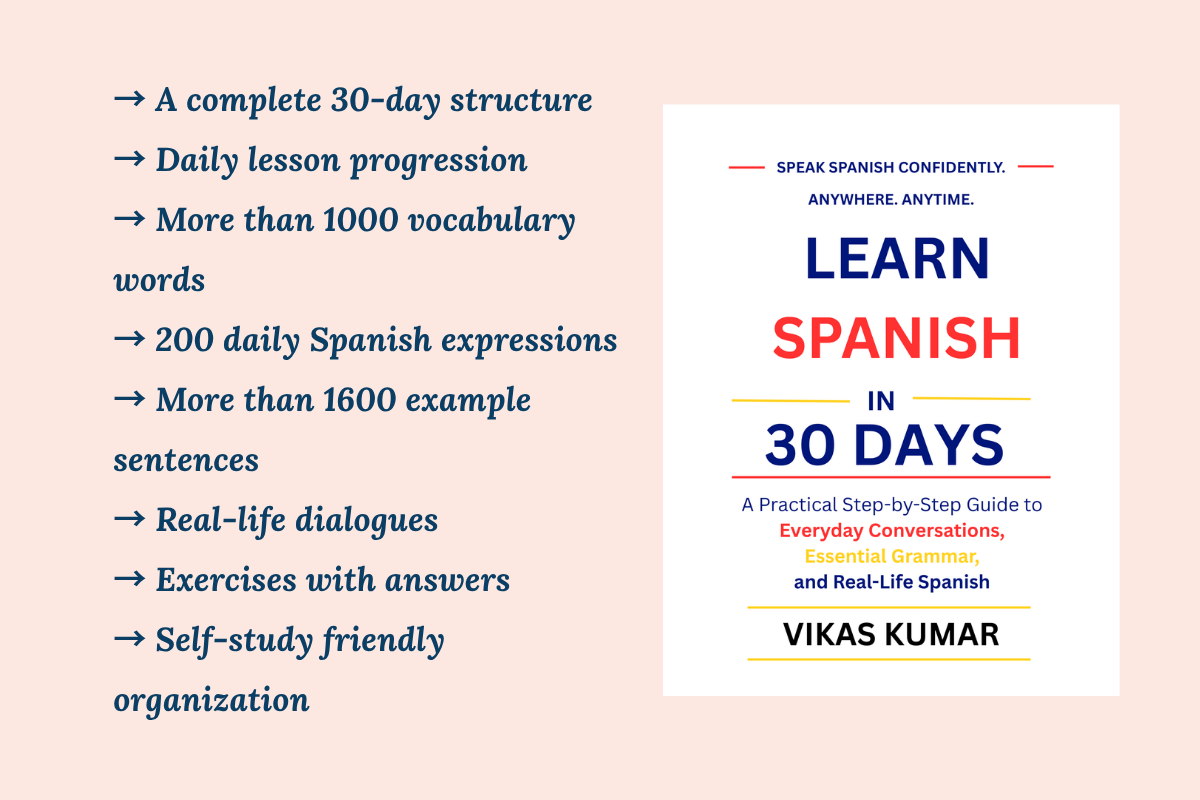
Learn Spanish in 30 Days includes:
→ A complete 30-day structure
→ Daily lesson progression
→ More than 1000 vocabulary words
→ 200 daily Spanish expressions
→ More than 1600 example sentences
→ Real-life dialogues
→ Exercises with answers
→ Self-study friendly organization
For learners who want a ready-made learning plan rather than creating their own schedule, Learn Spanish in 30 Days: A Complete Beginner’s Guide to Everyday Conversations provides a structured system designed specifically for beginner self-learners.
Conclusion
A structured 30-day Spanish beginner course schedule removes uncertainty and helps learners focus on steady progress.
When lessons, vocabulary, conversations, examples, and exercises are organized into a clear roadmap, learning becomes more manageable and more consistent.
Whether you are studying independently, preparing for travel, building a new skill, or returning to Spanish after a long break, following a structured learning plan can help you build a strong foundation and develop practical communication skills with confidence.

Vikas Kumar is the founder of My Language Classes, a language learning platform dedicated to helping learners develop practical communication skills in Spanish, Japanese, and English through comprehensive grammar guides, structured learning resources, books, and evidence-informed educational content.
At My Language Classes, we believe that successful language learning is built on clarity, consistency, meaningful practice, and a deep understanding of how languages work. Every article is carefully researched and created to simplify complex concepts, provide practical guidance, and help learners develop confidence through real-world communication.
Inspired by the principles behind How Language Learning Really Works, our mission is to make high-quality language learning accessible to learners around the world by providing accurate, trustworthy, and comprehensive resources that support lasting progress, lifelong learning, and meaningful communication.
Leave a Reply