

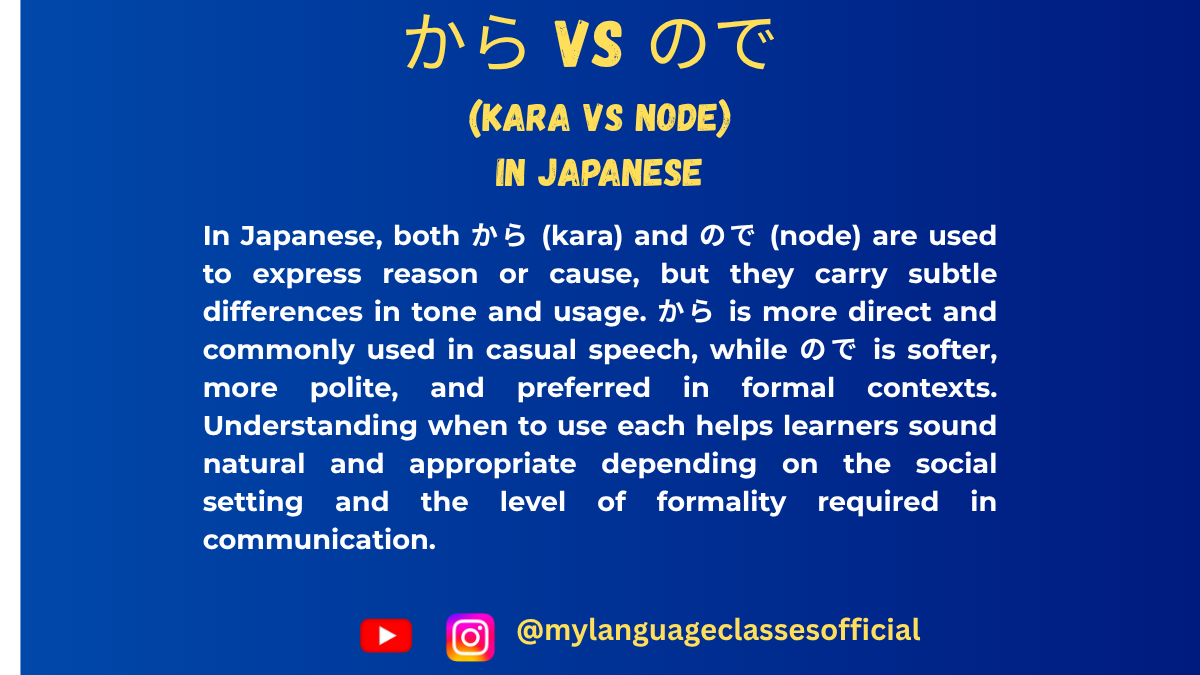
Because in Japanese: から (kara) vs. ので (node) can be confusing because both are commonly translated as “because” or “since,” yet they do not always express the same nuance. Both connect a reason to a result, but から often presents the reason more directly, while ので often gives the explanation in a softer and more explanatory way.
The difference is not limited to formality or politeness. Speaker attitude, context, and the relationship between the reason and the statement that follows can all influence the choice. Both patterns can be used after verbs and adjectives, while nouns and な-adjectives require different connecting forms.
For example, both sentences below can mean “I am not going because I am busy today.”
今日は忙しいから、行きません。
Kyō wa isogashii kara, ikimasen.
I am not going because I am busy today.
今日は忙しいので、行きません。
Kyō wa isogashii node, ikimasen.
I am not going because I am busy today.
The basic meaning is the same, but the tone is slightly different. The sentence with から states the speaker’s reason more directly. The sentence with ので sounds somewhat softer and more like an explanation of the situation.
You also need to understand how these expressions connect to different parts of speech. Verbs and い-adjectives connect differently from nouns and な-adjectives, and errors in these forms are common among learners.
For a structured explanation of these and other essential beginner grammar patterns, Mastering Japanese Grammar for JLPT N5 is available on My Language Classes website and on Amazon. This article will explain the meaning, grammar, differences, and natural use of から and ので so you can choose the right form with greater confidence.
What Do から (kara) and ので (node) Mean in Japanese?
Both から (kara) and ので (node) are important Japanese grammar patterns used to express a reason or cause. Depending on the context, both can be translated into English as “because,” “since,” or “so.”
The basic function of both expressions is to connect a reason with a result or statement.
Consider these two sentences:
寒いから、窓を閉めます。
Samui kara, mado o shimemasu.
Because it is cold, I will close the window.
寒いので、窓を閉めます。
Samui node, mado o shimemasu.
Because it is cold, I will close the window.
Both sentences express the same basic idea. The speaker is closing the window because of the cold weather.
However, から often presents the reason more directly. It can sound as if the speaker is clearly stating their own reason or conclusion. ので usually presents the reason in a softer, more explanatory way. In many everyday situations, the difference is subtle.
The meaning also depends on the context. Neither expression has a fixed English equivalent, and translating both simply as “because” can hide the difference in Japanese tone.
Consider another pair:
明日は休みだから、ゆっくりします。
Ashita wa yasumi da kara, yukkuri shimasu.
Because tomorrow is a day off, I will relax.
明日は休みなので、ゆっくりします。
Ashita wa yasumi na node, yukkuri shimasu.
Because tomorrow is a day off, I will relax.
Both sentences are grammatically correct and have the same basic meaning. The から sentence sounds more direct, while the ので sentence gives the reason in a softer manner.
At the most basic level, the difference can be understood this way:
→ から presents the reason more directly.
→ ので presents the reason more softly and explanatorily.
This distinction is useful, but it should not be treated as an absolute rule. The natural choice between から and ので can also depend on the relationship between the speaker and listener, the situation, and what the speaker wants the sentence to sound like.
How Do You Say “Because” in Japanese?
Japanese has several ways to express “because,” but から and ので are among the most important grammar patterns for explaining a reason. Both connect one part of a sentence with another, showing that the first part provides the reason for the second.
For example:
雨が降っているから、行きません。
Ame ga futte iru kara, ikimasen.
Because it is raining, I will not go.
雨が降っているので、行きません。
Ame ga futte iru node, ikimasen.
Because it is raining, I will not go.
Both sentences answer the same question:
→ Why are you not going?
The reason is that it is raining.
However, Japanese does not always choose a grammar pattern simply by translating the English word “because.” The speaker must also consider how the reason is being presented. A speaker may state a reason directly, explain a situation more softly, or choose a different expression based on the context.
This is why both から and ので can be translated as “because” in English while still having a difference in nuance.
Is There Only One Way to Say “Because” in Japanese?
No. Japanese has several expressions that can communicate a relationship of cause or reason. The appropriate expression depends on the meaning, grammar pattern, and context.
This article focuses specifically on:
→ から, which commonly gives a reason more directly
→ ので, which commonly gives a reason in a softer and more explanatory way
These patterns are used frequently in everyday Japanese and are essential for learners because they can appear in casual conversations, polite explanations, requests, and written communication.
How Do You Choose the Right Japanese Word for “Because”?
A useful starting point is to consider how you want to present the reason.
If you are stating your reason clearly and directly, から may be the natural choice:
疲れたから、寝ます。
Tsukareta kara, nemasu.
Because I am tired, I will sleep.
If you are giving the reason in a softer and more explanatory way, ので may be more natural:
疲れたので、寝ます。
Tsukareta node, nemasu.
Because I am tired, I will sleep.
The difference may seem small in a simple sentence. However, the choice can become more noticeable when the sentence involves a request, refusal, explanation, or other situation where tone matters.
The next step is to understand the central difference between から and ので before examining their individual grammar patterns.
What Is the Basic Difference Between から and ので?
The basic difference between から and ので is the way the speaker presents the reason. Both can connect a reason to a result, and in many situations, both can be translated as “because” in English. However, から often presents the reason more directly, while ので often sounds softer and more explanatory.
This difference can be seen by comparing the same situation.
時間がないから、タクシーで行きます。
Jikan ga nai kara, takushī de ikimasu.
Because I do not have time, I will go by taxi.
時間がないので、タクシーで行きます。
Jikan ga nai node, takushī de ikimasu.
Because I do not have time, I will go by taxi.
The basic message is the same. In the sentence with から, the speaker states the reason more directly. In the sentence with ので, the reason is presented more gently as an explanation of the situation.
How Is から More Direct?
から often creates a clearer sense that the speaker is presenting a reason for a decision, opinion, action, or conclusion. The speaker may be giving a personal reason and then showing the result that follows from it.
For example:
お腹がすいたから、何か食べます。
Onaka ga suita kara, nanika tabemasu.
Because I am hungry, I will eat something.
The sentence directly connects the speaker’s condition with their decision. The feeling of hunger is presented as the reason for eating.
This does not mean that から is always emotional, strong, or impolite. It is a very common and natural part of Japanese conversation. The directness simply refers to how clearly the speaker presents the reason as the basis for what follows.
How Is ので Softer and More Explanatory?
ので often presents the reason as an explanation of the circumstances. It can make the connection between the reason and the result sound less forceful.
For example:
お腹がすいたので、何か食べます。
Onaka ga suita node, nanika tabemasu.
Because I am hungry, I will eat something.
The meaning is almost identical to the から version. However, ので can sound more like an explanation of the situation rather than a direct statement of personal reasoning.
This tendency becomes especially useful in polite communication.
今日は予定があるので、参加できません。
Kyō wa yotei ga aru node, sanka dekimasen.
Because I have plans today, I cannot participate.
Here, ので gives a polite explanation for the refusal. Using から would still be grammatically correct:
今日は予定があるから、参加できません。
Kyō wa yotei ga aru kara, sanka dekimasen.
Because I have plans today, I cannot participate.
The から sentence is more direct, while the ので sentence sounds somewhat softer.
Are から and ので Always Different?
No. In many sentences, the difference is subtle, and either expression may sound natural.
For example:
明日は仕事があるから、早く寝ます。
Ashita wa shigoto ga aru kara, hayaku nemasu.
Because I have work tomorrow, I will go to bed early.
明日は仕事があるので、早く寝ます。
Ashita wa shigoto ga aru node, hayaku nemasu.
Because I have work tomorrow, I will go to bed early.
Both are natural Japanese. The choice changes the nuance more than the basic meaning.
The following comparison provides a useful general guide:
| から | ので |
|---|---|
| Often presents the reason more directly | Often presents the reason more softly |
| Can emphasize the speaker’s reasoning | Often sounds more explanatory |
| Common in casual and direct communication | Common in polite and explanatory contexts |
| Can naturally support requests and commands | Often sounds gentler in polite explanations |
These differences should be understood as general tendencies rather than fixed rules. The context, sentence ending, relationship between the speakers, and intended tone can all affect which form sounds more natural.
How Do You Use から (kara) in Japanese?
から is used to connect a reason to the statement, action, or result that follows. The basic meaning is usually “because” or “since.”
The most common pattern is:
→ Reason + から + result
For example:
雨が降っているから、行きません。
Ame ga futte iru kara, ikimasen.
Because it is raining, I will not go.
The first part of the sentence gives the reason. The second part shows the result or decision.
→ Reason: 雨が降っている, “It is raining”
→ Result: 行きません, “I will not go”
In everyday Japanese, the から clause often appears before the main result. This structure makes the reason clear before the speaker gives the conclusion.
Can から Be Used in Casual and Polite Japanese?
Yes. から can be used in both casual and polite Japanese. The expression itself does not make a sentence automatically casual or impolite.
Compare:
疲れたから、帰る。
Tsukareta kara, kaeru.
Because I am tired, I am going home.
疲れたから、帰ります。
Tsukareta kara, kaerimasu.
Because I am tired, I will go home.
The first sentence is casual because of the plain ending 帰る. The second sentence is polite because it uses 帰ります.
This is important because learners sometimes assume that から itself is less polite than ので. In reality, the overall level of politeness depends on the complete sentence.
For example:
時間がないから、急ぎます。
Jikan ga nai kara, isogimasu.
Because I do not have time, I will hurry.
This sentence is polite because the result uses 急ぎます. The reason is still presented directly through から.
Can から Be Used to Explain Personal Reasons?
Yes. から is especially natural when speakers clearly state the reason behind their own decision, opinion, or action.
For example:
日本語が好きだから、毎日勉強しています。
Nihongo ga suki da kara, mainichi benkyō shiteimasu.
Because I like Japanese, I study every day.
The speaker directly presents their personal reason for studying.
Another example:
明日は早いから、もう寝ます。
Ashita wa hayai kara, mō nemasu.
Because I have to get up early tomorrow, I will go to bed now.
Here, the speaker gives a direct explanation for their decision to sleep.
Can から Come After the Result?
Yes. In conversation, the reason can also appear after the main statement. This is common when the speaker gives the conclusion first and then adds the reason.
For example:
今日は行きません。忙しいから。
Kyō wa ikimasen. Isogashii kara.
I am not going today because I am busy.
In natural speech, Japanese speakers may add から after stating the main point. This can sound conversational and direct.
However, for learners, the basic structure is the easiest place to start:
→ Reason + から + result
The following sections explain how から connects to verbs, い-adjectives, nouns, and な-adjectives.
How Does から Follow Verbs?
When から is used to give a reason, it can follow a verb clause. The verb clause comes first, followed by から, and then the result or conclusion.
The basic pattern is:
→ Verb clause + から + result
For example:
雨が降っているから、行きません。
Ame ga futte iru kara, ikimasen.
Because it is raining, I will not go.
Here, 雨が降っている, “It is raining,” is the reason, and から connects it to the result, 行きません, “I will not go.”
What Verb Form Comes Before から?
When the reason clause comes before から, the verb normally appears in the plain form.
The plain-form pattern can include:
→ Dictionary form + から
→ Negative form + から
→ Past form + から
→ ている form + から
Examples:
時間があるから、手伝います。
Jikan ga aru kara, tetsudaimasu.
Because I have time, I will help.
The verb ある appears in its dictionary form before から.
時間がないから、今日は行きません。
Jikan ga nai kara, kyō wa ikimasen.
Because I do not have time, I will not go today.
The negative form ない comes before から.
電車が遅れたから、遅刻しました。
Densha ga okureta kara, chikoku shimashita.
Because the train was delayed, I was late.
The past form 遅れた comes before から because the reason occurred in the past.
今、勉強しているから、後で電話します。
Ima, benkyō shite iru kara, ato de denwa shimasu.
Because I am studying now, I will call you later.
The ている form describes an action in progress and is followed by から.
Can Polite Verb Forms Be Used Before から?
In everyday Japanese, the plain form is the standard and most common form before から.
→ 行くから
→ 行かないから
→ 行ったから
→ 行っているから
However, polite forms can also appear before から in certain formal or polite contexts.
For example:
時間がありませんから、今日は帰ります。
Jikan ga arimasen kara, kyō wa kaerimasu.
Because I do not have time, I will go home today.
This structure is grammatically correct and sounds polite. It is more formal than the plain-form version:
時間がないから、今日は帰ります。
Jikan ga nai kara, kyō wa kaerimasu.
Because I do not have time, I will go home today.
Both sentences are correct. The difference comes from the form of the verb before から and the overall tone of the sentence.
What Should You Remember About Verbs and から?
The main point is that the clause before から gives the reason for what follows.
For example:
明日は早く起きるから、もう寝ます。
Ashita wa hayaku okiru kara, mō nemasu.
Because I will wake up early tomorrow, I will go to bed now.
The reason is 明日は早く起きる, “I will wake up early tomorrow.” The result is もう寝ます, “I will go to bed now.”
The basic pattern is:
→ Verb clause expressing the reason + から + result
This pattern works with present, past, negative, and ongoing actions. Once you understand how から connects a verb clause to its result, you can apply the same basic logic to other parts of speech.
How Does から Follow い-Adjectives?
When から follows an い-adjective, the adjective normally connects directly to から. The final い remains unchanged.
The basic pattern is:
→ い-adjective + から + result
For example:
この本は面白いから、読んでください。
Kono hon wa omoshiroi kara, yonde kudasai.
Because this book is interesting, please read it.
The reason is:
→ この本は面白い, “This book is interesting.”
The result is:
→ 読んでください, “Please read it.”
The adjective 面白い connects directly to から:
→ 面白い + から
Does the Final い Change Before から?
No. In the plain affirmative form, the final い remains.
Examples:
この店は安いから、よく行きます。
Kono mise wa yasui kara, yoku ikimasu.
Because this store is cheap, I often go there.
今日は暑いから、窓を開けます。
Kyō wa atsui kara, mado o akemasu.
Because it is hot today, I will open the window.
The patterns are:
→ 安い + から
→ 暑い + から
The い-adjective does not need an additional particle or connecting form before から.
How Do Negative い-Adjectives Connect to から?
A negative い-adjective can also be followed directly by から.
For example:
今日は寒くないから、コートはいりません。
Kyō wa samukunai kara, kōto wa irimasen.
Because it is not cold today, I do not need a coat.
The negative form 寒くない connects directly to から:
→ 寒くない + から
Another example:
この問題は難しくないから、すぐできます。
Kono mondai wa muzukashikunai kara, sugu dekimasu.
Because this problem is not difficult, I can do it quickly.
The basic pattern remains the same. The adjective, whether affirmative or negative, comes directly before から.
Can い-Adjectives Be Used in Polite Forms Before から?
Yes. The plain form is common, but polite forms can also be used.
For example:
このホテルは高いから、泊まりません。
Kono hoteru wa takai kara, tomarimasen.
Because this hotel is expensive, I will not stay there.
This sentence uses the plain form 高い before から and a polite ending in the result.
A more formal structure is also possible:
このホテルは高いですから、泊まりません。
Kono hoteru wa takai desu kara, tomarimasen.
Because this hotel is expensive, I will not stay there.
The second version is more formal because the reason clause uses です.
For most everyday situations, learners should remember the basic structure:
→ い-adjective + から
Examples:
→ 忙しいから, “because I am busy”
→ 面白いから, “because it is interesting”
→ 高くないから, “because it is not expensive”
This pattern is different from nouns and な-adjectives, which require an additional form before から.
How Do You Use だから (dakara) After Nouns and な-Adjectives?
Nouns and な-adjectives do not connect directly to から when they express a reason in the same way that verbs and い-adjectives do. They normally use the form だ before から.
The basic patterns are:
→ Noun + だから + result
→ な-adjective + だから + result
This is because nouns and な-adjectives require the copula だ in the plain form before connecting to から.
How Does a Noun Connect to から?
When a noun gives the reason, the basic pattern is:
→ Noun + だから + result
For example:
日曜日だから、休みです。
Nichiyōbi da kara, yasumi desu.
Because it is Sunday, it is a day off.
The noun 日曜日, “Sunday,” becomes the reason for the result.
The connection is:
→ 日曜日 + だ + から
Another example is:
学生だから、毎日勉強しています。
Gakusei da kara, mainichi benkyō shiteimasu.
Because I am a student, I study every day.
Here, 学生, “student,” is a noun. It requires だ before から:
→ 学生だから
This is an important pattern to remember because using a noun directly before から is not the standard plain-form structure for this type of sentence.
How Does a な-Adjective Connect to から?
A な-adjective also normally uses だ before から in the plain form.
The basic pattern is:
→ な-adjective + だから + result
For example:
この部屋は静かだから、勉強しやすいです。
Kono heya wa shizuka da kara, benkyō shiyasui desu.
Because this room is quiet, it is easy to study here.
The な-adjective 静か, “quiet,” becomes:
→ 静か + だ + から
Another example is:
この町は便利だから、住みやすいです。
Kono machi wa benri da kara, sumiyasui desu.
Because this town is convenient, it is easy to live here.
The connection is:
→ 便利だから
What Is the Difference Between い-Adjectives and な-Adjectives Before から?
The difference is in the form that appears before から.
| Word Type | Structure |
|---|---|
| Verb | Verb clause + から |
| い-adjective | い-adjective + から |
| Noun | Noun + だから |
| な-adjective | な-adjective + だから |
For example:
寒いから、窓を閉めます。
Samui kara, mado o shimemasu.
Because it is cold, I will close the window.
静かだから、ここで勉強します。
Shizuka da kara, koko de benkyō shimasu.
Because it is quiet, I will study here.
寒い is an い-adjective, so it connects directly to から. 静か is a な-adjective, so だ appears before から.
Can You Use Polite Forms with Nouns and な-Adjectives Before から?
Yes. In polite or formal speech, ですから can be used instead of だから.
For example:
日曜日ですから、学校は休みです。
Nichiyōbi desu kara, gakkō wa yasumi desu.
Because it is Sunday, the school is closed.
この部屋は静かですから、勉強しやすいです。
Kono heya wa shizuka desu kara, benkyō shiyasui desu.
Because this room is quiet, it is easy to study here.
The basic distinction is:
→ だから is the plain-form connection.
→ ですから is a more polite or formal connection.
This completes the main grammar patterns for から. Verbs and い-adjectives can connect directly to から, while nouns and な-adjectives require だから in the standard plain-form pattern.
How Do You Use ので (node) in Japanese?
Like から, ので connects a reason to a result. It is commonly translated as “because” or “since,” but it often presents the reason in a softer and more explanatory way.
The basic pattern is:
→ Reason + ので + result
For example:
時間がないので、急ぎます。
Jikan ga nai node, isogimasu.
Because I do not have time, I will hurry.
The first part, 時間がない, gives the reason. The second part, 急ぎます, gives the action that follows from that reason.
In many sentences, ので and から can both be grammatically correct.
時間がないから、急ぎます。
Jikan ga nai kara, isogimasu.
Because I do not have time, I will hurry.
時間がないので、急ぎます。
Jikan ga nai node, isogimasu.
Because I do not have time, I will hurry.
The basic meaning remains the same. The ので version generally sounds softer and more explanatory.
Where Can ので Be Used?
ので is common in everyday Japanese, especially when a speaker wants to explain a situation politely or avoid sounding too direct. It can appear in conversations, polite explanations, apologies, refusals, and requests.
For example:
用事があるので、今日は行けません。
Yōji ga aru node, kyō wa ikemasen.
Because I have something to do, I cannot go today.
The speaker is explaining why they cannot attend. Using ので makes the explanation sound softer.
Consider another example:
体調が悪いので、今日は休みます。
Taichō ga warui node, kyō wa yasumimasu.
Because I do not feel well, I will take the day off.
This sentence gives the listener a reason for the speaker’s decision without presenting the reason too forcefully.
Is ので Only Used in Polite Japanese?
No. ので is not limited to polite Japanese. It can be used in casual, neutral, and polite contexts.
For example:
疲れたので、もう寝る。
Tsukareta node, mō neru.
Because I am tired, I am going to sleep now.
The sentence ending 寝る is casual, but ので is still used correctly.
A polite version is:
疲れたので、もう寝ます。
Tsukareta node, mō nemasu.
Because I am tired, I will go to sleep now.
The level of politeness comes from the overall sentence, including the verb ending and the situation. ので can contribute a softer tone, but it does not automatically make every sentence formal or polite.
How Is ので Different from から in Basic Use?
The basic grammar role is similar:
→ Reason + から + result
→ Reason + ので + result
The main difference is usually the way the reason is presented. から can sound like a more direct statement of the speaker’s reason, while ので can sound more like an explanation of the circumstances.
For example:
雨が降っているから、帰ります。
Ame ga futte iru kara, kaerimasu.
Because it is raining, I will go home.
雨が降っているので、帰ります。
Ame ga futte iru node, kaerimasu.
Because it is raining, I will go home.
Both sentences are natural. The から sentence presents the reason more directly. The ので sentence sounds somewhat softer and more explanatory.
How Does ので Follow Verbs?
When ので follows a verb, the verb clause provides the reason for the statement or result that follows. The basic structure is:
→ Verb clause + ので + result
For example:
用事があるので、今日は行けません。
Yōji ga aru node, kyō wa ikemasen.
Because I have something to do, I cannot go today.
The clause 用事がある, “I have something to do,” gives the reason. It is followed directly by ので.
What Verb Forms Can Come Before ので?
The reason clause before ので can use different verb forms depending on the meaning of the sentence.
It can include:
→ Dictionary form + ので
→ Negative form + ので
→ Past form + ので
→ ている form + ので
For example:
時間があるので、手伝います。
Jikan ga aru node, tetsudaimasu.
Because I have time, I will help.
The verb ある is in the dictionary form.
時間がないので、今日は行きません。
Jikan ga nai node, kyō wa ikimasen.
Because I do not have time, I will not go today.
The negative form ない comes before ので.
電車が遅れたので、遅刻しました。
Densha ga okureta node, chikoku shimashita.
Because the train was delayed, I was late.
The past form 遅れた comes before ので because the reason occurred in the past.
今、勉強しているので、後で電話します。
Ima, benkyō shite iru node, ato de denwa shimasu.
Because I am studying now, I will call you later.
The ている form 勉強している describes an action that is currently in progress.
Can Polite Verb Forms Be Used Before ので?
Yes. While the plain form is common, polite forms can also be used before ので.
For example:
時間がありませんので、今日は帰ります。
Jikan ga arimasen node, kyō wa kaerimasu.
Because I do not have time, I will go home today.
This version sounds more formal than:
時間がないので、今日は帰ります。
Jikan ga nai node, kyō wa kaerimasu.
Because I do not have time, I will go home today.
Both sentences are grammatically correct. The first uses the polite negative form ありません, while the second uses the plain negative form ない.
What Should You Remember About Verbs and ので?
The main pattern is:
→ Verb clause expressing the reason + ので + result
The verb can describe a present situation, a past event, a negative situation, or an action in progress. The clause before ので provides the reason for the statement or action that follows.
How Does ので Follow い-Adjectives?
When ので follows an い-adjective, the adjective normally connects directly to ので. The final い remains unchanged.
The basic pattern is:
→ い-adjective + ので + result
For example:
この問題は難しいので、時間がかかります。
Kono mondai wa muzukashii node, jikan ga kakarimasu.
Because this problem is difficult, it takes time.
The reason is:
→ この問題は難しい, “This problem is difficult.”
The い-adjective 難しい connects directly to ので.
Does the Final い Change Before ので?
No. The final い remains unchanged when the adjective is in the affirmative plain form.
For example:
今日は暑いので、窓を開けます。
Kyō wa atsui node, mado o akemasu.
Because it is hot today, I will open the window.
この店は安いので、よく行きます。
Kono mise wa yasui node, yoku ikimasu.
Because this store is inexpensive, I often go there.
The patterns are:
→ 暑い + ので
→ 安い + ので
The adjective does not need an additional connecting form before ので.
How Do Negative い-Adjectives Connect to ので?
A negative い-adjective can also be followed directly by ので.
For example:
今日は寒くないので、コートはいりません。
Kyō wa samukunai node, kōto wa irimasen.
Because it is not cold today, I do not need a coat.
The negative form 寒くない connects directly to ので:
→ 寒くない + ので
Another example is:
この問題は難しくないので、すぐできます。
Kono mondai wa muzukashikunai node, sugu dekimasu.
Because this problem is not difficult, I can do it quickly.
The basic structure remains the same. Whether the い-adjective is affirmative or negative, the adjective form comes directly before ので.
Can You Use Polite い-Adjective Forms Before ので?
Yes. A plain い-adjective is common before ので, but a polite form can also be used in formal contexts.
For example:
このホテルは高いので、泊まりません。
Kono hoteru wa takai node, tomarimasen.
Because this hotel is expensive, I will not stay there.
A more formal version is:
このホテルは高いですので、泊まりません。
Kono hoteru wa takai desu node, tomarimasen.
Because this hotel is expensive, I will not stay there.
For everyday grammar, the most useful pattern to remember is:
→ い-adjective + ので
Examples include:
→ 忙しいので, “because I am busy”
→ 面白いので, “because it is interesting”
→ 高くないので, “because it is not expensive”
This pattern differs from nouns and な-adjectives, which use な before ので.
Why Do Nouns and な-Adjectives Use な Before ので?
Nouns and な-adjectives do not connect directly to ので. They use な before ので, which creates the forms なので and なので. This is one of the most important grammar differences between から and ので.
The basic patterns are:
→ Noun + なので + result
→ な-adjective + なので + result
For example:
学生なので、毎日忙しいです。
Gakusei na node, mainichi isogashii desu.
Because I am a student, I am busy every day.
The noun 学生, “student,” connects to ので through な:
→ 学生 + な + ので
How Do Nouns Connect to ので?
When a noun gives the reason for a result, use the pattern:
→ Noun + なので + result
For example:
日曜日なので、学校は休みです。
Nichiyōbi na node, gakkō wa yasumi desu.
Because it is Sunday, the school is closed.
Another example:
日本人なので、日本語を話せます。
Nihonjin na node, Nihongo o hanasemasu.
Because I am Japanese, I can speak Japanese.
In these examples, the noun connects with な before ので.
How Do な-Adjectives Connect to ので?
A な-adjective follows the same pattern:
→ な-adjective + なので + result
For example:
この場所は便利なので、人気があります。
Kono basho wa benri na node, ninki ga arimasu.
Because this place is convenient, it is popular.
The な-adjective 便利, “convenient,” connects to ので through な:
→ 便利 + な + ので
Another example:
ここは静かなので、勉強しやすいです。
Koko wa shizuka na node, benkyō shiyasui desu.
Because it is quiet here, it is easy to study.
The connection is:
→ 静か + な + ので
Why Is な Required Before ので?
The form な connects nouns and な-adjectives to ので in the standard plain-form grammar pattern. It performs a role similar to the way だ appears before から.
Compare:
学生だから、毎日忙しいです。
Gakusei da kara, mainichi isogashii desu.
Because I am a student, I am busy every day.
学生なので、毎日忙しいです。
Gakusei na node, mainichi isogashii desu.
Because I am a student, I am busy every day.
With から:
→ Noun or な-adjective + だから
With ので:
→ Noun or な-adjective + なので
The same difference appears with な-adjectives:
この部屋は静かだから、勉強しやすいです。
Kono heya wa shizuka da kara, benkyō shiyasui desu.
Because this room is quiet, it is easy to study here.
この部屋は静かなので、勉強しやすいです。
Kono heya wa shizuka na node, benkyō shiyasui desu.
Because this room is quiet, it is easy to study here.
This structure should be learned as a fixed grammar pattern:
→ Verb + から or ので
→ い-adjective + から or ので
→ Noun or な-adjective + だから
→ Noun or な-adjective + なので
This pattern is essential for using から and ので correctly in Japanese.
What Is the Difference Between だから and なので?
だから and なので are both used after nouns and な-adjectives to explain a reason. They are closely related to から and ので, but they follow the grammar rules required by nouns and な-adjectives.
The basic difference follows the same general pattern:
→ だから presents the reason more directly.
→ なので presents the reason in a softer and more explanatory way.
How Are だから and なので Formed?
The basic structures are:
→ Noun + だから
→ な-adjective + だから
→ Noun + なので
→ な-adjective + なので
For example:
日曜日だから、休みです。
Nichiyōbi da kara, yasumi desu.
Because it is Sunday, it is a day off.
日曜日なので、休みです。
Nichiyōbi na node, yasumi desu.
Because it is Sunday, it is a day off.
Both sentences are grammatically correct. The first uses だから, while the second uses なので.
How Do だから and なので Differ in Tone?
The difference is generally similar to the difference between から and ので.
Consider these examples:
学生だから、毎日忙しいです。
Gakusei da kara, mainichi isogashii desu.
Because I am a student, I am busy every day.
学生なので、毎日忙しいです。
Gakusei na node, mainichi isogashii desu.
Because I am a student, I am busy every day.
The sentence with だから presents the reason more directly. The sentence with なので sounds more explanatory and somewhat softer.
The difference can be subtle. In many ordinary situations, both expressions are possible, and the basic meaning does not change.
How Do だから and なので Work with な-Adjectives?
The same difference applies when the reason contains a な-adjective.
For example:
この部屋は静かだから、勉強しやすいです。
Kono heya wa shizuka da kara, benkyō shiyasui desu.
Because this room is quiet, it is easy to study here.
この部屋は静かなので、勉強しやすいです。
Kono heya wa shizuka na node, benkyō shiyasui desu.
Because this room is quiet, it is easy to study here.
静か is a な-adjective, so the structures are:
→ 静か + だから
→ 静か + なので
Another example is:
この町は便利だから、住みやすいです。
Kono machi wa benri da kara, sumiyasui desu.
Because this town is convenient, it is easy to live here.
この町は便利なので、住みやすいです。
Kono machi wa benri na node, sumiyasui desu.
Because this town is convenient, it is easy to live here.
Can だから and なので Always Be Used Interchangeably?
In many simple sentences, either form can be used without changing the basic meaning. However, the choice can change the tone of the sentence.
The following table provides a useful general comparison:
| だから | なので |
|---|---|
| Connects nouns and な-adjectives to a reason | Connects nouns and な-adjectives to a reason |
| Often sounds more direct | Often sounds softer and more explanatory |
| Based on the から pattern | Based on the ので pattern |
| Common in direct explanations | Common in softer or more polite explanations |
The most important point is that the grammar pattern must match the word type.
→ Verb or い-adjective + から
→ Verb or い-adjective + ので
→ Noun or な-adjective + だから
→ Noun or な-adjective + なので
Is ので More Polite Than から?
ので is often described as more polite than から, but that explanation is too simple. A better way to understand the difference is that ので often sounds softer and more explanatory, especially when the speaker is giving a reason in a polite situation.
Both から and ので can appear in polite Japanese. The level of politeness depends on the whole sentence, including the verb form, the sentence ending, and the relationship between the speakers.
For example:
時間がないから、行けません。
Jikan ga nai kara, ikemasen.
Because I do not have time, I cannot go.
時間がないので、行けません。
Jikan ga nai node, ikemasen.
Because I do not have time, I cannot go.
Both sentences use the polite negative form 行けません. Therefore, both are polite sentences. However, the sentence with ので presents the reason more softly.
Does から Make a Sentence Impolite?
No. から does not make a sentence impolite. It is used naturally in polite conversations as well as casual conversations.
For example:
予定がありますから、先に帰ります。
Yotei ga arimasu kara, saki ni kaerimasu.
Because I have plans, I will leave first.
This sentence is polite because of the verb forms あります and 帰ります. The speaker is simply presenting the reason more directly.
Compare it with:
予定があるので、先に帰ります。
Yotei ga aru node, saki ni kaerimasu.
Because I have plans, I will leave first.
Both are natural. The ので version generally sounds like a softer explanation, while the から version states the reason more directly.
When Does ので Sound More Polite?
ので is especially common when a speaker wants to explain a situation without sounding too forceful. This can be useful when refusing something, giving an apology, or explaining an inconvenience.
For example:
申し訳ありませんが、今日は予定があるので、参加できません。
Mōshiwake arimasen ga, kyō wa yotei ga aru node, sanka dekimasen.
I am sorry, but because I have plans today, I cannot participate.
The reason is presented as a calm explanation of the circumstances.
A similar sentence with から is also possible:
申し訳ありませんが、今日は予定があるから、参加できません。
Mōshiwake arimasen ga, kyō wa yotei ga aru kara, sanka dekimasen.
I am sorry, but because I have plans today, I cannot participate.
However, から sounds more direct in this context. ので can make the explanation feel less personal and less forceful.
Does ので Always Sound Formal?
No. ので can be used in casual Japanese as well.
For example:
雨が降っているので、家にいる。
Ame ga futte iru node, ie ni iru.
Because it is raining, I am staying home.
The sentence ending いる is plain, so the sentence itself is casual. The use of ので gives the reason a softer tone, but it does not automatically make the entire sentence formal.
The same idea can be expressed with から:
雨が降っているから、家にいる。
Ame ga futte iru kara, ie ni iru.
Because it is raining, I am staying home.
The basic meaning remains the same. The difference is mainly in how the speaker presents the reason.
A useful rule to remember is:
→ ので often sounds softer and more explanatory.
→ から often presents the reason more directly.
→ Neither expression determines politeness by itself.
→ The entire sentence and communication context determine how polite or formal the expression sounds.
Is から More Direct or Personal Than ので?
から is often more direct or personal than ので because it can present the speaker’s own reason, judgment, or decision more clearly. However, this does not mean that から is always emotional or subjective. The difference depends on the context and the way the speaker is presenting the reason.
Consider these two sentences:
私は日本語が好きだから、毎日勉強しています。
Watashi wa Nihongo ga suki da kara, mainichi benkyō shiteimasu.
Because I like Japanese, I study every day.
私は日本語が好きなので、毎日勉強しています。
Watashi wa Nihongo ga suki na node, mainichi benkyō shiteimasu.
Because I like Japanese, I study every day.
Both sentences are grammatically correct and communicate the same basic meaning. The sentence with から sounds more like the speaker is directly giving their personal reason for studying. The sentence with ので presents the same information as a softer explanation.
How Does から Express a Speaker’s Personal Reason?
から is especially natural when a speaker explains why they made a decision or why they intend to do something.
For example:
疲れたから、今日は早く帰ります。
Tsukareta kara, kyō wa hayaku kaerimasu.
Because I am tired, I will go home early today.
The speaker is directly connecting their condition with their decision. The structure makes the reasoning clear:
→ I am tired.
→ Therefore, I will go home early.
Another example is:
お金がないから、買いません。
Okane ga nai kara, kaimasen.
Because I do not have money, I will not buy it.
Here, the speaker gives a direct reason for their decision.
How Does ので Present the Reason More Neutrally?
ので can present the reason as an explanation of the situation rather than as a strongly stated personal reason.
For example:
疲れたので、今日は早く帰ります。
Tsukareta node, kyō wa hayaku kaerimasu.
Because I am tired, I will go home early today.
The speaker is giving the same information, but the tone is softer.
Another example is:
道路が混んでいるので、電車で行きます。
Dōro ga konde iru node, densha de ikimasu.
Because the roads are crowded, I will go by train.
The reason is presented as a situation or circumstance that explains the speaker’s decision.
Is から Always Subjective and ので Always Objective?
No. This is another explanation that should not be treated as an absolute grammar rule.
から can be used with facts and objective situations:
雨が降っているから、試合は中止です。
Ame ga futte iru kara, shiai wa chūshi desu.
Because it is raining, the game is canceled.
Likewise, ので can be used to explain a speaker’s personal decision:
疲れたので、もう寝ます。
Tsukareta node, mō nemasu.
Because I am tired, I am going to bed now.
The difference is therefore better understood as a difference in how the speaker presents the reason.
→ から often states the reason more directly.
→ から can clearly express the speaker’s reasoning or personal motivation.
→ ので often presents the reason as a softer explanation of the circumstances.
→ The difference may be very subtle in many sentences.
For more advanced Japanese grammar study, Mastering Japanese Grammar for JLPT N4 is available on My Language Classes website and on Amazon.
Can から and ので Be Used Interchangeably?
In many Japanese sentences, から and ので can be used interchangeably without changing the basic meaning. Both can connect a reason to a result, and both may be translated as “because” in English.
However, interchangeable does not mean identical. When both forms are possible, the choice can affect how directly or softly the reason is presented.
Consider these two sentences:
明日は仕事があるから、早く寝ます。
Ashita wa shigoto ga aru kara, hayaku nemasu.
Because I have work tomorrow, I will go to bed early.
明日は仕事があるので、早く寝ます。
Ashita wa shigoto ga aru node, hayaku nemasu.
Because I have work tomorrow, I will go to bed early.
Both sentences are natural and grammatically correct. The first sentence states the reason more directly. The second presents the reason as a softer explanation.
When Can Both から and ので Be Used?
Both forms are often possible when the speaker is simply explaining a situation or giving a reason for an action.
For example:
今日は暑いから、窓を開けます。
Kyō wa atsui kara, mado o akemasu.
Because it is hot today, I will open the window.
今日は暑いので、窓を開けます。
Kyō wa atsui node, mado o akemasu.
Because it is hot today, I will open the window.
The basic meaning is the same in both sentences. The choice mainly affects the tone.
This also applies to explanations about past events:
電車が遅れたから、遅刻しました。
Densha ga okureta kara, chikoku shimashita.
Because the train was delayed, I was late.
電車が遅れたので、遅刻しました。
Densha ga okureta node, chikoku shimashita.
Because the train was delayed, I was late.
Both are grammatically correct. The ので version can sound more like an explanation of the circumstances.
When Is から More Natural?
から can be more natural when a speaker directly gives their reason for a decision, opinion, or action.
For example:
お腹がすいたから、何か食べます。
Onaka ga suita kara, nanika tabemasu.
Because I am hungry, I will eat something.
The speaker is directly explaining their reason for eating. ので is also possible, but から fits naturally with a direct statement of personal reasoning.
Another example is:
今日は疲れたから、出かけたくない。
Kyō wa tsukareta kara, dekaketakunai.
Because I am tired today, I do not want to go out.
This sentence gives a clear and direct reason for the speaker’s feeling.
When Is ので More Natural?
ので can be more natural when the speaker wants to explain a situation politely or soften the tone of the reason.
For example:
申し訳ありませんが、時間がないので、先に帰ります。
Mōshiwake arimasen ga, jikan ga nai node, saki ni kaerimasu.
I am sorry, but because I do not have time, I will leave first.
The speaker is explaining their situation in a polite way. The sentence with から would still be grammatically possible, but ので sounds softer in this context.
Another example is:
急用ができたので、会議に参加できません。
Kyūyō ga dekita node, kaigi ni sanka dekimasen.
Because an urgent matter came up, I cannot attend the meeting.
Here, ので presents the reason as an explanation of the circumstances.
How Does the Choice Change the Tone?
The following comparison provides a useful guide:
| Situation | から | ので |
|---|---|---|
| Direct personal reason | Often very natural | Also possible |
| Neutral explanation | Possible | Often natural |
| Polite explanation | Correct | Often sounds softer |
| Casual conversation | Very common | Also possible |
| Personal decision | Often natural | Possible with a softer tone |
| Explaining circumstances | Possible | Often natural |
These patterns are useful guidelines rather than fixed rules. Japanese speakers choose between から and ので based on the context and the tone they want to create.
The most reliable approach is to ask how you want to present the reason. If you want to state it more directly, から may be the natural choice. If you want to give a softer explanation of the situation, ので may be more natural.
Can You Use から and ので in Requests and Commands?
Both から and ので can be used when a sentence explains the reason for a request, instruction, or command. However, the choice can affect how directly the reason is presented.
A common pattern is:
→ Reason + から or ので + request or instruction
For example:
危ないから、触らないでください。
Abunai kara, sawaranaide kudasai.
Because it is dangerous, please do not touch it.
The reason, 危ない, “It is dangerous,” is presented directly before the request.
The same basic meaning can be expressed with ので:
危ないので、触らないでください。
Abunai node, sawaranaide kudasai.
Because it is dangerous, please do not touch it.
The ので version gives the reason in a softer, more explanatory way.
Is から Natural with Requests and Commands?
Yes. から is common when the speaker wants to clearly state the reason for a request, instruction, or command.
For example:
もう遅いから、早く寝てください。
Mō osoi kara, hayaku nete kudasai.
Because it is already late, please go to bed early.
The reason is stated directly, followed by the request.
Another example:
ここは危ないから、入らないで。
Koko wa abunai kara, hairanaide.
Because it is dangerous here, do not enter.
This is a direct and natural instruction. The use of から fits the clear connection between the reason and the command.
Does ので Make a Request Sound Softer?
It can. ので often makes the explanation of the reason sound less forceful, which can be useful in polite communication.
For example:
こちらは危険なので、入らないでください。
Kochira wa kiken na node, hairanaide kudasai.
Because this area is dangerous, please do not enter.
The request itself is polite because it uses 入らないでください. The use of ので presents the reason as a calm explanation of the situation.
Another example is:
明日は早いので、静かにしてください。
Ashita wa hayai node, shizuka ni shite kudasai.
Because I have to get up early tomorrow, please be quiet.
The speaker is explaining the circumstances before making the request.
Can ので Be Used with Direct Commands?
The same basic grammar pattern can be used, but context matters. ので often sounds more natural when the speaker is explaining a situation and then making a polite request or instruction.
For example:
雨が降っているので、傘を持って行ってください。
Ame ga futte iru node, kasa o motte itte kudasai.
Because it is raining, please take an umbrella with you.
The speaker first gives the reason and then makes a polite request.
Compare this with:
雨が降っているから、傘を持って行って。
Ame ga futte iru kara, kasa o motte itte.
Because it is raining, take an umbrella with you.
Both are natural. The first sounds like a polite explanation followed by a request. The second is more direct and conversational.
A useful general comparison is:
→ から often gives a direct reason before a request or command.
→ ので often gives a softer explanation before a request or instruction.
→ Both can be grammatically correct when the context supports the sentence.
→ The final choice depends on the relationship between the speakers and the tone of the complete sentence.
When Should You Use から Instead of ので?
Use から when you want to present a reason more directly. It is especially natural when you are explaining a personal decision, opinion, intention, or action. The speaker clearly states the reason and then gives the result.
For example:
お腹がすいたから、何か食べます。
Onaka ga suita kara, nanika tabemasu.
Because I am hungry, I will eat something.
The speaker’s feeling of hunger is directly connected to the decision to eat.
Another example is:
お金がないから、買いません。
Okane ga nai kara, kaimasen.
Because I do not have money, I will not buy it.
The speaker gives a clear reason for their decision.
When Is から Natural for Personal Decisions?
から is commonly used when the reason directly explains why the speaker plans to do something or why they made a particular choice.
For example:
日本語が好きだから、毎日勉強しています。
Nihongo ga suki da kara, mainichi benkyō shiteimasu.
Because I like Japanese, I study every day.
The speaker gives a personal reason for studying.
Another example:
明日は早いから、もう寝ます。
Ashita wa hayai kara, mō nemasu.
Because I have to get up early tomorrow, I will go to bed now.
The reason is presented directly, followed by the speaker’s decision.
Is から Common in Casual Conversation?
Yes. から is very common in casual Japanese and is often a natural choice when speakers explain their reasons directly.
For example:
疲れたから、今日は家にいる。
Tsukareta kara, kyō wa ie ni iru.
Because I am tired, I am staying home today.
The plain form いる makes the sentence casual, and から clearly connects the speaker’s condition to their decision.
Another example is:
この映画は面白いから、見て。
Kono eiga wa omoshiroi kara, mite.
Because this movie is interesting, watch it.
The speaker gives a direct reason for the request.
Can から Be Used in Polite Japanese?
Yes. から is not limited to casual speech. It can also be used in polite sentences.
For example:
時間がありませんから、先に帰ります。
Jikan ga arimasen kara, saki ni kaerimasu.
Because I do not have time, I will leave first.
A less formal version is:
時間がないから、先に帰ります。
Jikan ga nai kara, saki ni kaerimasu.
Because I do not have time, I will leave first.
Both sentences are grammatically correct. The first uses the polite form ありません before から, while the second uses the plain form ない.
As a general guide, から is a natural choice when:
→ You want to state a reason directly.
→ You are explaining a personal decision or action.
→ You are speaking in a casual or conversational context.
→ You want to create a clear connection between a reason and its result.
These are general tendencies rather than strict rules. ので can also be used in many of these situations, but から often makes the reason sound more direct.
When Should You Use ので Instead of から?
Use ので when you want to present a reason more softly and as an explanation of the situation. It is often a natural choice in polite communication, especially when explaining a refusal, apology, decision, or inconvenience.
For example:
今日は予定があるので、参加できません。
Kyō wa yotei ga aru node, sanka dekimasen.
Because I have plans today, I cannot participate.
The speaker is explaining why they cannot participate. The reason is presented as an explanation of the circumstances.
Another example is:
体調が悪いので、今日は休みます。
Taichō ga warui node, kyō wa yasumimasu.
Because I do not feel well, I will take the day off today.
Here, ので explains the situation that led to the speaker’s decision.
When Is ので Natural in Polite Explanations?
ので is commonly used when the speaker wants to give a reason without sounding overly direct. This is particularly useful when declining an invitation or explaining why something is not possible.
For example:
申し訳ありませんが、明日は仕事があるので、行けません。
Mōshiwake arimasen ga, ashita wa shigoto ga aru node, ikemasen.
I am sorry, but because I have work tomorrow, I cannot go.
The phrase 申し訳ありませんが already creates a polite tone, and ので continues the explanation in a soft manner.
A similar sentence with から is also possible:
申し訳ありませんが、明日は仕事があるから、行けません。
Mōshiwake arimasen ga, ashita wa shigoto ga aru kara, ikemasen.
I am sorry, but because I have work tomorrow, I cannot go.
Both sentences are grammatically correct. The ので version generally sounds less direct.
Is ので Useful When Explaining Circumstances?
Yes. ので is often natural when the reason is presented as a circumstance that explains what follows.
For example:
電車が遅れているので、少し遅れます。
Densha ga okurete iru node, sukoshi okuremasu.
Because the train is delayed, I will be a little late.
The speaker is explaining the circumstances that caused the delay.
Another example is:
今日は雨なので、試合は中止です。
Kyō wa ame na node, shiai wa chūshi desu.
Because it is rainy today, the game is canceled.
However, there is an important grammar point here. 雨 is a noun, so the natural form is 雨なので, not 雨ななので. The pattern is:
→ Noun + なので
This gives:
→ 雨なので
The same pattern applies to な-adjectives:
→ 静かなので
→ 便利なので
Can ので Be Used in Casual Japanese?
Yes. ので is not limited to formal situations. It can also be used in casual speech when the speaker wants to present a reason in a softer or more explanatory way.
For example:
明日早いので、もう寝る。
Ashita hayai node, mō neru.
Because I have to get up early tomorrow, I am going to sleep now.
The sentence ending 寝る is casual. The use of ので affects the tone of the reason, but it does not make the entire sentence formal.
As a general guide, ので is a natural choice when:
→ You want to give a softer explanation for a decision.
→ You are explaining why something is not possible.
→ You are giving a reason in a polite situation.
→ You want to present the reason as part of the circumstances.
→ You want to avoid sounding more direct than the situation requires.
These are general usage patterns rather than strict rules. から can also be used in many of the same situations, but the tone of the explanation may become more direct.
Common Mistakes with から (kara) and ので (node)
The most common mistakes with から and ので involve using the wrong form after nouns and な-adjectives, treating ので as automatically formal, or assuming that both expressions always have exactly the same nuance.
Mistake 1: Using a Noun Directly Before から
A noun does not normally connect directly to から when expressing a reason.
Incorrect:
学生から、毎日勉強しています。
Gakusei kara, mainichi benkyō shiteimasu.
Because I am a student, I study every day.
Correct:
学生だから、毎日勉強しています。
Gakusei da kara, mainichi benkyō shiteimasu.
Because I am a student, I study every day.
Use:
→ Noun + だから
The same pattern applies to な-adjectives:
Incorrect:
この部屋は静かから、勉強しやすいです。
Kono heya wa shizuka kara, benkyō shiyasui desu.
Because this room is quiet, it is easy to study here.
Correct:
この部屋は静かだから、勉強しやすいです。
Kono heya wa shizuka da kara, benkyō shiyasui desu.
Because this room is quiet, it is easy to study here.
Mistake 2: Using だ Before ので
Nouns and な-adjectives use な before ので, not だ.
Incorrect:
学生だので、毎日忙しいです。
Gakusei da node, mainichi isogashii desu.
Because I am a student, I am busy every day.
Correct:
学生なので、毎日忙しいです。
Gakusei na node, mainichi isogashii desu.
Because I am a student, I am busy every day.
The same rule applies to な-adjectives:
Incorrect:
静かだので、よく勉強できます。
Shizuka da node, yoku benkyō dekimasu.
Because it is quiet, I can study well.
Correct:
静かなので、よく勉強できます。
Shizuka na node, yoku benkyō dekimasu.
Because it is quiet, I can study well.
Remember:
→ Noun or な-adjective + だから
→ Noun or な-adjective + なので
Mistake 3: Adding な Before a Noun That Is Already Followed by なので
The form なので already contains the required な. Do not add another な.
Incorrect:
雨ななので、試合は中止です。
Ame na na node, shiai wa chūshi desu.
Because it is raining, the game is canceled.
Correct:
雨なので、試合は中止です。
Ame na node, shiai wa chūshi desu.
Because of the rain, the game is canceled.
The structure is:
→ 雨 + な + ので
Therefore, the final form is 雨なので.
Mistake 4: Thinking ので Is Always More Polite Than から
Both から and ので can appear in polite sentences.
For example:
時間がないから、行けません。
Jikan ga nai kara, ikemasen.
Because I do not have time, I cannot go.
時間がないので、行けません。
Jikan ga nai node, ikemasen.
Because I do not have time, I cannot go.
Both sentences use the polite form 行けません. The difference is mainly in how the reason is presented.
→ から often sounds more direct.
→ ので often sounds softer and more explanatory.
Politeness depends on the entire sentence, not only on the choice between から and ので.
Mistake 5: Treating から and ので as Completely Identical
In many sentences, both expressions can be used without changing the basic meaning. However, they do not always create exactly the same tone.
For example:
疲れたから、今日は早く帰ります。
Tsukareta kara, kyō wa hayaku kaerimasu.
Because I am tired, I will go home early today.
疲れたので、今日は早く帰ります。
Tsukareta node, kyō wa hayaku kaerimasu.
Because I am tired, I will go home early today.
The basic meaning is the same, but から gives the reason more directly, while ので presents it as a softer explanation.
Mistake 6: Using the Wrong Form After Different Word Types
A simple comparison helps prevent many errors:
| Word Type | With から | With ので |
|---|---|---|
| Verb | 行くから | 行くので |
| い-adjective | 寒いから | 寒いので |
| Noun | 学生だから | 学生なので |
| な-adjective | 静かだから | 静かなので |
This is the main grammar pattern to remember:
→ Verbs connect directly to から and ので.
→ い-adjectives connect directly to から and ので.
→ Nouns use だから and なので.
→ な-adjectives use だから and なので.
How Can You Choose Between から and ので?
When you need to choose between から and ので, first check the grammar pattern. Then consider the tone you want to create. The choice is often straightforward once you separate these two decisions.
Step 1: Check What Comes Before the Expression
The first step is to identify the word type.
→ Verb + から / ので
行くから
Iku kara
Because I will go.
行くので
Iku node
Because I will go.
→ い-adjective + から / ので
暑いから
Atsui kara
Because it is hot.
暑いので
Atsui node
Because it is hot.
→ Noun + だから / なので
学生だから
Gakusei da kara
Because I am a student.
学生なので
Gakusei na node
Because I am a student.
→ な-adjective + だから / なので
静かだから
Shizuka da kara
Because it is quiet.
静かなので
Shizuka na node
Because it is quiet.
This grammar check should come first. You cannot choose the correct expression without identifying what comes before it.
Step 2: Decide How Directly You Want to State the Reason
After choosing the correct grammar form, consider how you want to present the reason.
Use から or だから when you want to state the reason more directly.
Use ので or なので when you want the reason to sound softer and more explanatory.
For example:
疲れたから、今日は休みます。
Tsukareta kara, kyō wa yasumimasu.
Because I am tired, I will take the day off today.
疲れたので、今日は休みます。
Tsukareta node, kyō wa yasumimasu.
Because I am tired, I will take the day off today.
Both sentences are correct. The first presents the reason more directly. The second gives the reason in a softer way.
Step 3: Consider the Situation
If you are speaking casually and directly, から is often a natural choice.
For example:
時間がないから、もう行く。
Jikan ga nai kara, mō iku.
Because I do not have time, I am leaving now.
If you are giving an explanation, especially in a polite situation, ので may be a natural choice.
時間がないので、先に失礼します。
Jikan ga nai node, saki ni shitsurei shimasu.
Because I do not have time, I will leave first.
This does not mean that から is always casual or that ので is always polite. Both expressions can be used in casual and polite Japanese.
A Simple Decision Guide
A practical way to choose is:
→ Is the reason based on a verb or い-adjective? Use から or ので.
→ Is the reason based on a noun or な-adjective? Use だから or なので.
→ Do you want to present the reason more directly? Choose から or だから.
→ Do you want to give the reason as a softer explanation? Choose ので or なので.
→ Is the sentence polite? Check the politeness of the entire sentence, not only から or ので.
With regular exposure to natural Japanese, choosing between these forms becomes easier. The grammar pattern gives you the correct structure, while the context helps you choose the most appropriate nuance.
Key Takeaway
→ Both から (kara) and ので (node) express a reason or cause and are commonly translated as “because” or “since.”
→ から generally presents the reason more directly.
→ ので generally presents the reason in a softer and more explanatory way.
→ Verbs connect directly to から and ので.
→ い-adjectives also connect directly to から and ので.
→ Nouns use だから with から and なので with ので.
→ な-adjectives use だから with から and なので with ので.
→ だから is formed from だ + から.
→ なので is formed from な + ので.
→ Both から and ので can be used in casual and polite Japanese.
→ The choice between them does not determine politeness by itself.
→ から is often natural when giving a direct reason for a personal decision, opinion, action, or request.
→ ので is often natural when giving a softer explanation of circumstances, especially in refusals, apologies, and polite communication.
→ In many situations, both forms are grammatically correct, and the difference is mainly in nuance.
→ Choosing the correct form first depends on the word type that comes before the expression.
Conclusion
Because in Japanese can be expressed with both から (kara) and ので (node), but choosing between them requires more than translating the English word “because.” Both expressions connect a reason to a result, while their grammar patterns and nuances differ.
The first step is to identify the word type before the expression. Verbs and い-adjectives connect directly to から or ので. Nouns and な-adjectives use だから or なので.
The second step is to consider how the reason is being presented. から generally states a reason more directly and is often natural when explaining a personal decision, opinion, or action. ので usually presents the reason as a softer explanation and is often useful when explaining circumstances, giving a refusal, or speaking in a situation where a less direct tone is appropriate.
Both expressions are common in natural Japanese, and neither one is automatically casual, formal, or polite. The complete sentence and the situation determine the overall level of politeness. In many sentences, both から and ので are grammatically possible, with the main difference appearing in the tone and nuance.
For a deeper understanding of essential Japanese grammar from beginner to upper-intermediate levels, Mastering Japanese Grammar for JLPT N5, N4, N3, and N2 provides structured lessons on the grammar patterns learners need at each JLPT level.

Vikas Kumar is the founder of My Language Classes, a language learning platform dedicated to helping learners develop practical communication skills in Spanish, Japanese, and English through comprehensive grammar guides, structured learning resources, books, and evidence-informed educational content.
At My Language Classes, we believe that successful language learning is built on clarity, consistency, meaningful practice, and a deep understanding of how languages work. Every article is carefully researched and created to simplify complex concepts, provide practical guidance, and help learners develop confidence through real-world communication.
Inspired by the principles behind How Language Learning Really Works, our mission is to make high-quality language learning accessible to learners around the world by providing accurate, trustworthy, and comprehensive resources that support lasting progress, lifelong learning, and meaningful communication.
Leave a Reply