

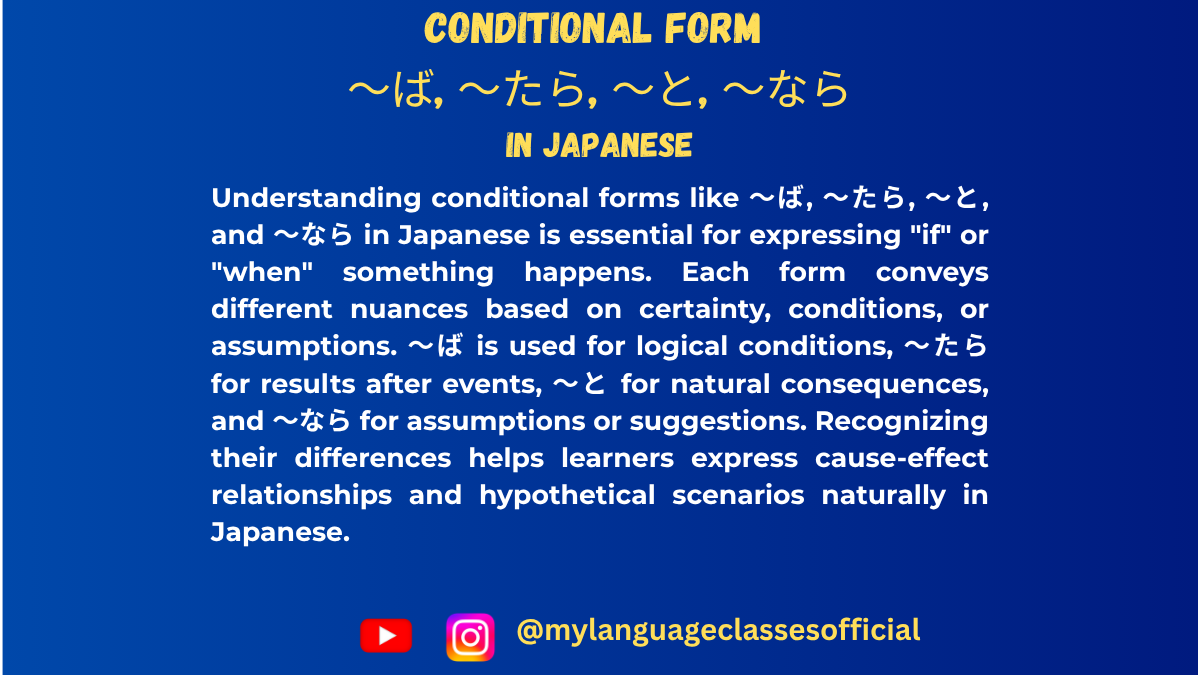
Japanese Conditional Forms: 〜ば, 〜たら, 〜と, 〜なら Explained
In Japanese, conditional and hypothetical sentences are commonly expressed using four key grammatical structures: 〜ば, 〜たら, 〜と, and 〜なら. Each has unique nuances and appropriate usage contexts. In this article, Japanese conditional forms ば ,たら, と, なら is explained.
1. 〜ば (Ba-form)
Usage:
- Expresses general conditions and hypothetical situations.
- Often used in formal speech and writing.
- Cannot be used for past events.
- Cannot be used with volitional expressions (e.g., requests, invitations).
Formation:
| Verb Type | Formation |
|---|---|
| Ichidan (る-verbs) | Drop る + れば (e.g., 食べる → 食べれば) |
| Godan (う-verbs) | Change last う-row syllable to え-row + ば (e.g., 行く → 行けば) |
| Adjectives (い-adj.) | Drop い + ければ (e.g., 安い → 安ければ) |
| Nouns/な-adjectives | + ならば (e.g., 便利ならば) |
Examples:
- 早く行けば、電車に間に合いますよ。(If you go early, you will catch the train.)
- お金があれば、旅行したいです。(If I have money, I want to travel.)
- 静かであれば、勉強しやすいです。(If it is quiet, it is easy to study.)
2. 〜たら (Tara-form)
Usage:
- Used for general conditions, past conditions, and hypothetical situations.
- Can be used in past, present, or future contexts.
- Can be used with volitional expressions (e.g., requests, invitations).
Formation:
| Word Type | Formation |
| Verbs (Past た-form + ら) | 飲む → 飲んだら |
| い-adjectives | 楽しい → 楽しかったら |
| な-adjectives / Nouns | 簡単だ → 簡単だったら |
Examples:
- 雨が降ったら、家にいます。(If it rains, I will stay home.)
- お金があったら、旅行に行きたいです。(If I had money, I would travel.)
- 暇だったら、手伝ってください。(If you are free, please help.)
3. 〜と (To-form)
Usage:
- Expresses natural consequences, habitual results, and general truths.
- Does not express personal volition or future uncertainty.
- Common in proverbs and scientific facts.
Formation:
| Word Type | Formation |
| Verbs (Dictionary form + と) | 行く → 行くと |
| い-adjectives | 高い → 高いと |
| な-adjectives / Nouns | 便利だ → 便利だと |
Examples:
- 春になると、桜が咲きます。(When spring comes, cherry blossoms bloom.)
- このボタンを押すと、ドアが開きます。(If you press this button, the door will open.)
- 夜になると、気温が下がります。(When it becomes night, the temperature drops.)
4. 〜なら (Nara-form)
Usage:
- Used for assumptions, recommendations, and contextual conditions.
- Often used in conversations.
- Used when giving advice or referring to prior information.
Formation:
| Word Type | Formation |
| Verbs (Dictionary form + なら) | 行く → 行くなら |
| い-adjectives | 面白い → 面白いなら |
| な-adjectives / Nouns | 簡単だ → 簡単なら |
Examples:
- 日本に行くなら、京都を訪れるべきです。(If you go to Japan, you should visit Kyoto.)
- お金がないなら、アルバイトをしたほうがいい。(If you don’t have money, you should get a part-time job.)
- 映画を見るなら、ポップコーンを買いましょう。(If we’re watching a movie, let’s buy popcorn.)
5. Comparison Table: 〜ば vs. 〜たら vs. 〜と vs. 〜なら
| Condition Type | 〜ば | 〜たら | 〜と | 〜なら |
| General Conditions | ✅ | ✅ | ✅ | ✅ |
| Hypothetical Situations | ✅ | ✅ | ❌ | ✅ |
| Past Situations | ❌ | ✅ | ❌ | ✅ |
| Natural Consequences | ❌ | ❌ | ✅ | ❌ |
| Volitional Expressions | ❌ | ✅ | ❌ | ✅ |
| Recommendations/Advice | ❌ | ❌ | ❌ | ✅ |
6. Situations Where They Are Used
| Situation | Example | Best Form |
| If it rains, I will stay home. | 雨が降ったら、家にいます。 | 〜たら |
| If you push this button, the door will open. | このボタンを押すと、ドアが開きます。 | 〜と |
| If I had money, I would travel. | お金があれば、旅行したい。 | 〜ば |
| If you are free, please help me. | 暇だったら、手伝ってください。 | 〜たら |
| If you go to Japan, you should visit Kyoto. | 日本に行くなら、京都を訪れるべきです。 | 〜なら |
| If you don’t study, you will fail the exam. | 勉強しないと、試験に落ちる。 | 〜と |
Conclusion
Each of these conditional forms—〜ば, 〜たら, 〜と, and 〜なら—has its specific nuances and contexts. By mastering these distinctions, learners can express conditional and hypothetical ideas naturally and accurately in Japanese. Understanding when to use each structure will significantly improve fluency and comprehension.
Happy learning! 😊

Vikas Kumar is the founder of My Language Classes, a language learning platform dedicated to helping learners develop practical communication skills in Spanish, Japanese, and English through comprehensive grammar guides, structured learning resources, books, and evidence-informed educational content.
At My Language Classes, we believe that successful language learning is built on clarity, consistency, meaningful practice, and a deep understanding of how languages work. Every article is carefully researched and created to simplify complex concepts, provide practical guidance, and help learners develop confidence through real-world communication.
Inspired by the principles behind How Language Learning Really Works, our mission is to make high-quality language learning accessible to learners around the world by providing accurate, trustworthy, and comprehensive resources that support lasting progress, lifelong learning, and meaningful communication.
Leave a Reply