
Learn Spanish in 30 Days Book searches are often made by people who have a specific goal in mind. They are not usually looking to pass an exam or study Spanish academically. Instead, they want to communicate while traveling, interact more confidently at work, and participate in everyday conversations.
For these learners, choosing the right resource matters. A practical Spanish learning book should help learners understand how the language is used in real situations rather than presenting isolated information without context.
For learners looking for a complete communication-focused learning system, Learn Spanish in 30 Days is available as an eBook on the My Language Classes website and on Amazon in Kindle, paperback, and hardcover formats. The book is designed to help beginners build practical communication skills through structured lessons, vocabulary development, conversations, dialogues, and exercises.
This article explores what makes a Learn Spanish in 30 Days Book suitable for travel, work, and daily conversations and why practical communication should be a priority for many learners.
Why Most Learners Want Practical Spanish Rather Than Academic Spanish
Most beginners learn Spanish because they want to use it.
Their goals are often connected to real-life situations rather than formal language study.
Communicating While Traveling
Travelers often want to ask questions, understand directions, order food, check into hotels, and interact confidently with local people.
Practical communication skills make these experiences smoother and more enjoyable.
Using Spanish in Professional Settings
Professionals may encounter Spanish-speaking colleagues, customers, clients, or business partners.
Even basic communication skills can help improve interactions and confidence.
Handling Everyday Conversations
Many learners want to talk about themselves, ask questions, respond naturally, and understand common expressions.
These are the communication skills that support everyday interactions.
Building Confidence in Real Situations
Language learning becomes more rewarding when learners can apply what they study immediately.
Real-world usage often creates stronger motivation and engagement.
What Should a Learn Spanish in 30 Days Book Include for Real-Life Communication?
Not every Spanish learning resource is designed around practical communication.
Certain features are especially important for learners who want to use Spanish in real situations.
Everyday Vocabulary
A useful vocabulary foundation allows learners to understand and express common ideas.
Common Expressions and Responses
Daily communication depends heavily on expressions that appear repeatedly in conversations.
Real-Life Dialogues
Dialogues demonstrate how Spanish works naturally between speakers.
Practical Example Sentences
Examples help learners understand how vocabulary and sentence patterns are used.
Conversation Practice
Communication improves when learners see and practice realistic interactions.
Structured Learning Progression
A clear roadmap helps learners build skills gradually without becoming overwhelmed.
These are some of the reasons why Learn Spanish in 30 Days: A Complete Beginner’s Guide to Everyday Conversations is designed as a practical learning system rather than simply a collection of lessons.
How Learn Spanish in 30 Days Supports Travel Communication
Travel is one of the most common reasons people begin learning Spanish.
The book includes concepts and communication patterns that can support a wide range of travel situations.
Greetings and Introductions
Introducing yourself and understanding common greetings are essential skills for travelers.
The book begins by building these foundations.
Asking for Directions
Understanding directions and asking for help are practical communication skills that travelers frequently need.
Shopping and Payments
Many travel interactions involve purchases, requests, and basic exchanges.
The book helps learners become familiar with these communication patterns.
Hotels and Accommodation
Accommodation-related conversations often require practical vocabulary and question forms.
Restaurants and Food Ordering
Food-related interactions are among the most common travel experiences.
Understanding everyday communication supports smoother interactions.
General Travel Conversations
The combination of vocabulary, expressions, examples, and dialogues helps learners prepare for a variety of situations they may encounter while traveling.
How Learn Spanish in 30 Days Supports Workplace Communication
Many professionals learn Spanish to improve communication opportunities.
While beginners are not expected to conduct complex business discussions immediately, practical communication skills still provide value.
Introducing Yourself Professionally
The ability to present basic information about yourself can be useful in professional environments.
Basic Workplace Conversations
Simple workplace interactions often involve greetings, questions, and common exchanges.
Communicating With Colleagues
Basic Spanish can help create more comfortable interactions with Spanish-speaking coworkers.
Understanding Common Questions and Responses
Many workplace conversations rely on frequently used communication patterns.
Building Communication Confidence
Confidence often grows as learners become familiar with common expressions and sentence structures.
The structured approach used throughout the book supports this gradual development.
Learn Spanish in 30 Days and Everyday Conversations
Everyday communication is where most learners use Spanish most frequently.
Talking About Yourself
Learners build the ability to discuss personal information, interests, and daily activities.
Talking About Daily Activities
Daily routines provide useful opportunities to practice communication.
Asking and Answering Questions
Questions and responses form the foundation of many conversations.
Expressing Preferences and Opinions
Communicating preferences helps learners participate more actively in conversations.
Participating in Social Conversations
The combination of vocabulary, expressions, and dialogues supports everyday interactions.
This communication-focused approach is one of the strengths of Learn Spanish in 30 Days: A Complete Beginner’s Guide to Everyday Conversations, helping learners move beyond isolated study and toward practical usage.
Features That Make This Book Practical for Real-Life Use
Several features contribute to the book’s focus on practical communication.
1000+ Vocabulary Words With Meanings and Examples
Vocabulary is presented with context, examples, and translations.
This supports both understanding and retention.
200 Daily Spanish Expressions
Common expressions provide useful language that learners can apply immediately.
More Than 1600 Example Sentences
Repeated exposure to examples helps learners recognize patterns and understand usage.
Real-Life Dialogues
Dialogues demonstrate natural communication in realistic situations.
Exercises With Answers
Exercises reinforce understanding and support independent learning.
Four-Week Learning Roadmap
The structured progression helps learners develop communication skills gradually and consistently.
Together, these features create a practical learning experience that supports real-world communication goals.
Why This Learn Spanish in 30 Days Book Works Well for Self-Learners
Many learners prefer studying independently.
The book includes several features that support self-study success.
Daily Lesson Structure
Clear lesson organization helps learners stay focused.
Clear Explanations
Concepts are presented in an accessible and beginner-friendly way.
English Translations Throughout
Translations support comprehension and reduce confusion.
Independent Learning Support
Exercises and dialogues help learners practice without requiring constant guidance.
Flexible Study Schedule
The learning system allows learners to study at a pace that suits their schedule.
Who Can Benefit Most From This Book?
Travelers
Travelers gain useful communication skills that can support real-world interactions abroad.
Working Professionals
Professionals benefit from communication-focused learning that supports practical usage.
Students
Students can use the book as a structured self-study resource.
Self-Learners
Independent learners benefit from having a complete learning system in one place.
Complete Beginners
The structured roadmap is designed specifically for beginners.
Learners Returning to Spanish
Those who studied Spanish previously can use the book to rebuild and strengthen their foundation.
What Results Can You Expect After 30 Days?
Consistent study can help learners build meaningful beginner-level skills.
Realistic outcomes include:
→ Better vocabulary knowledge
→ Greater communication confidence
→ Improved understanding of common expressions
→ Ability to participate in simple conversations
→ Better preparation for travel situations
→ Stronger everyday communication skills
The goal is not complete fluency but a practical foundation that supports continued growth.
Is Learn Spanish in 30 Days the Right Choice for Travel, Work, and Daily Conversations?
When evaluating a Learn Spanish in 30 Days Book, practical communication should be a major consideration.
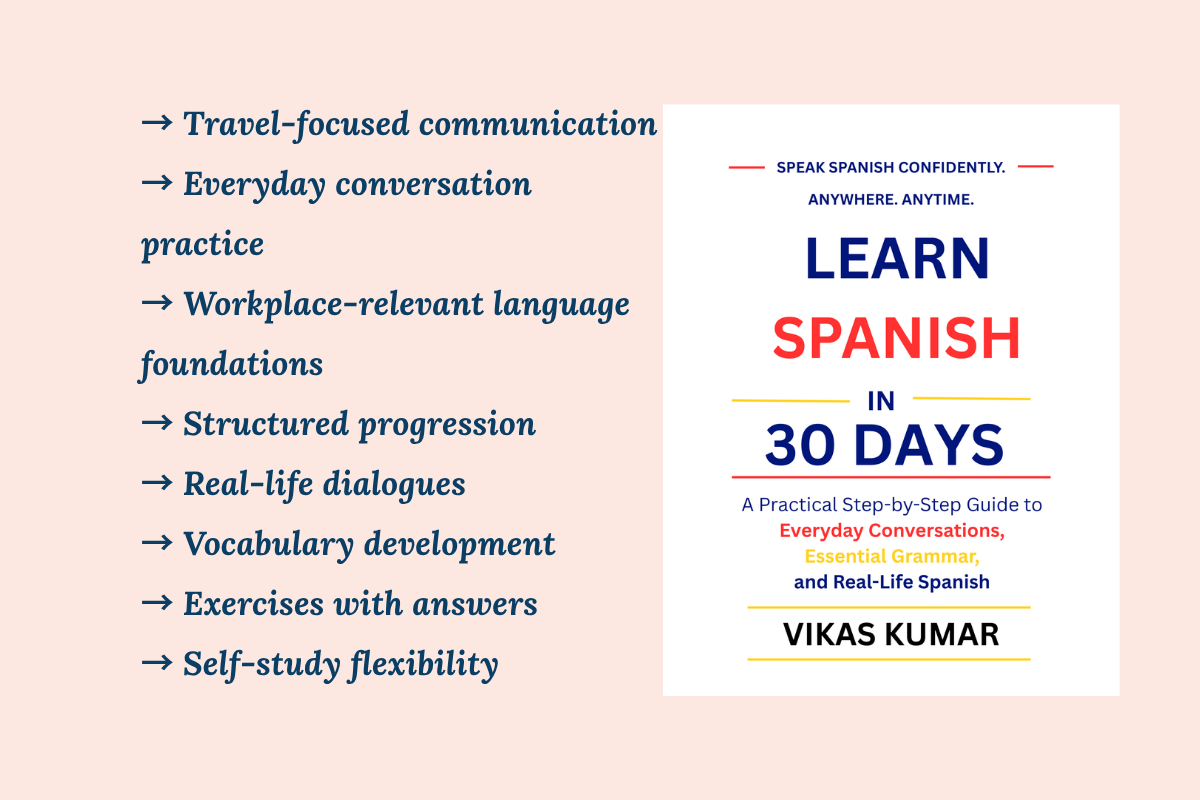
Learn Spanish in 30 Days combines:
→ Travel-focused communication
→ Everyday conversation practice
→ Workplace-relevant language foundations
→ Structured progression
→ Real-life dialogues
→ Vocabulary development
→ Exercises with answers
→ Self-study flexibility
For learners whose primary goal is practical communication, Learn Spanish in 30 Days: A Complete Beginner’s Guide to Everyday Conversations provides a structured and beginner-friendly system that supports travel, work, and everyday interactions through a clear learning roadmap.
Conclusion
Most learners study Spanish because they want to communicate in real situations. Travel experiences, workplace interactions, and everyday conversations all require practical language skills rather than isolated knowledge.
A learning system that combines vocabulary, dialogues, examples, exercises, and structured progression can help learners develop those skills more effectively.
Whether your goal is travel, professional growth, social communication, or personal development, a practical and communication-focused approach can help you build confidence and create a strong foundation for future Spanish learning.

Vikas Kumar is the founder of My Language Classes, a language learning platform dedicated to helping learners develop practical communication skills in Spanish, Japanese, and English through comprehensive grammar guides, structured learning resources, books, and evidence-informed educational content.
At My Language Classes, we believe that successful language learning is built on clarity, consistency, meaningful practice, and a deep understanding of how languages work. Every article is carefully researched and created to simplify complex concepts, provide practical guidance, and help learners develop confidence through real-world communication.
Inspired by the principles behind How Language Learning Really Works, our mission is to make high-quality language learning accessible to learners around the world by providing accurate, trustworthy, and comprehensive resources that support lasting progress, lifelong learning, and meaningful communication.
Leave a Reply