

Mastering Japanese Counters
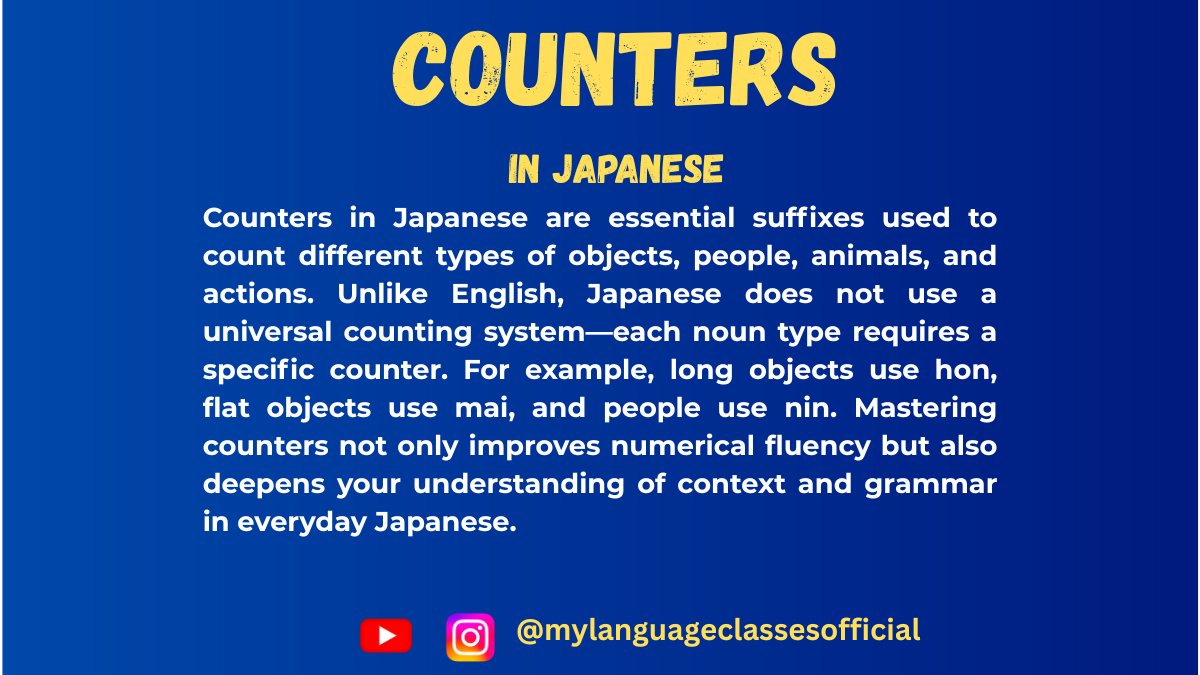
When learning Japanese, one unique and challenging aspect for learners is the use of counters. Unlike English, Japanese uses specific words when counting objects, animals, people, and even abstract concepts. These counters change depending on the type and shape of the item being counted. In this post, we’ll delve deep into the world of Japanese counters, explain the logic behind them, and provide tips to use them confidently in everyday conversation.
What Are Counters in Japanese?
Counters are suffixes used to indicate the type or category of the item being counted. For example:
- 本 (ほん) is used for long, cylindrical objects like bottles or pencils.
- 枚 (まい) is for thin, flat objects like paper or plates.
- 匹 (ひき) is for animals like cats or fish.
To count items, you combine a number with the appropriate counter, often modifying the pronunciation depending on the number.
Basic Structure
The typical structure is:
Number + Counter
Examples:
- 一本 (いっぽん) — one pen (using the counter for long objects)
- 三枚 (さんまい) — three sheets of paper (using the counter for flat objects)
- 五匹 (ごひき) — five dogs (using the counter for animals)
However, it’s important to know irregular pronunciations, which often occur with numbers like 1, 3, 6, and 8. We’ll discuss this in detail below.
Common Counters and Their Usage
Here are some of the most frequently used counters:
1. General Items: 個 (こ)
Used for small, generic objects.
- Examples: 一個 (いっこ) — one piece, 三個 (さんこ) — three pieces.
2. Long Objects: 本 (ほん)
Used for items like pens, bottles, trees, and trains.
- Irregular pronunciations:
- 1本 (いっぽん)
- 3本 (さんぼん)
- 6本 (ろっぽん)
3. Flat Objects: 枚 (まい)
Used for items like paper, plates, and T-shirts.
- Examples: 一枚 (いちまい) — one sheet, 十枚 (じゅうまい) — ten sheets.
4. People: 人 (にん)
Used for counting people, with some exceptions:
- 1 person: 一人 (ひとり)
- 2 people: 二人 (ふたり)
- 3 or more: Regular pattern (三人 [さんにん], etc.).
5. Animals: 匹 (ひき)
Used for small animals like cats, dogs, and fish.
- Irregular pronunciations:
- 1匹 (いっぴき)
- 3匹 (さんびき)
- 6匹 (ろっぴき)
6. Books and Magazines: 冊 (さつ)
Used for bound objects like books and notebooks.
- Irregular pronunciations:
- 1冊 (いっさつ)
- 8冊 (はっさつ)
7. Machines and Vehicles: 台 (だい)
Used for cars, TVs, and other machinery.
- Examples: 一台 (いちだい), 五台 (ごだい).
8. Large Animals: 頭 (とう)
Used for cows, horses, and elephants.
- Examples: 一頭 (いっとう), 三頭 (さんとう).
Tips to Master Counters
- Start with Common Counters: Focus on frequently used counters like 個, 本, and 枚 before delving into specialized ones.
- Memorize Irregular Forms: Pay attention to irregular readings for numbers like 1, 3, 6, and 8.
- Practice with Real-Life Examples: Use counters in context, like ordering food or describing objects around you. For instance:
- レストランで: コーヒーを二杯 (にはい)ください (At a restaurant: “Two cups of coffee, please.”).
- Watch Native Speakers: Listen to native speakers to understand how counters are naturally used in conversation.
Things to Keep in Mind
- Context Matters: The appropriate counter often depends on the item’s size, shape, or category.
- Colloquial Shortcuts: In casual conversation, native speakers may drop the counter altogether if the context is clear:
- Example: りんご三つ (みっつ) instead of 三個.
- Counters for Abstract Concepts: Words like 回 (かい) for times or 度 (ど) for occurrences can be tricky. Practice distinguishing them:
- 一回 (いっかい) — once
- 一度 (いちど) — one time (but often implies a more formal or singular occasion).
Learning Through Examples
Here are some sample sentences to see counters in action:
- Books and Magazines:
- 本を三冊買いました。
(ほんをさんさつかいました)
I bought three books.
- 本を三冊買いました。
- Animals:
- 犬が五匹います。
(いぬがごひきいます)
There are five dogs.
- 犬が五匹います。
- Drinks:
- ビールを二杯ください。
(びーるをにはいください)
Two beers, please.
- ビールを二杯ください。
- People:
- 学生が十人来ました。
(がくせいがじゅうにんきました)
Ten students came.
- 学生が十人来ました。
Practice Makes Perfect
To truly master Japanese counters, practice is essential. Start by identifying objects around you and attaching the appropriate counter. Here’s a challenge for you:
- Look around your room and count:
- Books (冊)
- Pens (本)
- Chairs (台)
- Photos (枚).
By incorporating counters into daily life, you’ll quickly become more comfortable and natural when speaking Japanese.
Final Thoughts
Japanese counters can feel overwhelming at first, but they also add precision and beauty to the language. By focusing on common counters, practicing regularly, and immersing yourself in authentic Japanese content, you’ll be able to master this unique aspect of Japanese in no time. Keep practicing, and don’t be afraid to make mistakes—they’re the stepping stones to fluency. 頑張ってね!(Good luck!)
Happy learning! 😊

Vikas Kumar is the founder of My Language Classes, a language learning platform dedicated to helping learners develop practical communication skills in Spanish, Japanese, and English through comprehensive grammar guides, structured learning resources, books, and evidence-informed educational content.
At My Language Classes, we believe that successful language learning is built on clarity, consistency, meaningful practice, and a deep understanding of how languages work. Every article is carefully researched and created to simplify complex concepts, provide practical guidance, and help learners develop confidence through real-world communication.
Inspired by the principles behind How Language Learning Really Works, our mission is to make high-quality language learning accessible to learners around the world by providing accurate, trustworthy, and comprehensive resources that support lasting progress, lifelong learning, and meaningful communication.
Leave a Reply