
Mastering Japanese Question Words
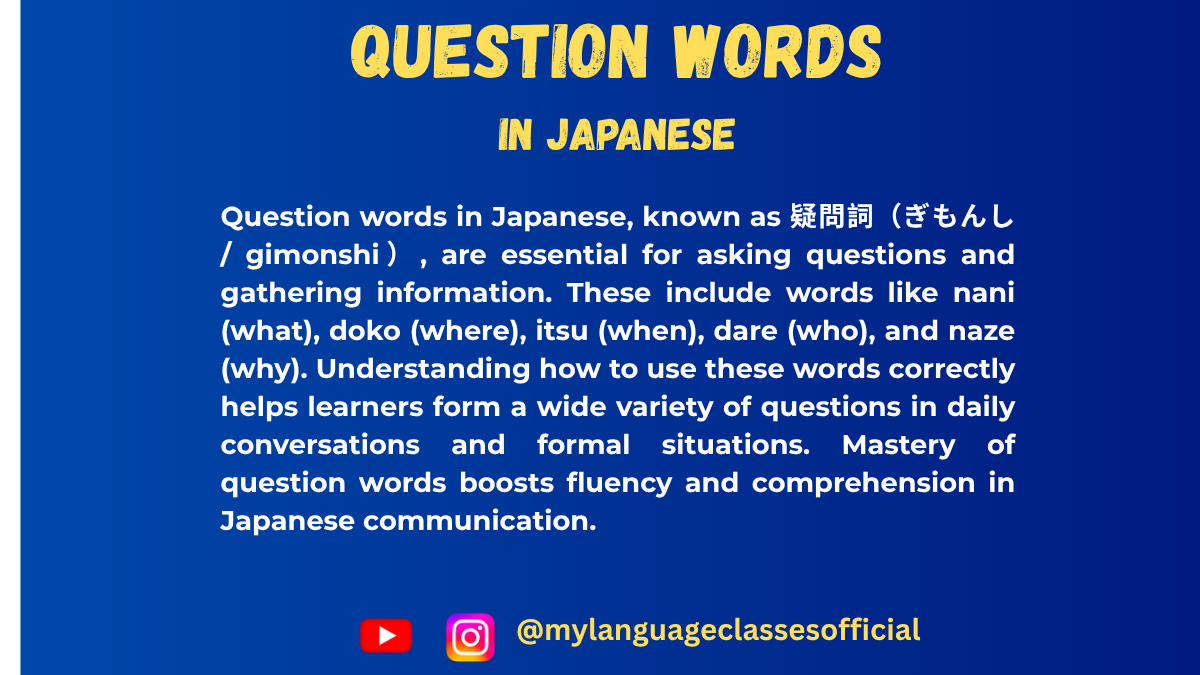
When learning Japanese, understanding how to ask questions is essential to communication. Whether you’re inquiring about someone’s day or seeking directions in Tokyo, mastering question forms will significantly enhance your confidence. In this blog post, we’ll delve into Japanese question words, how to use them, and the role of か (ka) for forming yes/no questions. Let’s get started!
Essential Japanese Question Words
Japanese question words are key for asking specific questions. Here’s a breakdown of the most common ones:
1. 何 (なに/nani) – “What”
- Examples:
- これは何ですか? (Kore wa nani desu ka?) – What is this?
- 何を食べますか? (Nani o tabemasu ka?) – What will you eat?
The word 何 changes depending on context:
- When followed by ですか (desu ka), it remains nani.
- With particles like を (o) or が (ga), it’s also nani.
- Before な (na)-row sounds, it often becomes なん (nan), e.g., 何時 (なんじ/nanji) – “What time?”
2. 誰 (だれ/dare) – “Who”
- Examples:
- 誰ですか? (Dare desu ka?) – Who is it?
- あなたは誰ですか? (Anata wa dare desu ka?) – Who are you?
For polite speech, you can use どなた (donata) instead of 誰.
3. どこ (doko) – “Where”
- Examples:
- トイレはどこですか? (Toire wa doko desu ka?) – Where is the bathroom?
- あなたはどこに住んでいますか? (Anata wa doko ni sunde imasu ka?) – Where do you live?
4. いつ (itsu) – “When”
- Examples:
- いつ来ますか? (Itsu kimasu ka?) – When will you come?
- 試験はいつですか? (Shiken wa itsu desu ka?) – When is the exam?
5. なぜ (naze) / どうして (doushite) – “Why”
- Examples:
- なぜ行きませんか? (Naze ikimasen ka?) – Why won’t you go?
- どうして泣いているんですか? (Doushite naite irun desu ka?) – Why are you crying?
While なぜ and どうして both mean “why,” どうして is more conversational, whereas なぜ is slightly formal.
6. いくら (ikura) – “How much”
- Examples:
- これはいくらですか? (Kore wa ikura desu ka?) – How much is this?
- 昼ご飯はいくらかかりますか? (Hirugohan wa ikura kakarimasu ka?) – How much does lunch cost?
Forming Yes/No Questions with か (ka)
Japanese yes/no questions are incredibly straightforward—just add か to the end of a sentence. Let’s break it down:
1. Verb + か
- Examples:
- 食べますか? (Tabemasu ka?) – Do you eat? / Will you eat?
- 映画を見ますか? (Eiga o mimasu ka?) – Will you watch the movie?
2. Noun + ですか
- Examples:
- 学生ですか? (Gakusei desu ka?) – Are you a student?
- 日本人ですか? (Nihonjin desu ka?) – Are you Japanese?
Adding か turns a statement into a polite question.
Bonus: Combining Question Words with か
You can combine question words with か to create open-ended questions:
- 何か (nani ka) – “Something”
- 誰か (dare ka) – “Someone”
- どこか (doko ka) – “Somewhere”
For example:
- 何か食べますか? (Nani ka tabemasu ka?) – Will you eat something?
- 誰か来ますか? (Dare ka kimasu ka?) – Will someone come?
Pro Tip for Learners
In informal conversation, か is often omitted:
- これ何? (Kore nani?) – What’s this?
- 誰? (Dare?) – Who?
Practice Makes Perfect
To solidify your understanding, try creating sentences using each question word. For instance:
- Where do you live?
- あなたはどこに住んでいますか? (Anata wa doko ni sunde imasu ka?)
- What will you eat?
- 何を食べますか? (Nani o tabemasu ka?)
Post your examples in the comments for feedback or ask additional questions to enhance your learning. Remember, the key to mastering Japanese question forms is consistent practice!
Happy learning! がんばってください! (Ganbatte kudasai!) 😊

Vikas Kumar is the founder of My Language Classes, a language learning platform dedicated to helping learners develop practical communication skills in Spanish, Japanese, and English through comprehensive grammar guides, structured learning resources, books, and evidence-informed educational content.
At My Language Classes, we believe that successful language learning is built on clarity, consistency, meaningful practice, and a deep understanding of how languages work. Every article is carefully researched and created to simplify complex concepts, provide practical guidance, and help learners develop confidence through real-world communication.
Inspired by the principles behind How Language Learning Really Works, our mission is to make high-quality language learning accessible to learners around the world by providing accurate, trustworthy, and comprehensive resources that support lasting progress, lifelong learning, and meaningful communication.
Leave a Reply