

Understanding Passive Form verbs in Japanese
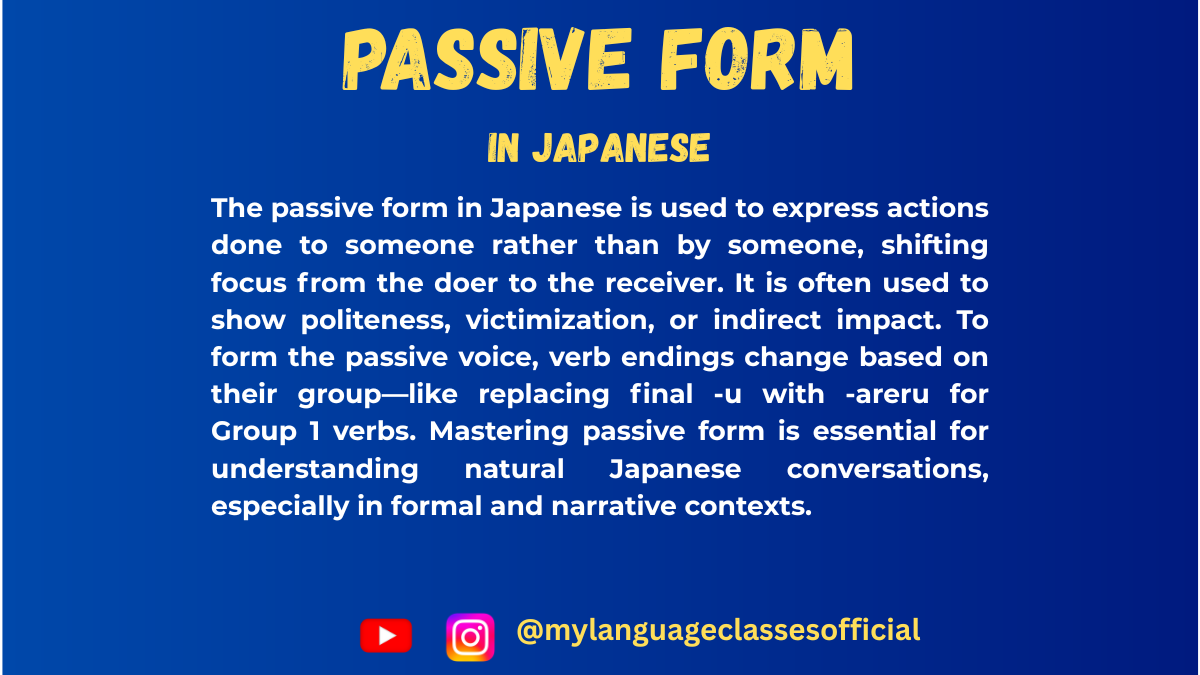
The passive form (受身形, うけみけい) in Japanese is used in various situations, primarily to describe actions where the subject is affected by someone else’s actions. Unlike in English, where the passive voice is often avoided, Japanese frequently uses it in daily conversations and formal writing. In this blog post, we will thoroughly explore the formation and usage of passive verbs in different contexts.
Usage of Passive Form in Japanese
The passive form is used in the following situations:
- When someone is negatively affected by an action (被害受身 – ひがいうけみ)
- Japanese: 私は弟にケーキを食べられました。
- Romaji: Watashi wa otōto ni kēki o taberaremashita.
- Meaning: I had my cake eaten by my younger brother.
- When describing an event from the perspective of the affected person
- Japanese: 私は先生にほめられました。
- Romaji: Watashi wa sensei ni homeraremashita.
- Meaning: I was praised by my teacher.
- When discussing historical or public events
- Japanese: このお寺は100年前に建てられました。
- Romaji: Kono otera wa hyaku nen mae ni tateraremashita.
- Meaning: This temple was built 100 years ago.
- When avoiding mentioning the doer explicitly (formal, impersonal expressions)
- Japanese: 日本ではお米が多く食べられています。
- Romaji: Nihon de wa okome ga ōku taberareteimasu.
- Meaning: Rice is widely eaten in Japan.
- When talking about natural phenomena
- Japanese: その山は雪で覆われています。
- Romaji: Sono yama wa yuki de ōwareteimasu.
- Meaning: That mountain is covered with snow.
- In literary or poetic expressions
- Japanese: 彼女の歌は世界中で聞かれています。
- Romaji: Kanojo no uta wa sekaijū de kikareteimasu.
- Meaning: Her songs are heard all over the world.
Formation of Passive Verbs
Japanese verbs are categorized into three groups. The passive form is formed differently for each group.
Group 1 (Ichidan verbs / 一段動詞)
Formation: Drop the final る and add られる
| Verb | Potential Form | Passive Form | Example Sentence (Japanese) | Romaji | Meaning |
|---|---|---|---|---|---|
| 食べる (たべる) | 食べられる | 食べられる | 私は友達にお菓子を食べられた。 | Watashi wa tomodachi ni okashi o taberareta. | I had my sweets eaten by a friend. |
| 見る (みる) | 見られる | 見られる | 私の秘密はみんなに見られた。 | Watashi no himitsu wa minna ni mirareta. | My secret was seen by everyone. |
| 教える (おしえる) | 教えられる | 教えられる | 日本語は先生に教えられた。 | Nihongo wa sensei ni oshierareta. | Japanese was taught by the teacher. |
Group 2 (Godan verbs / 五段動詞)
Formation: Change the final u sound to a sound and add れる
| Verb | Potential Form | Passive Form | Example Sentence (Japanese) | Romaji | Meaning |
| 書く (かく) | 書ける | 書かれる | 私の名前が黒板に書かれた。 | Watashi no namae ga kokuban ni kakareta. | My name was written on the blackboard. |
| 読む (よむ) | 読める | 読まれる | この本は多くの人に読まれた。 | Kono hon wa ōku no hito ni yomareta. | This book was read by many people. |
| 言う (いう) | 言える | 言われる | 先生に「すごい」と言われた。 | Sensei ni “sugoi” to iwareta. | I was told “amazing” by the teacher. |
Group 3 (Irregular verbs / 不規則動詞)
| Verb | Potential Form | Passive Form | Example Sentence (Japanese) | Romaji | Meaning |
| する | できる | される | 彼の仕事は上司に評価された。 | Kare no shigoto wa jōshi ni hyōka sareta. | His work was evaluated by the boss. |
| 来る (くる) | 来られる | 来られる | 私の家に友達が来られた。 | Watashi no ie ni tomodachi ga korareta. | A friend came to my house. |
More Example Sentences
- 彼は友達にからかわれた。 (Kare wa tomodachi ni karakawareta.) – He was teased by his friends.
- 雨が降って、試合が中止された。 (Ame ga futte, shiai ga chūshi sareta.) – The match was canceled due to rain.
- 私の自転車が盗まれた。 (Watashi no jitensha ga nusumareta.) – My bicycle was stolen.
- その映画は世界中で見られている。 (Sono eiga wa sekaijū de mirareteiru.) – The movie is being watched worldwide.
- 彼は先生に叱られた。 (Kare wa sensei ni shikarareta.) – He was scolded by the teacher.
- この本は多くの人に読まれた。 (Kono hon wa ōku no hito ni yomareta.) – This book was read by many people.
- 先生に質問が聞かれた。 (Sensei ni shitsumon ga kikareta.) – A question was asked by the teacher.
- 日本では魚がよく食べられる。 (Nihon de wa sakana ga yoku taberareru.) – Fish is often eaten in Japan.
- その話は新聞に書かれていた。 (Sono hanashi wa shinbun ni kakareteita.) – That story was written in the newspaper.
- 彼の名前は歴史に残されている。 (Kare no namae wa rekishi ni nokosareteiru.) – His name is left in history.
Fill in the Blanks Exercise:
- 私の名前が黒板に____。
- 先生にほめ____。
- 私は友達にお弁当を____。
- その建物は100年前に____。
- その映画はたくさんの人に____。
- 宿題が____。
- 彼は友達に____。
- その話は新聞に____。
- 日本では魚がよく____。
- 彼の仕事は上司に____。
Answers:
- 書かれた 2. られた 3. 食べられた 4. 建てられた 5. 見られた 6. された 7. からかわれた 8. 書かれた 9. 食べられる 10. 評価された
Things to Keep in Mind
- Passive verbs often imply an indirect effect on the subject.
- Passive form is commonly used in formal writing and polite speech.
- Certain verbs are more frequently used in passive form, such as 言う (to say), 書く (to write), and する (to do).
- When the subject is negatively affected, the nuance of 被害受身 (negative passive) comes into play.
- Passive sentences often omit the doer (agent) for a softer, indirect tone.
Conclusion
Mastering the passive form of verbs in Japanese is crucial for fluency and understanding natural speech patterns. It is widely used in both formal and informal contexts. By practicing passive verb conjugations and understanding their nuanced usage, learners can improve their comprehension and communication skills in Japanese effectively. Keep practicing and using these forms in daily conversation to become more proficient!
Happy learning! 😊

Vikas Kumar is the founder of My Language Classes, a language learning platform dedicated to helping learners develop practical communication skills in Spanish, Japanese, and English through comprehensive grammar guides, structured learning resources, books, and evidence-informed educational content.
At My Language Classes, we believe that successful language learning is built on clarity, consistency, meaningful practice, and a deep understanding of how languages work. Every article is carefully researched and created to simplify complex concepts, provide practical guidance, and help learners develop confidence through real-world communication.
Inspired by the principles behind How Language Learning Really Works, our mission is to make high-quality language learning accessible to learners around the world by providing accurate, trustworthy, and comprehensive resources that support lasting progress, lifelong learning, and meaningful communication.
Leave a Reply