

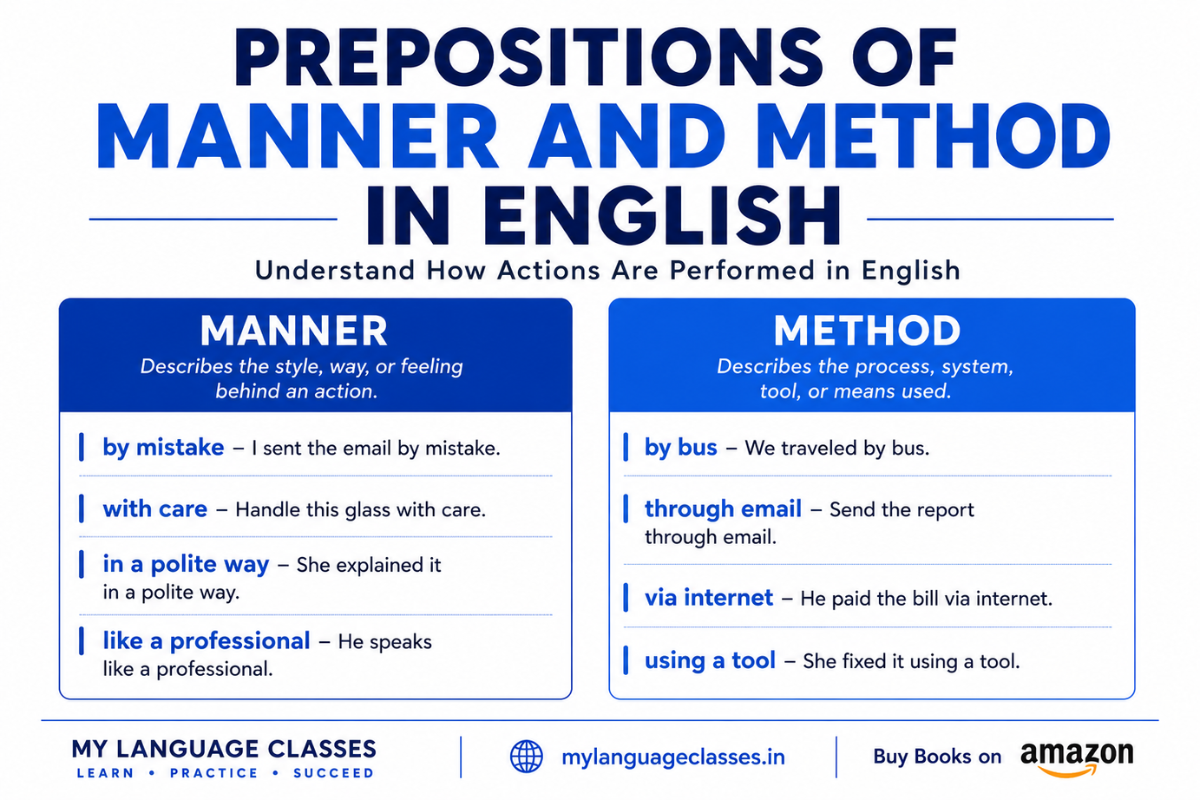
Prepositions of manner and method in English help you explain how an action happens, but many learners struggle to understand the difference between them. Both answer the question “how,” yet they describe different aspects of an action. One focuses on the style or behavior, while the other focuses on the process or means used to complete the action.
For example, compare these two sentences:
→ She spoke with confidence.
→ She spoke through a microphone.
Both sentences describe how she spoke, but the meaning is different. The first describes her manner, while the second describes the method. This distinction is essential if you want to speak and write English accurately.
Many learners mix these concepts because they often use similar prepositions such as by and with. Without a clear understanding, it becomes easy to form sentences that sound unnatural or unclear. This is why learning prepositions of manner and method in English as separate categories is important.
If you are building a strong foundation in English grammar, Communicative English Foundation available on My Language Classes website and on Amazon will help you understand how grammar works in real communication, not just in theory. It strengthens your ability to form correct and meaningful sentences across different situations.
In this guide, you will learn:
→ What prepositions are and how they function
→ What manner and method mean in English grammar
→ How prepositions of manner and method are used
→ The key differences between them
→ Common mistakes and how to avoid them
By the end of this article, you will be able to clearly identify and use prepositions of manner and method in everyday English with confidence.
What Are Prepositions of Manner and Method in English?
Prepositions of manner and method in English are used to explain how an action happens, but they describe different aspects of that action. Understanding this distinction is important because it helps you form sentences that are clear, precise, and natural.
Before we look at manner and method separately, it is important to understand what a preposition is and how it functions in English grammar.
What Is a Preposition in English Grammar?
A preposition is a word that shows the relationship between a noun or pronoun and another word in a sentence. It often tells you about direction, place, time, cause, or manner.
Common prepositions include:
→ in
→ on
→ at
→ by
→ with
→ through
→ via
These words may look small, but they play a major role in sentence meaning.
For example:
→ She is sitting on the chair.
→ He arrived at the station.
→ They traveled by train.
In each sentence, the preposition connects ideas and adds important meaning.
Prepositions are usually followed by a noun or pronoun, which is called the object of the preposition.
Example:
→ She wrote the letter with a pen.
Here, with is the preposition, and a pen is its object.
What Do “Manner” and “Method” Mean in English?
To understand prepositions of manner and method in English, you need to clearly understand the difference between “manner” and “method.”
Manner
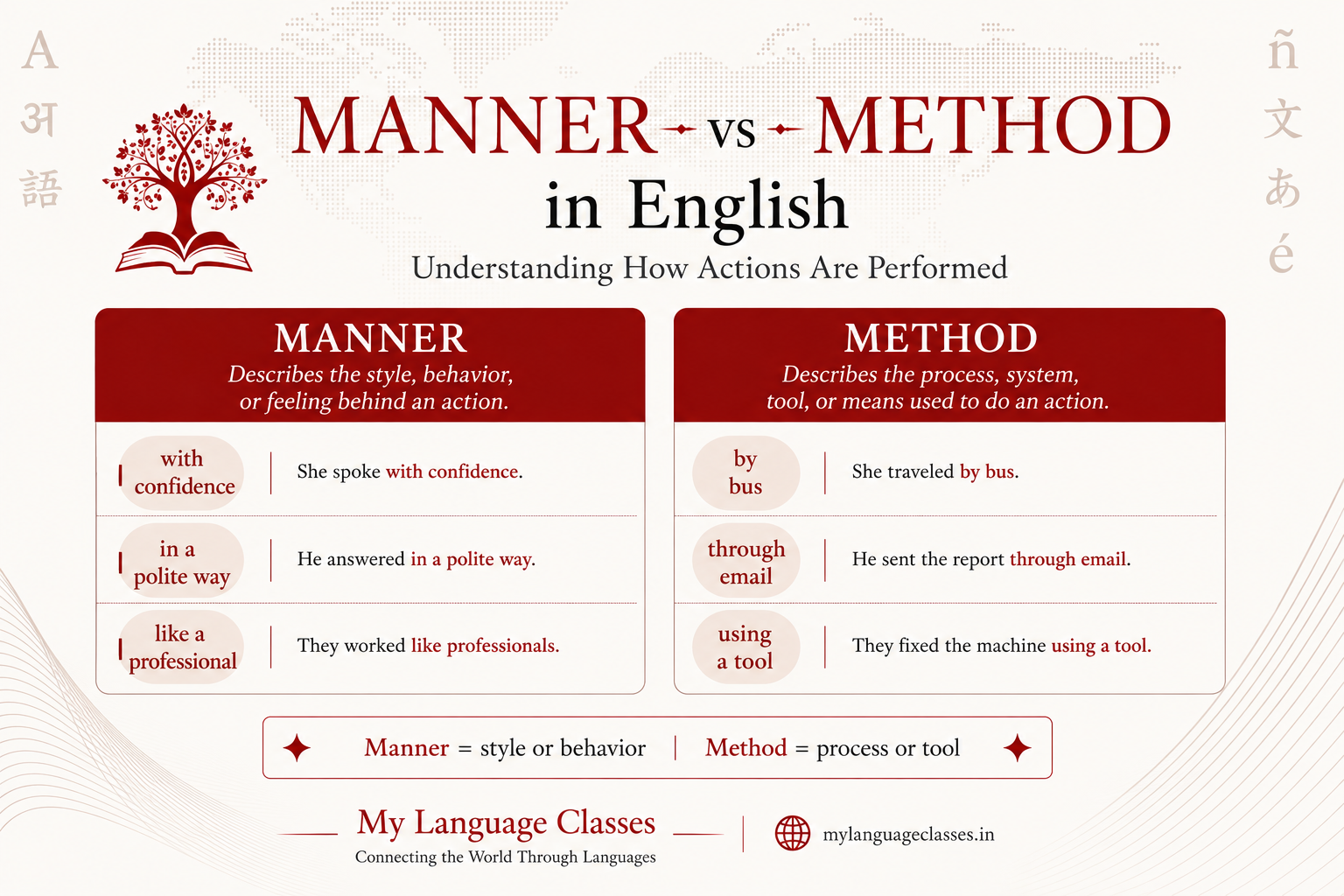
Manner refers to the way something happens in terms of style, behavior, attitude, or feeling. It describes how an action is performed from a human or expressive perspective.
Examples:
→ She spoke with confidence.
→ He answered in a polite way.
→ They reacted like professionals.
In all these sentences, the focus is on the style or behavior of the action.
Method
Method refers to the process, system, tool, or means used to perform an action. It focuses on how something is done in a practical or technical sense.
Examples:
→ She sent the message through email.
→ He traveled by bus.
→ They solved the problem using a new technique.
Here, the focus is on the process or tool used to complete the action.
Why Are Manner and Method Confused?
Manner and method are often confused because both answer the question “how.” However, they do not mean the same thing.
Compare these:
→ She cut the vegetables with a knife.
→ She cut the vegetables with care.
In the first sentence, with a knife describes the method because it tells us the tool used.
In the second sentence, with care describes the manner because it tells us how the action was performed in terms of behavior.
Understanding this difference is the key to using prepositions correctly.
What Are Prepositions of Manner in English?
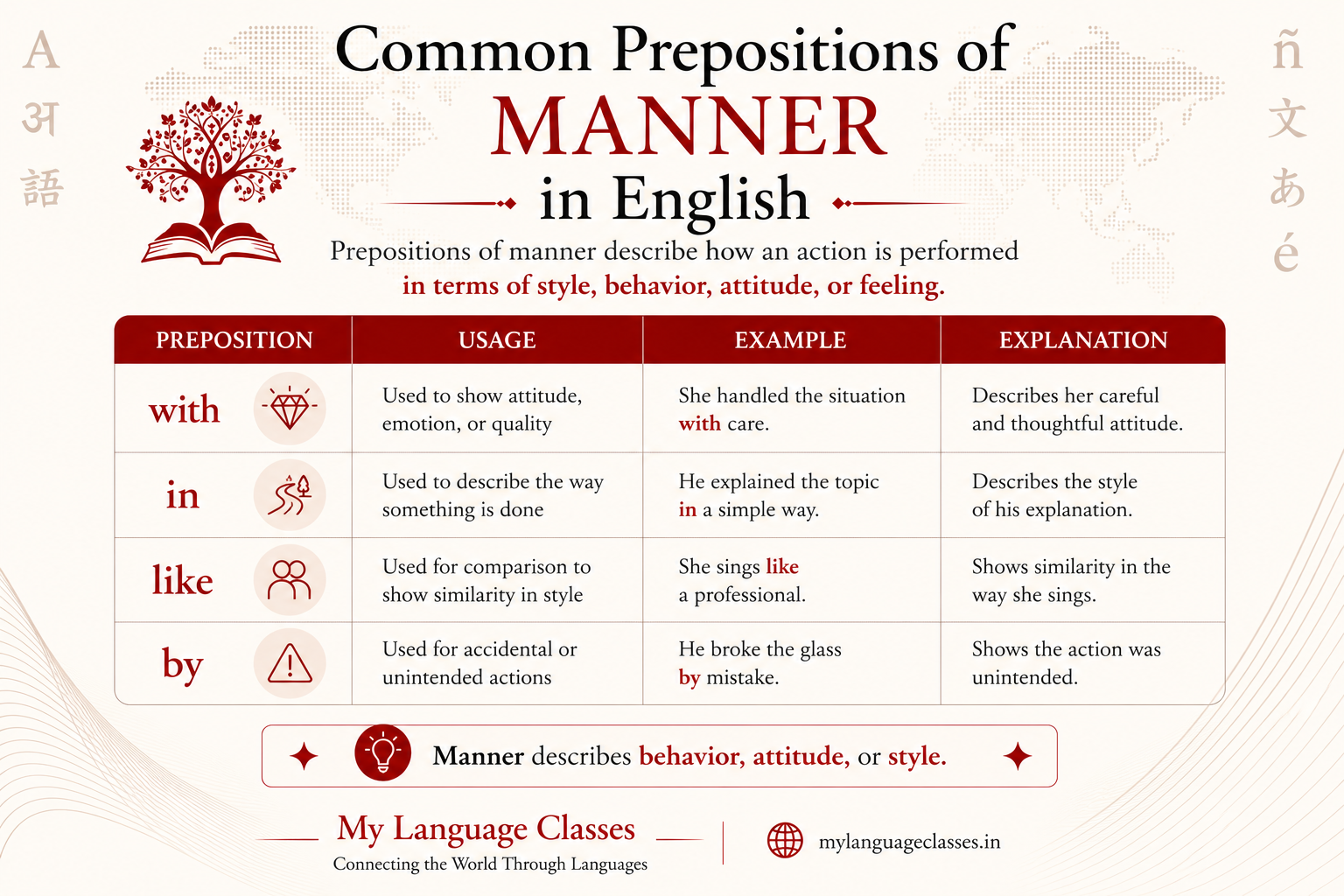
Prepositions of manner in English are used to describe how an action is performed in terms of style, behavior, attitude, or feeling. They focus on the human or expressive aspect of an action rather than the technical process.
When you use prepositions of manner, you are not explaining the tool or system used. Instead, you are describing the way the action feels or appears.
For example:
→ She spoke with confidence.
→ He answered in a polite way.
→ They worked like professionals.
In each of these sentences, the focus is on behavior or style, not on the method.
Which Prepositions Are Commonly Used for Manner?
Several prepositions are commonly used to express manner in English. Each one carries a slightly different meaning, depending on context.
→ with
Used to show attitude, emotion, or quality
Example: She handled the situation with care.
→ in
Used to describe the way something is done, often followed by “a way” or similar structure
Example: He explained the topic in a simple way.
→ like
Used for comparison to show similarity in behavior or style
Example: She sings like a professional.
→ by (in some cases)
Used for accidental or unintended actions
Example: He broke the glass by mistake.
These prepositions help add depth and clarity to sentences by describing how something happens.
How Are Prepositions of Manner Used in Sentences?
Prepositions of manner usually follow a verb and are connected to a noun phrase that describes the behavior or style.
Common pattern:
→ Verb + preposition + noun phrase
Examples:
→ She spoke with confidence.
→ He completed the task with great focus.
→ They reacted in a calm manner.
These structures are very common in both spoken and written English.
If you want to master how prepositions work across different contexts, Complete English Prepositions Mastery Guide available on My Language Classes website and on Amazon provides detailed explanations, patterns, and practice that strengthen your overall grammar accuracy.
What Are Some Examples of Prepositions of Manner?
The table below shows clear examples to help you understand how prepositions of manner function in real sentences.
| Sentence | Preposition of Manner | Explanation |
|---|---|---|
| She spoke with confidence. | with | Describes her attitude |
| He answered in a polite way. | in | Describes behavior |
| They worked like professionals. | like | Shows similarity in style |
| He reacted with anger. | with | Shows emotion |
| She completed the work with care. | with | Shows careful behavior |
These examples show that prepositions of manner help you express how something is done in a more natural and meaningful way.
What Are Prepositions of Method in English?
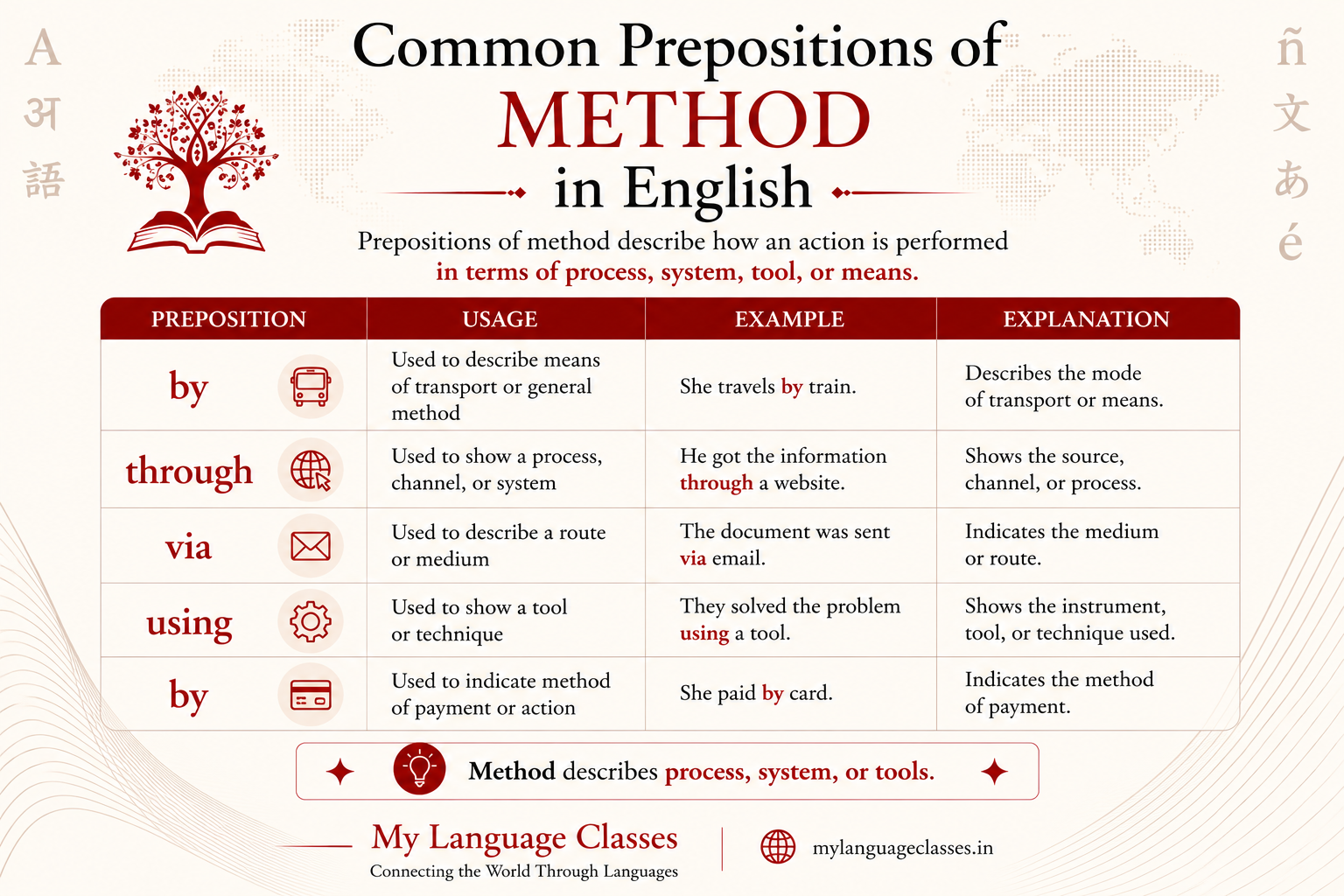
Prepositions of method in English are used to describe how an action is performed in terms of process, system, tool, or means. Unlike manner, which focuses on behavior or style, method focuses on the practical way something is done.
When you use prepositions of method, you are explaining the mechanism behind an action.
For example:
→ She sent the message through email.
→ He traveled by train.
→ They solved the problem using a new technique.
In each sentence, the focus is on the method or system used to complete the action.
Which Prepositions Are Commonly Used for Method?
Several prepositions are commonly used to express method in English. Each one highlights a different type of process or medium.
→ by
Used to describe means of transport or general method
Example: She goes to work by bus.
→ through
Used to show a process, channel, or system
Example: He got the job through a referral.
→ via
Used to describe a route or medium, often in formal contexts
Example: The file was sent via email.
→ using
Used to show a tool or technique
Example: They fixed the issue using a new method.
These prepositions help explain how something is achieved in a clear and structured way.
How Are Prepositions of Method Used in Sentences?
Prepositions of method usually follow a verb and are connected to a noun that represents a tool, system, or process.
Common pattern:
→ Verb + preposition + noun
Examples:
→ She contacted him through a friend.
→ He learned English via online courses.
→ They completed the project using advanced software.
This structure is widely used in both formal and informal English.
What Are Some Examples of Prepositions of Method?
The table below shows how prepositions of method are used in real sentences.
| Sentence | Preposition of Method | Explanation |
|---|---|---|
| She travels by train. | by | Describes the mode of transport |
| He got the information through a website. | through | Shows the source or channel |
| The document was sent via email. | via | Indicates the medium |
| They solved the problem using a tool. | using | Shows the instrument or technique |
| She paid by card. | by | Indicates method of payment |
These examples show that prepositions of method help explain how an action is completed from a practical or technical perspective.
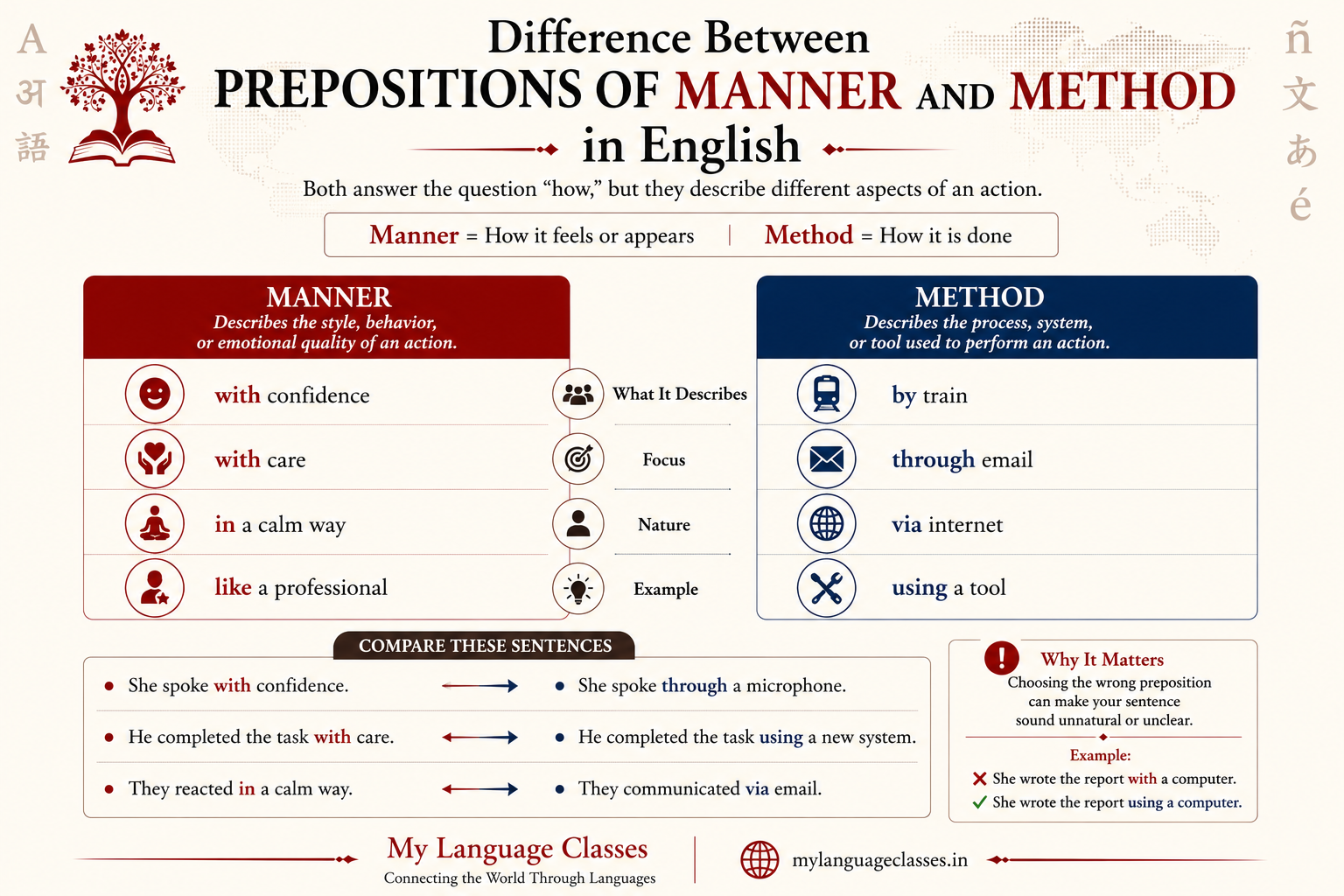
What Is the Difference Between Prepositions of Manner and Method in English?
The difference between prepositions of manner and method in English becomes clear when you focus on what kind of “how” the sentence is describing. Both answer the same question, but they describe different aspects of an action.
Prepositions of manner describe the style, behavior, or emotional quality of an action. Prepositions of method describe the process, system, or tool used to perform that action.
A simple way to understand this is:
→ Manner = How it feels or appears
→ Method = How it is done
Clear Comparison Between Manner and Method
| Manner | Method |
|---|---|
| Describes behavior or style | Describes process or tool |
| Focuses on attitude or feeling | Focuses on system or means |
| Often human or expressive | Often practical or technical |
| Example: with confidence | Example: by train |
Compare These Sentences
Looking at paired examples makes the difference much easier to understand.
→ She spoke with confidence.
→ She spoke through a microphone.
The first sentence shows manner because it describes her confidence. The second shows method because it describes the tool she used.
→ He completed the task with care.
→ He completed the task using a new system.
In the first sentence, with care describes behavior. In the second, using a new system describes the method.
→ They reacted in a calm way.
→ They communicated via email.
Again, the first focuses on style, while the second focuses on the medium.
Why This Difference Matters
If you confuse manner and method, your sentence may still be grammatically correct, but the meaning can become unclear or unnatural.
For example:
→ She wrote the report with a computer.
This sounds unnatural because with a computer describes a tool, so it should be method:
→ She wrote the report using a computer.
Understanding this distinction helps you choose the correct preposition and express your ideas more clearly.
Can the Same Preposition Be Used for Both Manner and Method?
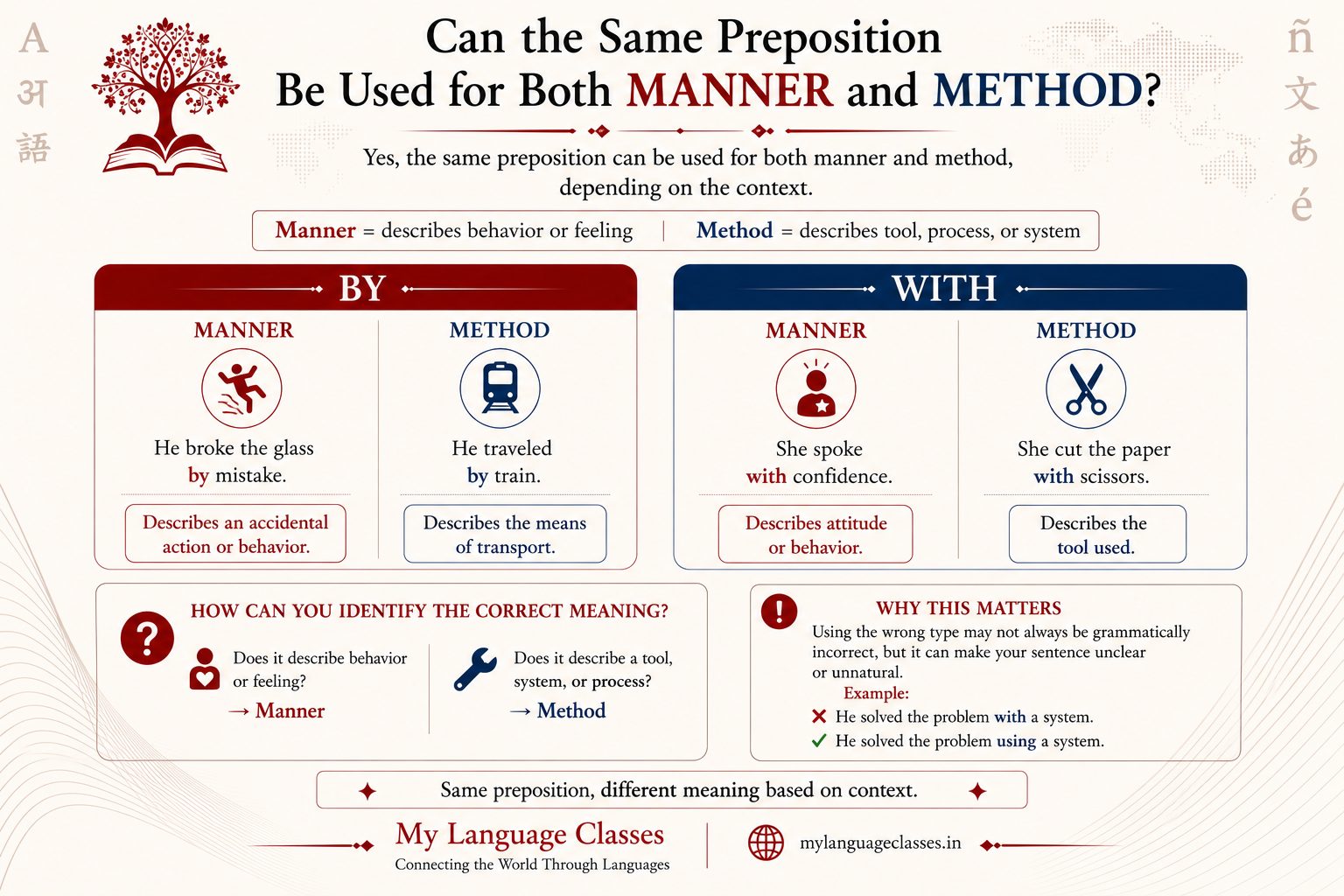
Yes, the same preposition can be used for both manner and method in English, depending on the context. This is one of the main reasons learners get confused, especially with common prepositions like by and with.
The meaning of the sentence changes based on whether the preposition describes behavior or a tool, process, or system.
How Does Context Change the Meaning?
Let’s look at how the same preposition can express both manner and method.
Using “by”
→ He broke the glass by mistake.
This is manner because it describes an accidental action.
→ He traveled by train.
This is method because it describes the means of transport.
Using “with”
→ She spoke with confidence.
This is manner because it describes her attitude.
→ She cut the paper with scissors.
This is method because it describes the tool used.
In both cases, the preposition stays the same, but the meaning changes based on what follows it.
How Can You Identify the Correct Meaning?
You can identify whether a preposition is showing manner or method by asking a simple question:
→ Does it describe behavior or feeling? → Manner
→ Does it describe a tool, system, or process? → Method
This quick check helps you choose the correct interpretation in real situations.
Why This Matters in Real Communication
Using the wrong type may not always make your sentence grammatically incorrect, but it can make it unclear or unnatural.
For example:
→ He solved the problem with a system.
This sounds unnatural because “system” relates to method, not behavior.
Correct version:
→ He solved the problem using a system.
Understanding how context changes meaning helps you avoid these subtle mistakes and communicate more clearly.
What Are Common Mistakes with Prepositions of Manner and Method in English?
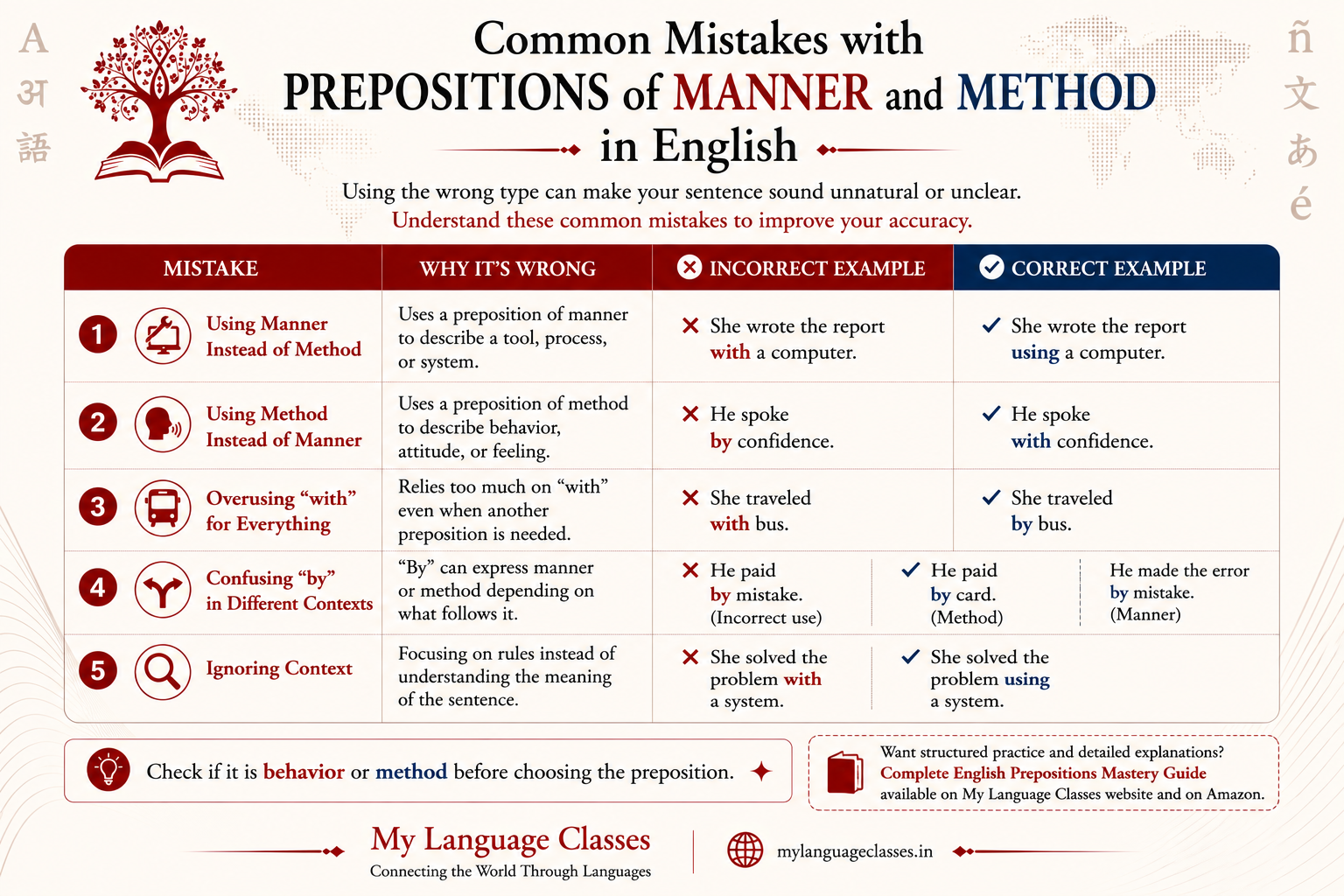
Prepositions of manner and method in English are often confused because they both answer the question “how.” However, using the wrong type can make your sentence sound unnatural or unclear. Understanding these common mistakes will help you avoid errors and improve your accuracy.
Mistake 1: Using Manner Instead of Method
This happens when a learner uses a preposition that describes behavior instead of a tool or process.
Incorrect:
→ She wrote the report with a computer.
Correct:
→ She wrote the report using a computer.
“Computer” is a tool, so the sentence requires a method, not manner.
Mistake 2: Using Method Instead of Manner
This mistake occurs when a learner uses a process or tool where a feeling or behavior should be expressed.
Incorrect:
→ He spoke by confidence.
Correct:
→ He spoke with confidence.
“Confidence” describes attitude, so it belongs to manner.
Mistake 3: Overusing “with” for Everything
Many learners rely too much on with, which leads to incorrect sentences.
Incorrect:
→ She traveled with bus.
Correct:
→ She traveled by bus.
“Bus” is a means of transport, so it requires by, not with.
Mistake 4: Confusing “by” in Different Contexts
The preposition by can express both manner and method, which creates confusion.
Examples:
→ He made the error by mistake. (Manner)
→ He paid by card. (Method)
The meaning depends on what follows the preposition.
Mistake 5: Ignoring Context
Sometimes learners memorize rules but do not consider the meaning of the sentence.
Incorrect:
→ She solved the problem with a system.
Correct:
→ She solved the problem using a system.
Always focus on whether the sentence describes behavior or a process.
If you want structured practice to avoid these mistakes and build accuracy step by step, Complete English Prepositions Mastery Guide available on My Language Classes website and on Amazon provides detailed exercises and real usage examples.
How Can You Identify Prepositions of Manner and Method in English?
Prepositions of manner and method in English can be identified easily when you focus on the role they play in the sentence. Instead of memorizing lists, it is more effective to understand how they function in context.
What Question Should You Ask?
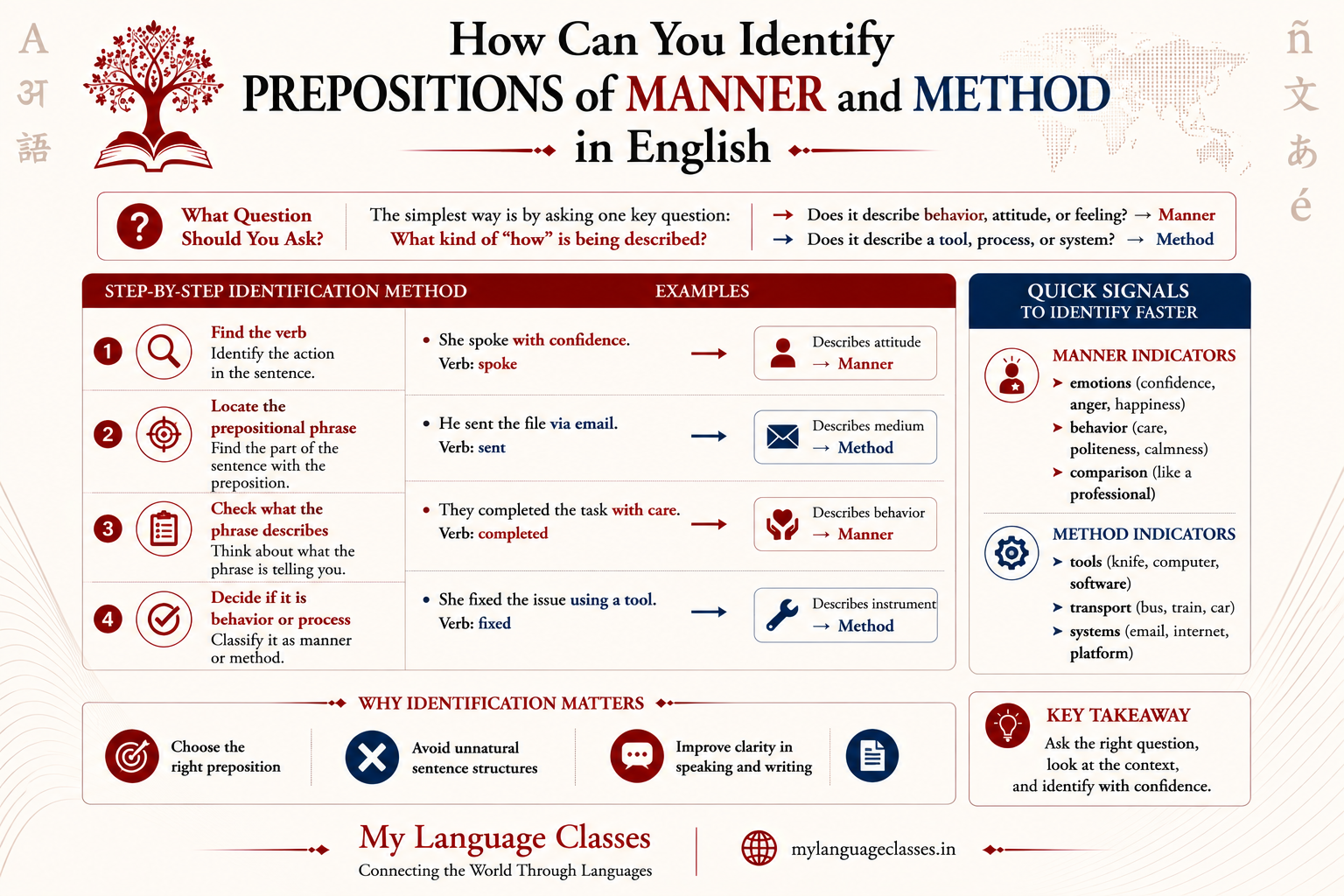
The simplest way to identify them is by asking one key question:
→ What kind of “how” is being described?
Then apply this check:
→ Does it describe behavior, attitude, or feeling? → Manner
→ Does it describe a tool, process, or system? → Method
This approach works in most situations and helps you avoid confusion.
Step-by-Step Identification Method
Follow this simple process when analyzing a sentence:
→ Step 1: Find the verb (the action)
→ Step 2: Locate the prepositional phrase
→ Step 3: Check what the phrase describes
→ Step 4: Decide if it is behavior or process
Let’s apply this:
→ She spoke with confidence.
Verb: spoke
Phrase: with confidence
Result: Describes attitude → Manner
→ He sent the file via email.
Verb: sent
Phrase: via email
Result: Describes medium → Method
→ They completed the task with care.
Verb: completed
Phrase: with care
Result: Describes behavior → Manner
→ She fixed the issue using a tool.
Verb: fixed
Phrase: using a tool
Result: Describes instrument → Method
What Signals Manner vs Method Quickly?
Some quick signals can help you identify them faster:
Manner indicators
→ emotions (confidence, anger, happiness)
→ behavior (care, politeness, calmness)
→ comparison (like a professional)
Method indicators
→ tools (knife, computer, software)
→ transport (bus, train, car)
→ systems (email, internet, platform)
These signals act as shortcuts when you are reading or writing.
Why Identification Matters
If you can identify the type correctly, you can:
→ Choose the right preposition
→ Avoid unnatural sentence structures
→ Improve clarity in both writing and speaking
This skill becomes especially important in formal writing and exams where precision matters.
Key Takeaways About Prepositions of Manner and Method in English
Understanding prepositions of manner and method in English becomes much easier when you focus on their function in real sentences. Instead of memorizing isolated rules, it is more useful to remember how each type answers a different kind of “how.”
Here are the most important grammatical points from this guide:
→ Prepositions of manner describe behavior, attitude, or feeling
→ Prepositions of method describe tools, systems, or processes
→ Manner focuses on style, while method focuses on execution
→ Common manner structures include “with + emotion/quality” and “in a + manner phrase”
→ Common method structures include “by + transport/method,” “through + system,” and “using + tool”
→ The same preposition can express both meanings depending on context
→ Words like confidence, care, and calmness signal manner
→ Words like computer, bus, email, and system signal method
→ Always check what the phrase describes before choosing the preposition
→ Incorrect usage may not break grammar rules but can make sentences sound unnatural
If you want to strengthen your understanding with structured grammar progression and practice, Complete English Prepositions Mastery Guide available on My Language Classes website and on Amazon provides focused exercises and real usage patterns to build accuracy step by step.
Conclusion
Prepositions of manner and method in English are closely related, but they serve different purposes in communication. Once you understand the difference between behavior and process, choosing the correct preposition becomes much more natural.
A clear sentence depends on selecting the right type. When you describe how something feels or appears, you use manner. When you describe how something is done using a tool, system, or process, you use method. This distinction allows you to express ideas more precisely and avoid confusion.
As you continue learning, focus on real examples and patterns instead of isolated rules. Over time, your understanding will become automatic, and you will be able to use these structures confidently in both speaking and writing.
Mastering this concept is an important step toward building strong and accurate English communication skills.

Vikas Kumar is the founder of My Language Classes, a language learning platform dedicated to helping learners develop practical communication skills in Spanish, Japanese, and English through comprehensive grammar guides, structured learning resources, books, and evidence-informed educational content.
At My Language Classes, we believe that successful language learning is built on clarity, consistency, meaningful practice, and a deep understanding of how languages work. Every article is carefully researched and created to simplify complex concepts, provide practical guidance, and help learners develop confidence through real-world communication.
Inspired by the principles behind How Language Learning Really Works, our mission is to make high-quality language learning accessible to learners around the world by providing accurate, trustworthy, and comprehensive resources that support lasting progress, lifelong learning, and meaningful communication.
Leave a Reply