

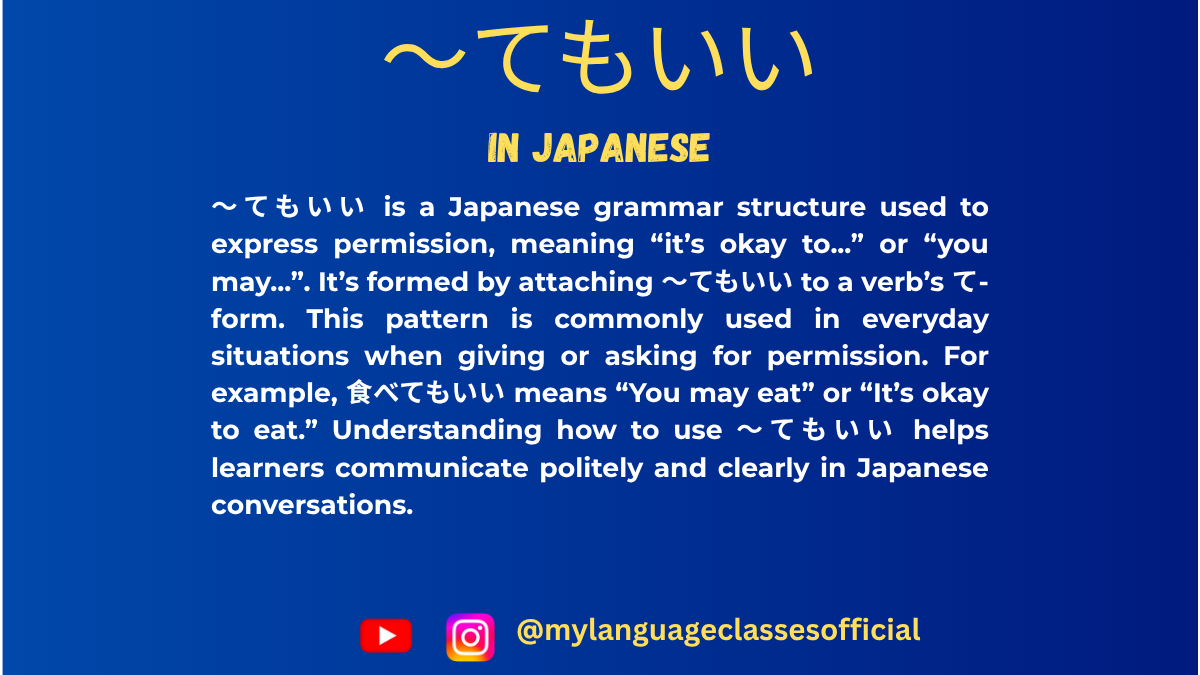
How to Use 〜てもいい in Japanese
In Japanese, 〜てもいい is a versatile grammatical structure that expresses permission, possibility, and sometimes even a suggestion. This phrase is widely used in daily conversations, making it essential for learners to master. In this blog post, we will explore the meaning, formation, and various situations where 〜てもいい is used.
Meaning of 〜てもいい
The phrase 〜てもいい (temo ii) literally translates to “It’s okay to ~” or “You may ~” in English. It is used when granting permission or indicating that an action is acceptable.
It can be broken down as follows:
- 〜て (te-form): The te-form of a verb
- も (mo): A particle meaning “also” or “even”
- いい (ii): Meaning “good” or “okay”
How to Form 〜てもいい
To use 〜てもいい, follow these steps:
- Convert the verb to its te-form
- Attach もいい to the te-form
Example Conjugations:
| Verb Type | Dictionary Form | て-Form | 〜てもいい Form | Meaning |
|---|---|---|---|---|
| Group 1 | 書く (kaku) | 書いて (kaite) | 書いてもいい | It’s okay to write. |
| Group 2 | 食べる (taberu) | 食べて (tabete) | 食べてもいい | It’s okay to eat. |
| Irregular | する (suru) | して (shite) | してもいい | It’s okay to do. |
| Irregular | 来る (kuru) | 来て (kite) | 来てもいい | It’s okay to come. |
Situations Where 〜てもいい is Used
1. Granting Permission
This is the most common use of 〜てもいい, where it gives someone the approval to do something.
Examples:
- ここで写真を撮ってもいいですか?
(Koko de shashin o totte mo ii desu ka?)
→ Is it okay to take pictures here? - この部屋で電話してもいいですか?
(Kono heya de denwa shite mo ii desu ka?)
→ May I make a phone call in this room?
2. Asking for Permission
When seeking approval to do something, 〜てもいいですか? is commonly used.
Examples:
- 水を飲んでもいいですか?
(Mizu o nonde mo ii desu ka?)
→ May I drink water? - もう帰ってもいいですか?
(Mou kaette mo ii desu ka?)
→ Is it okay if I go home now?
3. Suggesting an Option
Sometimes, 〜てもいい can be used to suggest an option rather than explicitly asking or granting permission.
Examples:
- 疲れたら、休んでもいいですよ。
(Tsukaretara, yasunde mo ii desu yo.)
→ If you’re tired, you can take a rest. - 時間があれば、後で来てもいいよ。
(Jikan ga areba, ato de kite mo ii yo.)
→ If you have time, you can come later.
4. Expressing Tolerance
In some cases, 〜てもいい expresses tolerance for a situation, meaning “it doesn’t matter if…” or “it’s acceptable if…”
Examples:
- 少し遅れてもいいですよ。
(Sukoshi okurete mo ii desu yo.)
→ It’s okay if you’re a little late. - 雨が降ってもいいから、試合を続けよう。
(Ame ga futte mo ii kara, shiai o tsuzukeyou.)
→ Even if it rains, let’s continue the game.
Negative Form: 〜てはいけない (You Must Not ~)
While 〜てもいい gives permission, its opposite 〜てはいけない expresses prohibition.
Examples:
- ここでタバコを吸ってはいけません。
(Koko de tabako o sutte wa ikemasen.)
→ You must not smoke here. - 授業中に携帯を使ってはいけません。
(Jugyou chuu ni keitai o tsukatte wa ikemasen.)
→ You are not allowed to use your phone during class.
Summary: Key Points
- 〜てもいい means “It’s okay to ~” or “You may ~.”
- It is used for granting permission, asking for permission, suggesting an option, or expressing tolerance.
- It follows the te-form of a verb + もいい.
- The negative counterpart is 〜てはいけない, which expresses prohibition.
Conclusion
Mastering 〜てもいい is crucial for smooth communication in Japanese. Whether you’re asking for permission, giving someone an option, or expressing tolerance, this structure will make your conversations more natural and polite. Keep practicing by using it in different situations, and you’ll soon be speaking Japanese more fluently!
Happy learning! 😊

Vikas Kumar is the founder of My Language Classes, a language learning platform dedicated to helping learners develop practical communication skills in Spanish, Japanese, and English through comprehensive grammar guides, structured learning resources, books, and evidence-informed educational content.
At My Language Classes, we believe that successful language learning is built on clarity, consistency, meaningful practice, and a deep understanding of how languages work. Every article is carefully researched and created to simplify complex concepts, provide practical guidance, and help learners develop confidence through real-world communication.
Inspired by the principles behind How Language Learning Really Works, our mission is to make high-quality language learning accessible to learners around the world by providing accurate, trustworthy, and comprehensive resources that support lasting progress, lifelong learning, and meaningful communication.
Leave a Reply