

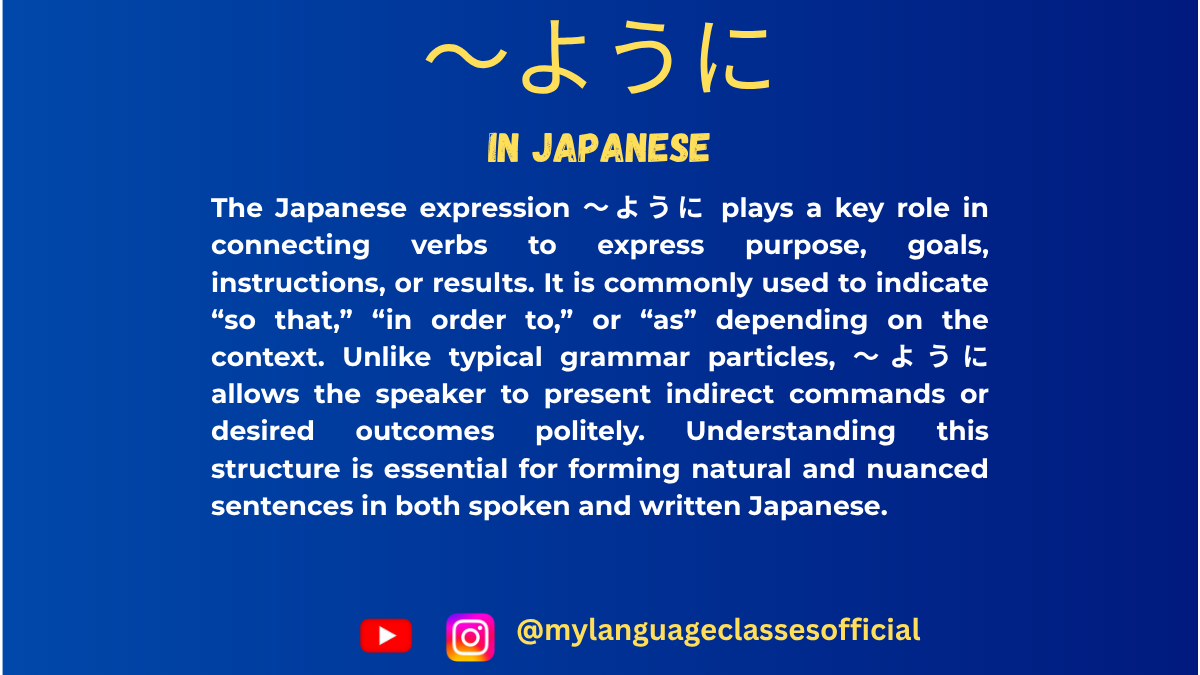
Using 〜ように in Japanese
The Japanese expression 「〜ように」 is an essential grammatical structure that serves various purposes, including expressing hopes, requests, instructions, comparisons, goals, and habitual actions. This guide will provide an in-depth look at the different uses of 「〜ように」, along with clear explanations and example sentences.
1. Expressing Hopes or Wishes
「〜ように」 is used to express a hope or wish for something to happen, similar to saying “I hope that…” in English.
Structure:
Verb (potential form / negative form) + ように
Examples:
- 試験に合格できますように。
(Shiken ni goukaku dekimasu you ni.)
→ “I hope I can pass the exam.” - 雨が降らないように。
(Ame ga furanai you ni.)
→ “I hope it doesn’t rain.”
2. Expressing Goals or Objectives
This usage is similar to saying “in order to” in English. It indicates a goal or purpose for an action.
Structure:
Verb (potential form / dictionary form) + ように
Examples:
- 日本語が話せるように、毎日勉強しています。
(Nihongo ga hanaseru you ni, mainichi benkyou shiteimasu.)
→ “I study every day in order to be able to speak Japanese.” - 風邪を引かないように、マフラーをします。
(Kaze wo hikanai you ni, mafuraa wo shimasu.)
→ “I wear a scarf so that I don’t catch a cold.”
3. Giving Instructions or Advice (Indirect Commands)
When making polite or indirect requests, suggestions, or advice, 「〜ように」 is often used.
Structure:
Verb (plain non-past form) + ように 言う / 注意する / 頼む / 伝える
Examples:
- 先生は学生に宿題を忘れないように言いました。
(Sensei wa gakusei ni shukudai wo wasurenai you ni iimashita.)
→ “The teacher told the students not to forget their homework.” - 医者に早く寝るように注意された。
(Isha ni hayaku neru you ni chuui sareta.)
→ “The doctor advised me to sleep early.” - 彼に遅刻しないように頼みました。
(Kare ni chikoku shinai you ni tanomimashita.)
→ “I asked him not to be late.”
4. Making Comparisons
When used with verbs like なる (to become), 「〜ように」 can indicate a comparison or similarity.
Structure:
Noun + のように / Verb (plain form) + ように
Examples:
- 彼は先生のように話します。
(Kare wa sensei no you ni hanashimasu.)
→ “He speaks like a teacher.” - この部屋はまるでホテルのように綺麗です。
(Kono heya wa marude hoteru no you ni kirei desu.)
→ “This room is as clean as a hotel.”
5. Indicating Habitual Actions or Natural Consequences
This structure shows that something naturally happens or occurs habitually.
Structure:
Verb (dictionary form / negative form) + ようになる
Examples:
- 毎日練習して、日本語が話せるようになった。
(Mainichi renshuu shite, nihongo ga hanaseru you ni natta.)
→ “After practicing every day, I became able to speak Japanese.” - 最近、早く起きるようになりました。
(Saikin, hayaku okiru you ni narimashita.)
→ “Recently, I have started waking up early.”
6. Expressing Something Indirectly
When introducing a previous statement or explanation, 「〜ように」 can mean “as mentioned before” or “as expected.”
Structure:
Verb (plain form) + ように
Examples:
- 前に話したように、このプロジェクトは重要です。
(Mae ni hanashita you ni, kono purojekuto wa juuyou desu.)
→ “As I mentioned before, this project is important.” - 先生が言ったように、復習することが大切です。
(Sensei ga itta you ni, fukushuu suru koto ga taisetsu desu.)
→ “As the teacher said, reviewing is important.”
7. Expressing a Desired Outcome in a Prayer or Wish
This structure is common in prayers and formal expressions.
Structure:
Verb (potential form / negative form) + ように
Examples:
- みんなが幸せになりますように。
(Minna ga shiawase ni narimasu you ni.)
→ “I hope everyone becomes happy.” - 悪いことが起こらないように。
(Warui koto ga okoranai you ni.)
→ “I hope nothing bad happens.”
Summary: Situations Where 「〜ように」 is Used
| Usage | Meaning | Example |
|---|---|---|
| Expressing Hopes or Wishes | “I hope that…” | 試験に合格できますように。 |
| Expressing Goals | “In order to…” | 日本語が話せるように勉強しています。 |
| Giving Instructions / Advice | Indirect commands | 先生は学生に宿題を忘れないように言いました。 |
| Making Comparisons | “Like…” | 彼は先生のように話します。 |
| Indicating Habitual Actions | “To become able to…” | 日本語が話せるようになった。 |
| Introducing Statements | “As mentioned…” | 前に話したように、このプロジェクトは重要です。 |
| Expressing Wishes in Prayer | Formal wishes | みんなが幸せになりますように。 |
Conclusion
「〜ように」 is a versatile and essential grammar structure in Japanese. Understanding its different uses can greatly enhance your ability to communicate hopes, goals, indirect commands, comparisons, and habitual changes. By mastering this structure, you will sound more natural and fluent in Japanese!
Would you like me to cover any other grammar points in detail? Let me know in the comments!
Happy learning! 😊

Vikas Kumar is the founder of My Language Classes, a language learning platform dedicated to helping learners develop practical communication skills in Spanish, Japanese, and English through comprehensive grammar guides, structured learning resources, books, and evidence-informed educational content.
At My Language Classes, we believe that successful language learning is built on clarity, consistency, meaningful practice, and a deep understanding of how languages work. Every article is carefully researched and created to simplify complex concepts, provide practical guidance, and help learners develop confidence through real-world communication.
Inspired by the principles behind How Language Learning Really Works, our mission is to make high-quality language learning accessible to learners around the world by providing accurate, trustworthy, and comprehensive resources that support lasting progress, lifelong learning, and meaningful communication.
Leave a Reply