

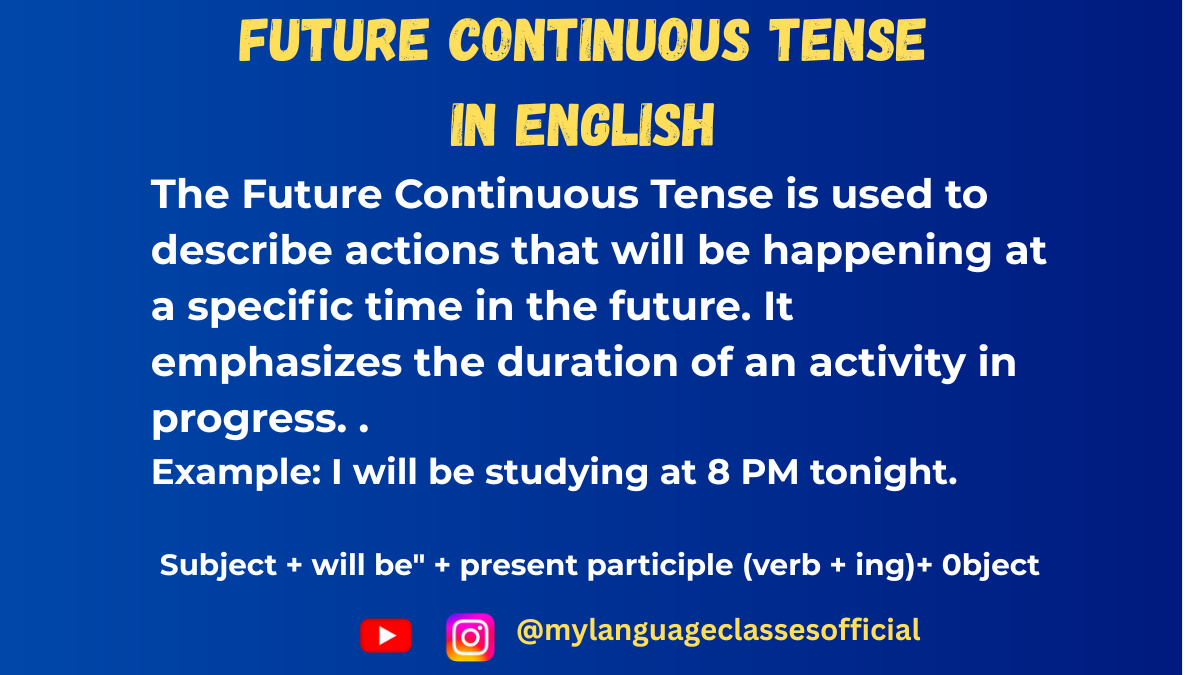
Future Continuous Tense in English helps you describe actions that will be in progress at a particular time in the future. It allows you to explain what someone will be doing at a specific moment, what activities will be happening during a future period, and how two future activities may overlap. Understanding this tense makes it easier to describe schedules, expectations, and future situations with greater precision.
Consider this example: At 8 p.m. tomorrow, I will be studying English.
The sentence tells us what the speaker expects to be doing at a particular future time. It does not say when the study session will begin or end. Instead, it presents studying as an activity that will be in progress at 8 p.m.
This distinction matters because English uses different tense forms to communicate different relationships between actions and time. The Simple Future can describe an action that will happen, while the Future Continuous emphasizes an activity expected to be underway at a future point.
In this guide, we will examine the meaning, formula, sentence structures, and common uses of the Future Continuous Tense. We will also explore its differences from other English tenses, explain frequent grammatical mistakes, and show how to choose the correct form according to the meaning you want to express.
For a broader understanding of English verb forms and how they work together, Complete English Tenses Mastery Guide provides a structured reference to the rules, examples, and usage patterns that help learners develop a clearer understanding of English grammar.
What Is the Future Continuous Tense in English?
The Future Continuous Tense describes an action or activity that will be in progress at a particular time in the future. It helps you explain what someone will be doing at a specific moment or what will be happening during a future period.
For example:
→ At 9 a.m. tomorrow, I will be attending a meeting.
→ This time next week, she will be traveling to New York.
→ They will be working on the new project throughout the afternoon.
In each sentence, the focus is on an activity expected to be in progress during a future period. The sentences do not necessarily tell us when the activities will begin or end. Instead, they present the activities from the perspective of a future time.
How Does the Future Continuous Tense Work?
To understand this tense, imagine looking at a particular moment in the future and describing what is happening at that time.
Suppose your friend calls you at 8 p.m. tomorrow. You expect to be studying English when the call arrives. You could say:
At 8 p.m. tomorrow, I will be studying English.
The sentence describes your expected activity at that future moment. You may begin studying earlier and finish later, but the important point is that the activity will be in progress at 8 p.m.
Consider another example:
This time tomorrow, we will be flying to London.
The sentence presents the flight as an activity expected to be underway at the same time on the following day. It does not focus on the departure or arrival. It focuses on what will be happening during the flight.
This way of looking at future activities makes the Future Continuous useful when discussing schedules, travel, work, study, and everyday plans.
What Is the Main Purpose of the Future Continuous Tense?
The main purpose of the Future Continuous is to describe an activity expected to be in progress at a future reference point.
Compare these sentences:
→ I will read the report tomorrow.
→ I will be reading the report at 10 a.m. tomorrow.
The first sentence uses the Simple Future to describe a future action. The second uses the Future Continuous to emphasize the activity expected to be in progress at a particular time.
The distinction becomes clearer with another example:
→ She will cook dinner tonight.
→ She will be cooking dinner at 7 p.m. tonight.
The first sentence describes a future action without specifying its progress at a particular moment. The second tells us what she is expected to be doing at 7 p.m.
Both sentences are grammatically correct. The appropriate choice depends on the meaning you want to communicate.
Is the Future Continuous Also Called the Future Progressive?
Yes. The Future Continuous Tense is also known as the Future Progressive Tense. Both names refer to the same grammatical construction.
The term continuous emphasizes an activity that is in progress, while progressive describes the same general idea of an ongoing action.
For example:
→ At noon, I will be having lunch.
→ At noon, I will be eating lunch with my colleagues.
Both sentences use the Future Continuous to describe activities expected to be underway at noon.
You may encounter either name in English grammar books and learning materials. The terminology differs, but the basic formula and grammatical uses remain the same.
What Does the Future Continuous Tense Not Necessarily Tell You?
The Future Continuous does not automatically tell you when an activity will start, when it will finish, or whether it will be completed.
Consider this sentence:
At 6 p.m., he will be working on the project.
We know that working is expected to be in progress at 6 p.m. However, the sentence does not tell us when he started working or when he expects to finish.
Now compare it with:
By 6 p.m., he will have completed the project.
This sentence uses the Future Perfect and emphasizes expected completion by 6 p.m.
The difference matters because an activity being in progress and an activity being complete are two different ideas. The Future Continuous focuses on the first, while the Future Perfect focuses on the second.
Understanding this distinction helps you select the appropriate tense instead of using future forms interchangeably.
As you study the Future Continuous alongside other English tense forms, Complete English Tenses Mastery Guide provides a structured reference for understanding their formulas, meanings, and differences.
What Is the Formula for the Future Continuous Tense?
The Future Continuous Tense follows a consistent grammatical structure: will be + present participle. You use this structure to describe an activity that is expected to be in progress at a particular time in the future.
The basic formula is:
Subject + will be + verb-ing
For example:
→ I will be studying English tonight.
→ She will be working at 10 a.m. tomorrow.
→ They will be traveling to Japan next week.
In these sentences, will establishes the future reference, be forms part of the continuous construction, and the verb ending in -ing expresses the ongoing activity.
1. What Is the Formula for Affirmative Sentences?
An affirmative sentence states that an activity will be in progress at a future time.
The formula is:
Subject + will be + present participle + other information
Examples:
→ I will be reading a book this evening.
→ You will be attending the meeting tomorrow.
→ He will be preparing dinner at 7 p.m.
→ She will be studying for her examination tonight.
→ We will be visiting our relatives next weekend.
→ They will be playing soccer after school.
Notice that the auxiliary structure remains the same for every subject. You use will be with I, you, he, she, it, we, and they.
For example, you say She will be working, not She will is working. The verb be follows will in its base form, regardless of the subject.
2. What Is the Formula for Negative Sentences?
A negative sentence indicates that an activity will not be in progress at a particular future time.
The formula is:
Subject + will not be + present participle + other information
Examples:
→ I will not be working tomorrow evening.
→ She will not be attending the meeting at noon.
→ He will not be traveling next weekend.
→ We will not be staying at the hotel on Friday night.
→ They will not be using the conference room tomorrow morning.
In everyday English, will not is commonly shortened to won’t.
For example:
→ I will not be studying at 9 p.m.
→ I won’t be studying at 9 p.m.
Both sentences are grammatically correct. The contraction is common in conversation, while the full form may be preferred in more formal writing.
The important point is that not comes after will, while be remains before the verb ending in -ing.
3. What Is the Formula for Yes/No Questions?
To form a yes/no question, place will before the subject. Keep be and the present participle after the subject.
The formula is:
Will + subject + be + present participle + other information?
Examples:
→ Will you be studying tonight?
→ Will she be working tomorrow morning?
→ Will he be attending the meeting?
→ Will we be traveling together next week?
→ Will they be staying at the hotel?
These questions ask whether an activity is expected to be in progress at a future time or during a future period.
You can answer them with a short response:
→ Yes, I will.
→ No, I will not.
→ Yes, she will.
→ No, she will not.
The short answer uses will or will not without repeating the complete verb phrase. The context makes the intended activity clear.
4. What Is the Formula for WH Questions?
WH questions begin with a question word such as what, where, when, why, or how.
The general formula is:
Question word + will + subject + be + present participle + other information?
Examples:
→ What will you be doing tomorrow evening?
→ Where will she be staying during her trip?
→ When will they be arriving at the office?
→ Why will he be working late tonight?
→ How will you be traveling to the conference?
The question word identifies the information you want. The remaining structure follows the Future Continuous question pattern.
For example, What will you be doing tomorrow evening? asks about an activity expected to be in progress during that future period.
The structure remains consistent even when you change the question word or the subject.
5. How Does the Formula Change With Different Subjects?
The Future Continuous uses the same auxiliary structure with every subject. Unlike the Simple Present, it does not require is, am, or are after the subject.
Examples:
→ I will be reading at 8 p.m.
→ You will be reading at 8 p.m.
→ He will be reading at 8 p.m.
→ She will be reading at 8 p.m.
→ It will be running by tomorrow morning.
→ We will be reading at 8 p.m.
→ They will be reading at 8 p.m.
The verb form remains unchanged because will is followed by the base form be, which is followed by the present participle.
This consistency makes the Future Continuous easier to form once you understand its basic pattern.
6. How Do You Form the -ing Verb Correctly?
The Future Continuous requires the present participle, which is generally formed by adding -ing to the base verb. However, some verbs require spelling changes.
Examples:
→ Work → working
→ Read → reading
→ Play → playing
→ Make → making
→ Write → writing
→ Run → running
→ Sit → sitting
→ Lie → lying
For most verbs, you simply add -ing. When a verb ends in a silent e, that letter is usually dropped before adding -ing. Some short verbs ending in a consonant require the final consonant to be doubled. Verbs ending in -ie generally change that ending to -y before adding -ing.
For example:
→ She will be writing an email tomorrow morning.
→ They will be running in the park this evening.
→ He will be making dinner at 7 p.m.
→ We will be lying on the beach next weekend.
Correct spelling matters because the present participle is an essential part of the Future Continuous structure.
How Can You Remember the Future Continuous Formula?
The most reliable approach is to remember the three essential components:
→ Will establishes the future reference.
→ Be forms part of the continuous construction.
→ The present participle describes the ongoing activity.
Once you understand these components, you can form affirmative sentences, negative sentences, and questions without changing the basic verb structure.
For example, the affirmative sentence She will be studying tonight becomes She will not be studying tonight in the negative form and Will she be studying tonight? as a yes/no question.
For a broader understanding of English tense formulas and their differences, Complete English Tenses Mastery Guide provides a structured reference to the grammatical patterns and usage rules that help you form accurate sentences.
How Do You Form Affirmative Sentences in the Future Continuous Tense?
Affirmative sentences in the Future Continuous Tense describe activities that are expected to be in progress at a particular time in the future. To form them correctly, use will be followed by the present participle of the main verb.
The basic formula is:
Subject + will be + verb-ing + other information
For example:
→ I will be studying English at 8 p.m. tonight.
→ She will be working from home tomorrow morning.
→ They will be traveling to Chicago next week.
Each sentence describes an activity expected to be underway at a future time. The structure stays the same regardless of the subject, so you do not need to change will be for different people or things.
1. How Do You Form Affirmative Sentences With Different Subjects?
The Future Continuous uses the same auxiliary structure with all subjects. Whether the subject is I, you, he, she, it, we, or they, the formula remains will be + verb-ing.
Examples:
→ I will be reading a novel this evening.
→ You will be attending the conference tomorrow.
→ He will be preparing for his examination tonight.
→ She will be teaching English at 10 a.m.
→ It will be raining in the afternoon.
→ We will be visiting our relatives this weekend.
→ They will be playing soccer after school.
Notice that the verb phrase does not change according to the subject. You say he will be working and they will be working. You do not use will is, will are, or will am.
This consistency makes the Future Continuous relatively straightforward to form once you understand its basic structure.
2. How Do You Use the Future Continuous With Regular Verbs?
Regular verbs generally form the present participle by adding -ing to the base form. You can then place the resulting form after will be.
Examples:
→ Work → working: I will be working late tomorrow.
→ Read → reading: She will be reading a book tonight.
→ Play → playing: They will be playing tennis this weekend.
→ Talk → talking: We will be talking to the manager tomorrow.
→ Watch → watching: He will be watching the game at 7 p.m.
The main verb remains in its -ing form regardless of the subject. The auxiliary phrase will be carries the grammatical structure of the Future Continuous.
For example, She will be reading a book tonight describes an activity expected to be in progress during the evening. The sentence does not necessarily indicate when she will start or finish reading.
3. How Do You Form the Present Participle When Spelling Changes Are Required?
Some verbs require spelling changes before you add -ing. Applying these rules correctly helps you avoid common mistakes in Future Continuous sentences.
When a verb ends in a silent e, you usually remove the e before adding -ing.
Examples:
→ Make → making: She will be making dinner tonight.
→ Write → writing: I will be writing an article tomorrow.
→ Drive → driving: He will be driving to work in the morning.
Some short verbs ending in a consonant require the final consonant to be doubled.
Examples:
→ Run → running: They will be running in the park tomorrow morning.
→ Sit → sitting: We will be sitting near the front during the presentation.
→ Swim → swimming: She will be swimming at the pool this afternoon.
When a verb ends in -ie, the ending generally changes to -y before adding -ing.
Examples:
→ Lie → lying: He will be lying on the beach tomorrow afternoon.
→ Die → dying: The plant will be dying if it does not receive enough water.
The correct form of the present participle is essential because the Future Continuous requires the -ing form of the main verb.
4. How Do You Use Time Expressions in Affirmative Sentences?
Time expressions help identify when an activity is expected to be in progress. They often appear at the end or beginning of a Future Continuous sentence.
Examples:
→ At 9 a.m. tomorrow, I will be attending a meeting.
→ She will be studying English this evening.
→ This time next week, we will be staying in New York.
→ They will be working on the project throughout the afternoon.
→ At midnight, he will be traveling home.
These expressions establish the future reference point or period. For example, at 9 a.m. tomorrow identifies a specific moment, while throughout the afternoon describes a broader period.
The time expression does not determine the tense by itself. The Future Continuous is appropriate when the sentence presents the activity as expected to be in progress at the stated time.
5. How Do You Describe Work and Study Activities?
The Future Continuous is particularly useful when discussing work and study schedules because it helps describe what someone expects to be doing at a future time.
Examples:
→ I will be preparing a presentation tomorrow morning.
→ She will be attending classes throughout the afternoon.
→ He will be reviewing the documents at 3 p.m.
→ We will be discussing the new proposal during the meeting.
→ They will be studying English at the library tonight.
These sentences focus on the activities expected to be underway during the specified times. They do not necessarily tell us whether the activities will be completed by then.
For example, I will be preparing a presentation tomorrow morning describes the expected activity during that period. If you want to emphasize that the presentation will be complete by a deadline, the Future Perfect may communicate that meaning more clearly.
6. How Do You Describe Travel and Personal Activities?
Affirmative Future Continuous sentences can also describe travel, social plans, and everyday activities.
Examples:
→ We will be flying to Boston this time tomorrow.
→ She will be visiting her grandparents next weekend.
→ I will be having lunch with my colleagues at noon.
→ They will be staying at a hotel near the airport.
→ He will be shopping for groceries tomorrow evening.
These sentences present the activities as expected to be underway during a future period. Depending on the context, they can describe planned activities or what the speaker expects will be happening.
For example, We will be flying to Boston this time tomorrow focuses on the flight expected to be in progress at that future moment. It does not focus on the departure or arrival.
7. What Are the Most Common Mistakes in Affirmative Sentences?
Several errors occur when learners form affirmative sentences in the Future Continuous.
Incorrect: She will working tomorrow morning.
Correct: She will be working tomorrow morning.
The verb be is required after will.
Incorrect: He will be work at 10 a.m.
Correct: He will be working at 10 a.m.
The main verb must appear in its present participle form.
Incorrect: They will are playing soccer this evening.
Correct: They will be playing soccer this evening.
The Future Continuous uses will be, not will are.
Incorrect: I will be write an email tonight.
Correct: I will be writing an email tonight.
The main verb must end in -ing, with any necessary spelling changes.
These corrections illustrate the same underlying rule: affirmative Future Continuous sentences require will be followed by the present participle.
How Can You Form Affirmative Sentences Correctly?
Use the following guidelines when writing affirmative sentences in the Future Continuous.
→ Begin with the subject.
→ Add will be without changing the auxiliary structure for different subjects.
→ Use the present participle of the main verb.
→ Add a time expression when it helps clarify when the activity is expected to be in progress.
→ Check the spelling of verbs ending in e, short verbs requiring consonant doubling, and verbs ending in ie.
For example, By 8 p.m. tomorrow, I will be preparing my presentation follows the correct structure and identifies the future period during which the activity is expected to be underway.
Understanding affirmative sentence formation gives you a foundation for learning negative sentences and questions in the same tense. For a broader explanation of English tense structures and their uses, Complete English Tenses Mastery Guide provides a structured reference to grammatical formulas, rules, and examples.
How Do You Form Negative Sentences in the Future Continuous Tense?
To form a negative sentence in the Future Continuous Tense, place not after will and before be. Keep the main verb in its -ing form.
The formula is:
Subject + will not be + verb-ing + other information
For example:
→ I will not be working tomorrow evening.
→ She will not be attending the meeting at noon.
→ They will not be staying at the hotel on Friday night.
→ We will not be traveling this weekend.
→ He will not be sleeping at 10 p.m.
These sentences describe activities that are not expected to be in progress at a particular future time. The negative form follows the same structure regardless of the subject. You do not need to change the form of will or be for different subjects.
How Do You Use the Contraction Won’t?
In everyday English, speakers often use won’t instead of will not. Both forms are grammatically correct, and the contraction is especially common in conversations and informal writing.
The formula becomes:
Subject + won’t be + verb-ing + other information
For example:
→ I will not be working tomorrow evening.
→ I won’t be working tomorrow evening.
→ She will not be attending the meeting at noon.
→ She won’t be attending the meeting at noon.
→ They will not be staying at the hotel on Friday night.
→ They won’t be staying at the hotel on Friday night.
The meaning remains the same. Remember that won’t replaces will not, but the word be must remain in the sentence before the main verb’s -ing form.
How Do You Change an Affirmative Sentence Into a Negative Sentence?
You can convert an affirmative Future Continuous sentence into a negative one by placing not after will. Keep the remaining sentence structure unchanged.
Consider these examples:
→ Affirmative: He will be driving at 8 p.m.
→ Negative: He will not be driving at 8 p.m.
→ Affirmative: We will be studying tomorrow afternoon.
→ Negative: We will not be studying tomorrow afternoon.
→ Affirmative: Maria will be waiting outside the office at noon.
→ Negative: Maria will not be waiting outside the office at noon.
Notice that the verb be stays in place, and the main verb retains its -ing form. You do not need to change the time expression or rearrange the sentence.
What Does a Negative Future Continuous Sentence Mean?
A negative sentence usually indicates that an activity will not be in progress at a specified future time. However, it does not necessarily mean that the activity will not happen at all.
For example:
→ I will not be working at 9 p.m. tomorrow.
This sentence tells the listener that the speaker does not expect to be working at that time. The speaker might work earlier in the day or resume work later.
Similarly:
→ They will not be traveling on Monday morning.
This statement indicates that travel is not expected to be in progress on Monday morning. It does not rule out travel at another time.
Understanding this distinction helps you use the Future Continuous Tense to describe future situations accurately.
For a broader understanding of English verb structures, Complete English Tenses Mastery Guide by My Language Classes explains how tense formulas, sentence patterns, and time references work together to express meaning clearly.
How Do You Form Yes/No Questions in the Future Continuous Tense?
To form a yes/no question in the Future Continuous Tense, place will before the subject. Keep be after the subject and use the main verb in its -ing form.
The formula is:
Will + subject + be + verb-ing + other information?
For example:
→ Will you be working tomorrow evening?
→ Will she be attending the meeting at noon?
→ Will they be staying at the hotel on Friday night?
→ Will he be studying at 8 p.m.?
→ Will we be traveling together next week?
Each question asks whether an activity is expected to be in progress at a particular future time or during a future period.
How Do You Change a Statement Into a Yes/No Question?
You can turn an affirmative Future Continuous sentence into a yes/no question by moving will to the beginning. The other parts of the sentence remain in the same order.
Consider these examples:
→ Statement: You will be working tomorrow morning.
→ Question: Will you be working tomorrow morning?
→ Statement: Maria will be waiting outside the office.
→ Question: Will Maria be waiting outside the office?
→ Statement: They will be discussing the proposal at 3 p.m.
→ Question: Will they be discussing the proposal at 3 p.m.?
Notice that be stays immediately before the main verb’s -ing form. You should not remove be or change the main verb to its base form.
For example, Will you be working tomorrow? is correct, while Will you working tomorrow? and Will you be work tomorrow? are incorrect.
How Do You Answer Yes/No Questions in the Future Continuous Tense?
You can answer these questions with a short answer or a complete sentence. Short answers commonly use will or will not, while complete answers can repeat the Future Continuous structure.
For example:
Question: Will you be working tomorrow evening?
→ Yes, I will.
→ No, I will not.
→ Yes, I will be working tomorrow evening.
→ No, I will not be working tomorrow evening.
Consider a few more examples:
Question: Will she be attending the meeting at noon?
→ Yes, she will.
→ No, she will not.
Question: Will they be staying at the hotel on Friday night?
→ Yes, they will.
→ No, they will not.
In everyday conversation, speakers often use won’t in negative short answers.
→ No, I won’t.
→ No, she won’t.
→ No, they won’t.
The short answer does not need to repeat the main verb because the question already establishes the activity being discussed.
When Should You Use Yes/No Questions in the Future Continuous Tense?
Use this question structure when you want to ask about an activity expected to be in progress at a future time. It can also help you ask about someone’s plans in a polite, neutral way.
For example:
→ Will you be using the computer this afternoon?
→ Will you be driving to the office tomorrow?
→ Will your team be working on the project next week?
→ Will you be joining us for dinner tonight?
The first three questions ask about anticipated activities. The last question can also sound less direct than asking someone whether they intend to join you. The exact meaning depends on the situation and the speaker’s intention.
Understanding how will, be, and the -ing form work together makes it easier to form accurate questions across different subjects and situations. For a more complete explanation of English tense structures, Complete English Tenses Mastery Guide by My Language Classes covers the formulas and uses that help you express future actions clearly.
How Do You Form WH Questions in the Future Continuous Tense?
WH questions in the Future Continuous Tense ask for specific information about an activity expected to be in progress at a future time. These questions begin with words such as what, where, when, why, who, and how.
The basic formula is:
WH word + will + subject + be + verb-ing + other information?
For example:
→ What will you be doing tomorrow evening?
→ Where will she be staying during her trip?
→ When will they be arriving at the office?
→ Why will he be working late tonight?
→ How will you be traveling to the conference?
Each question seeks information beyond a simple yes or no. The WH word determines the type of information you want to know, while the rest of the sentence follows the Future Continuous structure.
How Do You Form WH Questions With Different Question Words?
The choice of WH word depends on the information you need. The sentence structure generally stays the same, although questions about the subject can follow a different pattern.
What asks about an activity or action.
→ What will you be studying next semester?
→ What will they be discussing during the meeting?
Where asks about a location.
→ Where will you be working next year?
→ Where will your family be staying this weekend?
When asks about a time.
→ When will she be leaving for the airport?
→ When will you be meeting the new manager?
Why asks about a reason.
→ Why will they be moving to another city?
→ Why will he be staying at the office late?
How asks about a method, manner, or process.
→ How will you be preparing for the examination?
→ How will they be handling customer requests tomorrow?
In each example, will comes before the subject, followed by be and the main verb in its -ing form.
How Do You Ask About the Subject of a Future Activity?
When who asks which person will perform an activity, the sentence structure can change because who itself acts as the subject.
For example:
→ Who will be leading the discussion tomorrow?
→ Who will be presenting the report at the meeting?
→ Who will be looking after the children this evening?
In these questions, who replaces the subject. You do not add another subject after will because the question word already identifies the person performing the action.
However, when you ask about the object of an activity, you retain the usual question structure.
→ Who will you be meeting tomorrow?
→ Who will she be helping during the event?
In the first pair of examples, who asks about the person performing the activity. In the second pair, it asks about the person receiving the action.
How Do You Form WH Questions With Prepositions?
Some WH questions include prepositions such as with, for, or about. In everyday English, these prepositions often appear at the end of the question.
For example:
→ Who will you be traveling with?
→ What will she be working on tomorrow?
→ Which client will they be meeting with next week?
→ What will he be writing about during the workshop?
These structures are natural in modern English. The preposition provides additional information about the relationship between the activity and the person or thing mentioned in the question.
What Mistakes Should You Avoid When Forming WH Questions?
A common mistake is leaving out be or placing the main verb in its base form.
Incorrect: What will you doing tomorrow?
Correct: What will you be doing tomorrow?
Incorrect: Where will she be stay next week?
Correct: Where will she be staying next week?
Another mistake is using the statement word order after the WH word.
Incorrect: What you will be doing tomorrow?
Correct: What will you be doing tomorrow?
Remember the standard pattern: begin with the WH word, place will before the subject, and follow the subject with be and the -ing form. When who acts as the subject, use the corresponding subject-question structure.
For a broader understanding of how English tense patterns work across statements, negatives, and questions, Complete English Tenses Mastery Guide by My Language Classes explains the structures and distinctions that help you form sentences accurately.
What Is the Role of Will, Be, and the -ing Form in the Future Continuous Tense?
The Future Continuous Tense follows a consistent structure: will + be + verb-ing. Each part contributes to the meaning and grammatical form of the sentence. Understanding these components helps you form accurate statements, negatives, and questions without memorizing separate rules for every subject.
Consider this example:
→ She will be studying at 8 p.m. tomorrow.
Here, will places the activity in the future, be completes the required verb structure, and studying presents the activity as ongoing at the specified time.
How Does Will Work in the Future Continuous Tense?
The word will is a modal auxiliary verb used to express future meaning. In the Future Continuous Tense, it appears before the subject in questions and after the subject in statements.
For example:
→ I will be working tomorrow morning.
→ He will be traveling next week.
→ They will be preparing for the meeting at noon.
Unlike some present and past tense forms, will does not change according to the subject. You use the same form with I, you, he, she, it, we, and they.
→ I will be reading.
→ She will be reading.
→ They will be reading.
Do not add -s to the main verb because the subject is singular. The main verb takes the -ing form in every case.
Why Is Be Necessary After Will?
In the Future Continuous Tense, be follows will and comes before the main verb in its -ing form. This structure is essential to the tense.
Compare these sentences:
→ Correct: I will be working at 6 p.m.
→ Incorrect: I will working at 6 p.m.
The second sentence is grammatically incorrect because it leaves out be. The modal verb will is followed by the base form of a verb, and the continuous construction requires be before the -ing form.
The word be remains unchanged, regardless of the subject.
→ She will be cooking dinner.
→ We will be cooking dinner.
→ They will be cooking dinner.
You should not replace be with am, is, or are after will. For example, She will be cooking dinner is correct, while She will is cooking dinner is incorrect.
What Is the Purpose of the -ing Form?
The main verb takes its present participle form, which usually means adding -ing to the base verb. This form helps express an activity that is expected to be in progress at a future reference point.
For example:
→ work becomes working
→ read becomes reading
→ study becomes studying
→ write becomes writing
→ make becomes making
Some verbs require spelling changes before you add -ing. For example, write becomes writing because the final e is removed. Similarly, run becomes running because the final consonant is doubled.
Consider how the verb form affects these sentences:
→ I will read the report tomorrow.
→ I will be reading the report at 10 a.m. tomorrow.
The first sentence states a future activity. The second presents reading as an activity expected to be in progress at a particular time. The verb structure helps communicate this difference.
How Do Will, Be, and the -ing Form Work Together?
These three components form a single grammatical structure. Removing one or changing the order can make the sentence incorrect or alter its meaning.
| Component | Function | Example |
|---|---|---|
| Will | Establishes future meaning | will |
| Be | Forms the continuous verb structure | will be |
| Verb-ing | Presents the activity as ongoing | will be working |
The complete pattern is subject + will + be + verb-ing.
→ She will be teaching at 11 a.m.
→ We will be discussing the proposal tomorrow.
→ They will be waiting outside the station at noon.
The same components appear in negative sentences and questions, although their order changes.
→ Negative: She will not be teaching at 11 a.m.
→ Yes/no question: Will she be teaching at 11 a.m.?
→ WH question: Where will she be teaching tomorrow?
Learning the purpose of each component makes the Future Continuous Tense easier to understand and apply. For a systematic explanation of English verb forms and their relationships, Complete English Tenses Mastery Guide by My Language Classes covers the structures that help you build accurate sentences and express time clearly.
When Do You Use the Future Continuous Tense?
The Future Continuous Tense describes activities that are expected to be in progress at a particular future time. It helps you present a future situation from the viewpoint of an ongoing action rather than simply stating that something will happen.
For example:
→ I will be working at 9 a.m. tomorrow.
→ She will be traveling to Madrid this time next week.
→ They will be having dinner when we arrive.
In each sentence, the speaker presents an activity as ongoing at a future point or during a future situation. The tense is especially useful when you want to describe what someone will be doing, explain expected activities, or ask about another person’s plans.
1. To Describe an Action in Progress at a Specific Future Time
One of the most common uses of the Future Continuous Tense is to describe an activity that is expected to be happening at a particular future time.
For example:
→ I will be attending a meeting at 10 a.m. tomorrow.
→ She will be teaching her English class at 4 p.m.
→ We will be traveling to Jaipur this time tomorrow.
→ The students will be taking their examination at noon.
The time reference helps you imagine the activity as it unfolds. The sentences do not necessarily tell you when the activity begins or ends. They focus on what will be happening at the specified time.
2. To Describe Activities During a Future Period
You can use the Future Continuous Tense to describe activities that are expected to take place over a future period, especially when the activity itself is the focus.
For example:
→ I will be working on my book throughout the weekend.
→ She will be staying with her relatives during the summer holidays.
→ They will be renovating their house next month.
→ We will be studying English during the winter break.
These sentences present activities associated with a future period. They do not necessarily establish that the activity will continue without interruption throughout that entire period.
3. To Talk About Expected Future Activities
The Future Continuous Tense can describe activities that you expect to happen as part of a person’s routine, schedule, or circumstances.
For example:
→ The manager will be meeting the new employees tomorrow.
→ My brother will be attending university next year.
→ The team will be preparing the final report this afternoon.
→ We will be visiting our grandparents during the holidays.
These statements present the activities as expected future events. Depending on the context, the speaker may be describing a planned activity, a regular expectation, or something anticipated to be happening at that time.
4. To Ask Polite Questions About Someone’s Plans
The Future Continuous Tense can make questions about another person’s activities sound neutral and considerate. It allows you to ask what someone will be doing without directly asking them to make a decision or commitment.
For example:
→ Will you be using the meeting room this afternoon?
→ Will you be driving to the office tomorrow?
→ Will you be attending the conference next week?
→ Will you be staying for dinner tonight?
These questions can help you coordinate schedules, check availability, or make arrangements. Their tone depends on the situation, but the Future Continuous often provides a natural way to ask about anticipated activities.
5. To Describe Two Activities Happening at the Same Future Time
You can use the Future Continuous Tense to describe two activities that are expected to happen simultaneously.
For example:
→ I will be preparing dinner while my sister will be setting the table.
→ The students will be taking notes while the teacher will be explaining the lesson.
→ She will be working in the office while her husband will be traveling abroad.
In these examples, both activities are presented as ongoing during the same future period. Words such as while help establish the relationship between them.
You can also use the Future Continuous in one clause and another suitable tense in the second clause when the sentence expresses a different relationship between the activities.
6. To Describe an Activity in Progress When Another Event Occurs
The Future Continuous Tense can describe an activity that is expected to be in progress when another future event happens. The other event often appears in a clause beginning with when or while.
For example:
→ I will be cooking when you arrive.
→ She will be sleeping when the train reaches the station.
→ They will be discussing the proposal when the director joins the meeting.
The Future Continuous presents the ongoing activity, while the other clause identifies the event that occurs during it.
Notice that English generally uses the simple present in a future time clause beginning with when, rather than placing will in that clause. Therefore, I will be cooking when you arrive is correct, while I will be cooking when you will arrive is generally incorrect in this context.
How Do You Choose the Right Use?
The best way to choose the Future Continuous Tense is to consider how you want to present the activity.
→ Use it when you want to describe what will be happening at a particular future time.
→ Use it when you want to describe an activity associated with a future period.
→ Use it when you want to discuss expected activities or ask neutral questions about plans.
→ Use it when you want to show that one activity will be in progress during another future event.
The central idea remains consistent across these uses. The Future Continuous Tense presents an activity as ongoing from a future point of view. Understanding this meaning helps you choose the tense based on the situation instead of relying only on time expressions.
For a broader understanding of how English tenses express actions, time, and duration, Complete English Tenses Mastery Guide by My Language Classes explains the structures and distinctions that help you choose the appropriate tense in different contexts.
How Do You Use the Future Continuous for Actions in Progress at a Future Time?
The Future Continuous Tense describes an activity that will be in progress at a specific future time. It allows you to focus on what someone will be doing at that moment rather than simply stating that an action will happen.
The basic formula is:
Subject + will + be + verb-ing + future time reference
For example:
→ I will be studying at 8 p.m. tonight.
→ She will be teaching her class at 10 a.m. tomorrow.
→ They will be traveling to Tokyo this time next week.
→ We will be discussing the proposal at noon.
Each sentence identifies a future time when the activity is expected to be underway. The activity may begin earlier and finish later, but the sentence focuses on the period when it is in progress.
How Do You Describe an Activity at an Exact Future Time?
You can use the Future Continuous Tense with a specific clock time, date, or scheduled moment to describe an expected ongoing activity.
For example:
→ At 7 a.m. tomorrow, I will be preparing breakfast.
→ At 11 a.m., the students will be taking their examination.
→ At 3 p.m. on Friday, our team will be reviewing the results.
→ At midnight, the travelers will be crossing the border.
The expressions at 7 a.m. tomorrow, at 11 a.m., at 3 p.m. on Friday, and at midnight establish the reference points. The Future Continuous explains what is expected to be happening at those times.
Compare these two sentences:
→ I will finish the report at 5 p.m. tomorrow.
→ I will be writing the report at 5 p.m. tomorrow.
The first sentence presents the report’s completion as a future event. The second describes writing as an activity expected to be in progress at 5 p.m. The difference lies in the speaker’s focus, not simply in the time reference.
How Do You Use This Time to Describe Future Situations?
You can also use expressions such as this time tomorrow, this time next week, and this time next year to compare a future moment with the present.
For example:
→ This time tomorrow, I will be flying to London.
→ This time next week, she will be attending an international conference.
→ This time next month, we will be moving into our new office.
→ This time next year, they will be studying at university.
These expressions encourage the reader or listener to imagine a future scene. The Future Continuous presents the activity as ongoing at that point.
However, the activity does not have to continue throughout the entire day, week, month, or year. The sentence focuses on the activity at the future reference point.
How Do You Use the Future Continuous With a Future Event?
An activity may already be in progress when another future event occurs. In such cases, the Future Continuous can describe the ongoing activity, while the simple present identifies the event that occurs during it.
For example:
→ I will be working when you arrive.
→ She will be sleeping when her flight lands.
→ They will be having lunch when the meeting begins.
→ We will be driving home when the storm reaches the city.
In these sentences, the first activity is expected to be in progress when the second event happens. The time clause uses the simple present because English generally uses the simple present to refer to future events after when in this type of sentence.
The structure is particularly useful when you want to explain what will be happening at the moment another event takes place.
What Should You Remember About Future Time References?
A future time expression often makes the meaning of the Future Continuous easier to understand, but the expression alone does not determine which tense you should use. The intended meaning matters more.
Compare the following sentences:
→ At 9 a.m. tomorrow, I will attend the meeting.
→ At 9 a.m. tomorrow, I will be attending the meeting.
The first sentence presents attendance as a future event. The second emphasizes the activity as something expected to be underway at that time. In a suitable context, both sentences can be correct.
The Future Continuous is especially useful when you want readers or listeners to picture an activity unfolding at a future moment. Once you understand this viewpoint, choosing the tense becomes easier because you can focus on the meaning you want to communicate.
For a deeper explanation of English tense structures and the differences between future forms, Complete English Tenses Mastery Guide by My Language Classes provides a structured reference for understanding how verb forms express time and ongoing actions.
How Do You Use the Future Continuous for Activities During a Future Period?
The Future Continuous Tense can describe activities that are expected to take place during a future period. It is useful when you want to explain what someone will be doing over a period of time without focusing on the exact beginning or ending of the activity.
For example:
→ I will be working on my book this weekend.
→ She will be staying with her grandparents during the holidays.
→ They will be renovating their house next month.
→ We will be studying English throughout the summer.
These sentences connect an activity with a future period. They focus on the nature of the activity rather than presenting it as a single completed event.
However, the Future Continuous does not automatically mean that an activity will continue without interruption throughout the entire period. The surrounding context determines how long the activity is expected to continue.
How Do You Describe Activities Over Several Days?
You can use the Future Continuous to describe activities associated with a period lasting several days. This is particularly useful when discussing work, travel, study, or temporary living arrangements.
For example:
→ I will be attending a training program next week.
→ My sister will be preparing for her final examinations over the next few days.
→ We will be traveling around Spain during our vacation.
→ The engineers will be inspecting the building throughout the week.
Each sentence presents an activity expected to take place during a future period. The exact duration of the activity may depend on the circumstances.
For instance, I will be attending a training program next week does not necessarily mean that the training will occupy every hour of the week. It identifies the activity associated with that period.
How Do You Talk About Work and Study During a Future Period?
The Future Continuous is useful for describing ongoing professional or academic activities. It allows you to discuss what people will be occupied with during a particular period.
For example:
→ Our team will be developing a new website this month.
→ I will be writing several chapters of my book over the next two weeks.
→ The students will be preparing their presentations during the semester.
→ She will be teaching English classes throughout the summer.
These sentences emphasize activities that are expected to occupy time in the future. They can also help explain why someone may be busy or unavailable during a particular period.
Consider this example:
→ I will be working on a new project next week, so I may not be available for long meetings.
The Future Continuous establishes the expected activity, while the second clause explains its practical consequence. This structure makes the sentence useful in everyday professional communication.
How Do You Describe Travel and Temporary Arrangements?
You can use the Future Continuous when discussing activities connected with travel, holidays, or temporary stays.
For example:
→ We will be exploring Barcelona during our vacation.
→ He will be staying at a hotel near the airport for three nights.
→ They will be visiting several museums during their trip.
→ I will be living with my cousin while I look for an apartment.
The tense presents these activities as part of a future period. It can help listeners understand what someone expects to be doing while away from home or occupied with a temporary situation.
Some of these sentences may also describe planned activities. The Future Continuous can overlap with other future forms, so the most suitable tense depends on whether you want to emphasize an ongoing activity, an arrangement, or a completed event.
How Is the Future Continuous Different From the Simple Future?
The Simple Future and Future Continuous can both describe future activities, but they present those activities differently.
Compare these examples:
→ I will study English next week.
→ I will be studying English next week.
The first sentence states that studying English will happen in the future. Depending on the context, it may express an intention, prediction, or decision.
The second sentence presents studying English as an activity expected to occupy time during the following week. It draws more attention to the ongoing nature of the activity.
Consider another comparison:
→ She will work on the report tomorrow.
→ She will be working on the report tomorrow.
Both sentences can be correct. The first makes a general statement about future work, while the second emphasizes the activity as something expected to be underway or to occupy time tomorrow.
The distinction is not absolute. Context, rather than the tense alone, determines the full meaning.
What Should You Remember When Describing a Future Period?
When you use the Future Continuous for activities during a future period, focus on the activity and its expected place within that period.
→ Use it to describe work, study, travel, or other activities expected to occupy future time.
→ Use expressions such as next week, during the holidays, over the next few days, and throughout the summer when they fit the intended meaning.
→ Do not assume that the activity must continue every moment of the stated period.
→ Consider the Simple Future when you want to make a general statement about a future event rather than emphasize an ongoing activity.
Understanding this distinction helps you describe future activities more precisely. For a systematic explanation of how English tenses express time, actions, and duration, Complete English Tenses Mastery Guide by My Language Classes covers the grammatical patterns that help you select the right tense for different contexts.
How Do You Use the Future Continuous for Expected Future Events?
The Future Continuous Tense can describe activities that you expect to happen as part of a future situation, schedule, or routine. It presents an activity as something that will be underway or occupying time in the future.
For example:
→ The manager will be meeting the new employees tomorrow.
→ I will be attending a conference next week.
→ They will be preparing the annual report this afternoon.
→ We will be celebrating my parents’ anniversary on Saturday.
These sentences describe expected future activities. Depending on the context, the activities may be planned, anticipated, or part of an established schedule. The Future Continuous emphasizes the activity rather than simply announcing that an event will occur.
How Do You Describe Expected Activities at Work?
The Future Continuous is useful when discussing professional activities that are expected to take place at a particular time or during a future period.
For example:
→ The director will be interviewing candidates tomorrow morning.
→ Our team will be reviewing the new proposal at 2 p.m.
→ The accountant will be preparing the financial statements next week.
→ I will be meeting several clients during the business trip.
These sentences help communicate what people are expected to be doing. They are particularly useful when discussing workloads, coordinating schedules, or explaining professional commitments.
Compare these two sentences:
→ The director will interview the candidates tomorrow.
→ The director will be interviewing the candidates tomorrow.
Both are grammatically correct. The first presents the interviews as a future event, while the second emphasizes the activity as something expected to take place during the specified period.
How Do You Describe Expected Activities in Daily Life?
You can use the Future Continuous to talk about ordinary activities that you anticipate doing in the future.
For example:
→ I will be shopping for groceries this evening.
→ She will be visiting her grandparents tomorrow.
→ We will be watching a movie after dinner.
→ My brother will be preparing for his examination this weekend.
The tense allows you to describe expected activities naturally. It can also provide context when explaining your availability or discussing plans with other people.
For example:
→ I will be studying this evening, so I may not answer the phone immediately.
Here, the Future Continuous explains the activity that is expected to occupy your time. The second clause describes a possible consequence.
Does the Future Continuous Always Describe a Fixed Plan?
No. The Future Continuous does not always indicate a formally arranged or confirmed plan. It can also describe an activity that the speaker expects to be happening in the future.
Consider these examples:
→ The company will be expanding its operations next year.
→ Many students will be preparing for their examinations in March.
→ The weather conditions will be affecting travel throughout the afternoon.
These sentences present anticipated activities or situations. The speaker may be making an informed prediction rather than referring to a personal arrangement.
The distinction depends on the context. The tense itself emphasizes an activity expected to be ongoing or to occupy a future period, while other words and circumstances help explain why the speaker expects it to happen.
How Is the Future Continuous Different From a Simple Prediction?
The Simple Future often expresses a prediction, decision, promise, or future event. The Future Continuous focuses more directly on an activity expected to be in progress.
Compare these examples:
→ She will give a presentation tomorrow.
→ She will be giving a presentation tomorrow.
The first sentence announces a future event. The second emphasizes the presentation as an activity expected to take place during that period.
Consider another pair:
→ They will discuss the new policy at the meeting.
→ They will be discussing the new policy at the meeting.
Both sentences can describe the same future situation. The second places greater emphasis on the discussion as an ongoing activity.
These differences are matters of meaning and emphasis. The Future Continuous is not automatically more accurate or more appropriate than the Simple Future. Choose the form that communicates your intended meaning.
What Should You Remember About Expected Future Activities?
The Future Continuous helps you describe activities that you anticipate will be happening in the future. You can use it for professional commitments, everyday activities, schedules, and reasonable expectations.
→ Use it when you want to emphasize an activity rather than merely announce a future event.
→ Use it when the activity is expected to be underway or to occupy time during a future period.
→ Do not assume that every Future Continuous sentence refers to a formally confirmed arrangement.
→ Consider the Simple Future when your main purpose is to express a prediction, decision, promise, or general statement about the future.
Understanding the relationship between grammatical structure and intended meaning helps you use the Future Continuous more naturally. For a systematic explanation of English tense forms and their differences, Complete English Tenses Mastery Guide by My Language Classes provides a structured reference for building accurate sentences and expressing future activities clearly.
How Do You Use the Future Continuous for Polite Questions About Plans?
The Future Continuous Tense can make questions about someone’s future activities sound polite, neutral, and considerate. It allows you to ask what a person will be doing without directly asking them to make a decision or commit to a plan.
For example:
→ Will you be using the meeting room this afternoon?
→ Will you be joining us for dinner tonight?
→ Will you be traveling to the office tomorrow?
→ Will you be attending the conference next week?
These questions ask about expected future activities. Depending on the context, they can help you check availability, coordinate schedules, or make arrangements without putting unnecessary pressure on the other person.
How Does the Future Continuous Make Questions More Polite?
The Future Continuous often presents a question as an inquiry about an activity that may already be part of someone’s plans. This can make the question feel less direct than asking whether the person intends to do something.
Compare these examples:
→ Will you use the meeting room this afternoon?
→ Will you be using the meeting room this afternoon?
Both questions are grammatically correct. The first asks directly about using the room. The second often sounds more neutral because it focuses on the activity expected to be in progress.
Consider another example:
→ Will you help me with this report tomorrow?
→ Will you be helping me with this report tomorrow?
The first question can sound like a direct request for assistance. The second may sound more like a question about an existing expectation or arrangement. However, tone depends on the relationship between the speakers and the surrounding conversation. The Future Continuous does not automatically make every question polite.
How Do You Ask About Someone’s Availability?
You can use the Future Continuous to find out whether someone will be occupied with an activity at a particular time. This is especially useful when arranging meetings, planning visits, or coordinating work.
For example:
→ Will you be working tomorrow afternoon?
→ Will she be attending the meeting at 11 a.m.?
→ Will they be staying at the hotel on Friday night?
→ Will your team be using the conference room after lunch?
These questions help you understand what someone expects to be doing. You can then make plans based on the answer.
For example:
A: Will you be using the conference room at 3 p.m.?
B: No, we will not be using it then.
The question checks whether the room will be occupied. The answer provides information that can help the speakers coordinate their schedules.
How Do You Ask About Future Activities Without Sounding Too Direct?
The Future Continuous can help you ask about plans in a way that leaves room for the other person to explain their circumstances.
For example:
→ Will you be coming to the office tomorrow?
→ Will you be staying for the presentation?
→ Will you be joining us for lunch?
→ Will you be visiting your family during the holidays?
These questions focus on expected activities rather than directly demanding a decision. They are useful in everyday conversations, professional communication, and social situations.
However, if you need to make a direct request, the Future Continuous may not communicate your intention clearly enough on its own.
For example:
→ Will you be sending me the document today?
This question can ask about an expected action. Depending on the context, it might also function as a polite reminder. If you need to make a clear request, you could say, Could you send me the document today?
Choosing the right structure depends on whether you want information about someone’s plans or want that person to take a specific action.
How Do You Answer Polite Questions in the Future Continuous?
You can answer these questions with short answers or complete sentences. The most suitable response depends on how much information you want to provide.
Question: Will you be attending the meeting tomorrow?
→ Yes, I will.
→ No, I will not.
→ Yes, I will be attending the meeting tomorrow.
Question: Will you be using the office this afternoon?
→ Yes, I will.
→ No, I will not.
→ No, I will not be using it this afternoon.
In everyday conversation, you can also use contractions such as won’t in negative responses.
→ No, I won’t.
→ No, I won’t be attending the meeting tomorrow.
A short answer is usually sufficient when the question requires only confirmation. A complete answer is helpful when you want to clarify your plans or provide additional details.
What Should You Remember About Polite Future Questions?
The Future Continuous can help you ask about future activities naturally, especially when checking availability or coordinating plans.
→ Use it to ask what someone will be doing at a particular future time.
→ Use it when you want to inquire about an activity without making a direct request.
→ Remember that the polite effect depends on context, tone, and the relationship between the speakers.
→ Choose a direct request when you need someone to take a specific action rather than simply tell you about their plans.
Understanding how tense and context work together helps you communicate more naturally. For a broader explanation of English tense structures, Complete English Tenses Mastery Guide by My Language Classes covers the grammatical patterns that help you form accurate questions and express your intended meaning clearly.
How Do You Use the Future Continuous for Simultaneous Future Activities?
The Future Continuous Tense can describe two or more activities that are expected to be in progress at the same time in the future. It helps you show that different people or groups will be occupied with separate activities during the same period.
For example:
→ I will be preparing dinner while my sister will be setting the table.
→ The teacher will be explaining the lesson while the students will be taking notes.
→ She will be working in the office while her husband will be traveling abroad.
→ They will be discussing the project while we will be reviewing the budget.
In these sentences, both activities are presented as ongoing during an overlapping period. The word while helps establish this relationship between the actions.
How Do You Connect Two Simultaneous Activities?
You can connect two Future Continuous clauses with words such as while to show that activities will be happening at the same time.
The general pattern is:
Subject + will be + verb-ing + while + subject + will be + verb-ing
For example:
→ I will be reading while my brother will be watching television.
→ The manager will be interviewing candidates while the assistant will be organizing their documents.
→ We will be preparing the presentation while our colleagues will be collecting the data.
Each clause has its own subject and Future Continuous verb structure. Together, the clauses describe activities that are expected to overlap in time.
However, you do not always need to repeat the full Future Continuous structure in both clauses. English often uses a simpler construction when the meaning remains clear.
For example:
→ I will be preparing dinner while my sister sets the table.
→ She will be studying while her children play outside.
These sentences can also describe simultaneous future activities. The choice of tense in the second clause depends on the intended meaning and the sentence structure.
How Do You Describe Two People Doing Different Things at the Same Time?
The Future Continuous is particularly useful when two people have different responsibilities or activities during the same future period.
For example:
→ My father will be driving while my mother will be checking the directions.
→ The chef will be preparing the main course while the assistants will be arranging the plates.
→ I will be writing the report while my colleague will be checking the figures.
→ The students will be completing their assignments while the teacher will be reviewing their work.
These examples show how separate activities can take place simultaneously. The tense helps you present each activity as ongoing rather than focusing only on the fact that it will occur.
This use is helpful when describing work processes, family routines, travel arrangements, and other situations involving multiple activities.
How Do You Describe Activities Happening at the Same Time During a Future Event?
You can also use the Future Continuous to describe activities that will overlap during a particular future event or period.
For example:
→ During the conference, the speakers will be presenting their research while the attendees will be taking notes.
→ At the festival, some visitors will be watching the performances while others will be exploring the food stalls.
→ During the examination, the students will be answering questions while the supervisors will be monitoring the room.
The opening time expression establishes the future context, while the two clauses explain what different people are expected to be doing during that period.
The activities do not have to begin or end at precisely the same moment. They only need to overlap in the way the sentence describes.
Is While Always Followed by the Future Continuous?
No. Although while frequently connects two continuous activities, the verb tense in the second clause depends on what you want to express.
Compare these examples:
→ I will be cooking while my sister will be setting the table.
→ I will be cooking while my sister sets the table.
Both sentences can describe simultaneous future activities. The first emphasizes both activities as ongoing. The second uses the simple present in the while clause to describe the sister’s expected activity.
You should also distinguish while from when. The word while often emphasizes overlapping activities, whereas when can identify the time at which an event occurs.
For example:
→ I will be working while my colleague prepares the presentation.
→ I will be working when my colleague arrives.
In the first sentence, the activities overlap. In the second, the arrival identifies the time when the ongoing work will be taking place.
What Should You Remember About Simultaneous Future Activities?
Use the Future Continuous when you want to emphasize activities that will be in progress during the same future period.
→ Use while to connect activities that overlap in time.
→ Use a separate subject and verb structure for each clause when both activities need explicit emphasis.
→ Remember that the activities do not need to begin or end at exactly the same moment.
→ Choose the verb tense in each clause according to the relationship between the activities and the meaning you want to communicate.
Understanding simultaneous actions helps you use the Future Continuous to describe more complex situations clearly. For a broader explanation of English tense structures and their differences, Complete English Tenses Mastery Guide by My Language Classes provides a structured reference for understanding how verb forms express time and ongoing activities.
How Do You Use the Future Continuous When Another Future Event Occurs?
The Future Continuous Tense describes an activity that will be in progress when another future event occurs. It helps you explain what someone will be doing at the moment something else happens.
For example:
→ I will be cooking when you arrive.
→ She will be sleeping when the train reaches the station.
→ They will be discussing the proposal when the director joins the meeting.
→ We will be driving home when the storm reaches the city.
In each sentence, the Future Continuous describes the ongoing activity, while the other clause identifies an event that occurs during it. This structure helps you establish a clear relationship between two future events.
How Does the Future Continuous Work With When?
You can use the Future Continuous in the main clause and the Simple Present in a time clause beginning with when. The main clause describes the ongoing future activity, while the time clause identifies when another event occurs.
The general pattern is:
Subject + will be + verb-ing + when + subject + simple present verb
For example:
→ I will be working when you arrive.
→ She will be studying when her parents return.
→ We will be eating dinner when the guests arrive.
→ They will be traveling when the conference begins.
Notice that the verbs arrive, return, arrive, and begins appear in the Simple Present. Although these events refer to the future, English generally uses the Simple Present in time clauses introduced by when.
Therefore, the following sentence is incorrect in this context:
→ Incorrect: I will be working when you will arrive.
→ Correct: I will be working when you arrive.
This distinction is important because the future meaning comes from the complete sentence, not from using will in every clause.
How Do You Describe an Activity That Is Already in Progress?
The Future Continuous is particularly useful when the ongoing activity is expected to be happening before another event takes place.
For example:
→ I will be reading when the telephone rings.
→ The children will be sleeping when their parents return home.
→ She will be presenting her research when the conference director arrives.
→ We will be waiting at the station when the train arrives.
The first activity provides the background for the second event. The sentence directs attention toward what will already be happening when the event occurs.
Consider this example:
I will be preparing dinner when my friends arrive.
The sentence presents dinner preparation as an activity in progress at the time of the friends’ arrival. It does not specify exactly when the preparation begins or ends.
How Do You Use While Instead of When?
You can also use while to connect an ongoing future activity with another activity or event. The two conjunctions serve related but different purposes.
When often identifies the time at which an event occurs.
→ I will be working when my manager calls.
While often emphasizes that two activities overlap in time.
→ I will be working while my manager reviews the report.
In the first sentence, the manager’s call identifies a particular event. In the second, the manager’s review is presented as an activity taking place during the speaker’s work.
The verb tense in the while clause depends on the intended meaning. You can use the Future Continuous in both clauses when you want to emphasize two ongoing activities.
→ I will be writing the report while my colleague will be checking the figures.
You can also use the Simple Present in the while clause when it naturally expresses the intended relationship.
→ I will be writing the report while my colleague checks the figures.
Both structures can be correct. The choice depends on the emphasis and the context.
Can You Use Before and After With the Future Continuous?
Yes. You can use before and after to establish the relationship between an ongoing future activity and another event. As with when, these conjunctions generally take the Simple Present in time clauses referring to the future.
For example:
→ I will be finishing my work before the meeting begins.
→ She will be traveling home after the conference ends.
→ They will be preparing the room before the guests arrive.
→ We will be discussing the results after the manager returns.
These sentences describe future activities in relation to other events. The conjunction establishes the timing, while the Future Continuous presents the activity as ongoing or occupying time.
Remember that the Simple Present in these time clauses does not necessarily refer to the present. The surrounding sentence establishes the future meaning.
What Is the Difference Between an Ongoing Activity and a Future Event?
The distinction depends on how you want to present the situation.
Compare these sentences:
→ I will call you when I reach home.
→ I will be working when you call me.
In the first sentence, will call expresses a future action, while reach appears in the Simple Present within the time clause.
In the second sentence, will be working describes an activity expected to be in progress when the call occurs. The verb call appears in the Simple Present because it belongs to a future time clause introduced by when.
These structures help you communicate whether you are emphasizing a future action, an ongoing activity, or the timing relationship between two events.
For a deeper understanding of how English tenses work together in complex sentences, Complete English Tenses Mastery Guide by My Language Classes explains the structures that help you express future activities and their timing accurately.
Which Time Expressions Are Commonly Used With the Future Continuous Tense?
The Future Continuous Tense often appears with time expressions that identify when an activity is expected to be in progress. These expressions help establish a future reference point or period, making it easier to understand the timing of an activity.
Common expressions include at this time tomorrow, at 8 p.m. tonight, this time next week, tomorrow morning, throughout the afternoon, and when you arrive.
For example:
→ I will be working at 9 a.m. tomorrow.
→ She will be traveling this time next week.
→ They will be attending a conference throughout the afternoon.
→ We will be having dinner when you arrive.
However, a time expression does not automatically require the Future Continuous. The tense depends on whether you want to emphasize an activity in progress, a general future event, or another relationship in time.
1. At a Specific Future Time
Expressions such as at 7 p.m. tomorrow, at noon, at midnight, and at this time tomorrow identify a particular future moment.
Examples:
→ I will be studying at 8 p.m. tonight.
→ The manager will be meeting the new employees at 10 a.m. tomorrow.
→ We will be crossing the border at midnight.
→ At this time tomorrow, she will be flying to London.
These expressions are especially useful when you want to describe what someone is expected to be doing at a specific time.
The activity may begin before that moment and continue afterward. The sentence focuses on what will be happening at the stated time rather than when the activity starts or finishes.
2. During a Future Period
Expressions such as tomorrow morning, next week, during the holidays, over the next few days, and throughout the summer connect an activity with a future period.
Examples:
→ I will be working on my book next week.
→ She will be staying with her grandparents during the holidays.
→ The team will be reviewing the project over the next few days.
→ We will be studying English throughout the summer.
These expressions provide a broader time frame than a specific clock time. They help describe activities that are expected to occupy time during a future period.
Remember that these expressions do not necessarily mean the activity will continue without interruption throughout the entire period. The context determines the intended duration.
3. This Time Tomorrow and This Time Next Week
Expressions such as this time tomorrow, this time next week, and this time next year help you imagine a future situation by comparing it with the present moment.
Examples:
→ This time tomorrow, I will be traveling to Madrid.
→ This time next week, we will be attending a language conference.
→ This time next month, she will be working at her new office.
→ This time next year, they will be studying at university.
These expressions work naturally with the Future Continuous because they establish a future reference point at which an activity is expected to be underway.
They are particularly useful when discussing travel, education, work, and other activities that extend over time.
4. When and While
The conjunctions when and while help connect an ongoing future activity with another event or activity.
Examples:
→ I will be cooking when you arrive.
→ She will be sleeping when the train reaches the station.
→ They will be discussing the proposal while we review the budget.
→ I will be writing the report while my colleague checks the figures.
When often identifies the event that occurs during an ongoing activity. While frequently emphasizes that two activities overlap.
Notice that English generally uses the Simple Present in future time clauses beginning with when. The same pattern commonly applies to clauses introduced by before and after.
→ Correct: I will be working when you arrive.
→ Incorrect: I will be working when you will arrive.
The first sentence expresses the future meaning correctly without placing will in the time clause.
5. Before, After, and By the Time
The expressions before, after, and by the time establish relationships between events. They can appear with the Future Continuous when you want to describe an activity in relation to another future event.
Examples:
→ I will be preparing dinner before the guests arrive.
→ She will be traveling home after the conference ends.
→ They will be waiting outside by the time we arrive.
These sentences describe activities expected to be in progress or taking place around the time of another event.
However, by the time also commonly appears with the Future Perfect when the speaker wants to emphasize that an activity will be complete before a particular future point.
Compare these examples:
→ I will be working when you arrive.
→ I will have finished the report by the time you arrive.
The first sentence emphasizes an activity in progress. The second emphasizes completion before the arrival.
6. All Day, All Morning, and Throughout the Day
Expressions such as all day, all morning, throughout the afternoon, and during the evening can describe activities associated with a future period.
Examples:
→ I will be attending meetings all morning.
→ She will be studying throughout the afternoon.
→ They will be working on the new project all day tomorrow.
→ We will be traveling during the evening.
These expressions emphasize the period associated with the activity. They do not always mean that the activity will continue continuously without breaks.
For example, I will be attending meetings all morning suggests that meetings will occupy much of the morning, but it does not necessarily mean that every minute will be spent in a meeting.
How Do You Choose the Right Time Expression?
Choose a time expression that communicates the intended reference point or period.
→ Use at 8 p.m. tomorrow when you want to identify a specific future time.
→ Use this time next week when you want to describe an activity at a comparable future moment.
→ Use during the holidays or throughout the afternoon when you want to describe activities associated with a broader period.
→ Use when or while to connect an ongoing activity with another event or activity.
→ Use by the time carefully, because the sentence may require the Future Perfect if completion is the main focus.
The key is to choose the tense according to the meaning you want to express, then use a time expression that makes the timing clear. For a broader explanation of English tense structures, Complete English Tenses Mastery Guide by My Language Classes covers the grammatical patterns that help you express future actions, ongoing activities, and completion accurately.
Can You Use the Future Continuous for Future Plans and Arrangements?
Yes, you can use the Future Continuous Tense to describe future plans and arrangements, especially when you want to emphasize an activity that is expected to be in progress at a particular time or during a future period.
For example:
→ I will be attending a conference next Monday.
→ She will be staying with her relatives during the holidays.
→ We will be traveling to Japan next month.
→ They will be working on the new project throughout the week.
These sentences describe activities that the speakers expect to take place in the future. Depending on the context, the activities may be planned, arranged, or simply anticipated.
However, the Future Continuous does not always indicate a confirmed arrangement. Its main purpose is to present an activity as ongoing or occupying time in the future.
How Do You Describe Planned Activities With the Future Continuous?
You can use the Future Continuous when discussing activities that are part of your expected schedule.
For example:
→ I will be meeting my editor tomorrow afternoon.
→ My brother will be attending university next semester.
→ We will be visiting our grandparents this weekend.
→ The marketing team will be preparing the campaign next month.
Each sentence presents an activity expected to happen during a future period. The emphasis falls on the activity rather than simply announcing that an event will occur.
Consider this example:
→ I will meet my editor tomorrow afternoon.
→ I will be meeting my editor tomorrow afternoon.
Both sentences can be correct. The first presents the meeting as a future event. The second emphasizes the meeting as an activity expected to take place at that time.
The distinction is often subtle, and context helps determine which form sounds more natural.
How Is the Future Continuous Different From the Present Continuous for Future Plans?
The Present Continuous can describe future arrangements, particularly when the arrangements have already been made. The Future Continuous can also describe planned activities, but it places more emphasis on the activity expected to be happening in the future.
Compare these sentences:
→ I am meeting my manager tomorrow.
→ I will be meeting my manager tomorrow.
The first sentence commonly presents the meeting as an arrangement. The second presents it as an expected future activity and may sound more neutral in certain contexts.
Consider another comparison:
→ We are traveling to Spain next week.
→ We will be traveling to Spain next week.
Both sentences can describe the same trip. The Present Continuous often emphasizes an existing arrangement, while the Future Continuous presents the travel as an activity expected to take place during that period.
These distinctions are not absolute. Both forms can describe future plans, and the surrounding context determines the intended emphasis.
How Do You Use the Future Continuous When Coordinating Schedules?
The Future Continuous is particularly useful when discussing plans with other people, checking availability, or coordinating activities.
For example:
→ Will you be attending the meeting tomorrow morning?
→ Will your team be using the conference room this afternoon?
→ Will you be traveling to the office on Friday?
→ Will they be staying with us during the weekend?
These questions ask about expected activities. They can help you determine whether someone will be available or whether a particular arrangement needs to be adjusted.
For example:
A: Will you be using the conference room at 2 p.m.?
B: No, we will be meeting with the client in another office.
The question focuses on the expected activity at a specific time. The answer provides information that helps the speakers coordinate their schedules.
Does the Future Continuous Mean That a Plan Is Confirmed?
No. The tense itself does not guarantee that an activity is formally arranged or certain to happen.
For example:
→ I will be working from home next Friday.
This sentence presents working from home as an expected future activity. Whether the arrangement is confirmed depends on the circumstances.
Similarly:
→ She will be visiting her family during the holidays.
The sentence communicates an expected visit, but it does not establish how firmly the plan has been arranged.
If you need to emphasize a confirmed arrangement, the Present Continuous may be more appropriate in many contexts.
→ She is visiting her family on Saturday.
This form commonly suggests that the visit has already been arranged. Nevertheless, the Future Continuous remains appropriate when the emphasis is on the activity expected to be taking place.
When Should You Choose the Future Continuous for Plans?
Choose the Future Continuous when you want to describe an activity that is expected to occupy time in the future or to be underway at a particular moment.
→ Use it to discuss activities that form part of your expected schedule.
→ Use it to ask about another person’s anticipated activities or availability.
→ Use the Present Continuous when you want to emphasize an existing future arrangement.
→ Use the Simple Future when you want to make a general statement about a future event, decision, or prediction.
Understanding these differences helps you choose a tense based on meaning rather than assuming that every future plan requires the same grammatical structure.
For a systematic explanation of English tenses and their uses, Complete English Tenses Mastery Guide by My Language Classes covers the patterns that help you distinguish future activities, arrangements, and events.
What Is the Difference Between the Future Continuous and the Simple Future?
The Future Continuous and the Simple Future both describe future activities, but they present those activities differently. The Simple Future often expresses a future action, prediction, decision, or promise. The Future Continuous emphasizes an activity that is expected to be in progress at a particular future time or during a future period.
Understanding this distinction helps you choose the tense that communicates your intended meaning accurately.
What Is the Main Difference Between These Two Tenses?
The Simple Future commonly follows this structure:
Subject + will + base verb
The Future Continuous follows this structure:
Subject + will + be + verb-ing
Compare these examples:
→ Simple Future: I will work tomorrow.
→ Future Continuous: I will be working tomorrow.
The first sentence states that the speaker will work in the future. The second emphasizes working as an activity expected to occupy time tomorrow.
Both sentences are grammatically correct. The appropriate choice depends on the context and the meaning you want to express.
When Should You Use the Simple Future Instead of the Future Continuous?
Use the Simple Future when you want to express a future action without emphasizing its ongoing nature.
For example:
→ I will call you tonight.
→ She will submit the report tomorrow.
→ They will visit their grandparents next weekend.
→ We will discuss the proposal during the meeting.
These sentences communicate future actions or events. They do not specifically present those actions as being in progress at a particular future moment.
The Simple Future is also common when making predictions, promises, offers, and decisions.
→ I think it will rain tomorrow.
→ I will help you with the presentation.
→ We will send you the documents by email.
→ I will answer that question now.
In the final example, will expresses a decision made at the moment of speaking, even though the action will happen immediately afterward.
When Should You Use the Future Continuous Instead?
Use the Future Continuous when you want to emphasize an activity expected to be in progress at a future reference point.
For example:
→ I will be working at 9 a.m. tomorrow.
→ She will be submitting the report when the manager arrives.
→ They will be visiting their grandparents this time next weekend.
→ We will be discussing the proposal at 3 p.m.
These sentences direct attention toward the activity itself. They describe what someone is expected to be doing at a particular time or during a future period.
Consider the difference between these examples:
→ I will read the book tomorrow.
→ I will be reading the book tomorrow.
The first sentence presents reading as a future activity. The second emphasizes reading as an activity expected to occupy time during the day.
Neither sentence necessarily tells you when the reading will begin or finish. The difference lies in how the speaker presents the activity.
How Does the Meaning Change With a Specific Time Expression?
A specific time expression can make the distinction between the two tenses easier to understand.
Compare these examples:
→ The students will take the examination at 10 a.m.
→ The students will be taking the examination at 10 a.m.
The first sentence announces a future event. The second emphasizes the examination as an activity expected to be underway at 10 a.m.
Consider another pair:
→ She will drive to the office at 8 a.m.
→ She will be driving to the office at 8 a.m.
The first sentence presents a future action. Depending on the context, it may describe a planned departure or a general statement about what will happen.
The second sentence presents driving as an activity expected to be in progress at 8 a.m.
The time expression helps establish the context, but it does not determine the tense by itself. Your intended meaning remains the deciding factor.
Can the Simple Future and Future Continuous Describe the Same Event?
Yes. Both tenses can describe the same future event while emphasizing different aspects of it.
For example:
→ The manager will meet the new employees tomorrow.
→ The manager will be meeting the new employees tomorrow.
Both sentences describe an expected meeting. The first presents the meeting as a future event, while the second emphasizes the activity as something expected to take place during that period.
Here is another example:
→ We will travel to Japan next month.
→ We will be traveling to Japan next month.
Both sentences can refer to the same trip. The Simple Future presents the travel as a future event, while the Future Continuous emphasizes the activity over the relevant period.
These differences are often subtle. In natural English, speakers choose between the forms based on context, emphasis, and the message they want to communicate.
What Are the Negative and Question Forms of These Tenses?
The two tenses also differ in their sentence structures.
The Simple Future uses will not or won’t before the base verb.
→ I will not work tomorrow.
→ She will not attend the meeting.
The Future Continuous places not after will, followed by be and the -ing form.
→ I will not be working tomorrow.
→ She will not be attending the meeting.
The same distinction appears in questions.
→ Will you work tomorrow?
→ Will you be working tomorrow?
The first question asks whether the person will work. The second often focuses on whether working will be an activity in progress or part of the person’s schedule at that time.
Both forms are correct. The context determines which question is more suitable.
How Can You Choose the Correct Tense?
Before selecting a tense, consider what you want to communicate.
→ Choose the Simple Future when you want to state a future action, make a prediction, offer help, or express a decision.
→ Choose the Future Continuous when you want to describe an activity expected to be in progress at a future time.
→ Consider the surrounding context because both forms can describe the same future event.
→ Do not assume that every sentence with a future time expression requires the Future Continuous.
The central distinction is between presenting a future action and emphasizing an activity in progress. Once you understand this difference, you can choose between the two forms more confidently.
For a complete explanation of how English tense structures differ in meaning and use, Complete English Tenses Mastery Guide by My Language Classes provides a structured reference for understanding future actions, ongoing activities, and other essential tense patterns.
What Is the Difference Between the Future Continuous and the Future Perfect?
The Future Continuous and the Future Perfect describe future situations from different perspectives. The Future Continuous focuses on an activity that will be in progress at a future time, while the Future Perfect focuses on an action that will be completed by a future time.
Understanding this distinction helps you describe ongoing activities and completed actions accurately.
What Are the Formulas for These Two Tenses?
The Future Continuous follows this formula:
Subject + will + be + verb-ing
Examples:
→ I will be writing the report at 5 p.m.
→ She will be studying at 8 p.m.
→ They will be traveling this time tomorrow.
The Future Perfect follows a different formula:
Subject + will + have + past participle
Examples:
→ I will have written the report by 5 p.m.
→ She will have completed her studies by next year.
→ They will have reached their destination by this time tomorrow.
The verb structures reflect different meanings. The Future Continuous presents an activity as ongoing at a future reference point. The Future Perfect presents an action as complete by that point.
When Should You Use the Future Continuous?
Use the Future Continuous when you want to describe what someone will be doing at a particular future time.
For example:
→ I will be preparing dinner at 7 p.m.
→ The students will be taking their examination at 10 a.m.
→ We will be discussing the proposal during the meeting.
→ She will be traveling to London this time tomorrow.
These sentences emphasize activities that are expected to be in progress. They do not necessarily tell you when the activities will finish.
For example, I will be preparing dinner at 7 p.m. tells you what the speaker expects to be doing at that time. It does not tell you whether dinner will be ready at 7:15 p.m. or 8 p.m.
When Should You Use the Future Perfect?
Use the Future Perfect when you want to emphasize that an action will be complete before or by a particular future time.
For example:
→ I will have prepared dinner by 7 p.m.
→ The students will have completed their examination by noon.
→ We will have discussed the proposal by the end of the meeting.
→ She will have reached London by this time tomorrow.
These sentences focus on completion. The specified time acts as a deadline or reference point by which the action is expected to be finished.
Expressions such as by 7 p.m., by tomorrow, by next year, and by the end of the week frequently appear with the Future Perfect because they establish a future point by which an action will be complete.
How Does the Meaning Change When You Use Each Tense?
Consider the following pair:
→ I will be writing the report at 5 p.m.
→ I will have written the report by 5 p.m.
The first sentence means that writing the report is expected to be in progress at 5 p.m. The report may or may not be finished at that time.
The second sentence means that the report is expected to be complete by 5 p.m. The focus is on the result rather than the activity in progress.
Consider another example:
→ She will be studying at 9 p.m.
→ She will have finished studying by 9 p.m.
The first sentence describes an ongoing activity at a future time. The second describes an activity that is expected to be complete before that time.
These differences are important because the tense changes how the listener understands the future situation.
Can You Use Both Tenses to Describe the Same Future Period?
Yes. You can use both tenses to discuss the same activity while emphasizing different aspects of it.
For example:
→ At 6 p.m., I will be working on the presentation.
→ By 6 p.m., I will have finished the presentation.
The first sentence describes work expected to be in progress at 6 p.m. The second indicates that the presentation is expected to be complete by that time.
You can also use the two tenses to describe different stages of a longer activity.
→ At noon, the team will be reviewing the proposal.
→ By the end of the day, the team will have reviewed the proposal.
The first sentence emphasizes the activity during the review. The second emphasizes its expected completion by the end of the day.
What Is the Difference Between At and By in These Sentences?
The prepositions at and by often help clarify the difference between the Future Continuous and the Future Perfect.
Use at to identify a particular time when an activity is expected to be in progress.
→ I will be attending a meeting at 3 p.m.
Use by to identify a deadline or a point before which an action is expected to be complete.
→ I will have finished the meeting by 3 p.m.
This distinction is useful, but the preposition alone does not determine which tense you must use. The intended meaning remains important.
For example, you can use by with the Future Continuous when the sentence describes an activity expected to be underway no later than a particular point.
→ By noon, I will be working on the final chapter.
This sentence indicates that the speaker expects to be working on the chapter by noon. It does not say that the chapter will be complete at that time.
What Mistakes Should You Avoid?
A common mistake is using the Future Continuous when the intended meaning requires completion.
Incorrect for the intended meaning: I will be finishing the report by Friday.
More precise when completion is the main focus: I will have finished the report by Friday.
The first sentence can be grammatical if the speaker means that the finishing activity will be taking place around Friday. However, the Future Perfect is generally more suitable when the intention is to emphasize that the report will be complete by the deadline.
Another mistake is confusing the verb forms.
→ Future Continuous: She will be writing the letter.
→ Future Perfect: She will have written the letter.
The Future Continuous uses be + verb-ing, while the Future Perfect uses have + past participle. Keeping these structures distinct helps you communicate whether an activity will be ongoing or complete.
How Can You Choose the Correct Tense?
Choose the tense according to the aspect of the future activity you want to emphasize.
→ Use the Future Continuous to describe an activity expected to be in progress at a future time.
→ Use the Future Perfect to describe an action expected to be complete by a future time.
→ Use time expressions such as at 5 p.m. when identifying a reference point for an ongoing activity.
→ Use expressions such as by Friday or by the end of the month when emphasizing a completion deadline.
The essential distinction is between an activity in progress and an action completed by a future point. Once you understand this difference, choosing between the two tenses becomes much easier.
For a systematic explanation of English tense structures and their differences, Complete English Tenses Mastery Guide by My Language Classes covers the patterns that help you express ongoing activities, completed actions, and future time relationships accurately.
What Is the Difference Between the Future Continuous and the Future Perfect Continuous?
The Future Continuous and the Future Perfect Continuous describe future activities, but they emphasize different aspects of those activities. The Future Continuous focuses on an activity that will be in progress at a future time. The Future Perfect Continuous emphasizes how long an activity will have continued by a particular future point.
Understanding this distinction helps you describe ongoing activities and their duration more precisely.
What Are the Formulas for These Two Tenses?
The Future Continuous follows this formula:
Subject + will + be + verb-ing
Examples:
→ I will be working at 5 p.m.
→ She will be studying at 8 p.m.
→ They will be traveling this time tomorrow.
The Future Perfect Continuous follows a different formula:
Subject + will + have + been + verb-ing
Examples:
→ I will have been working for eight hours by 5 p.m.
→ She will have been studying for three hours by 8 p.m.
→ They will have been traveling for twelve hours by this time tomorrow.
Both tenses describe activities connected with the future. However, the Future Continuous emphasizes the activity at a future reference point, while the Future Perfect Continuous emphasizes the duration leading up to that point.
When Should You Use the Future Continuous?
Use the Future Continuous when you want to describe what someone will be doing at a particular future time.
For example:
→ I will be teaching English at 10 a.m. tomorrow.
→ She will be preparing dinner at 7 p.m.
→ We will be discussing the proposal during the meeting.
→ They will be driving to the airport this time tomorrow.
These sentences focus on activities expected to be in progress at the specified times. They do not explain how long the activities will have continued before those moments.
For instance, I will be teaching English at 10 a.m. tomorrow tells you what the speaker expects to be doing at 10 a.m. It does not tell you whether the class started at 9 a.m. or 9:45 a.m.
When Should You Use the Future Perfect Continuous?
Use the Future Perfect Continuous when you want to emphasize the duration of an activity up to a particular future point.
For example:
→ By 5 p.m., I will have been working for eight hours.
→ By 8 p.m., she will have been studying for three hours.
→ By next June, they will have been living in London for five years.
→ By the time the train arrives, we will have been waiting for an hour.
These sentences focus on the time an activity will have continued before the reference point. Expressions such as for eight hours, for three hours, and for five years indicate duration.
The tense is particularly useful when you want to describe how long someone will have been working, studying, living somewhere, or waiting by a future time.
How Does the Meaning Change When You Use Each Tense?
Consider these two sentences:
→ I will be working at 5 p.m.
→ I will have been working for eight hours by 5 p.m.
The first sentence tells you that the speaker expects to be working at 5 p.m. It does not specify when the work began.
The second sentence tells you that the speaker expects to have accumulated eight hours of working time by 5 p.m. The emphasis is on the duration leading up to that point.
Consider another pair:
→ She will be studying at 9 p.m.
→ She will have been studying for three hours by 9 p.m.
The first sentence describes an activity in progress at 9 p.m. The second emphasizes how long the activity will have continued by that time.
This distinction allows you to communicate more precise information about future activities.
How Do You Use For and Since With These Tenses?
The words for and since can appear with both tenses, but their functions depend on the sentence.
Use for to express a duration.
→ By 6 p.m., I will have been working for seven hours.
→ By next month, she will have been studying Japanese for two years.
Use since to identify the starting point of an activity.
→ By December, I will have been working here since January.
→ By next summer, she will have been teaching English since 2022.
The Future Perfect Continuous is particularly common when the sentence emphasizes how long an activity will have continued by a future reference point.
With the Future Continuous, duration can also be expressed when the context supports it.
→ I will be working for three hours this evening.
Here, for three hours describes the expected duration of the future activity. The sentence does not use the Future Perfect Continuous because it focuses on the activity itself rather than the accumulated duration by a later reference point.
Can You Use Both Tenses to Describe the Same Activity?
Yes. You can use both tenses to describe the same activity while emphasizing different information.
For example:
→ At noon, I will be studying English.
→ By noon, I will have been studying English for two hours.
The first sentence describes the activity expected to be in progress at noon. The second explains how long the activity will have continued by noon.
Consider another example:
→ At 6 p.m., she will be working at the hospital.
→ By 6 p.m., she will have been working at the hospital for ten hours.
The first sentence identifies the activity expected at 6 p.m. The second emphasizes the duration of her work by that time.
Notice that the time expressions at and by help establish different reference points. The first identifies when an activity is expected to be in progress. The second often establishes a point by which a duration or result is being considered.
What Are the Main Differences Between These Tenses?
The distinction becomes clearer when you compare their grammatical structures and meanings.
| Feature | Future Continuous | Future Perfect Continuous |
|---|---|---|
| Formula | Will + be + verb-ing | Will + have + been + verb-ing |
| Main focus | Activity in progress at a future time | Duration of an activity up to a future time |
| Common time expressions | At 5 p.m., this time tomorrow | For three hours by 5 p.m., by next year |
| Example | I will be studying at 8 p.m. | I will have been studying for two hours by 8 p.m. |
Both tenses can describe activities that continue over time. The difference is the viewpoint from which the speaker presents the activity.
The Future Continuous directs attention toward what will be happening at a future point. The Future Perfect Continuous directs attention toward the duration accumulated by that point.
What Mistakes Should You Avoid?
One common mistake is using the Future Continuous when the intended meaning specifically emphasizes duration up to a future reference point.
Compare these examples:
→ Future Continuous: I will be working at 5 p.m.
→ Future Perfect Continuous: I will have been working for eight hours by 5 p.m.
The first sentence describes an activity in progress. The second emphasizes how long the activity will have continued by 5 p.m.
Another mistake is confusing the verb structures.
→ Correct: She will be studying at 8 p.m.
→ Correct: She will have been studying for three hours by 8 p.m.
The Future Continuous uses will be + verb-ing. The Future Perfect Continuous uses will have been + verb-ing. Each structure communicates a different perspective on the activity.
You should also remember that the Future Perfect Continuous is not always the best choice simply because a sentence contains for or since. Choose it when duration leading up to a future reference point is central to the intended meaning.
How Can You Choose the Correct Tense?
Consider what information you want to communicate about the future activity.
→ Use the Future Continuous when you want to describe what will be happening at a particular future time.
→ Use the Future Perfect Continuous when you want to emphasize how long an activity will have continued by a future time.
→ Use for to express duration and since to identify a starting point when those expressions fit the intended meaning.
→ Pay attention to the time reference so the reader can understand whether you are describing an ongoing activity or its accumulated duration.
Understanding this difference helps you communicate both future activities and their duration with greater precision. For a structured explanation of English tense forms and their uses, Complete English Tenses Mastery Guide by My Language Classes covers the grammatical patterns that help you express time, duration, and ongoing actions accurately.
What Is the Difference Between the Future Continuous and the Present Continuous?
The Future Continuous and the Present Continuous can both describe activities connected with the future, but they emphasize different aspects of those activities. The Future Continuous focuses on an activity expected to be in progress at a future time. The Present Continuous commonly describes an existing arrangement for a future event.
Understanding this distinction helps you choose the tense that best expresses your intended meaning.
What Are the Formulas for These Two Tenses?
The Future Continuous follows this formula:
Subject + will + be + verb-ing
Examples:
→ I will be traveling to Japan next month.
→ She will be attending a conference tomorrow.
→ They will be meeting the new manager at noon.
The Present Continuous follows this formula:
Subject + am/is/are + verb-ing
Examples:
→ I am traveling to Japan next month.
→ She is attending a conference tomorrow.
→ They are meeting the new manager at noon.
Both forms can describe future situations. The difference depends on the context and the aspect of the situation you want to emphasize.
When Do You Use the Future Continuous?
Use the Future Continuous when you want to describe an activity that is expected to be in progress at a future time or to occupy a future period.
For example:
→ I will be working at 9 a.m. tomorrow.
→ She will be studying this time next week.
→ We will be traveling throughout the afternoon.
→ They will be discussing the proposal when the director arrives.
These sentences focus on activities expected to be ongoing at the specified time or during the stated period.
For instance, I will be working at 9 a.m. tomorrow emphasizes what the speaker expects to be doing at that moment. The sentence does not necessarily indicate when the work begins or ends.
When Do You Use the Present Continuous for Future Plans?
The Present Continuous commonly describes future arrangements that have already been made or are reasonably established.
For example:
→ I am meeting my editor tomorrow afternoon.
→ She is flying to Madrid on Friday.
→ We are having dinner with our friends tonight.
→ They are moving to a new apartment next month.
These sentences present future events as arrangements. They often suggest that the details have already been decided.
The Present Continuous is particularly common when discussing appointments, travel arrangements, social plans, and scheduled personal activities.
How Does the Meaning Change Between the Two Tenses?
Consider these examples:
→ I am meeting my manager tomorrow.
→ I will be meeting my manager tomorrow.
Both sentences can describe the same future meeting. The Present Continuous often emphasizes the arrangement, while the Future Continuous presents the meeting as an expected future activity.
Consider another pair:
→ We are traveling to Spain next week.
→ We will be traveling to Spain next week.
The first sentence commonly presents the trip as an established arrangement. The second emphasizes the travel as an activity expected to take place during that period.
These differences are not absolute. The Future Continuous can describe planned activities, and the Present Continuous can describe events that will unfold over time. Context determines which form is more natural.
Can You Use the Present Continuous to Describe an Activity in Progress at a Future Time?
Yes, when the context supports that meaning. The Present Continuous can describe an arranged activity that will be underway at a future time.
For example:
→ I am working late tomorrow.
→ She is teaching two classes on Monday.
→ We are traveling all day Friday.
These sentences describe future arrangements or scheduled activities. Depending on the context, they can also indicate what someone expects to be doing during the specified period.
The Future Continuous can express a similar idea:
→ I will be working late tomorrow.
→ She will be teaching two classes on Monday.
→ We will be traveling all day Friday.
The difference often lies in emphasis. The Present Continuous commonly highlights an arrangement, while the Future Continuous emphasizes the activity expected to be taking place.
How Do You Choose Between the Present Continuous and the Future Continuous?
Consider the purpose of your statement before choosing the tense.
→ Use the Present Continuous when you want to emphasize a future arrangement, such as an appointment, a confirmed trip, or a planned meeting.
→ Use the Future Continuous when you want to emphasize an activity expected to be in progress at a future time or during a future period.
→ Consider the surrounding context because both forms can describe the same future situation.
→ Do not assume that the Present Continuous always refers to the present. It can refer to an established future arrangement when the time reference makes that meaning clear.
For example, I am meeting my manager tomorrow commonly emphasizes an arrangement, while I will be meeting my manager at 10 a.m. emphasizes the expected activity at a particular time. Both can be appropriate in the right context.
What Should You Remember About These Tenses?
The main distinction concerns how you present the future situation. The Present Continuous often communicates that an arrangement has been made. The Future Continuous focuses on an activity expected to be in progress at a future point.
Neither tense is automatically better than the other. Choose the structure that best communicates your intended meaning.
For a systematic explanation of English tense structures and their uses, Complete English Tenses Mastery Guide by My Language Classes covers the patterns that help you distinguish future arrangements, ongoing activities, and other time relationships.
What Are the Most Common Future Continuous Tense Mistakes?
The Future Continuous Tense follows a consistent grammatical structure, but learners sometimes make mistakes when forming statements, negatives, questions, and time clauses. Understanding these errors helps you build accurate sentences and communicate future activities more naturally.
The basic formula is:
Subject + will + be + verb-ing
For example:
→ I will be studying at 8 p.m.
→ She will be working tomorrow morning.
→ They will be traveling next week.
The following mistakes are common when using this tense.
1. Leaving Out Be After Will
One of the most common mistakes is omitting be between will and the main verb.
Incorrect: I will working tomorrow evening.
Correct: I will be working tomorrow evening.
Incorrect: She will studying at 9 p.m.
Correct: She will be studying at 9 p.m.
The Future Continuous requires will be before the main verb in its -ing form. The word be is an essential part of the grammatical structure.
Remember that will is followed by the base form of a verb. In this tense, that verb is be, which is then followed by the present participle.
2. Using the Base Verb Instead of the -ing Form
Another common mistake is using the base form of the main verb after will be.
Incorrect: I will be work tomorrow.
Correct: I will be working tomorrow.
Incorrect: They will be travel next week.
Correct: They will be traveling next week.
Incorrect: She will be write a report at noon.
Correct: She will be writing a report at noon.
The main verb must take its -ing form. Depending on the verb, spelling changes may be necessary.
→ work becomes working
→ make becomes making
→ run becomes running
→ write becomes writing
Learning these spelling patterns helps you form the Future Continuous correctly.
3. Using Am, Is, or Are After Will
The Future Continuous uses will be with every subject. You should not replace be with am, is, or are after will.
Incorrect: She will is studying tonight.
Correct: She will be studying tonight.
Incorrect: They will are working tomorrow.
Correct: They will be working tomorrow.
Incorrect: I will am traveling next week.
Correct: I will be traveling next week.
Unlike the Present Continuous, which uses am, is, or are, the Future Continuous uses the same structure for all subjects.
→ I will be reading.
→ He will be reading.
→ We will be reading.
The subject does not change the form of will be.
4. Placing Not in the Wrong Position
To make a Future Continuous sentence negative, place not after will and before be.
Incorrect: I will be not working tomorrow.
Correct: I will not be working tomorrow.
Incorrect: She will not attending the meeting.
Correct: She will not be attending the meeting.
Incorrect: They will be not traveling on Friday.
Correct: They will not be traveling on Friday.
You can also use the contraction won’t.
→ I will not be working tomorrow.
→ I won’t be working tomorrow.
Both forms are correct. The important point is to retain be before the main verb’s -ing form.
5. Using the Wrong Word Order in Questions
Questions in the Future Continuous require will before the subject.
Incorrect: You will be working tomorrow?
Correct: Will you be working tomorrow?
Incorrect: Where you will be staying?
Correct: Where will you be staying?
Incorrect: What she will be doing at noon?
Correct: What will she be doing at noon?
The standard structure for yes/no questions is:
Will + subject + be + verb-ing?
For WH questions, place the question word before will.
WH word + will + subject + be + verb-ing?
For example:
→ Will they be attending the meeting?
→ Where will they be staying?
→ What will you be studying next semester?
Following these patterns helps you form questions naturally and accurately.
6. Using Will in Future Time Clauses
English generally uses the Simple Present in time clauses introduced by words such as when, before, and after when referring to future events.
Incorrect: I will be working when you will arrive.
Correct: I will be working when you arrive.
Incorrect: She will be sleeping when the train will reach the station.
Correct: She will be sleeping when the train reaches the station.
Incorrect: We will be preparing dinner before the guests will arrive.
Correct: We will be preparing dinner before the guests arrive.
The main clause can use the Future Continuous, while the time clause uses the Simple Present.
For example:
→ I will be studying when my brother returns.
→ They will be waiting outside when the meeting ends.
→ She will be preparing the presentation before the manager arrives.
This structure allows you to describe an ongoing future activity and identify when another event occurs.
7. Using the Future Continuous With Stative Verbs
Some verbs describe states, feelings, opinions, possession, or knowledge rather than activities. These are commonly called stative verbs, and they are generally not used in continuous forms when they retain their stative meanings.
Incorrect in the usual stative meaning: I will be knowing the answer tomorrow.
Correct: I will know the answer tomorrow.
Incorrect in the usual stative meaning: She will be owning the house next year.
Correct: She will own the house next year.
Incorrect in the usual stative meaning: They will be believing his explanation.
Correct: They will believe his explanation.
Common stative verbs include know, believe, understand, own, and belong. However, some verbs can be used in continuous forms when their meanings change.
For example:
→ I will be thinking about your suggestion tomorrow.
Here, thinking describes an ongoing mental activity rather than simply expressing a fixed belief or opinion.
The important point is to consider the meaning of the verb in context.
8. Confusing the Future Continuous With the Future Perfect
The Future Continuous describes an activity expected to be in progress at a future time. The Future Perfect emphasizes an action expected to be complete by a future time.
Incorrect for the intended meaning of completion: I will be finishing the report by Friday.
More suitable when completion is the main focus: I will have finished the report by Friday.
The first sentence can be correct when you mean that the finishing activity will be taking place around Friday. However, the Future Perfect is generally more appropriate when you want to emphasize that the report will be complete by the deadline.
Compare these examples:
→ Future Continuous: I will be writing the report at 5 p.m.
→ Future Perfect: I will have written the report by 5 p.m.
The first focuses on the activity in progress. The second focuses on completion.
9. Assuming Every Future Activity Requires the Future Continuous
Not every future activity needs the Future Continuous. The Simple Future and Present Continuous can also describe future events and arrangements.
Compare these sentences:
→ I will visit my grandparents tomorrow.
→ I will be visiting my grandparents tomorrow.
→ I am visiting my grandparents tomorrow.
All three can be correct, but they may communicate different emphases.
The Simple Future presents a future action. The Future Continuous emphasizes the expected activity during a future period. The Present Continuous commonly presents an established future arrangement.
Choose the tense according to the meaning and context rather than using the Future Continuous automatically whenever you mention the future.
10. Assuming the Activity Must Continue Without Interruption
The Future Continuous presents an activity as ongoing at a future reference point or during a future period. It does not necessarily mean the activity will continue every moment without a break.
For example:
→ I will be working all afternoon.
This sentence suggests that work will occupy the afternoon, but it does not necessarily mean that the speaker will work continuously without breaks.
Similarly:
→ She will be studying throughout the weekend.
This describes an activity associated with the weekend. The sentence does not establish that she will study every minute of both days.
Understanding this distinction prevents you from interpreting the tense too literally.
How Can You Avoid These Mistakes?
You can improve your use of the Future Continuous by checking the sentence structure and intended meaning before choosing the tense.
→ Use will be + verb-ing for affirmative sentences.
→ Use will not be + verb-ing or won’t be + verb-ing for negative sentences.
→ Place will before the subject when forming questions.
→ Use the Simple Present in future time clauses introduced by when, before, and after in the usual contexts described above.
→ Pay attention to stative verbs and choose a tense that fits the meaning.
→ Distinguish ongoing activities from actions that will be complete by a future time.
→ Consider the Simple Future and Present Continuous when they better express your intended meaning.
The most reliable way to use the Future Continuous is to understand what the tense communicates, not merely to memorize its formula. When you recognize the relationship between verb structure, time reference, and meaning, it becomes easier to form accurate sentences in everyday English.
For a more complete explanation of English tense structures, Complete English Tenses Mastery Guide by My Language Classes covers the rules, forms, and distinctions that help you avoid common tense errors and communicate future activities clearly.
How Can You Use the Future Continuous Tense Correctly?
You can use the Future Continuous Tense correctly by understanding its purpose, following its sentence structure, and choosing it when you want to describe an activity expected to be in progress at a future time.
The basic formula is:
Subject + will + be + verb-ing
For example:
→ I will be working at 9 a.m. tomorrow.
→ She will be studying this time next week.
→ They will be traveling to Japan next month.
Each sentence describes an activity expected to be happening at a future time or during a future period. The tense helps you focus on the activity rather than simply stating that an event will occur.
1. Identify the Meaning You Want to Express
Before choosing the Future Continuous, consider whether you want to emphasize an ongoing activity, a future event, or an action that will be complete by a particular time.
Compare these examples:
→ I will read the book tomorrow.
→ I will be reading the book at 8 p.m. tomorrow.
→ I will have finished the book by Friday.
The first sentence presents reading as a future activity. The second describes reading as an activity expected to be in progress at a specific time. The third emphasizes completion by a future deadline.
All three sentences are grammatically correct, but they communicate different information.
Understanding these distinctions helps you choose the appropriate tense instead of relying on time expressions alone.
2. Follow the Correct Sentence Structure
The Future Continuous uses will be followed by the main verb in its -ing form. The structure remains the same regardless of the subject.
→ I will be studying tonight.
→ He will be studying tonight.
→ We will be studying tonight.
→ They will be studying tonight.
For negative sentences, place not after will.
→ I will not be studying tonight.
→ She will not be attending the meeting tomorrow.
You can also use won’t as a contraction of will not.
→ I won’t be studying tonight.
→ She won’t be attending the meeting tomorrow.
For yes/no questions, place will before the subject.
→ Will you be studying tonight?
→ Will she be attending the meeting tomorrow?
For WH questions, place the question word before will.
→ What will you be studying tonight?
→ Where will she be staying next week?
Following these patterns helps you form statements, negatives, and questions accurately.
3. Use Future Time References Clearly
Time expressions help readers understand when an activity is expected to be in progress. Common expressions include at 8 p.m. tomorrow, this time next week, tomorrow morning, and during the afternoon.
For example:
→ I will be attending a meeting at 10 a.m. tomorrow.
→ She will be traveling this time next week.
→ We will be working on the project throughout the afternoon.
→ They will be staying with their relatives during the holidays.
These expressions establish a future time or period associated with the activity.
However, the presence of a future time expression does not automatically require the Future Continuous. Choose the tense according to the meaning you want to communicate.
4. Use the Future Continuous to Connect Activities
The Future Continuous can describe an activity that will be in progress when another future event occurs.
For example:
→ I will be cooking when you arrive.
→ She will be studying when her parents return.
→ They will be discussing the proposal when the director joins the meeting.
In each sentence, the Future Continuous describes the ongoing activity, while the other clause identifies the event that occurs during it.
Notice that the clauses beginning with when use the Simple Present. English generally uses the Simple Present in future time clauses introduced by when, before, and after.
For example:
→ Correct: I will be working when you arrive.
→ Incorrect: I will be working when you will arrive.
This pattern allows you to describe future activities and their timing clearly.
5. Understand the Difference Between Future Tenses
Choosing the correct tense becomes easier when you understand the main distinctions between future forms.
| Tense | Main purpose | Example |
|---|---|---|
| Simple Future | Expresses a future action, decision, or prediction | I will work tomorrow. |
| Future Continuous | Describes an activity expected to be in progress at a future time | I will be working at 9 a.m. |
| Future Perfect | Emphasizes completion by a future time | I will have finished the work by noon. |
| Future Perfect Continuous | Emphasizes the duration of an activity up to a future time | I will have been working for four hours by noon. |
The tenses are related, but each presents a future situation from a different perspective.
For example, I will be working at noon describes an expected ongoing activity. I will have finished the work by noon emphasizes completion. I will have been working for four hours by noon emphasizes the duration of the activity leading up to that point.
Understanding the intended meaning is more useful than memorizing isolated formulas.
6. Pay Attention to Stative Verbs
Some verbs describe states rather than activities. These verbs are generally not used in continuous forms when they retain their stative meanings.
For example:
→ Correct: I will know the answer tomorrow.
→ Incorrect in the usual stative meaning: I will be knowing the answer tomorrow.
Similarly:
→ Correct: She will understand the instructions.
→ Incorrect in the usual stative meaning: She will be understanding the instructions.
Common stative verbs include know, believe, understand, own, and belong. Some verbs can appear in continuous forms when their meanings change, so the context matters.
For example, I will be thinking about your suggestion tomorrow is natural because thinking about describes an ongoing mental activity.
7. Avoid Common Structural Errors
Check that your sentence includes all the required components.
Incorrect: She will working at 10 a.m.
Correct: She will be working at 10 a.m.
Incorrect: They will be travel next week.
Correct: They will be traveling next week.
Incorrect: Will you working tomorrow?
Correct: Will you be working tomorrow?
Incorrect: I will be not attending the meeting.
Correct: I will not be attending the meeting.
These corrections follow the same basic principle: use will be + verb-ing in affirmative sentences, place not after will in negative sentences, and move will before the subject in questions.
What Should You Remember About Using the Future Continuous?
The Future Continuous becomes easier to use when you focus on its meaning and structure together.
→ Use it to describe an activity expected to be in progress at a future time.
→ Follow the formula subject + will + be + verb-ing in affirmative sentences.
→ Place not after will to form negative sentences.
→ Place will before the subject to form yes/no questions.
→ Use future time expressions to clarify when an activity is expected to occur.
→ Choose other future tenses when you need to emphasize a different meaning, such as completion or duration.
→ Use the Simple Present in future time clauses introduced by when, before, and after in the usual contexts described above.
The central principle is to choose the tense based on what you want to communicate. Once you understand how the Future Continuous presents ongoing future activities, you can use it more accurately in everyday conversations and writing.
For a comprehensive reference to English tense structures, Complete English Tenses Mastery Guide by My Language Classes explains the rules, formulas, and differences that help you build accurate sentences and express time clearly.
Key Takeaway
The Future Continuous Tense describes activities that are expected to be in progress at a particular future time or during a future period. Its structure is consistent across subjects, making it easier to form statements, negatives, and questions once you understand the basic formula.
The central formula is:
Subject + will + be + verb-ing
For example:
→ I will be studying at 8 p.m. tonight.
→ She will be attending a conference tomorrow.
→ They will be traveling this time next week.
These sentences emphasize activities expected to be ongoing at the specified times. They do not necessarily tell you when the activities will begin or end.
What You Should Remember About the Future Continuous
→ Formation: Use will be followed by the main verb in its -ing form. The structure remains the same for every subject.
→ Negative sentences: Place not after will, as in I will not be working tomorrow. You can also use won’t.
→ Yes/no questions: Place will before the subject, as in Will you be working tomorrow?
→ WH questions: Begin with a question word, followed by will, the subject, be, and the -ing form, as in What will you be doing tomorrow?
→ Actions in progress: Use the tense to describe what someone is expected to be doing at a specific future time.
→ Future periods: Use it to describe activities associated with periods such as next week, during the holidays, or throughout the afternoon.
→ Polite questions: Use it to ask about someone’s expected activities or availability, as in Will you be using the meeting room this afternoon?
→ Simultaneous activities: Use it to describe activities that overlap in time, often with while.
→ Future time clauses: Use the Simple Present in clauses introduced by when, before, and after when referring to future events in the usual contexts, as in I will be working when you arrive.
How Do You Distinguish the Future Continuous From Other Future Tenses?
Understanding the differences between future tenses helps you choose the correct structure for your intended meaning.
| Tense | Main focus | Example |
|---|---|---|
| Simple Future | A future action, prediction, decision, or promise | I will work tomorrow. |
| Future Continuous | An activity expected to be in progress at a future time | I will be working at 9 a.m. |
| Future Perfect | An action expected to be complete by a future time | I will have finished the work by noon. |
| Future Perfect Continuous | The duration of an activity up to a future time | I will have been working for four hours by noon. |
The Future Continuous focuses on an activity in progress. The Future Perfect emphasizes completion, while the Future Perfect Continuous emphasizes duration leading up to a future reference point.
The Present Continuous can also describe future arrangements. For example, I am meeting my manager tomorrow commonly presents an established arrangement, whereas I will be meeting my manager tomorrow emphasizes the expected future activity. The distinction depends on context, and both forms can be appropriate.
How Can You Use the Future Continuous More Accurately?
Focus on the meaning you want to communicate rather than relying on time expressions alone.
→ Use the Future Continuous when you want to describe an activity expected to be in progress at a future time.
→ Use the Simple Future when you want to express a future action, prediction, decision, or promise without emphasizing its ongoing nature.
→ Use the Future Perfect when completion by a future deadline is the main point.
→ Use the Future Perfect Continuous when you want to emphasize how long an activity will have continued by a future time.
→ Check that every Future Continuous sentence follows the correct verb structure, especially in negative sentences and questions.
Understanding these patterns helps you use English tenses more confidently in professional communication, academic writing, and everyday conversations. Instead of memorizing isolated examples, learn how each tense presents an action in relation to time.
For a structured reference to English tense formulas, rules, examples, and differences, Complete English Tenses Mastery Guide by My Language Classes brings the major tense patterns together to help you build accurate sentences and express your intended meaning clearly.
Conclusion
The Future Continuous Tense helps you describe activities that will be in progress at a particular future time or during a future period. It allows you to explain what someone will be doing, discuss expected activities, ask polite questions about plans, and connect ongoing activities with other future events.
The basic formula is subject + will + be + verb-ing. Once you understand this structure, forming affirmative sentences, negatives, and questions becomes much easier.
The most important step is to understand how the Future Continuous differs from other future tenses. The Simple Future expresses future actions, decisions, and predictions. The Future Continuous emphasizes activities expected to be in progress. The Future Perfect focuses on completion by a future time, while the Future Perfect Continuous emphasizes the duration of an activity leading up to that point.
You should also remember that time expressions alone do not determine which tense you need. Consider the meaning you want to communicate, the relationship between events, and whether you want to emphasize an action, an ongoing activity, or its completion.
With a clear understanding of these patterns, you can use the Future Continuous more accurately in everyday conversations, academic writing, and professional communication. Learning how English tenses express time and meaning gives you a stronger foundation for building sentences naturally.
To strengthen your understanding of English grammar beyond the Future Continuous, explore the Complete English Tenses Mastery Guide by My Language Classes. Written by Vikas Kumar, this guide provides a structured reference for understanding English tense formulas, rules, examples, and the differences between tense forms.

Vikas Kumar is the founder of My Language Classes, a language learning platform dedicated to helping learners develop practical communication skills in Spanish, Japanese, and English through comprehensive grammar guides, structured learning resources, books, and evidence-informed educational content.
At My Language Classes, we believe that successful language learning is built on clarity, consistency, meaningful practice, and a deep understanding of how languages work. Every article is carefully researched and created to simplify complex concepts, provide practical guidance, and help learners develop confidence through real-world communication.
Inspired by the principles behind How Language Learning Really Works, our mission is to make high-quality language learning accessible to learners around the world by providing accurate, trustworthy, and comprehensive resources that support lasting progress, lifelong learning, and meaningful communication.
Leave a Reply