
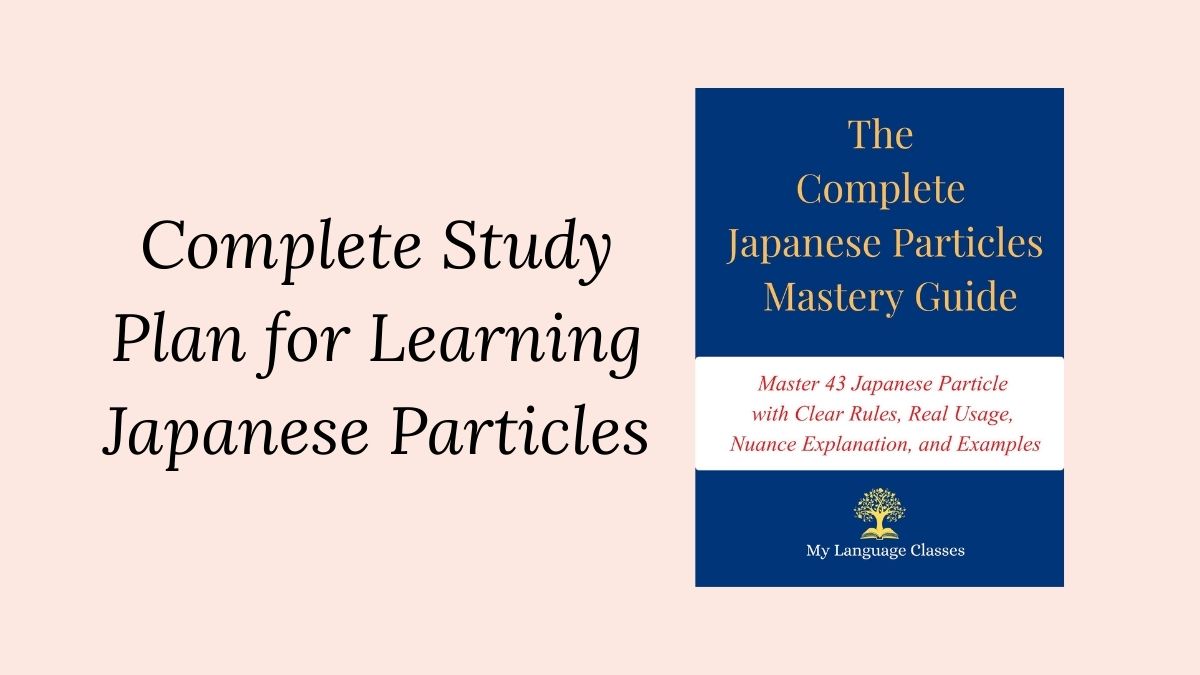
A Japanese particles study plan needs more than a list of particles to memorize. Learners need a resource that presents particles in a logical order, explains how each one functions, shows how usage changes with context, and provides enough examples to build a reliable understanding. The Complete Japanese Particles Mastery Guide is structured around this approach, making it suitable as the main study material for learners who want to work through Japanese particles from foundational grammar to advanced usage.
The book contains 43 focused chapters, with one chapter dedicated to each particle. Rather than treating the particles as isolated vocabulary items, it organizes them into progressive sections that reflect their grammatical functions and increasing complexity. This gives learners a practical structure to follow when using the book as part of a longer Japanese grammar study plan.
The Complete Japanese Particles Mastery Guide is available on the My Language Classes website as an eBook, and is also available on Amazon.
Building the Foundation with Core Japanese Particles
A study plan for Japanese particles should begin with the forms that learners encounter throughout basic sentence construction. The Complete Japanese Particles Mastery Guide starts with this foundation.
The opening section covers は, が, を, に, で, へ, の, も, と, and や. Together, these chapters address essential relationships involving topics, subjects, direct objects, direction, time, location, possession, inclusion, accompaniment, quotation, and listing.
This organization gives the learner a clear starting point. Instead of jumping between unrelated particle explanations, the book establishes the structural elements first. That makes it possible to build a stronger understanding of Japanese sentences before moving into particles with more specialized meanings.
For someone creating a Japanese particles study schedule, these chapters can form the first stage of study. Each particle can be studied individually, with the explanations and examples in the corresponding chapter serving as the primary learning material.
Moving from Basic Structure to More Specific Meanings
Once the core particles have been covered, the book moves into particles that express range, origin, endpoints, comparison, limitation, approximation, and emphasis.
The next sections cover から, まで, and より, followed by だけ, しか, など, くらい/ぐらい, ほど, こそ, でも, and すら.
This part of the book is important for a progressive study plan because these particles require learners to understand more than basic sentence relationships. Their meanings often depend on the context in which they appear, and some have functions that overlap with other expressions.
The guide addresses this by giving individual attention to each particle and including explanations of contextual nuance. It is therefore useful for learners who have already established basic particle knowledge and now need to understand more precise distinctions in Japanese usage.
Using the Book for Intermediate Particle Study
The Complete Japanese Particles Mastery Guide then moves into functional and compound particles. This section includes として, について, によって, によると, までに, って, とは, では, and には.
These expressions allow learners to work with more specific relationships and meanings in Japanese. They are particularly relevant when a learner has moved beyond basic sentence construction and wants to understand how Japanese expresses roles, topics, definitions, sources, deadlines, conditions, contrast, and emphasis.
For a structured study plan, this section can serve as a bridge between foundational particle knowledge and more advanced grammar. The learner is still working directly with particles, but the functions and contexts become more varied.
Progressing to Cause, Contrast, and Situational Expressions
The following section introduces ので, のに, ながら, ばかり, ように, and わりに. These forms allow learners to work with cause, contrast, simultaneous actions, limitation or tendency, purpose and manner, and situations that differ from expectations.
The value of having these expressions in the same resource is that learners can continue their particle study without having to change books when the grammar becomes more advanced. The book maintains the same chapter-based approach while moving into increasingly complex functions.
Each chapter is designed around a consistent pattern of explanation, usage, examples, and nuance. This consistency makes the resource suitable for sequential study as well as later reference when a learner needs to review a particular particle.
Reaching Advanced and Formal Japanese Usage
The final section of the book focuses on formal, academic, and advanced contexts. It covers にとって, において, に関して, につれて, によれば, にしたがって, and としても.
This gives the study plan a clear progression toward more sophisticated Japanese. Learners who have worked through the earlier sections can use these chapters to develop a better understanding of particles and compound expressions that occur in formal and professional communication.
This progression is one of the key reasons The Complete Japanese Particles Mastery Guide works as a study resource rather than simply a list of Japanese particles. The book moves from the structural foundations of Japanese sentences toward expressions that require greater control of context, meaning, and nuance.
How the Book Supports a Long-Term Study Plan
The structure of the book also allows learners to use it at different stages of Japanese study. A beginner can start with the foundational chapters and progress through the book in order. An intermediate learner can use specific sections to clarify particles that remain confusing. An advanced learner can focus on the later chapters dealing with nuance and formal usage.
The book is built around 43 dedicated particle chapters, with explanations covering core functions, detailed usage rules, contextual nuance, and real communication examples. It also uses comparisons and examples to address subtle differences between particles that may appear similar but serve different purposes.
That makes the resource useful for both sequential learning and targeted review. A learner can follow the book from beginning to end as a structured Japanese particles program, or return to individual chapters when a particular particle needs further study.
A Complete Japanese Particles Resource for Progressive Study
For learners looking for material to support a Japanese particles study plan from beginner foundations to advanced usage, The Complete Japanese Particles Mastery Guide provides a defined progression within one resource.
Its 43 chapters begin with the particles that form the foundation of Japanese sentence construction, then move through range, comparison, limitation, emphasis, functional relationships, cause and contrast, and finally formal and advanced usage. Each particle receives focused treatment rather than being reduced to a short definition or isolated example.
The book is therefore well suited to a study plan in which learners want to build particle knowledge systematically while keeping one consistent reference throughout the process. It can be used for self-study, Japanese grammar review, JLPT preparation, and continued reference as learners encounter more complex Japanese.
The Complete Japanese Particles Mastery Guide is available on the My Language Classes website as an eBook, and is also available on Amazon.

Vikas Kumar is the founder of My Language Classes, a language learning platform dedicated to helping learners develop practical communication skills in Spanish, Japanese, and English through comprehensive grammar guides, structured learning resources, books, and evidence-informed educational content.
At My Language Classes, we believe that successful language learning is built on clarity, consistency, meaningful practice, and a deep understanding of how languages work. Every article is carefully researched and created to simplify complex concepts, provide practical guidance, and help learners develop confidence through real-world communication.
Inspired by the principles behind How Language Learning Really Works, our mission is to make high-quality language learning accessible to learners around the world by providing accurate, trustworthy, and comprehensive resources that support lasting progress, lifelong learning, and meaningful communication.
Leave a Reply