

Japanese particles are small grammatical elements, but they have a major role in Japanese sentence construction. They show relationships between words, identify topics and subjects, mark objects, express direction and location, indicate comparison and limitation, and add emphasis or contextual meaning.
For learners, the difficulty is often not simply remembering what a particle means. The real challenge is understanding when to use it, how it functions in a sentence, and how its meaning changes according to context.
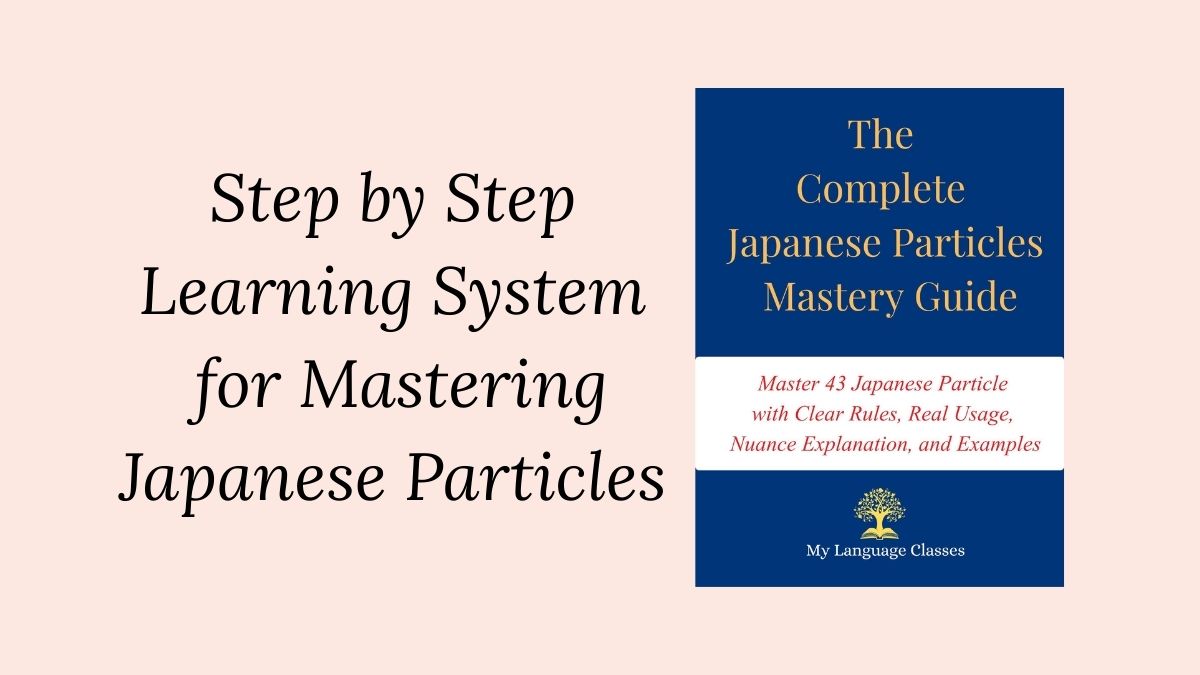
The Complete Japanese Particles Mastery Guide by My Language Classes is designed specifically around this problem.
The book contains 43 focused chapters, with one chapter dedicated to each particle. It provides structured explanations, detailed usage rules, nuance analysis, real Japanese examples, romaji, English translations, and guidance on common learner mistakes.
Where Can You Get The Complete Japanese Particles Mastery Guide?
It is also available on Amazon.
The book is designed as both a structured learning resource and a long-term reference for learners who want to understand Japanese particles systematically rather than study them as isolated grammar points.
What Does The Complete Japanese Particles Mastery Guide Cover?
The guide covers 43 Japanese particles across 43 dedicated chapters.
The chapters are organized into six major parts. The progression begins with the particles needed for basic Japanese sentence construction and gradually moves toward particles used for comparison, limitation, logical relationships, contextual expressions, and formal or academic Japanese.
Part 1: Core Structural Particles
Chapters 1–10
The first ten chapters establish the foundation of Japanese particle usage.
→ Chapter 1: は (wa) – Topic Marker
→ Chapter 2: が (ga) – Subject Marker
→ Chapter 3: を (wo) – Direct Object Marker
→ Chapter 4: に (ni) – Direction, Time, Indirect Object, Existence Marker
→ Chapter 5: で (de) – Location of Action, Means, Method Marker
→ Chapter 6: へ (e) – Direction Marker
→ Chapter 7: の (no) – Possession and Noun Modifier
→ Chapter 8: も (mo) – Inclusion and Emphasis Marker
→ Chapter 9: と (to) – Listing, Accompaniment, Quoting
→ Chapter 10: や (ya) – Non-Exhaustive Listing
These chapters deal with some of the most frequently encountered particles in Japanese.
Learners begin with fundamental relationships such as topic, subject, object, possession, location, direction, inclusion, listing, accompaniment, and quotation.
This gives the book a clear starting point before introducing more specialized particle functions.
What Comes After The Core Japanese Particles?
Part 2: Range, Origin, and Comparison Particles
Chapters 11–13
The next section focuses on boundaries, starting points, endpoints, and comparison.
→ Chapter 11: から (kara) – Starting Point and Reason
→ Chapter 12: まで (made) – Endpoint and Limit
→ Chapter 13: より (yori) – Comparison and Standard of Comparison
These particles allow learners to express relationships involving where something begins, where it ends, and how one thing is compared with another.
The section therefore builds on the structural foundation established in Chapters 1–10.
How Does The Book Explain Limitation, Approximation, and Emphasis?
Part 3: Limitation, Approximation, and Emphasis Particles
Chapters 14–21
This section introduces particles that add restriction, degree, approximation, comparison, and emphasis.
→ Chapter 14: だけ (dake) – Only, Just
→ Chapter 15: しか (shika) – Only with Negative Emphasis
→ Chapter 16: など (nado) – Examples, “And So On”
→ Chapter 17: くらい / ぐらい (kurai / gurai) – Approximate Degree or Amount
→ Chapter 18: ほど (hodo) – Degree, Extent, Comparison
→ Chapter 19: こそ (koso) – Strong Emphasis
→ Chapter 20: でも (demo) – Even, Suggestion, Contrast
→ Chapter 21: すら (sura) – Even, Strong Emphasis
This section is particularly important for learners who already understand basic Japanese sentence construction but need greater precision.
Particles such as だけ, しか, ほど, こそ, and すら can express related ideas while producing different meanings or emphasis. Understanding these distinctions requires more than memorising a single English equivalent.
The book therefore treats these particles as part of a larger system of meaning and usage.
What Are The Functional and Compound Particles Covered?
Part 4: Functional and Compound Relationship Particles
Chapters 22–30
The fourth section moves into particles and expressions that establish roles, relationships, conditions, definitions, emphasis, and other logical connections.
→ Chapter 22: として (toshite) – In the Role of, As
→ Chapter 23: について (ni tsuite) – About, Regarding
→ Chapter 24: によって (ni yotte) – By Means Of, Depending On
→ Chapter 25: によると (ni yoru to) – According To
→ Chapter 26: までに (made ni) – Deadline, By a Certain Time
→ Chapter 27: って (tte) – Casual Topic Marker, Quoting, Explanation
→ Chapter 28: とは (to wa) – Definition or Emphasis
→ Chapter 29: では (de wa) – Conditional or Contrast
→ Chapter 30: には (ni wa) – Emphasis, Limitation, Purpose
These chapters take learners beyond the most basic particle functions.
For example, として can describe a role or capacity, while について is used to express the subject or topic being discussed. によって can express means or dependency, while によると introduces information according to a source.
The book explains these expressions individually so learners can understand their specific grammatical functions rather than treating them as interchangeable structures.
How Does The Book Cover Cause, Contrast, and Situational Expressions?
Part 5: Cause, Contrast, and Situational Expression Particles
Chapters 31–36
The fifth section focuses on expressions that connect ideas and describe relationships between situations.
→ Chapter 31: ので (node) – Cause or Reason, Softer Tone
→ Chapter 32: のに (noni) – Despite, Contrast
→ Chapter 33: ながら (nagara) – While Doing
→ Chapter 34: ばかり (bakari) – Only, Just Finished, Tendency
→ Chapter 35: ように (you ni) – Purpose, Comparison, Manner
→ Chapter 36: わりに (wari ni) – Contrary to Expectation
These expressions are important because they help learners connect ideas rather than construct only simple sentences.
The section also introduces meanings that can be difficult to understand through direct translation. For example, the function of のに involves contrast, while わりに expresses a relationship between an expected result and an actual situation.
The guide gives learners a structured place to study these differences.
Does The Book Cover Formal and Advanced Japanese Particles?
Part 6: Formal, Academic, and Advanced Context Particles
Chapters 37–43
The final seven chapters move into particles and expressions used in more formal, academic, professional, and advanced Japanese contexts.
→ Chapter 37: にとって (ni totte) – From Someone’s Perspective
→ Chapter 38: において (ni oite) – In, At, Within Formal Contexts
→ Chapter 39: に関して (ni kanshite) – Regarding, Concerning
→ Chapter 40: につれて (ni tsurete) – As Something Changes
→ Chapter 41: によれば (ni yoreba) – According To, Formal Source Citation
→ Chapter 42: にしたがって (ni shitagatte) – In Accordance With
→ Chapter 43: としても (toshite mo) – Even If
The inclusion of these chapters makes the guide useful beyond introductory Japanese.
Learners who want to read more formal Japanese, understand academic expressions, or improve their precision in professional communication can use these chapters as a reference for functions that are less likely to be fully covered in basic Japanese lessons.
What Does Each Chapter Contain?
The book follows a consistent structure throughout its 43 chapters.
Each particle is treated as an individual grammar topic, allowing learners to study its meaning and usage without having to search through unrelated grammar sections.
The chapters explain:
→ The core function of the particle
→ Grammatical rules and sentence structures
→ Different usage patterns
→ Contextual meanings and nuance
→ Examples showing the particle in Japanese sentences
→ English translations for understanding
→ Pronunciation support through romaji
→ Differences between related or similar uses
→ Common mistakes and corrections
→ Practical explanations based on real Japanese communication
The consistent structure is important because learners can approach every new particle using the same learning process.
How Many Example Sentences Are Included?
The book contains 1,000+ example sentences, with romaji support and English translations.
These examples are used to show how particles operate in actual sentences rather than presenting them only as definitions.
The examples support the book’s focus on real usage, while the English translations allow learners to confirm the meaning of the complete sentence. The romaji provides additional pronunciation support, particularly for learners who are still developing confidence with Japanese script.
The result is a reference that combines grammatical explanation with sentence-level application.
Why Is Nuance Important in a Japanese Particle Book?
One of the central features of this guide is its focus on nuance.
Japanese particles can have meanings that overlap when translated into English, but their actual functions can differ depending on context.
A learner may know the basic translation of two particles and still choose the wrong one when constructing a sentence. This is why the book does not stop at basic definitions.
The chapters explain contextual differences and show how particles function in real sentence patterns. The book specifically emphasises subtle differences between similar particles and the importance of understanding why a particle is used in a particular context.
This makes the guide useful for learners who want to move beyond memorization.
Does The Book Help With Common Particle Mistakes?
Yes.
The guide includes common mistake and correction guidance as part of its learning approach.
This is particularly useful with Japanese particles because a sentence can contain familiar vocabulary and still sound incorrect or communicate something different because of particle choice.
By examining correct usage alongside common errors, learners can develop a clearer understanding of how Japanese sentence relationships work.
The book’s goal is therefore not simply to help learners recognise particles. It is designed to help them use particles more accurately.
How Does The Book Progress From Basic to Advanced Japanese?
The progression is one of the main structural features of the guide.
The book begins with the core particles needed for Japanese sentence construction. Chapters 1–10 establish relationships involving topics, subjects, objects, time, location, direction, possession, inclusion, listing, accompaniment, and quotation.
It then moves through:
Chapters 11–13: range, origin, and comparison
Chapters 14–21: limitation, approximation, degree, and emphasis
Chapters 22–30: functional and compound relationship expressions
Chapters 31–36: cause, contrast, and situational expressions
Chapters 37–43: formal, academic, and advanced contexts
This creates a clear progression rather than presenting 43 particles as an unrelated list.
Who Is The Complete Japanese Particles Mastery Guide For?
The guide is designed for learners at different stages of Japanese study.
Beginners
Beginners can use the early chapters to establish a strong foundation in Japanese particle usage.
The progression from は, が, を, に, and で toward more specialised particles gives new learners a structured sequence for studying this area of grammar.
Intermediate Learners
Intermediate learners can use the guide to review familiar particles and address areas where their usage remains uncertain.
The sections covering comparison, limitation, emphasis, compound expressions, and contextual relationships provide material beyond the basic particle system.
Advanced Learners
Advanced learners can use the later chapters to refine their understanding of nuance and formal usage.
The final section specifically includes expressions used in professional, academic, and higher-level Japanese contexts.
JLPT Preparation Learners
The guide can also be used as a particle-focused reference while preparing for the JLPT.
Rather than being limited to one examination level, it covers particles progressively from foundational to advanced usage, allowing learners to return to relevant chapters as their Japanese develops.
Teachers and Tutors
Japanese language teachers and tutors can also use the book as a structured reference when explaining particle functions, differences, examples, and common learner mistakes.
Self-Learners
For independent learners, the consistent chapter structure provides a clear way to study one particle at a time and return to individual chapters during revision.
What Makes This More Than A Basic Japanese Particle Reference?
A basic particle list can tell learners that は means “topic,” を marks the object, or に can indicate direction or time.
That information is useful, but it does not fully explain how particles function in real Japanese.
The Complete Japanese Particles Mastery Guide takes a broader approach.
It combines 43 dedicated chapters, 1,000+ examples, romaji, English translations, grammatical rules, usage explanations, contextual nuance, comparison, and mistake correction in one structured resource.
The book is therefore designed around understanding how particles work within Japanese sentences, not simply memorising English translations.
A Long-Term Japanese Grammar Resource
Japanese particles continue to matter as learners move from simple sentences to more complex communication.
They affect sentence structure, relationships between ideas, emphasis, interpretation, comparison, limitation, cause, contrast, and formal expression.
For this reason, a particle resource can remain useful even after the learner has completed an initial Japanese grammar course.
The Complete Japanese Particles Mastery Guide by My Language Classes is designed to serve that purpose. It can be used sequentially as a learning book, selectively for revision, or as a long-term reference when a particular particle creates confusion.
With 43 focused chapters and 1,000+ example sentences, the guide brings a substantial range of Japanese particle usage into one dedicated resource.
Get The Complete Japanese Particles Mastery Guide
The Complete Japanese Particles Mastery Guide by My Language Classes is designed for learners who want a structured and detailed approach to Japanese particles.
It covers the progression from core structural particles to range and comparison, limitation and emphasis, functional and compound expressions, cause and contrast, and formal and advanced usage.
With 43 dedicated chapters, 43 essential particles, 1,000+ example sentences, romaji support, English translations, nuance explanations, and common mistake guidance, the book provides a focused resource for building stronger Japanese sentence construction skills.
Available as an eBook on the My Language Classes website
The guide is suitable for beginners, intermediate learners, advanced students, JLPT preparation learners, teachers, tutors, and independent Japanese learners looking for a dedicated particle reference.

Vikas Kumar is the founder of My Language Classes, a language learning platform dedicated to helping learners develop practical communication skills in Spanish, Japanese, and English through comprehensive grammar guides, structured learning resources, books, and evidence-informed educational content.
At My Language Classes, we believe that successful language learning is built on clarity, consistency, meaningful practice, and a deep understanding of how languages work. Every article is carefully researched and created to simplify complex concepts, provide practical guidance, and help learners develop confidence through real-world communication.
Inspired by the principles behind How Language Learning Really Works, our mission is to make high-quality language learning accessible to learners around the world by providing accurate, trustworthy, and comprehensive resources that support lasting progress, lifelong learning, and meaningful communication.
Leave a Reply