

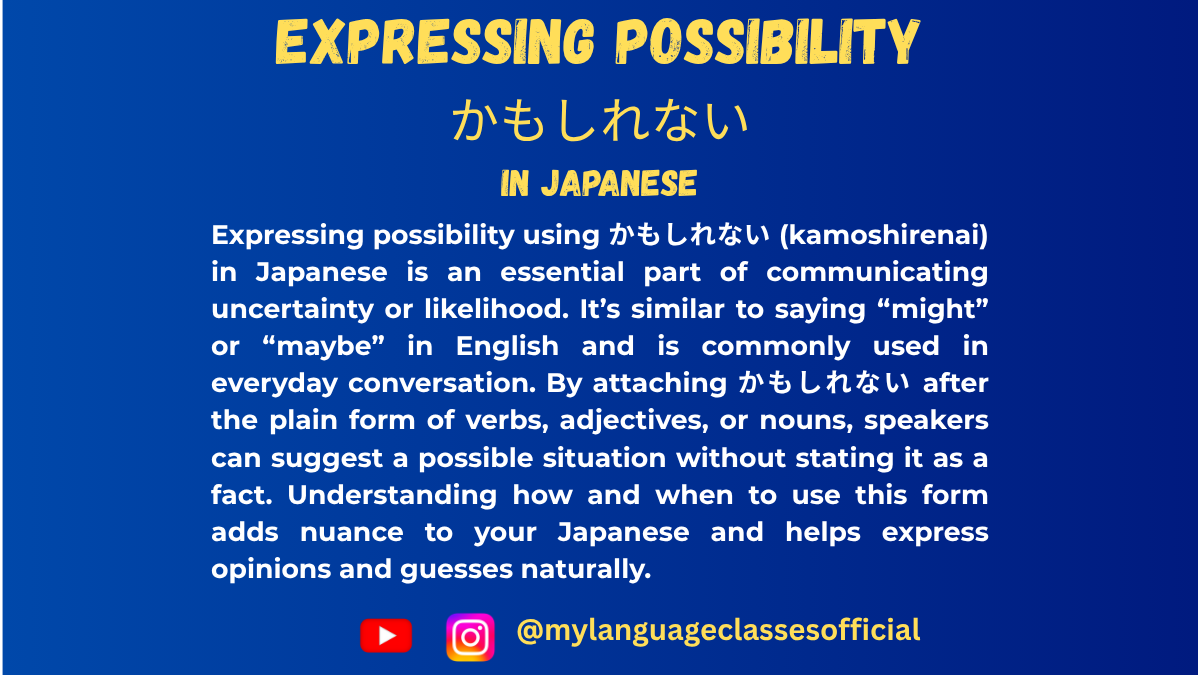
Expressing Possibility in Japanese: かもしれない
When learning Japanese, understanding how to express possibility or uncertainty is essential for nuanced communication. The phrase かもしれない (かも) is a versatile and frequently used expression in Japanese to indicate that something “might” happen or “could” be the case. In this blog post, we will delve deeply into the usage of かもしれない, including its grammatical structure, variations, and common situations where it is used.
What Does かもしれない Mean?
かもしれない literally translates to “might” or “could,” expressing a sense of possibility or uncertainty about a situation. It is often used when the speaker is unsure about the likelihood of an event or fact but wants to acknowledge its potentiality.
Variations in Formality:
- Casual: かもしれない
- Polite: かもしれません
- Abbreviated (Casual Speech): かも
- Example: これは大変かも。 (This could be serious.)
Grammatical Structure
かもしれない follows directly after a predicate and can attach to various parts of speech:
- Nouns:
- Structure: [Noun] + かもしれない
- Example: これはプレゼントかもしれない。 (This might be a present.)
- Adjectives (i-adjectives):
- Structure: [i-adjective] + かもしれない
- Example: あの店は高いかもしれない。 (That shop might be expensive.)
- Adjectives (na-adjectives):
- Structure: [na-adjective] + だ + かもしれない
- Example: この話は大事だかもしれない。 (This story might be important.)
- Verbs:
- Structure: [Verb (plain form)] + かもしれない
- Example: かれは来るかもしれない。 (He might come.)
Key Points to Remember
- Degree of Possibility: かもしれない implies a low to moderate degree of certainty. It’s not used for highly probable events.
- Uncertainty Tone: This expression adds a soft, non-committal tone to statements, making it useful in conversations where certainty is lacking.
- Position in Sentence:
- Always follows the predicate directly.
- Cannot be used at the start of a sentence.
- Politeness: Use かもしれません in formal situations or when speaking to superiors.
Common Situations to Use かもしれない
Here are some typical scenarios where かもしれない is used:
1. Guessing About Someone’s Actions:
- 他は明日会社に来ないかもしれない。
(He might not come to the office tomorrow.)
2. Weather Predictions:
- 今夜は雨が降るかもしれない。
(It might rain tonight.)
3. Speculating About the Past:
- 他はこのテストに落ちたかもしれない。
(He might have failed this test.)
4. Expressing Caution:
- その道は危ないかもしれない。
(That path might be dangerous.)
5. Making Suggestions With Hesitation:
- これを使ったら良い結果がでるかもしれない。
(Using this might give good results.)
6. Talking About Plans:
- 私は今年日本へ行くかもしれない。
(I might go to Japan this year.)
7. Health Concerns:
- あなたは病気になりかけているかもしれない。
(You might be getting sick.)
Practical Notes on Usage
- Avoid Overuse: While かもしれない is useful, overusing it can make your statements seem overly speculative.
- Alternative Phrases:
- Instead of かもしれない, consider using 可能性がある (かのうせいがある, “there is a possibility”) for more formal contexts.
- Context Matters:
- Use かもしれない sparingly in professional or serious settings where certainty is preferred.
Practice Exercise
Complete the following sentences with かもしれない:
- 今日はカラオケが出る…。
(It might snow today.) - あの人はこの仕事をキャンセルする…。
(That person might cancel this task.) - この商品は新品じゃない…。
(This product might not be new.)
Conclusion
かもしれない is a subtle yet powerful expression for conveying possibility and uncertainty in Japanese. By mastering its usage, you can add nuance to your conversations and sound more natural when speaking Japanese. Practice using it in different scenarios, and you’ll find it becoming a natural part of your language toolbox!

Vikas Kumar is the founder of My Language Classes, a language learning platform dedicated to helping learners develop practical communication skills in Spanish, Japanese, and English through comprehensive grammar guides, structured learning resources, books, and evidence-informed educational content.
At My Language Classes, we believe that successful language learning is built on clarity, consistency, meaningful practice, and a deep understanding of how languages work. Every article is carefully researched and created to simplify complex concepts, provide practical guidance, and help learners develop confidence through real-world communication.
Inspired by the principles behind How Language Learning Really Works, our mission is to make high-quality language learning accessible to learners around the world by providing accurate, trustworthy, and comprehensive resources that support lasting progress, lifelong learning, and meaningful communication.
Leave a Reply