

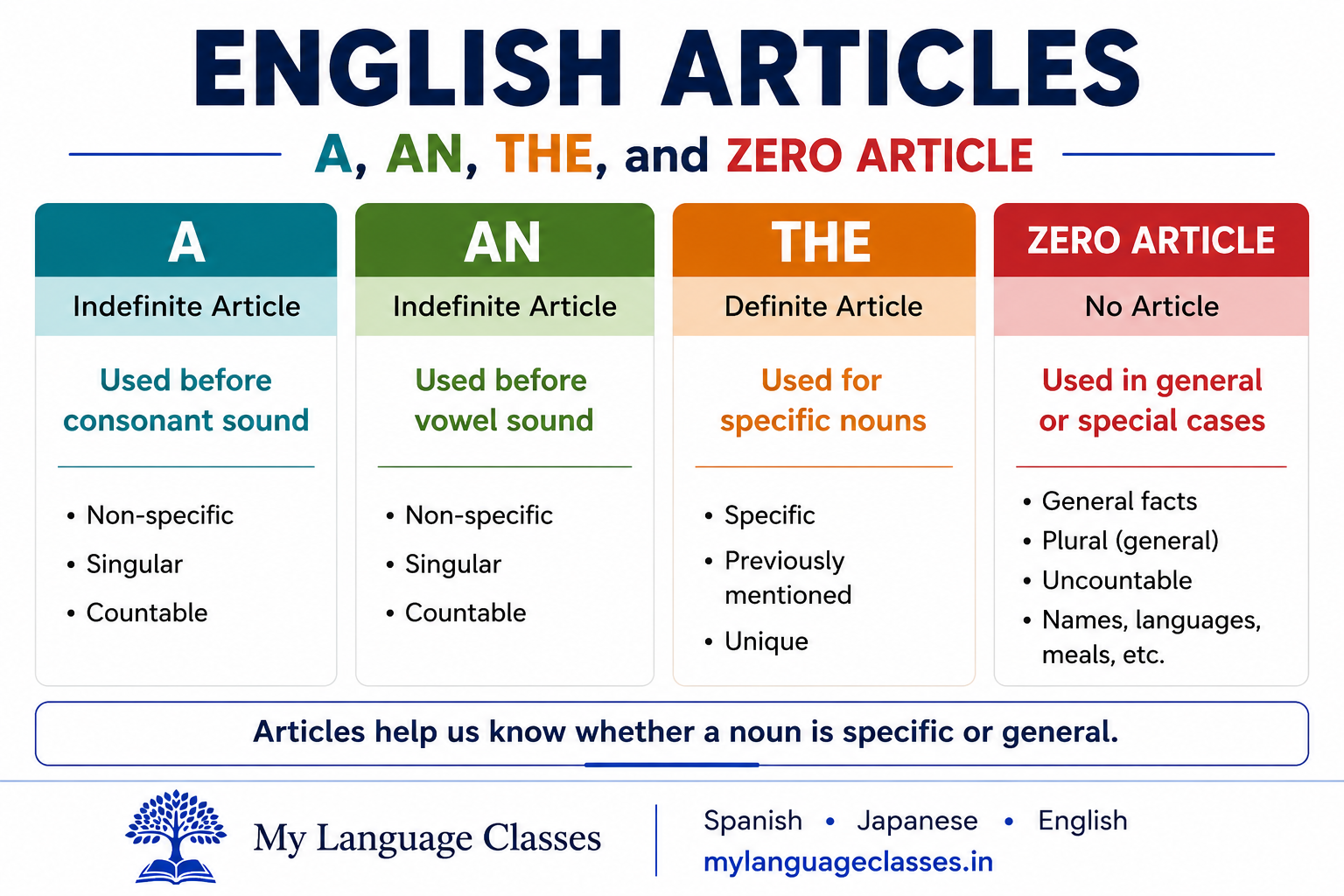
Articles in English are among the smallest words in English, but they have a significant impact on meaning. They help readers and listeners understand whether a noun refers to something specific, something general, or something already known. Choosing the correct article makes your English sound more natural and grammatically accurate.
English has three article systems: the indefinite articles a and an, the definite article the, and the zero article, where no article is used. Although these words are short, the rules behind them involve pronunciation, countability, specificity, and context. This is why article usage can be challenging, even for learners with a good understanding of English grammar.
In this guide, you’ll learn when to use a, an, the, and when to use no article at all. You’ll also discover the most important grammar rules, common exceptions, practical examples, and the mistakes learners make most often. By the end of the article, you’ll be able to choose the correct article with greater confidence in both speaking and writing.
If you’re building a strong foundation in English grammar, Mastering English Grammar for A1 Level, available on My Language Classes website, provides step-by-step lessons that explain essential grammar topics, including articles, with clear examples and practical explanations.
What Are Articles in English?
Articles are a type of determiner that appear before nouns. They help identify whether a noun refers to something specific, something non-specific, or something in general. Although articles are small words, they provide important information that makes sentences clearer and more precise.
Compare these sentences:
→ I bought a book.
→ I bought the book.
In the first sentence, a tells us the speaker is referring to one book, but not a particular one. In the second sentence, the tells us that both the speaker and the listener know exactly which book is being discussed.
English has three article systems.
| Article System | Article(s) | Main Use |
|---|---|---|
| Indefinite Article | a, an | Refers to a non-specific singular countable noun |
| Definite Article | the | Refers to a specific noun or something already known |
| Zero Article | No article | Used with certain plural nouns, uncountable nouns, proper nouns, and other special cases |
Articles always work together with nouns. They do not replace nouns or describe actions. Instead, they introduce nouns and help readers and listeners understand the intended meaning.
Consider these examples.
→ She adopted a puppy.
→ The puppy is very playful.
In the first sentence, the puppy is mentioned for the first time, so the indefinite article a is used. In the second sentence, the puppy has already been introduced, so the definite article the is used.
English articles are closely connected to several grammar concepts, including:
→ Countable and uncountable nouns
→ Singular and plural nouns
→ Specific and general reference
→ Pronunciation
→ Context
For this reason, choosing the correct article is not simply a matter of memorizing rules. You need to understand what the speaker is referring to and how the noun is being used within the sentence.
It is also important to understand that articles are only one type of determiner. Other determiners include words such as this, that, these, those, my, your, some, any, each, and every. Unlike these determiners, articles specifically indicate whether a noun is definite, indefinite, or requires no article at all.
As you continue through this guide, you’ll see that article selection depends on several factors working together. Understanding these patterns will help you make more accurate choices naturally instead of relying on memorized lists of rules.
What Are Indefinite Articles in English?
The indefinite articles a and an are used before singular countable nouns when the person, place, thing, or idea is not specific or is being mentioned for the first time. They introduce something that the listener or reader does not yet know or identify.
Compare these examples:
→ I saw a dog in the park.
→ The dog was playing with a ball.
In the first sentence, the speaker introduces the dog for the first time, so the noun is non-specific. In the second sentence, the dog has already been identified, so the definite article the is used.
The choice between a and an does not depend on the first letter of a word. It depends on the first sound of the word that follows.
This is one of the most important rules in English grammar and one of the most common areas where learners make mistakes.
The indefinite articles have two forms.
| Article | Used Before | Examples |
|---|---|---|
| a | Consonant sound | a teacher, a car, a university |
| an | Vowel sound | an apple, an engineer, an hour |
Both articles have the same grammatical function. Their only difference is pronunciation. English uses a before consonant sounds and an before vowel sounds to make speech smoother and easier to pronounce.
Indefinite articles are commonly used in the following situations.
→ Introducing something for the first time.
→ Referring to one person or thing that is not specific.
→ Talking about someone’s job or profession.
→ Referring to one example of a larger group.
→ Making general statements about singular countable nouns.
Examples:
→ She is a doctor.
→ He bought an umbrella.
→ We stayed in a hotel near the airport.
→ She wants to become an architect.
→ I need a notebook for class.
Notice that all of these nouns are singular, countable, and non-specific.
Another useful way to think about indefinite articles is that they often mean one, but without emphasizing the exact number.
Compare these examples:
→ I need a pen.
→ I need one pen.
Both sentences are grammatically correct, but the first sounds more natural in everyday English because the focus is on obtaining a pen rather than emphasizing the quantity.
As you continue reading, you’ll learn that choosing between a and an is much easier once you focus on pronunciation instead of spelling. This simple principle explains many situations that seem confusing at first, such as a university, an hour, and a European.
If you want structured practice using articles with singular nouns and noun phrases, Complete English A1 Grammar Practice Part-1, available on My Language Classes website, provides guided grammar lessons and practical exercises that help reinforce these patterns through real English usage.
What Is the Difference Between A and An?
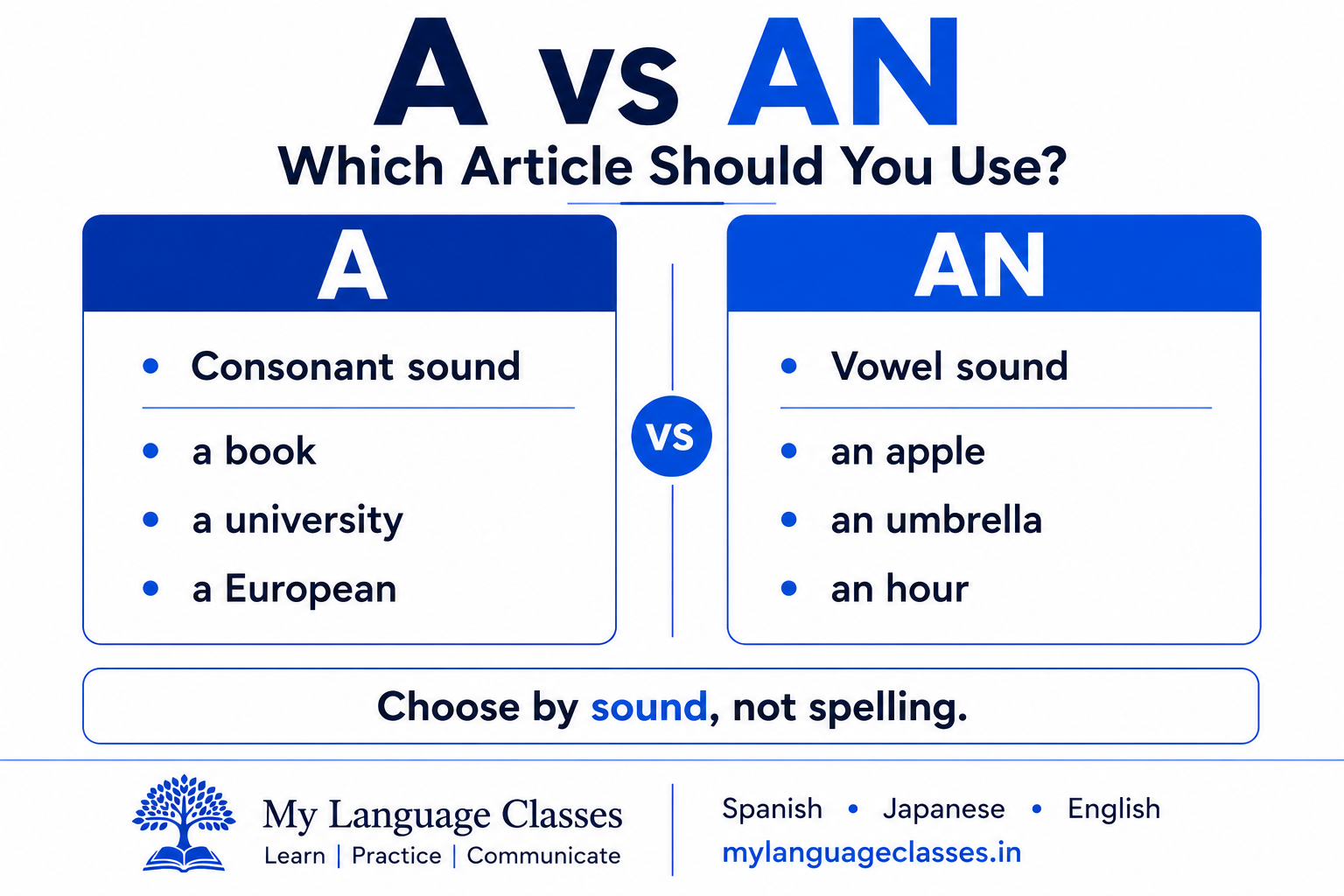
The articles a and an have the same grammatical function. Both are indefinite articles used before singular countable nouns. The only difference is the sound that begins the following word.
Many learners believe the choice depends on the first letter of the word. In reality, English articles are chosen according to pronunciation, not spelling.
When Do We Use A?
Use a before words that begin with a consonant sound.
Examples:
→ a book
→ a teacher
→ a house
→ a computer
Some words begin with a vowel letter but are pronounced with a consonant sound. These words also take a.
Examples:
→ a university
→ a uniform
→ a European country
→ a useful idea
→ a one-time event
Although these words begin with u, e, or o, they start with the consonant sounds /juː/ or /w/, so a is the correct article.
When Do We Use An?
Use an before words that begin with a vowel sound.
Examples:
→ an apple
→ an orange
→ an elephant
→ an engineer
Some words begin with the letter h, but the h is silent. Since the first sound is a vowel sound, they take an.
Examples:
→ an hour
→ an honest person
→ an honor
→ an heir
Although these words begin with the letter h, they are pronounced as though they begin with a vowel.
What About Acronyms and Initialisms?
The same pronunciation rule applies to abbreviations.
If the first spoken sound is a vowel sound, use an.
If the first spoken sound is a consonant sound, use a.
| Correct Expression | Reason |
|---|---|
| an MBA | “M” begins with the vowel sound /em/ |
| an FBI agent | “F” begins with the vowel sound /ef/ |
| an X-ray | “X” begins with the vowel sound /eks/ |
| a UNESCO project | “UNESCO” begins with the consonant sound /juː/ |
| a UK company | “UK” begins with the consonant sound /juː/ |
Listening to the pronunciation instead of looking only at the spelling will help you choose the correct article in these situations.
Quick Comparison
| Use A | Use An |
|---|---|
| Consonant sound | Vowel sound |
| a car | an apple |
| a university | an umbrella |
| a European | an engineer |
| a one-time event | an hour |
The easiest way to remember this rule is to focus on the first sound you hear, not the first letter you see. Once you develop this habit, choosing between a and an becomes much more natural, even with words that seem confusing at first.
When Do We Use the Definite Article The?
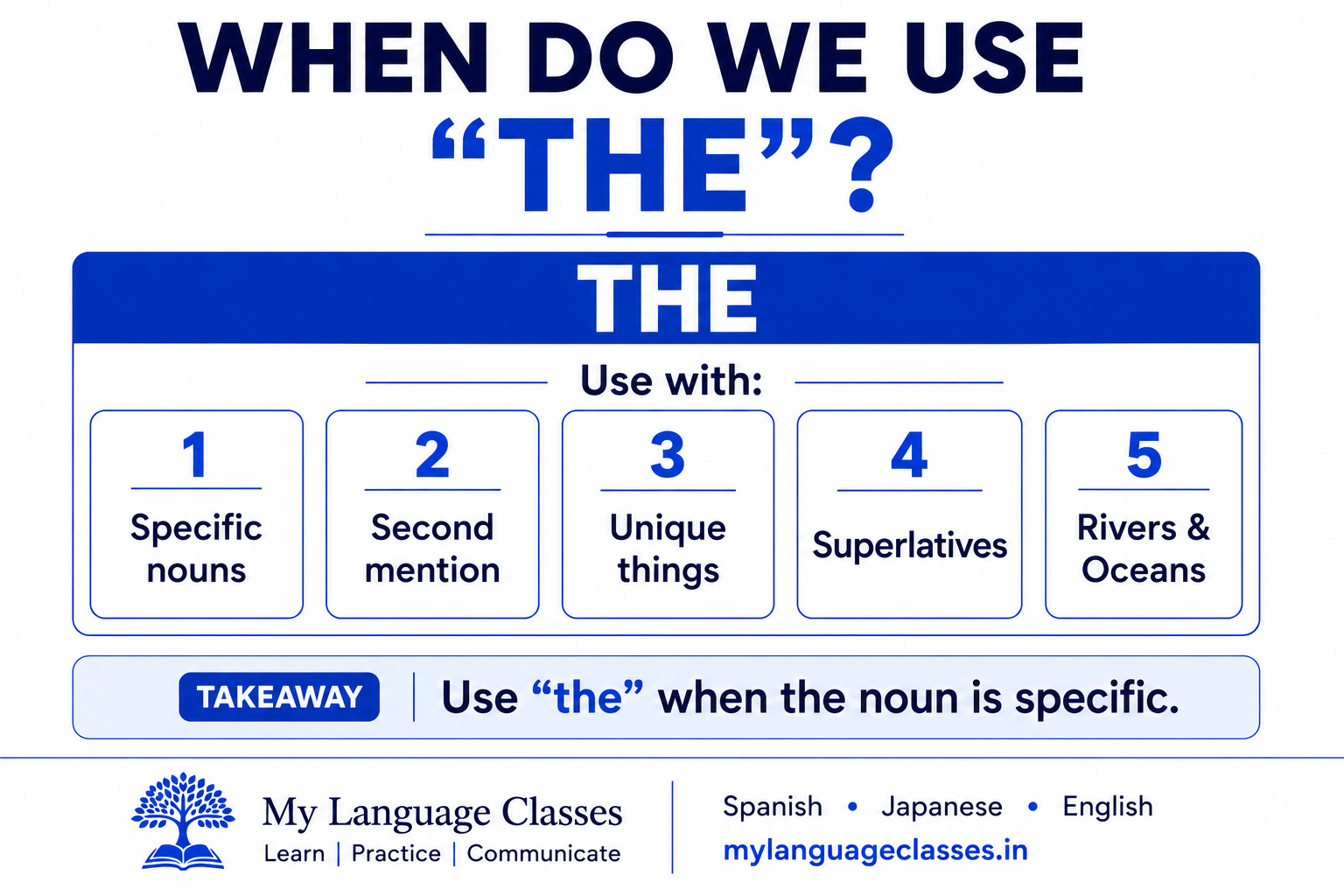
The definite article the is used when the noun refers to a specific person, place, thing, or idea. It tells the reader or listener that the noun is already known, has been mentioned before, or can be clearly identified from the context.
Unlike a and an, which introduce something non-specific, the points to a particular noun.
Compare these examples:
→ I bought a laptop yesterday.
→ The laptop is much faster than my old one.
In the first sentence, the laptop is mentioned for the first time, so a is used. In the second sentence, the laptop is now known, so the is the correct choice.
Use The for Something Already Mentioned
When a noun has already been introduced, use the if you mention it again.
Examples:
→ We saw a movie last night.
→ The movie was excellent.
→ She adopted a puppy.
→ The puppy quickly became part of the family.
This is known as the first mention and second mention rule.
Use The for Specific Nouns
Use the when both the speaker and the listener know which person or thing is being discussed.
Examples:
→ Please close the window.
→ Turn off the lights before you leave.
→ The manager would like to see you.
The exact noun is understood from the situation, so the is required.
Use The with Unique Things
Some nouns refer to something that is unique, so they normally take the.
Examples:
→ the sun
→ the moon
→ the Earth
→ the internet
Because there is only one of each in the intended context, the identifies them naturally.
Use The with Superlatives and Ordinal Numbers
Superlative adjectives identify one thing as the highest, lowest, best, or worst in a group. Ordinal numbers indicate position in a sequence. Both normally require the.
Examples:
→ the tallest building
→ the most interesting book
→ the first day
→ the second chapter
Use The with Families and Groups
Use the when referring to an entire family or a specific group of people.
Examples:
→ the Smiths
→ the Johnson family
→ the police
→ the public
Use The with Certain Geographic Names
Some geographic names always take the.
Examples:
→ the Pacific Ocean
→ the Nile River
→ the Himalayas
→ the Sahara Desert
You’ll learn the complete rules for geographic names later in this guide.
Use The with Newspapers, Hotels, and Famous Buildings
Many names of organizations, publications, hotels, and well-known buildings use the as part of their official name.
Examples:
→ the New York Times
→ the Ritz Hotel
→ the Empire State Building
→ the White House
Summary of the Most Common Uses of The
| Use The With | Examples |
|---|---|
| Second mention | the book, the movie |
| Specific nouns | the teacher, the door |
| Unique things | the sun, the moon |
| Superlatives | the best, the tallest |
| Ordinal numbers | the first, the third |
| Families and groups | the Smiths, the police |
| Certain geographic names | the Amazon River, the Alps |
| Newspapers and famous buildings | the Guardian, the Eiffel Tower |
The easiest way to decide whether to use the is to ask yourself one question:
Can the reader or listener identify exactly which noun I mean?
If the answer is yes, the definite article is often the correct choice.
What Is the Zero Article?
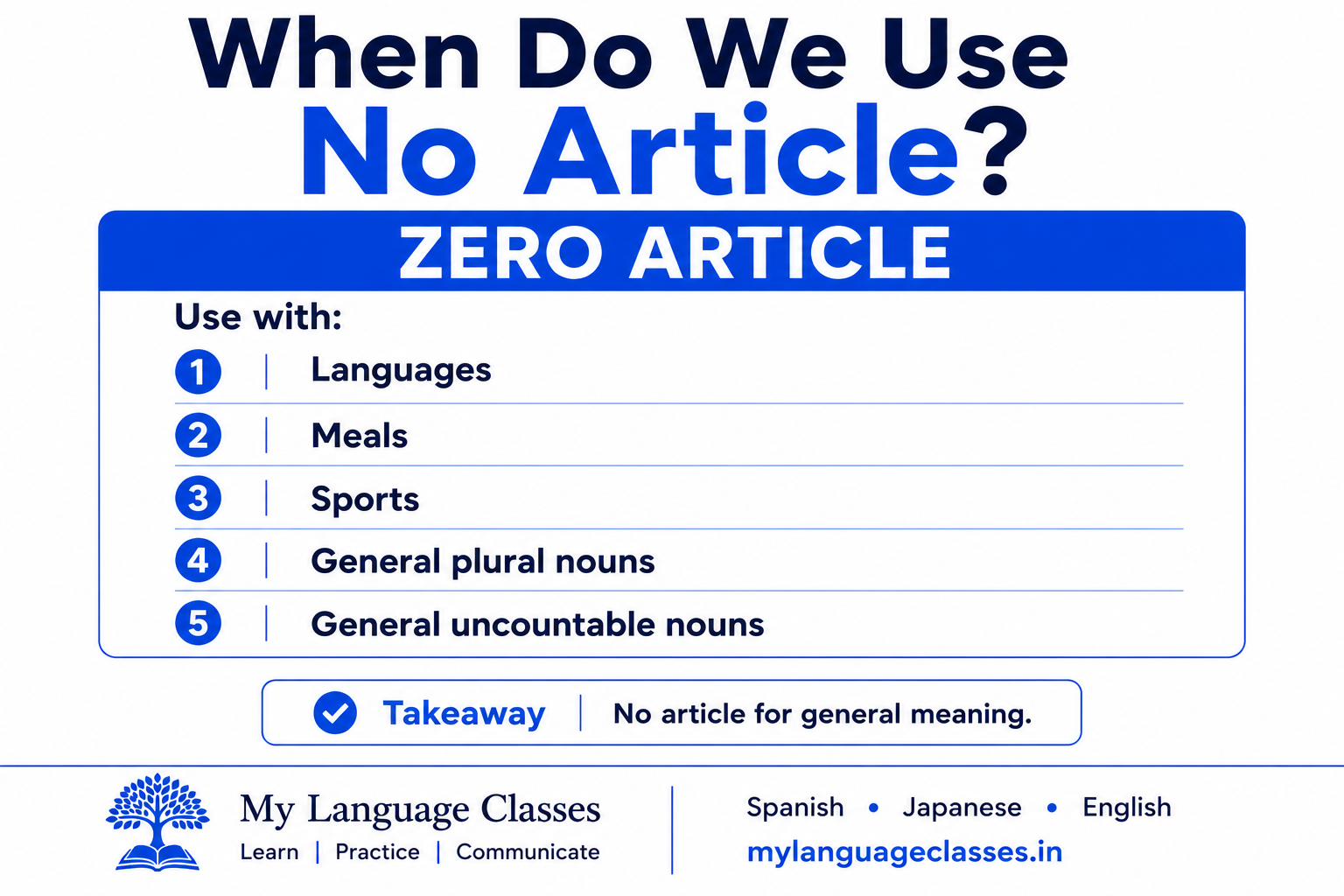
The zero article means no article is used before a noun. Although it may seem like the absence of a rule, it is actually an important part of English grammar with its own usage patterns.
English speakers do not always use a, an, or the. In many situations, leaving out the article is the correct grammatical choice. Knowing when not to use an article is just as important as knowing when to use one.
Use the Zero Article with General Plural Nouns
When talking about plural countable nouns in a general sense, no article is used.
Examples:
→ Dogs are loyal animals.
→ Teachers play an important role in society.
→ Books help us learn new ideas.
These sentences refer to all members of a group, not specific ones.
Compare:
→ Dogs are friendly. (General)
→ The dogs are friendly. (Specific dogs)
Use the Zero Article with Uncountable Nouns
Uncountable nouns used in a general sense usually do not take an article.
Examples:
→ Water is essential for life.
→ Music helps me relax.
→ Information is easy to find online.
→ Knowledge grows through practice.
When these nouns become specific, the is used.
Compare:
→ Water is important. (Water in general)
→ The water in this bottle is cold. (Specific water)
Use the Zero Article with Languages and School Subjects
Languages and academic subjects normally do not take an article.
Examples:
→ She speaks English.
→ They are learning Japanese.
→ Spanish is widely spoken.
→ Mathematics is my favorite subject.
Use the Zero Article with Meals
The names of everyday meals usually do not take an article when referring to the meal itself.
Examples:
→ We had breakfast at seven.
→ They are preparing lunch.
→ Dinner will be ready soon.
However, if the meal is made specific, the is used.
Example:
→ The dinner we had yesterday was excellent.
Use the Zero Article with Sports and Games
Sports and games are normally used without an article.
Examples:
→ She plays tennis.
→ They enjoy soccer.
→ We often play chess.
Use the Zero Article with Days, Months, and Most Holidays
Names of days, months, and most holidays do not usually require an article.
Examples:
→ Monday is my busiest day.
→ We are traveling in July.
→ Christmas is next week.
→ Thanksgiving is celebrated in November.
Use the Zero Article with Most Proper Nouns
Many proper nouns are used without an article.
Examples:
→ India
→ Japan
→ Canada
→ Hyderabad
→ Mount Everest
→ Asia
→ Oxford Street
These names identify unique places or people, so an article is generally unnecessary unless a specific grammar rule requires one.
Common Uses of the Zero Article
| Use No Article With | Examples |
|---|---|
| General plural nouns | Cats, teachers, books |
| General uncountable nouns | Water, music, information |
| Languages | English, Spanish, Japanese |
| School subjects | Science, History, Mathematics |
| Meals | Breakfast, lunch, dinner |
| Sports and games | Tennis, soccer, chess |
| Days and months | Monday, April |
| Most countries and cities | India, Brazil, Tokyo |
| Continents | Europe, Asia |
| Individual mountains | Mount Fuji, Mount Everest |
One simple way to recognize the zero article is to ask yourself whether the noun is referring to something in general rather than something specific. If it is a general plural noun, a general uncountable noun, or belongs to one of the categories above, no article is often the correct choice.
Remember that the zero article is not the same as forgetting to use an article. It is a grammatical choice with clear rules. Learning these patterns will help your English sound much more natural and closer to the way native speakers use the language.
How Do You Choose Between A, An, The, and No Article?
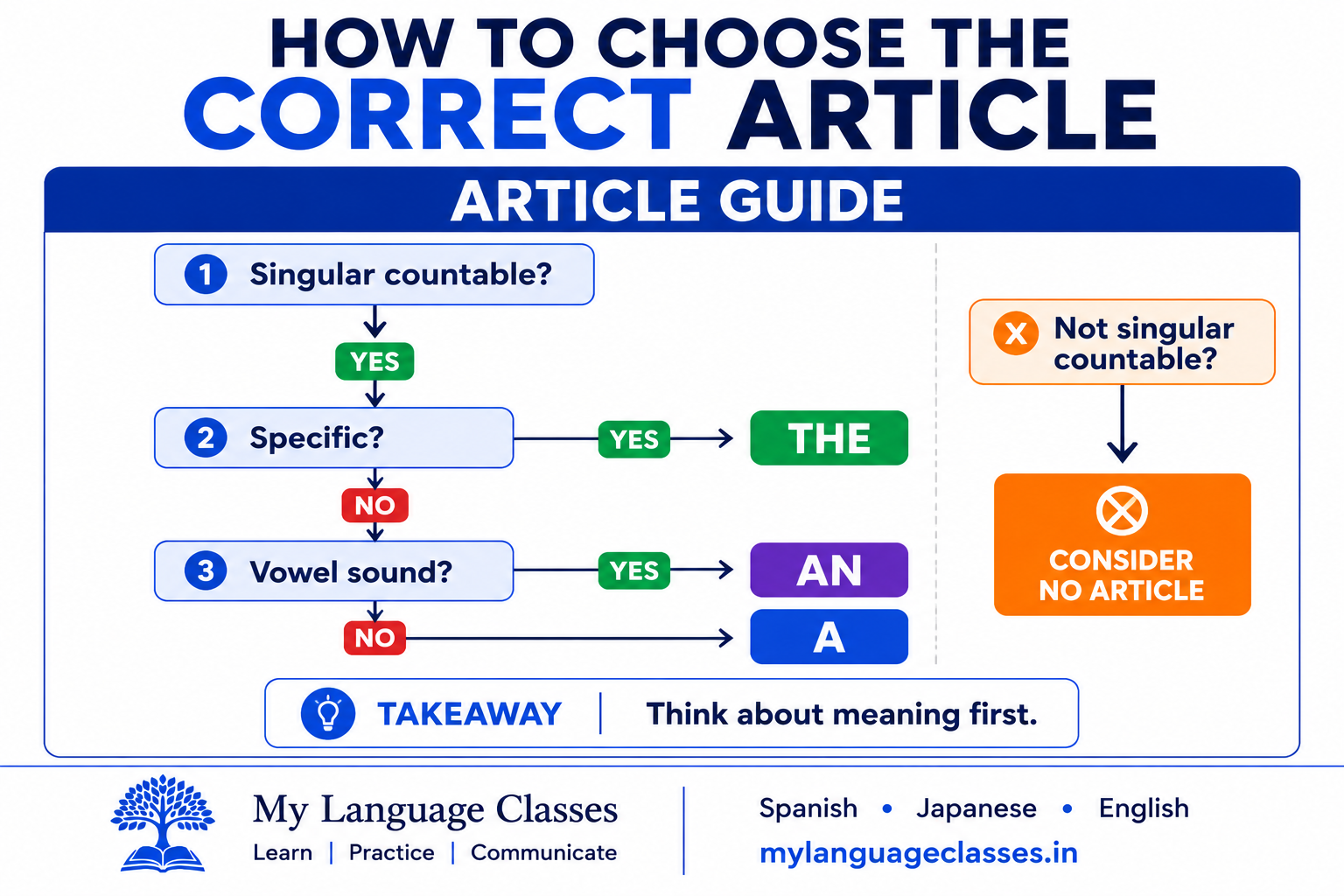
Choosing the correct article becomes much easier when you follow a logical sequence of questions instead of trying to memorize dozens of individual rules. Every time you use a noun, consider its countability, specificity, and pronunciation. These three factors will usually lead you to the correct article.
Step 1: Is the Noun Singular and Countable?
If the noun is a singular countable noun, it normally requires an article or another determiner.
Examples:
→ I bought a notebook.
→ The notebook is on my desk.
A singular countable noun usually cannot stand alone.
Incorrect:
→ I bought notebook.
Correct:
→ I bought a notebook.
Step 2: Is the Noun Specific?
If the noun refers to a particular person or thing that the reader or listener can identify, use the.
Examples:
→ Please close the door.
→ I enjoyed the movie we watched yesterday.
If the noun is not specific or is mentioned for the first time, use a or an.
Examples:
→ I saw a bird in the garden.
→ She adopted an animal from the shelter.
Step 3: Does the Word Begin with a Vowel Sound?
If you have decided to use an indefinite article, listen to the first sound, not the first letter.
Use a before a consonant sound.
Examples:
→ a teacher
→ a university
Use an before a vowel sound.
Examples:
→ an engineer
→ an hour
Step 4: Does the Noun Need an Article at All?
Some nouns do not require an article.
Examples:
→ Water is essential.
→ Children learn quickly.
→ She studies Spanish.
→ We play tennis every weekend.
In these cases, the zero article is the correct choice.
A Simple Decision Guide
| Question | Yes | No |
|---|---|---|
| Is it a singular countable noun? | Continue to Step 2 | Consider the zero article or the |
| Is it specific? | Use the | Continue to Step 3 |
| Does it begin with a vowel sound? | Use an | Use a |
This process works well for most everyday situations and helps reduce uncertainty when choosing an article.
Consider these examples.
| Sentence | Correct Article | Reason |
|---|---|---|
| I need ___ pen. | a | Singular, countable, non-specific, consonant sound |
| She bought ___ umbrella. | an | Singular, countable, vowel sound |
| Please pass ___ salt. | the | Specific object in the situation |
| ___ Water is important for life. | No article | General uncountable noun |
| ___ Dogs are loyal animals. | No article | General plural noun |
Instead of asking, “Which article should I memorize?”, ask yourself these four questions:
→ Is the noun singular and countable?
→ Is it specific?
→ If not specific, what is the first sound?
→ Does this noun require an article at all?
With regular practice, this decision process becomes automatic. Rather than remembering isolated grammar rules, you’ll begin choosing articles naturally based on the meaning of the sentence.
How Are Articles Used with Different Types of Nouns?
Articles are closely connected to the type of noun they introduce. Before choosing a, an, the, or no article, you should first identify whether the noun is countable or uncountable, singular or plural, and whether it refers to something specific or general.
Understanding these noun categories makes article usage much more predictable.
Articles with Singular Countable Nouns
A singular countable noun normally requires an article or another determiner. It cannot usually stand alone.
Use a or an when the noun is not specific.
Examples:
→ She adopted a cat.
→ He bought an umbrella.
Use the when the noun is specific.
Examples:
→ The cat is sleeping.
→ The umbrella is in the car.
Incorrect:
→ She adopted cat.
Correct:
→ She adopted a cat.
Articles with Plural Countable Nouns
Plural countable nouns can be used with the or with the zero article.
Use the zero article when talking about a group in general.
Examples:
→ Birds can fly.
→ Students need regular practice.
Use the when referring to a specific group.
Examples:
→ The birds in our garden sing every morning.
→ The students in this class passed the exam.
Articles with Uncountable Nouns
General uncountable nouns usually take the zero article.
Examples:
→ Water is essential.
→ Music brings people together.
→ Education changes lives.
Use the when the uncountable noun becomes specific.
Examples:
→ The water in this bottle is cold.
→ The music playing now is beautiful.
Articles with Proper Nouns
Most proper nouns do not take an article because they already identify a unique person, place, or organization.
Examples:
→ Emma
→ India
→ Tokyo
→ Mount Everest
→ Oxford University
Some proper nouns, however, always require the.
Examples:
→ the United States
→ the Netherlands
→ the Pacific Ocean
→ the United Nations
→ the Times of India
These exceptions follow established naming conventions and should be learned as patterns.
Articles with Professions
When talking about someone’s job, use a or an before the profession.
Examples:
→ She is a teacher.
→ He is an engineer.
→ My brother is a pilot.
Articles with Languages and Nationalities
Names of languages normally use the zero article.
Examples:
→ She speaks English.
→ They are learning Spanish.
→ He understands Japanese.
Nationality words follow different patterns depending on how they are used.
Examples:
→ She is an American.
→ He is a Brazilian.
→ They are Japanese.
When the nationality functions as an adjective before a noun, follow the normal article rules.
Examples:
→ an American student
→ a Spanish teacher
→ a Japanese company
Summary
| Noun Type | Article Usually Used | Example |
|---|---|---|
| Singular countable | a, an, the | a book, the book |
| Plural countable (general) | No article | Books are useful. |
| Plural countable (specific) | the | The books are on the table. |
| Uncountable (general) | No article | Water is essential. |
| Uncountable (specific) | the | The water is cold. |
| Proper nouns | Usually no article | India, Emma |
| Professions | a, an | a doctor, an artist |
| Languages | No article | English, Japanese |
Instead of memorizing separate rules for every noun, first identify the noun type. Then ask whether the noun is general or specific. In most situations, these two questions will guide you to the correct article.
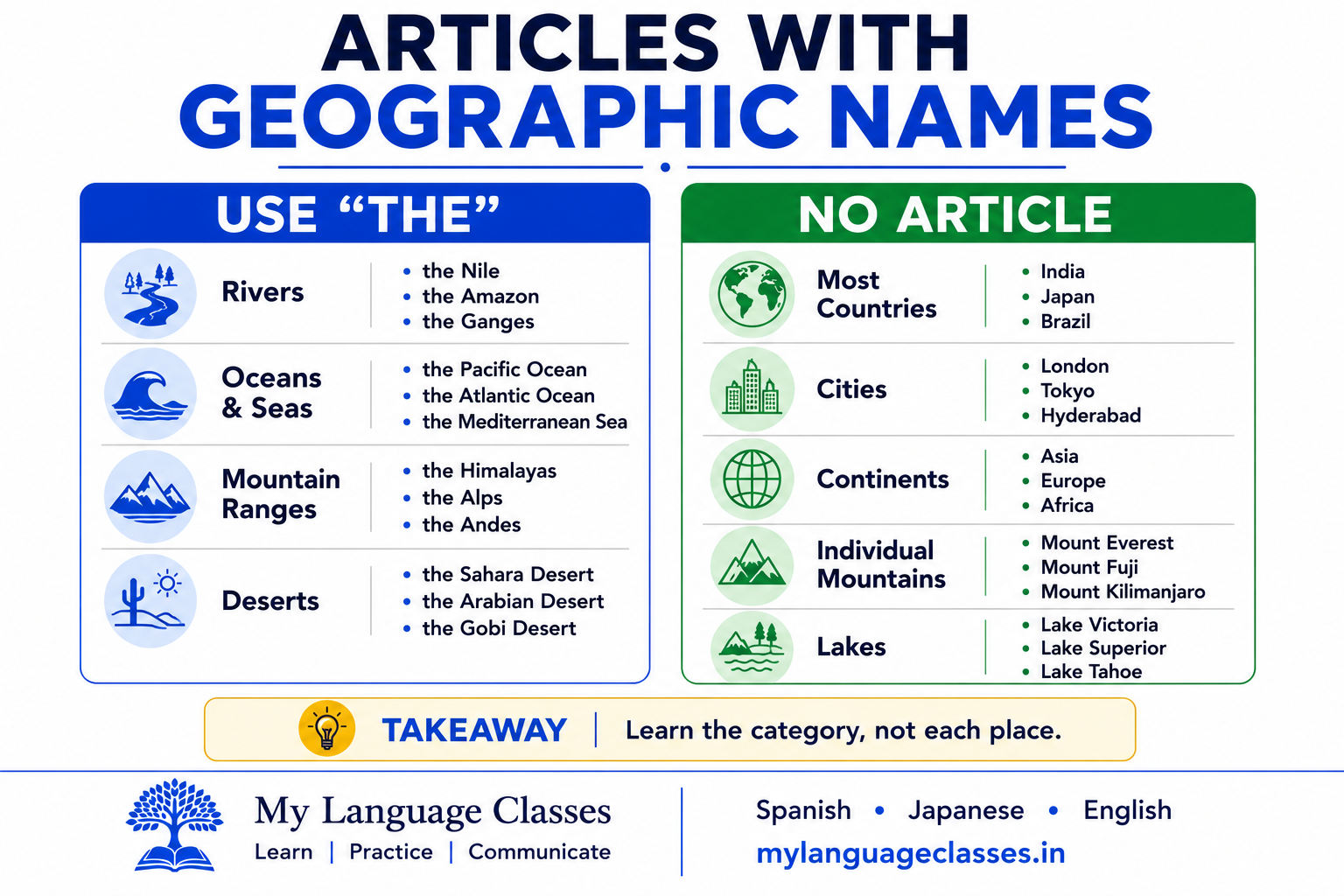
How Are Articles Used with Places and Geographic Names?
Articles are not used with all place names in the same way. Some geographic names always take the, some never take an article, and a few depend on the official name. Learning these patterns is much easier than trying to memorize individual place names.
Countries
Most country names do not take an article.
Examples:
→ India
→ Japan
→ Brazil
→ France
→ Australia
Some countries use the because their names include words such as states, kingdom, republic, or because they refer to a group of islands.
Examples:
→ the United States
→ the United Kingdom
→ the United Arab Emirates
→ the Czech Republic
→ the Philippines
Cities, Towns, and Villages
Cities, towns, and villages normally do not take an article.
Examples:
→ London
→ Tokyo
→ Hyderabad
→ Madrid
→ New York
Continents
Names of continents are generally used without an article.
Examples:
→ Asia
→ Europe
→ Africa
→ South America
Rivers
The names of rivers always take the.
Examples:
→ the Nile
→ the Amazon
→ the Ganges
→ the Mississippi
Oceans and Seas
Use the with the names of oceans and seas.
Examples:
→ the Pacific Ocean
→ the Atlantic Ocean
→ the Indian Ocean
→ the Mediterranean Sea
Mountain Ranges and Individual Mountains
Use the with mountain ranges.
Examples:
→ the Himalayas
→ the Alps
→ the Andes
Do not use an article with the names of individual mountains.
Examples:
→ Mount Everest
→ Mount Fuji
→ Mount Kilimanjaro
Deserts, Forests, and Canals
These geographic names usually take the.
Examples:
→ the Sahara Desert
→ the Black Forest
→ the Panama Canal
Lakes
Most lake names do not use an article.
Examples:
→ Lake Victoria
→ Lake Superior
→ Lake Tahoe
Streets, Roads, and Parks
Most street and road names do not take an article.
Examples:
→ Oxford Street
→ Park Avenue
→ MG Road
Many park names also follow this pattern.
Examples:
→ Central Park
→ Hyde Park
Hotels, Museums, and Famous Buildings
Many hotels, museums, theaters, and well-known buildings use the as part of their name.
Examples:
→ the Ritz Hotel
→ the British Museum
→ the Eiffel Tower
→ the White House
Quick Reference
| Place Type | Article | Examples |
|---|---|---|
| Most countries | No article | India, Japan |
| Countries with States, Kingdom, Republic | the | the United States |
| Cities | No article | London, Tokyo |
| Continents | No article | Asia, Europe |
| Rivers | the | the Nile |
| Oceans and seas | the | the Pacific Ocean |
| Mountain ranges | the | the Alps |
| Individual mountains | No article | Mount Everest |
| Lakes | No article | Lake Victoria |
| Deserts | the | the Sahara Desert |
| Forests | the | the Black Forest |
| Canals | the | the Panama Canal |
| Streets | No article | Oxford Street |
| Famous buildings | Usually the | the White House |
Rather than memorizing every geographic name, focus on the category it belongs to. Once you recognize the pattern, choosing the correct article becomes much easier and far more consistent.
What Are the Most Common Mistakes When Using Articles?
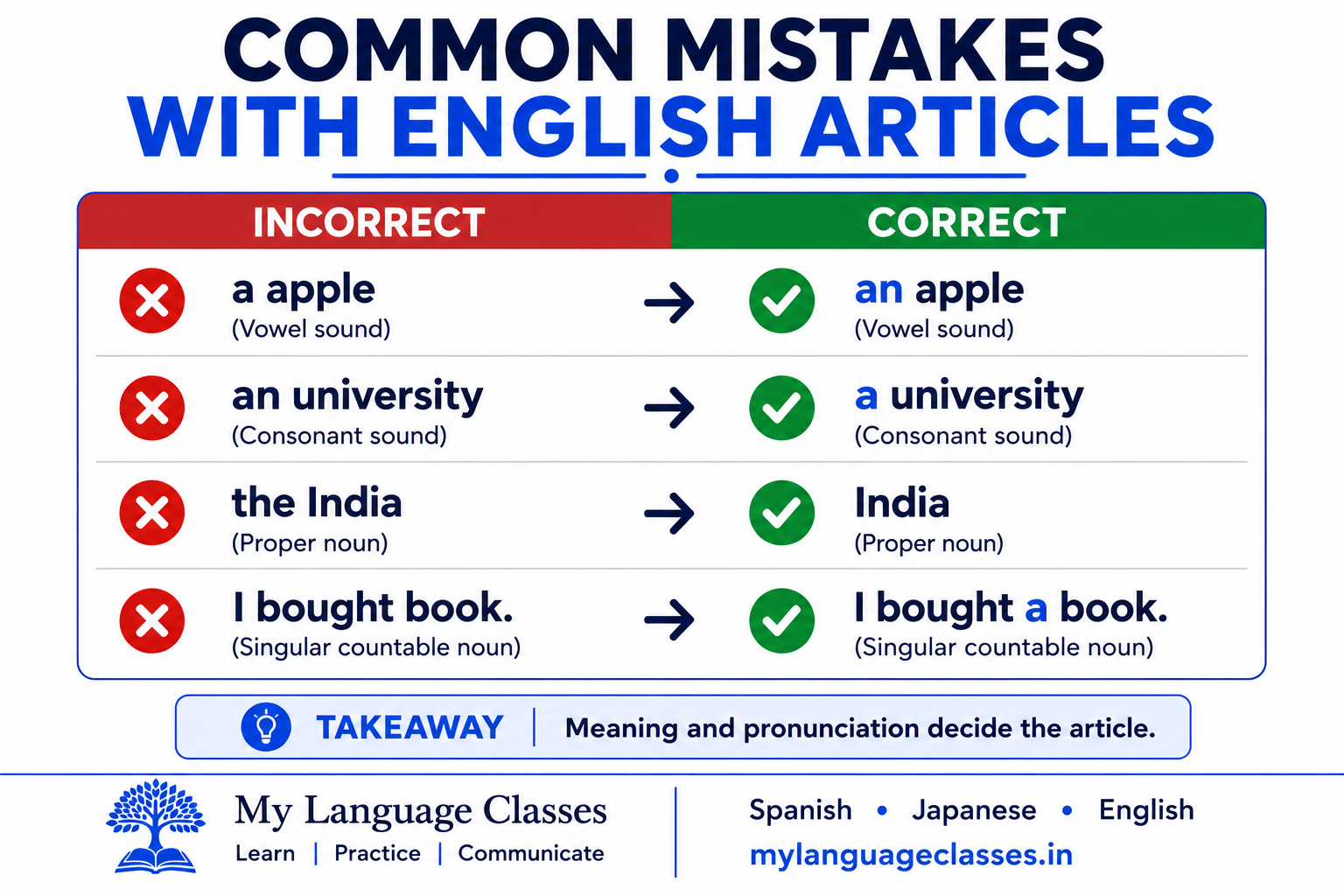
Even learners with a good understanding of English grammar make mistakes with articles. Most errors occur because English article usage depends on meaning, specificity, pronunciation, and noun type rather than a single rule. Learning to recognize these common mistakes will help you write and speak more naturally.
Mistake 1: Choosing A Instead of An
Remember that the choice depends on the first sound, not the first letter.
Incorrect:
→ a apple
→ a engineer
→ a hour
Correct:
→ an apple
→ an engineer
→ an hour
Mistake 2: Choosing An Instead of A
Some words begin with a vowel letter but a consonant sound.
Incorrect:
→ an university
→ an European country
→ an one-time event
Correct:
→ a university
→ a European country
→ a one-time event
Always listen to the pronunciation rather than looking only at the spelling.
Mistake 3: Omitting an Article Before a Singular Countable Noun
A singular countable noun usually needs an article or another determiner.
Incorrect:
→ I bought book.
→ She is teacher.
Correct:
→ I bought a book.
→ She is a teacher.
Mistake 4: Using The for General Meaning
Do not use the when talking about something in general.
Incorrect:
→ The dogs are loyal animals.
→ The life is beautiful.
Correct:
→ Dogs are loyal animals.
→ Life is beautiful.
Use the only when referring to something specific.
Mistake 5: Using an Article with Most Proper Nouns
Most names of people, cities, countries, and continents do not take an article.
Incorrect:
→ the India
→ the Tokyo
→ the Asia
Correct:
→ India
→ Tokyo
→ Asia
Remember that some proper nouns are exceptions, such as the United States and the Netherlands.
Mistake 6: Using an Article with General Uncountable Nouns
General uncountable nouns usually use the zero article.
Incorrect:
→ The information is important. (general meaning)
→ The education is essential. (general meaning)
Correct:
→ Information is important.
→ Education is essential.
Use the only when referring to a specific example.
Example:
→ The information in this report is accurate.
Summary of Common Mistakes
| Incorrect | Correct | Reason |
|---|---|---|
| a apple | an apple | Vowel sound |
| an university | a university | Consonant sound |
| I bought book. | I bought a book. | Singular countable noun |
| The dogs are friendly. (general) | Dogs are friendly. | General plural noun |
| the India | India | Proper noun |
| The information is useful. (general) | Information is useful. | General uncountable noun |
Instead of trying to memorize hundreds of individual rules, focus on identifying the noun type, whether the noun is specific or general, and how the following word is pronounced. These three habits will help you avoid most article mistakes in everyday English.
How Can You Master English Articles More Easily?
Learning English articles becomes much simpler when you understand the patterns behind them instead of trying to memorize long lists of rules. Native speakers rarely think about articles consciously because they recognize these patterns automatically. You can develop the same skill through regular practice and careful observation.
Think About Meaning Before Grammar
Before choosing an article, ask yourself whether the noun refers to something specific or general.
If the noun is specific, the is often the correct choice. If it is not specific, you may need a, an, or no article.
Developing this habit helps you make better decisions than relying on memorized rules alone.
Identify the Type of Noun
Always determine whether the noun is:
→ Singular or plural
→ Countable or uncountable
→ Common or proper
Once you identify the noun type, many article choices become much more straightforward.
Listen to Pronunciation
When deciding between a and an, focus on the first sound you hear rather than the first letter you see.
This simple habit prevents many common mistakes and helps your English sound more natural.
Notice Articles While Reading
As you read books, news articles, or websites, pay attention to the articles that appear before nouns.
Instead of reading only for meaning, observe why the writer chose a, an, the, or no article. Over time, these patterns become familiar.
Learn Common Patterns
Many article rules follow predictable patterns.
For example:
→ Rivers usually take the.
→ Languages usually take no article.
→ Singular countable nouns usually require an article.
→ General plural nouns often use the zero article.
Learning these patterns is much more effective than memorizing individual examples.
Practice in Complete Sentences
Articles should always be practiced within complete sentences rather than as isolated words. This helps you understand how meaning and context affect article choice.
If you want a structured grammar course that builds these skills step by step, Communicative English Foundation, available on My Language Classes website and on Amazon, explains essential grammar concepts through practical usage, helping you become more confident in everyday English communication.
Mastering articles takes time, but it does not require memorizing hundreds of exceptions. Focus on the noun, understand the meaning, and apply the patterns consistently. With regular exposure to authentic English, choosing the correct article gradually becomes a natural part of speaking and writing.
Key Takeaways
The English article system may seem challenging at first, but it follows clear patterns based on noun type, specificity, and pronunciation. Instead of memorizing individual rules, focus on understanding how articles work together with nouns in different contexts.
→ English has three article systems: a/an, the, and the zero article.
→ A and an are indefinite articles used with singular countable nouns.
→ Use a before a consonant sound.
→ Use an before a vowel sound.
→ Choose a or an based on pronunciation, not spelling.
→ Use the when referring to a specific person, place, thing, or idea.
→ Use the when a noun is mentioned again.
→ Use the with unique things, superlatives, and ordinal numbers.
→ The zero article means no article is used.
→ Use the zero article with general plural nouns.
→ Use the zero article with general uncountable nouns.
→ Languages, school subjects, meals, and sports usually take no article.
→ Most countries, cities, continents, and individual mountains do not take an article.
→ Rivers, oceans, seas, mountain ranges, and deserts usually take the.
→ A singular countable noun normally requires an article or another determiner.
→ Before choosing an article, identify whether the noun is countable or uncountable, singular or plural, and specific or general.
→ The easiest way to choose the correct article is to follow this order:
→ Identify the noun type.
→ Decide whether it is specific.
→ If it is indefinite, listen to the first sound.
→ Check whether the noun requires no article.
→ Learning article patterns is more effective than memorizing isolated rules.
→ Regular reading and listening help you develop a natural understanding of English article usage.
Conclusion
Articles are an essential part of English grammar because they help identify whether a noun is specific, non-specific, or used in a general sense. Although a, an, the, and the zero article are small words, they play a major role in making your English clear, accurate, and natural.
Throughout this guide, you learned that the correct article depends on several factors working together. You first need to identify the type of noun, determine whether it is specific or general, and, when using an indefinite article, pay attention to the first sound rather than the first letter. Once these patterns become familiar, choosing the correct article becomes much easier.
It is also important to remember that article usage is not about memorizing hundreds of exceptions. Most situations follow consistent grammar patterns. By understanding these patterns and applying them regularly, you will make fewer mistakes and develop greater confidence in both speaking and writing.
As you continue learning English, notice how native speakers use articles in books, newspapers, websites, and everyday conversations. Paying attention to these patterns will strengthen your grammar naturally and help you communicate with greater precision.
If you would like to continue building a strong foundation in English grammar, Mastering English Grammar for A1 Level and Complete English A1 Grammar Practice Part-1, both available on My Language Classes website, provide structured lessons, clear explanations, and practical examples that reinforce the grammar concepts covered in this guide.
Mastering English articles is not about remembering isolated rules. It is about understanding how nouns work in context. Once you can confidently choose between a, an, the, and no article, you will have developed one of the most valuable grammar skills for accurate and natural English communication.

Vikas Kumar is the founder of My Language Classes, a language learning platform dedicated to helping learners develop practical communication skills in Spanish, Japanese, and English through comprehensive grammar guides, structured learning resources, books, and evidence-informed educational content.
At My Language Classes, we believe that successful language learning is built on clarity, consistency, meaningful practice, and a deep understanding of how languages work. Every article is carefully researched and created to simplify complex concepts, provide practical guidance, and help learners develop confidence through real-world communication.
Inspired by the principles behind How Language Learning Really Works, our mission is to make high-quality language learning accessible to learners around the world by providing accurate, trustworthy, and comprehensive resources that support lasting progress, lifelong learning, and meaningful communication.
Leave a Reply