

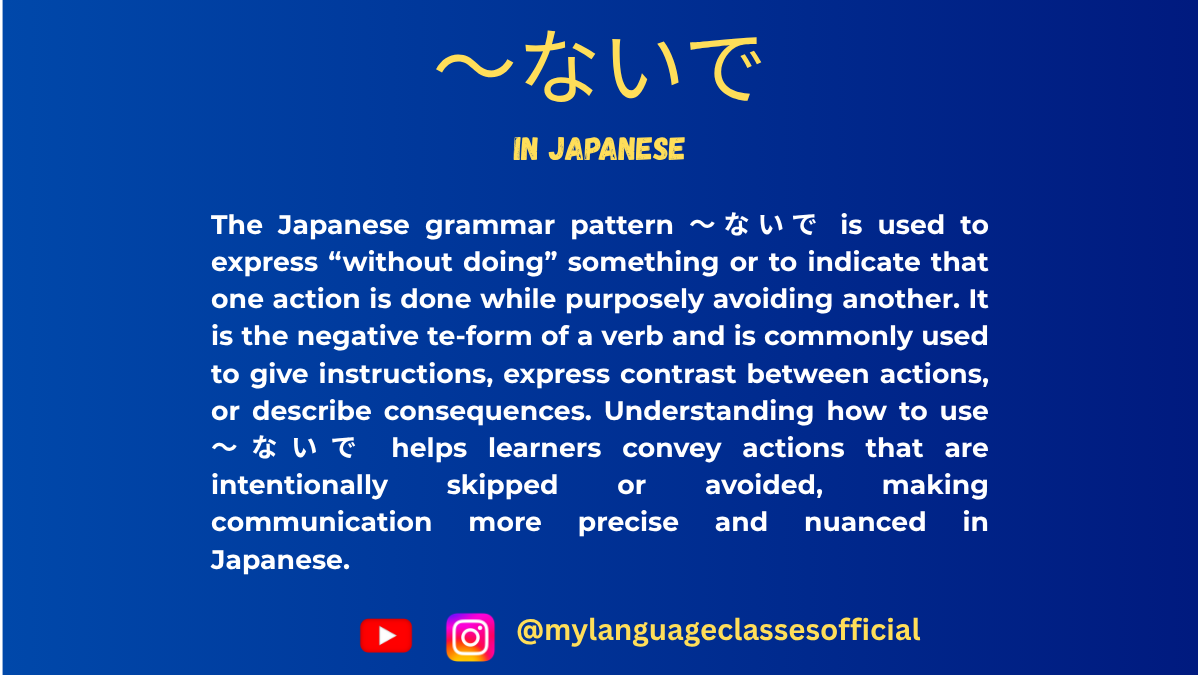
Using 〜ないで in Japanese
Learning how to express “without doing” in Japanese is essential for mastering natural and nuanced communication. The grammar structure 〜ないで (“〜naide”) is a versatile and commonly used expression in Japanese that allows speakers to convey the idea of “not doing something” or “without doing something.” In this blog post, we will explore the various situations where 〜ないで is used, its nuances, and how to incorporate it into your conversations.
What is 〜ないで?
〜ないで is the negative て-form of a verb. It attaches to the plain negative form (〜ない) of a verb to indicate actions that are not done or states that are avoided. Depending on the context, 〜ないで can:
- Express doing something without performing another action.
- Serve as a request or instruction not to do something.
- Indicate cause and effect, such as when one action was done because another was avoided.
Usage of 〜ないで
1. Expressing “without doing something”
This is the most common usage, where 〜ないで describes an action performed in the absence of another action.
- Structure: 〜ないで + another verb/action
- Examples:
- 家を出る前に朝ごはんを食べないで行きました。 (Ie o deru mae ni asagohan o tabenai de ikimashita.) “I left the house without eating breakfast.”
- 仕事を終えないで帰ってはだめです。 (Shigoto o oenai de kaette wa dame desu.) “You shouldn’t go home without finishing your work.”
2. Giving instructions or making requests
When used as a standalone phrase, 〜ないで acts as a direct or polite request not to perform a certain action.
- Structure: Verb (negative form) + ないで
- Examples:
- 詐欺にないで下さい。 (Saguni nai de kudasai.) “Please don’t lie.”
- ここですわらないで。 (Koko de suwaranai de.) “Don’t sit here.”
3. Cause and effect
In some cases, 〜ないで implies that a subsequent action happened because the preceding action was avoided.
- Structure: Verb (negative form) + ないで
- Examples:
- 「話しないで気づいてくれた。」 (Hanashinaide kidzuite kureta.) “They noticed without me saying anything.”
- 親に聞かないで自分で決めました。 (Oya ni kikanaide jibun de kimemashita.) “I decided on my own without asking my parents.”
4. Contrastive emphasis
Here, 〜ないで can emphasize a contrast between what is done and what is not done.
- Structure: 〜ないで + another clause/action
- Examples:
- さんぽを買わないで、アイスを買いました。 (Sanpo o kawanai de, aisu o kaimashita.) “I didn’t buy a sandwich; I bought ice cream instead.”
- 電車で行かないで、歩きました。 (Densha de ikanai de, arukimashita.) “I didn’t take the train; I walked instead.”
Situations Where 〜ないで is Used
- Describing actions done without another action:
- Leaving the house without eating.
- Traveling without packing necessary items.
- Making polite or casual requests:
- Asking someone not to smoke.
- Requesting someone to stay quiet.
- Cause and effect relationships:
- Explaining results stemming from avoiding an action.
- Contrasting actions:
- Highlighting differences between what was done and what wasn’t.
- In storytelling or hypothetical scenarios:
- Creating imagery of what happens when an action is avoided.
Important Notes on 〜ないで
- Formality: 〜ないで is appropriate in both casual and polite speech, but ensure you adjust the overall sentence to suit the context.
- Difference from 〜なくて: While both 〜ないで and 〜なくて convey negation, 〜ないで is specific to “without doing” or “don’t do,” whereas 〜なくて often implies “because not doing.”
- Example:
- 食べないで出かけた。 (“I went out without eating.”)
- 食べなくて出かけた。 (“I went out because I didn’t eat.”)
- Example:
- Verb nuance: The preceding verb influences the meaning and nuance of 〜ないで. Contextual understanding is crucial.
Practice Exercises
Try these sentences to solidify your understanding:
- Translate: “Please don’t run in the hallway.”
- Fill in the blank: 仕事をしないで、\u___。 (Hint: “Relax at home.”)
- Explain the difference in nuance between しないで and しなくて in a given context.
Mastering 〜ないで expands your ability to express nuanced actions and instructions in Japanese. With practice, you’ll find this structure indispensable in your language toolkit. Happy learning!
Happy learning! 😊

Vikas Kumar is the founder of My Language Classes, a language learning platform dedicated to helping learners develop practical communication skills in Spanish, Japanese, and English through comprehensive grammar guides, structured learning resources, books, and evidence-informed educational content.
At My Language Classes, we believe that successful language learning is built on clarity, consistency, meaningful practice, and a deep understanding of how languages work. Every article is carefully researched and created to simplify complex concepts, provide practical guidance, and help learners develop confidence through real-world communication.
Inspired by the principles behind How Language Learning Really Works, our mission is to make high-quality language learning accessible to learners around the world by providing accurate, trustworthy, and comprehensive resources that support lasting progress, lifelong learning, and meaningful communication.
Leave a Reply