

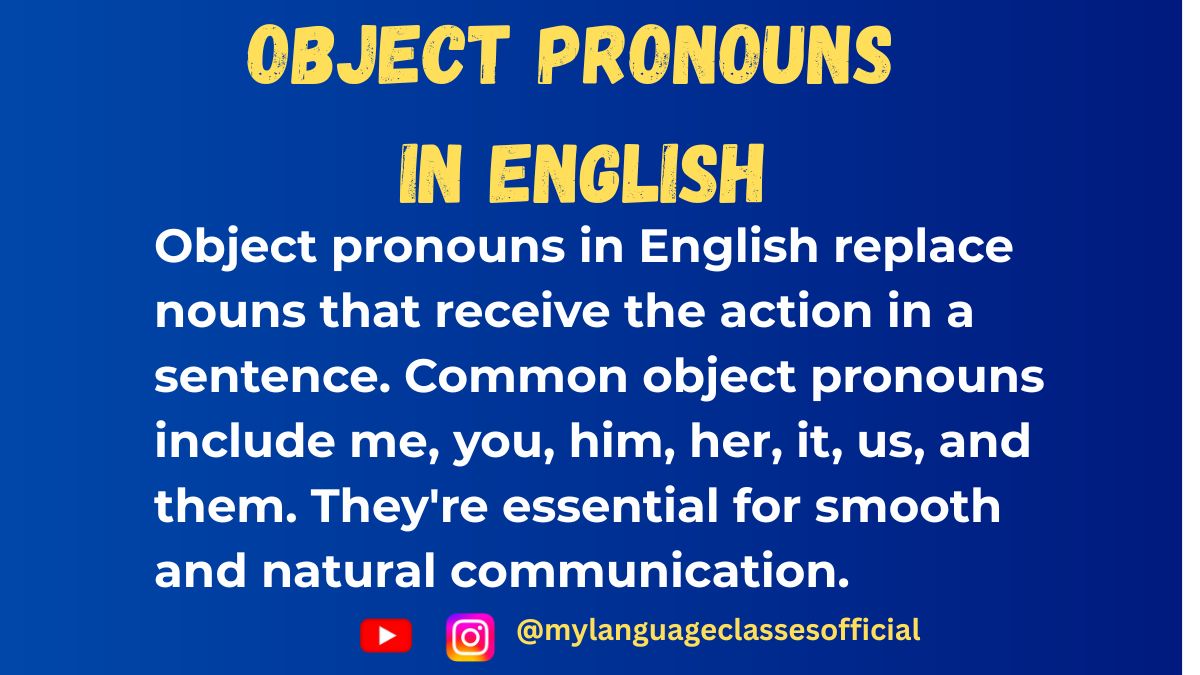
Do you want to sound more natural when speaking English? Are you confused when to say me, him, or them instead of I, he, or they? If yes, you’re not alone! Understanding object pronouns in English is a super simple trick that can instantly improve your English. Whether you’re a beginner or an advanced learner looking to polish your grammar, this guide is your go-to resource for using object pronouns correctly in real conversations.
In English, object pronouns play a big role in making our sentences smooth, clear, and natural. They help us avoid repeating names again and again. For example, instead of saying “I saw John. I liked John,” we say, “I saw John. I liked him.” See how much better that sounds?
This post is packed with easy-to-understand grammar rules, real-life examples, fun exercises, and helpful tips that will make object pronouns stick in your mind. You’ll learn how to use them correctly, spot common mistakes, and sound more fluent. Plus, we’ve included a section to practice what you learn!
Whether you’re practicing for school, preparing for a test, or just trying to sound more natural when chatting with friends or colleagues, this post is perfect for you.
Let’s begin this exciting journey to mastering object pronouns in English — and speaking more confidently every day!
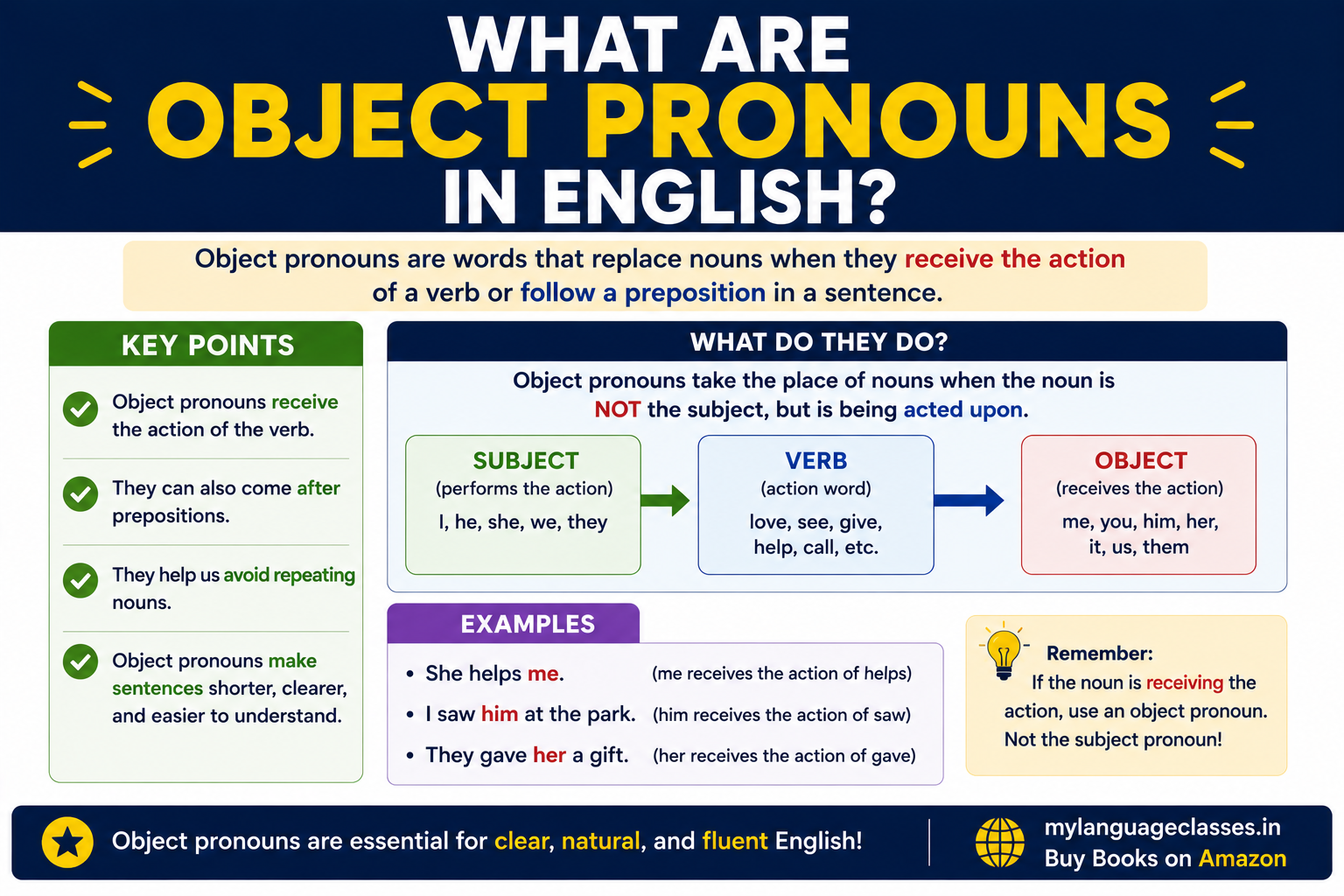
Common Expressions: 10 Real-Life Sentences Using Object Pronouns
Now that you know what object pronouns are, let’s see them in action. These real-life English sentences will help you understand how object pronouns are used in everyday conversations. Pay close attention to the bolded words — these are the object pronouns.
Here are 10 natural and useful sentences:
- My mom called me this morning to check on my health.
- Can you help us carry these bags?
- I saw Anna and waved at her.
- Jake is funny. Everyone likes him.
- Don’t worry about the tickets — I’ve already bought them.
- She invited me to her birthday party next week.
- We met our new neighbors yesterday. I really like them.
- That’s a great song! I heard it on the radio today.
- He doesn’t know me, but I’ve seen him before.
- My teacher gave us extra homework after class.
These sentences show how object pronouns like me, us, him, her, it, and them replace the object (the person or thing receiving the action) in a sentence. Notice how these pronouns keep the sentences short and smooth.
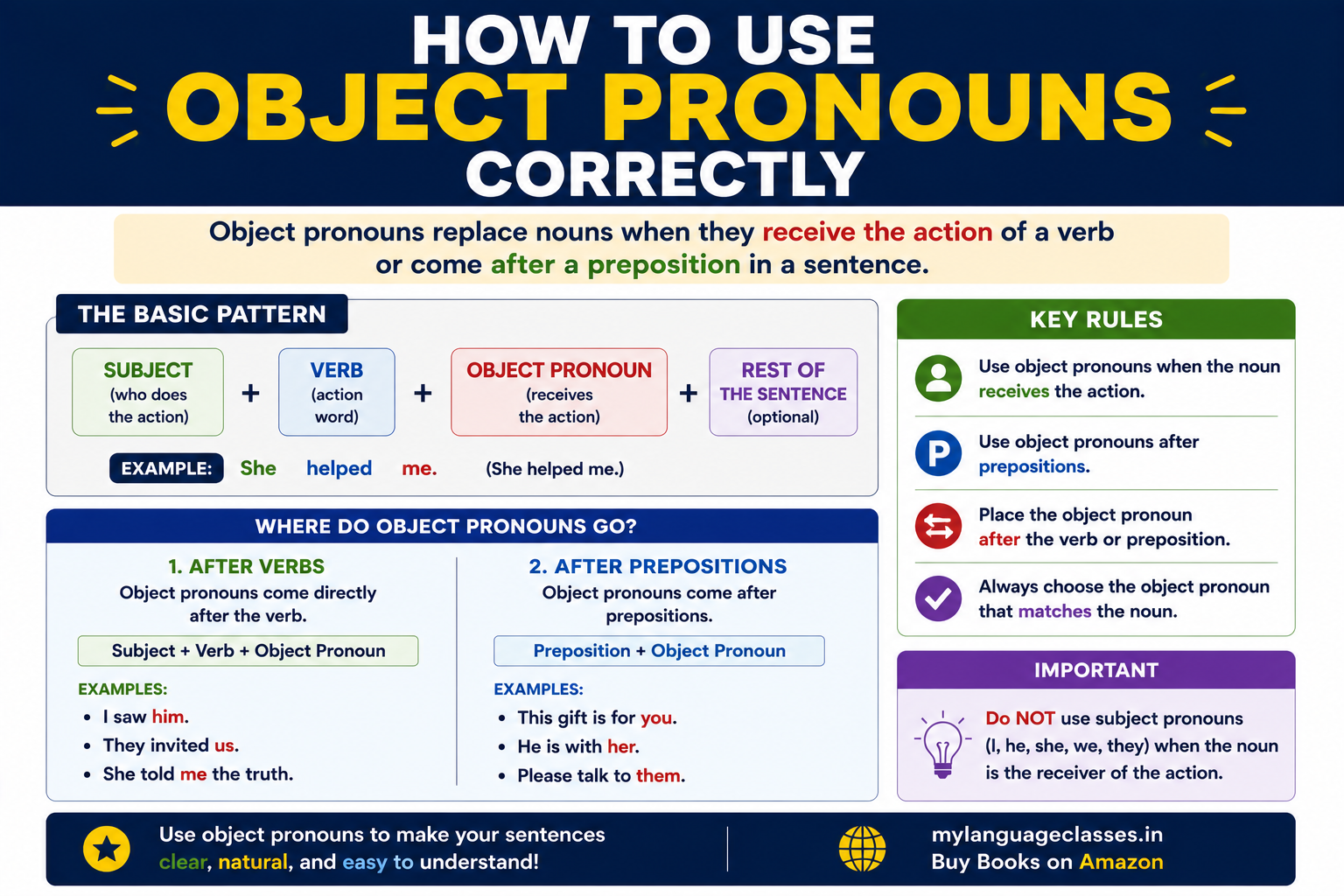
Usage: When Do We Use Object Pronouns in English?
Understanding when to use object pronouns is key to sounding natural and fluent in English. These small but powerful words are used in many everyday situations. Here’s a simple guide to help you know exactly when to use object pronouns in a sentence.
1. After a verb (when someone is receiving an action)
Object pronouns come after the main verb when someone or something is receiving the action.
- I called her.
- They saw me at the mall.
- She invited us to the event.
2. After prepositions (like to, for, with, at, about, etc.)
Prepositions are words that show a relationship between nouns or pronouns and other words in a sentence. Object pronouns come after these.
- He sat next to me.
- This gift is for you.
- Don’t talk about them like that.
3. To avoid repeating the noun
Instead of saying the same name again, we use an object pronoun to make the sentence smoother.
- I met Sarah. I liked her. (Instead of “I liked Sarah.”)
- We watched the movie. I loved it.
4. In questions and short answers
Object pronouns are often used to answer questions briefly and clearly.
- Who gave you the book? – She gave it to me.
- Did you see the kids? – Yes, I saw them.
5. In commands or requests
When giving instructions, object pronouns show who the action is directed toward.
- Please call me later.
- Tell him to wait.
- Show us the way.
6. In passive voice constructions
When focusing on the action more than the subject, object pronouns help make the sentence clear.
- The letter was sent to him yesterday.
- A message was left for her.
Keep these situations in mind, and using object pronouns will become second nature!
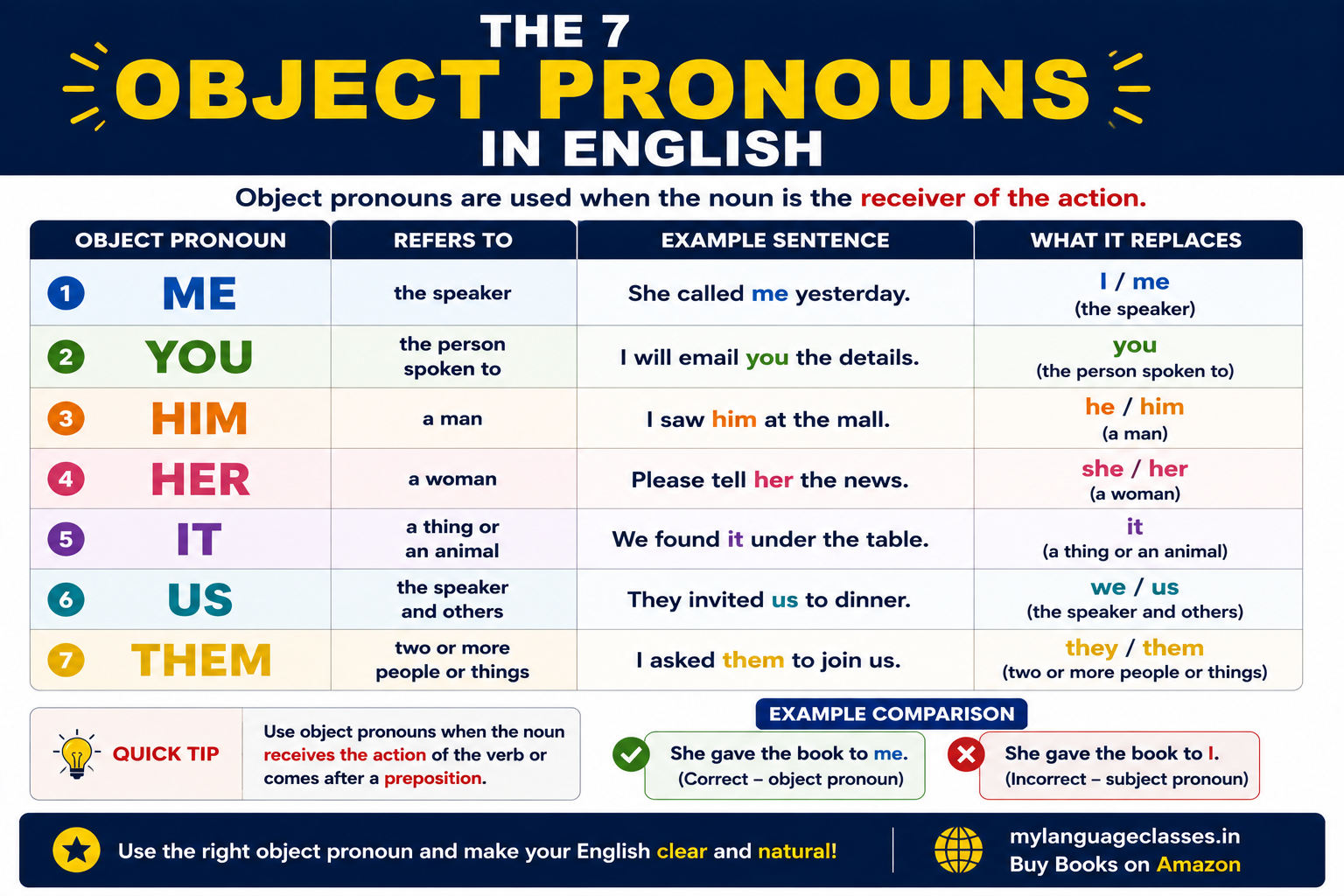
Conjugation Rules: List of All English Object Pronouns
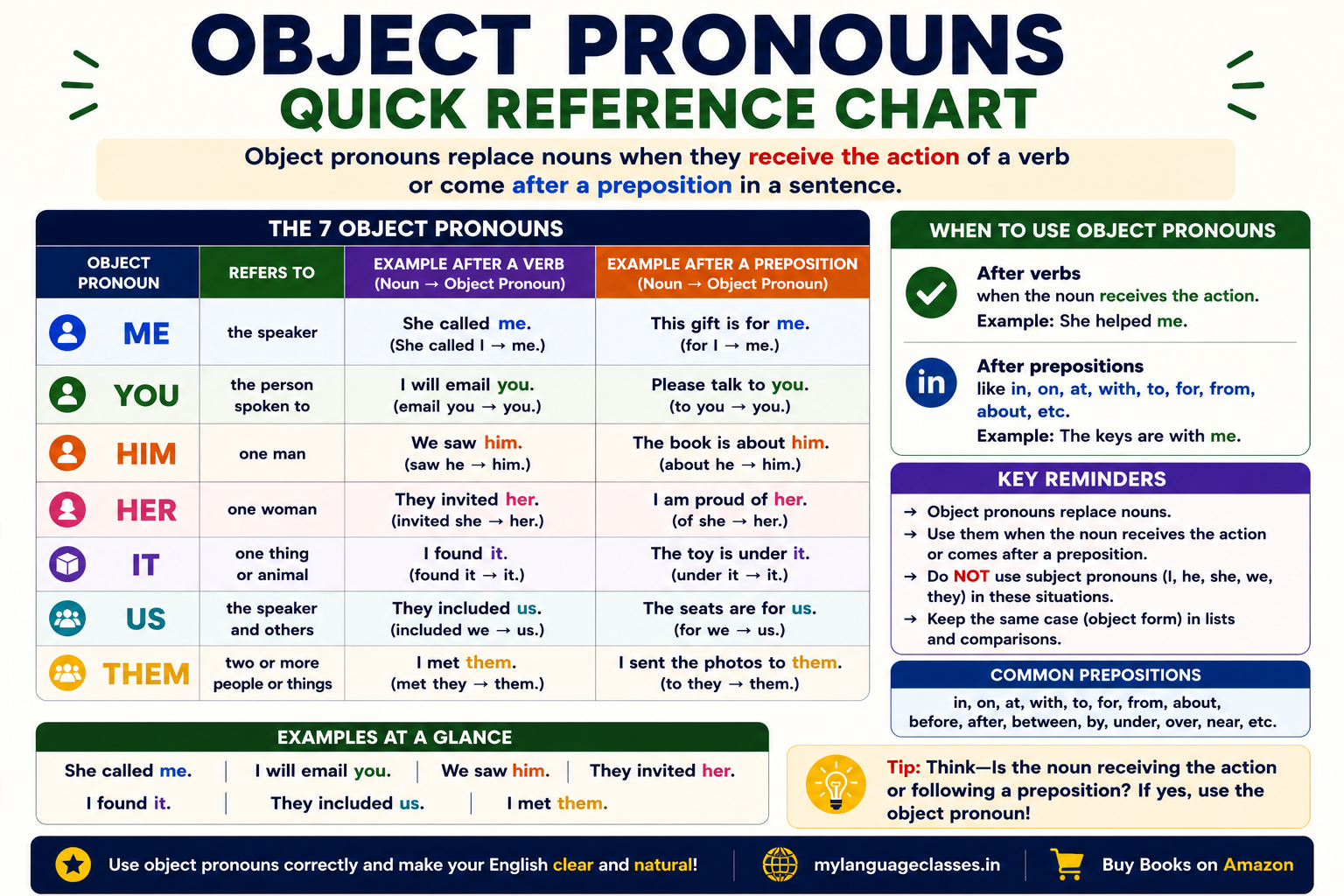
Unlike verbs, object pronouns in English don’t change with tense or time, but they do change depending on the subject pronoun they replace. That’s why it’s helpful to know the complete list and understand how each subject pronoun has a matching object pronoun.
Here’s a handy chart you can remember easily:
| Subject Pronoun | Object Pronoun | Example Sentence |
|---|---|---|
| I | me | She called me last night. |
| You | you | I saw you at the store. |
| He | him | Sarah likes him a lot. |
| She | her | I helped her with her homework. |
| It | it | I found it under the bed. |
| We | us | The teacher praised us. |
| They | them | He invited them to the party. |
Key Points to Remember:
- “You” stays the same whether it’s a subject or object.
- Object pronouns always come after the verb or after a preposition.
- They replace people, animals, or things that are receiving the action in the sentence.
Quick Review Trick:
Think of it like this:
- I becomes me
- He becomes him
- She becomes her
- We becomes us
- They becomes them
- You stays you
- It stays it
Say it out loud a few times, and you’ll remember it easily!
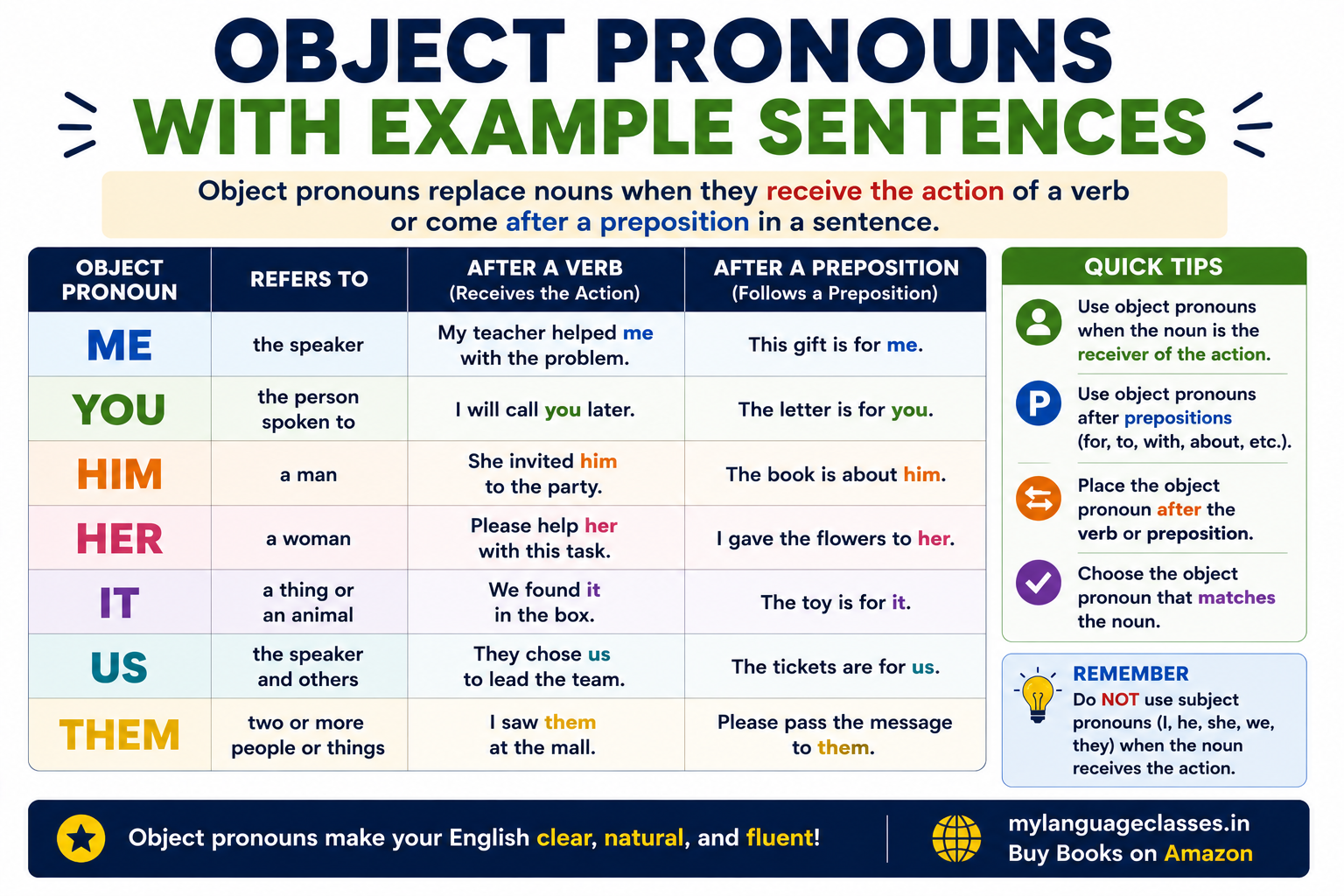
Grammar Rules for Object Pronouns in English
Learning grammar doesn’t have to be boring! When it comes to object pronouns, the rules are clear, simple, and easy to apply. Once you understand how and where to use them, your English will sound smoother and more natural.
Here are the most important grammar rules you need to know about object pronouns:
Rule 1: Use object pronouns after action verbs
When a verb shows what someone is doing to someone or something, use an object pronoun to show who is receiving the action.
Examples:
- I called her.
- They helped me.
- He hugged us.
Rule 2: Use object pronouns after prepositions
Prepositions (like to, for, with, at, about, from) are followed by object pronouns.
Examples:
- She sat next to him.
- This gift is for you.
- Don’t argue with them.
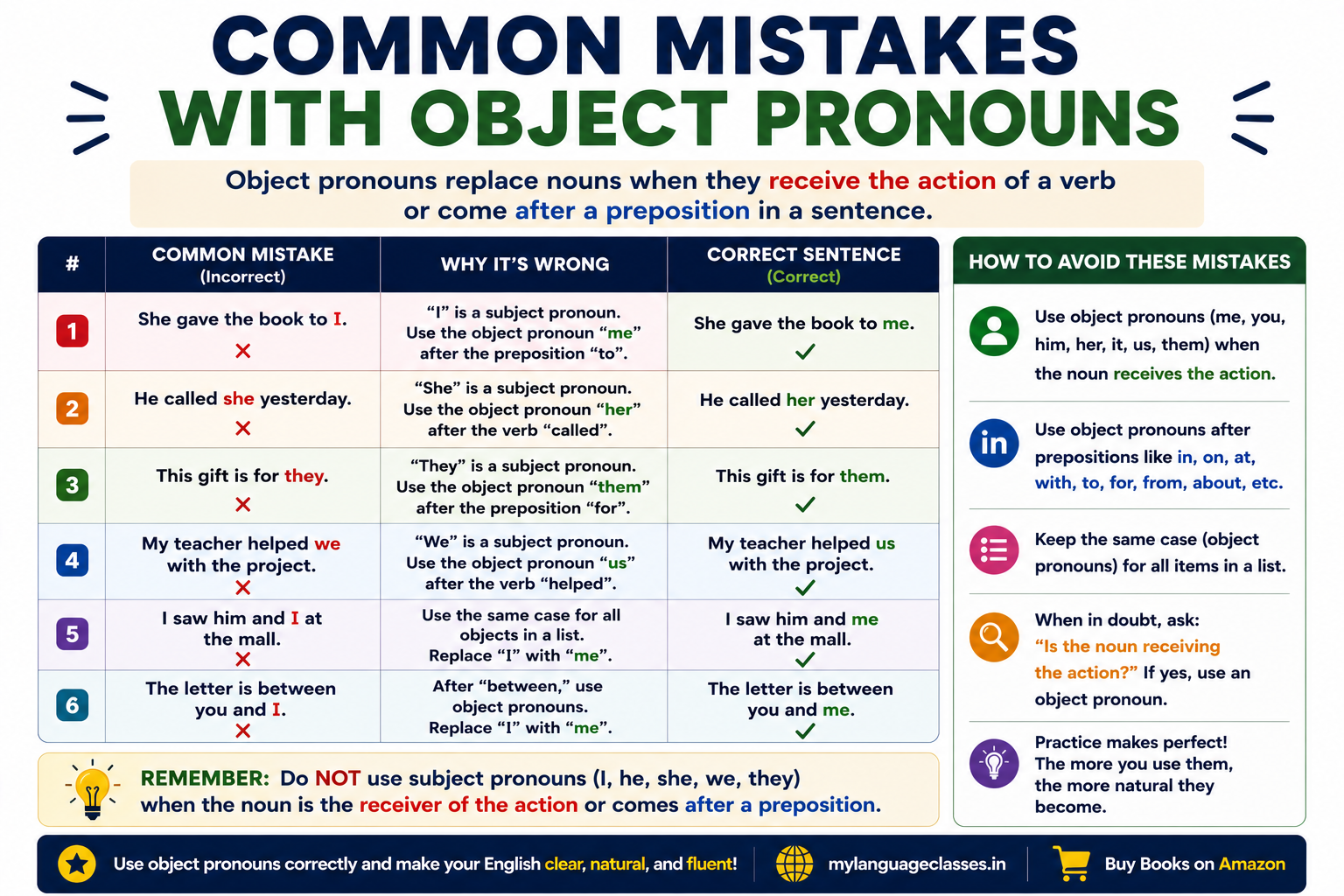
Rule 3: Never use subject pronouns where object pronouns are needed
Using a subject pronoun (I, he, she, we, they) in the object position is incorrect.
Incorrect: She gave the book to I.
Correct: She gave the book to me.
Rule 4: Object pronouns replace nouns already mentioned
If you’ve already mentioned a person or thing, you can use an object pronoun instead of repeating it.
Example:
- Anna loves her dog. She walks it every day.
Rule 5: In compound objects, put the pronoun at the end
When using a pronoun and a noun together as the object, put the pronoun after the noun.
Example:
- She called John and me. (Not “me and John”)
Rule 6: In questions, use object pronouns when answering
Example:
- Who helped you? – My brother helped me.
Rule 7: “It” is only used for things, animals, or unknown gender
Never use it to refer to a person (unless you’re talking about a baby in general terms or a surprise gender reveal).
Example:
- I found the wallet. I picked it up.
Rule 8: “Them” is for plural objects
Use them when you’re talking about more than one person or thing.
Examples:
- I saw the kids. I greeted them.
- She bought apples and ate them all.
Rule 9: Formal speech prefers correct object pronouns even in speech
Even though some people say “me and my friend” in casual English, the correct form is still important in writing and formal speaking.
Correct: Please come with my friend and me.
Rule 10: “Whom” is the formal question form for object pronouns (but rare in casual speech)
Examples:
- To whom did you give the gift?
(But in conversation, most people just say: Who did you give the gift to?)
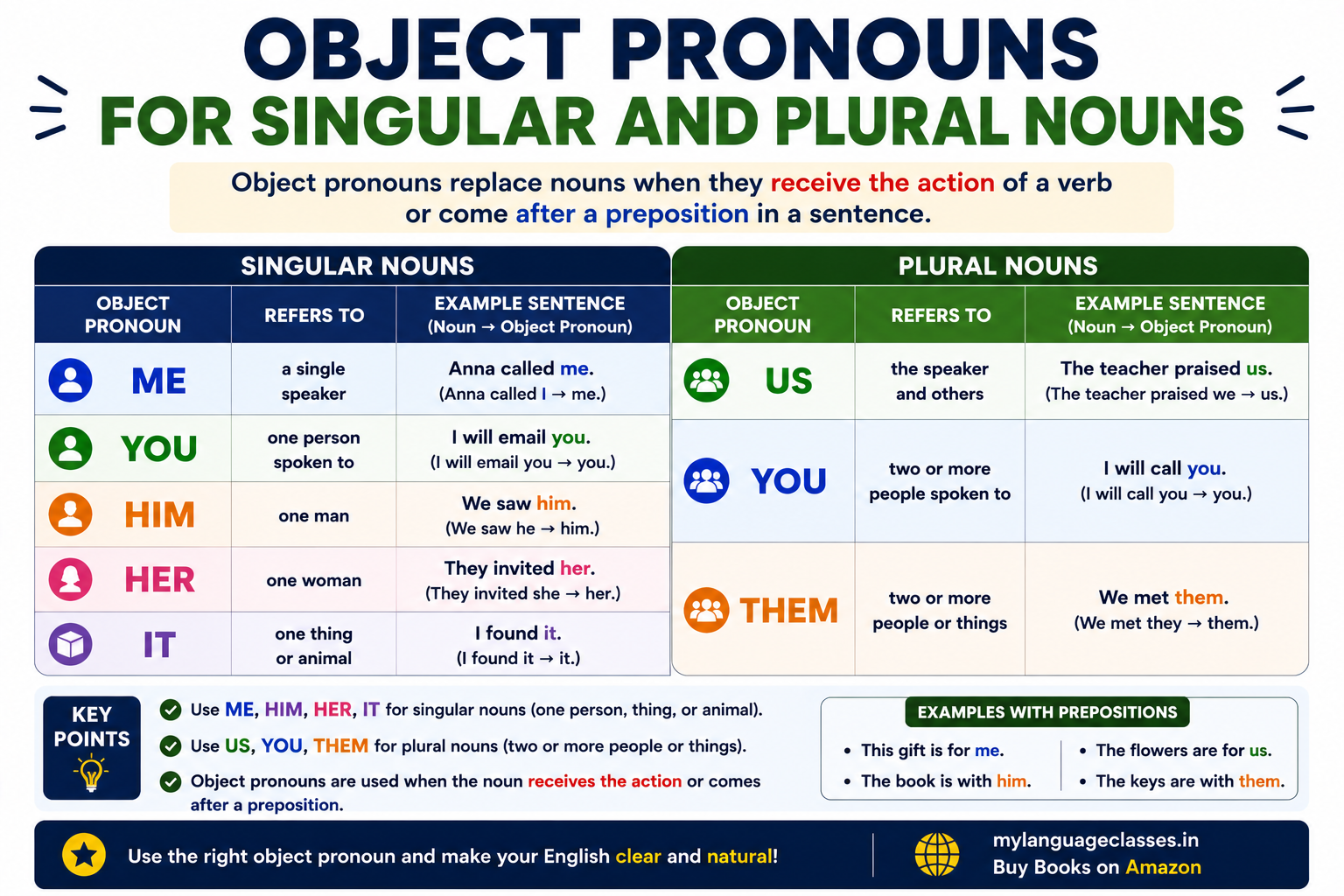
Things to Keep in Mind: Tricky Points, Exceptions, and Special Cases
Even though object pronouns are simple, there are a few tricky areas that often confuse English learners. Here are the most important things to remember, so you can avoid mistakes and feel more confident while speaking and writing.
1. “Me and my friend” vs. “My friend and me”
Many native speakers say, “Me and my friend went to the store,” but this is not correct. Why? Because “me” is an object pronoun, and it shouldn’t be used as a subject.
Correct:
- My friend and I went to the store. (“I” is the subject)
- She gave the invitation to my friend and me. (“me” is the object)
Tip: Remove the other person from the sentence and see if it still sounds right:
Would you say “Me went to the store”? No — so you shouldn’t say “Me and my friend went…”
2. “Between you and I” is wrong (even if it sounds formal)
This is a common mistake in both spoken and written English. The correct form is:
- Between you and me
Because “between” is a preposition, it must be followed by object pronouns.
3. Don’t mix up subject and object pronouns
Learners sometimes say things like:
- ❌ “Him is my brother.”
- ✅ “He is my brother.”
Or:
- ❌ “Can you help I?”
- ✅ “Can you help me?”
Remember: Subject pronouns do the action. Object pronouns receive the action.
4. “It” can sound cold when used for people
Be careful not to use “it” for a person. Even if you’re unsure about someone’s gender, it’s better to say they or use their name again.
- ❌ I met a teacher. It was kind.
- ✅ I met a teacher. They were kind. (More natural)
5. Object pronouns are used after “than” in comparisons (in informal speech)
In informal conversation, people often say:
- “She’s taller than me.” (common and accepted) But in formal writing, grammar experts prefer:
- “She’s taller than I (am).”
You’ll hear both forms, but in exams or writing, go for the formal one.
6. Word order in commands
When giving a command, object pronouns usually come after the verb.
- Help me.
- Tell him the truth.
- Show us the way.
7. “It” and “them” for animals and objects
Use “it” for singular animals or things (unless you’re being affectionate toward a pet — then you can say he or she). Use “them” for plural objects or animals.
- I saw a dog. I liked it.
- I saw the puppies. I played with them.
8. Object pronouns in short answers
This is super useful in conversations:
- “Who took your bag?” – “He took it.”
- “Did she call you?” – “Yes, she called me.”
Keep these details in mind, and you’ll avoid some of the most common mistakes English learners make!
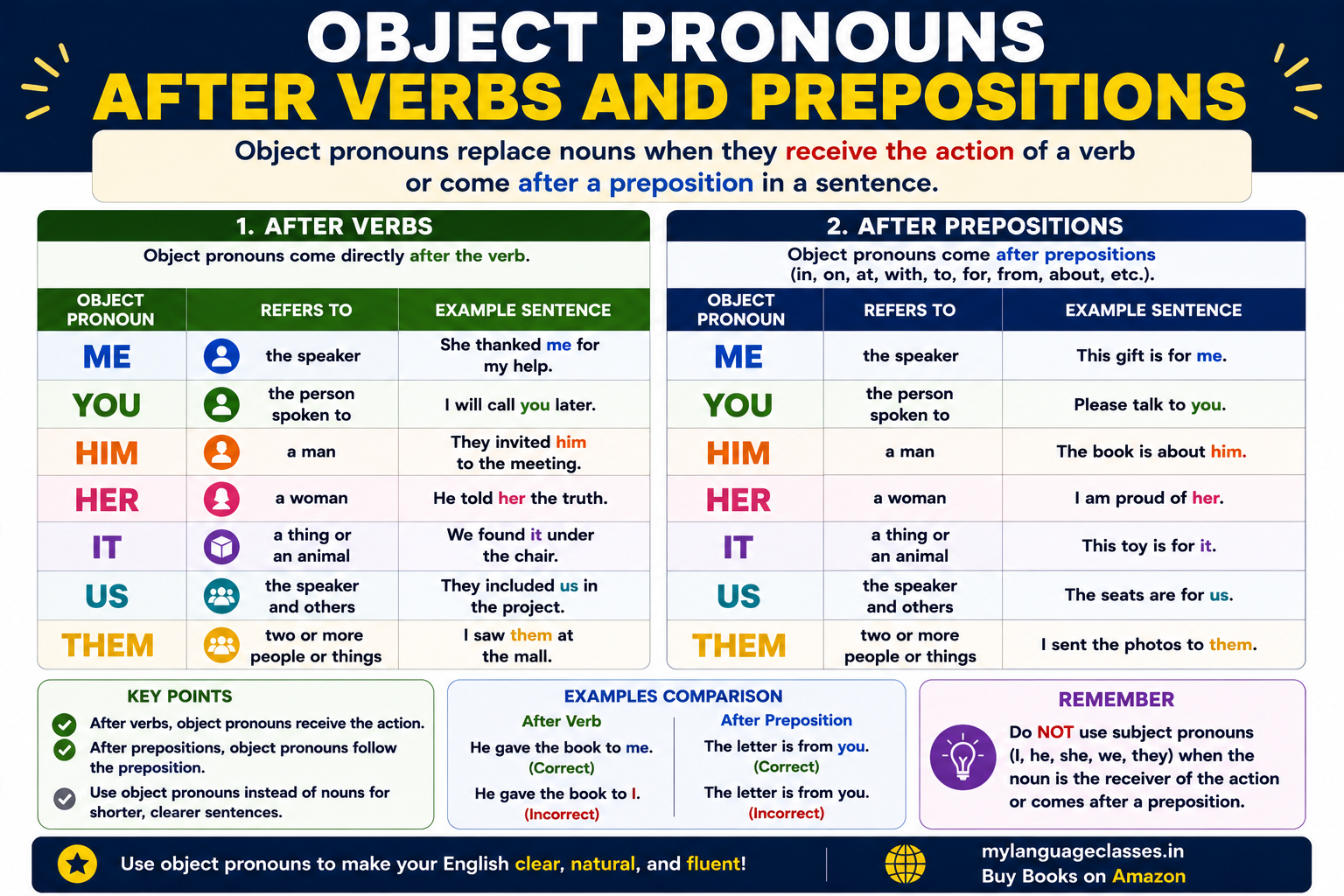
Common Mistakes and How to Avoid Them
Even advanced English learners sometimes make mistakes with object pronouns. But don’t worry! Once you know the common errors, it’s much easier to avoid them. Below are the top mistakes along with clear corrections and tips to help you speak and write like a pro.
Mistake 1: Using a subject pronoun instead of an object pronoun
Incorrect: She gave the book to I.
Correct: She gave the book to me.
Tip: After prepositions like to, for, with, use object pronouns, not subject ones.
Mistake 2: Mixing up “me” and “I”
Incorrect: Me and my brother went to the park.
Correct: My brother and I went to the park.
Tip: Remove the other person to check it. Would you say “Me went to the park”? Nope!
Mistake 3: Using “me” at the beginning of a sentence
Incorrect: Me don’t like cold weather.
Correct: I don’t like cold weather.
Tip: “Me” cannot be the subject of a sentence. Use “I” to do the action.
Mistake 4: Using “it” for people
Incorrect: I met a nurse. It was very kind.
Correct: I met a nurse. She was very kind. (or use “they” if gender is unknown)
Tip: Never use “it” for a person.
Mistake 5: Using “he” or “she” after a preposition
Incorrect: This is between you and I.
Correct: This is between you and me.
Tip: Always use object pronouns after prepositions.
Mistake 6: “Me” instead of “my” before a noun
Incorrect: That’s me book.
Correct: That’s my book.
Tip: Use “my” to show possession, not “me.”
Mistake 7: Using “them” for singular nouns
Incorrect: I saw the dog. I liked them.
Correct: I saw the dog. I liked it.
Tip: Use “them” for plural, “it” for singular.
Mistake 8: Putting the pronoun before the noun in compound objects
Incorrect: She called me and Alex.
Correct: She called Alex and me.
Tip: Always mention the other person’s name before the pronoun.
Mistake 9: Using the wrong pronoun in short answers
Incorrect: Who helped you? – Me.
Correct: Who helped you? – He did. / She did. / They did.
Tip: Use a subject pronoun in answers if it’s the person doing the action.
Mistake 10: Overusing object pronouns when they aren’t needed
Incorrect: She told me that me should go.
Correct: She told me that I should go.
Tip: Don’t double up on pronouns. Just use the right one in the right place.
Quick Fix: When in doubt, ask yourself:
- Is the pronoun doing the action? → Use I, he, she, we, they
- Is it receiving the action or following a preposition? → Use me, him, her, us, them
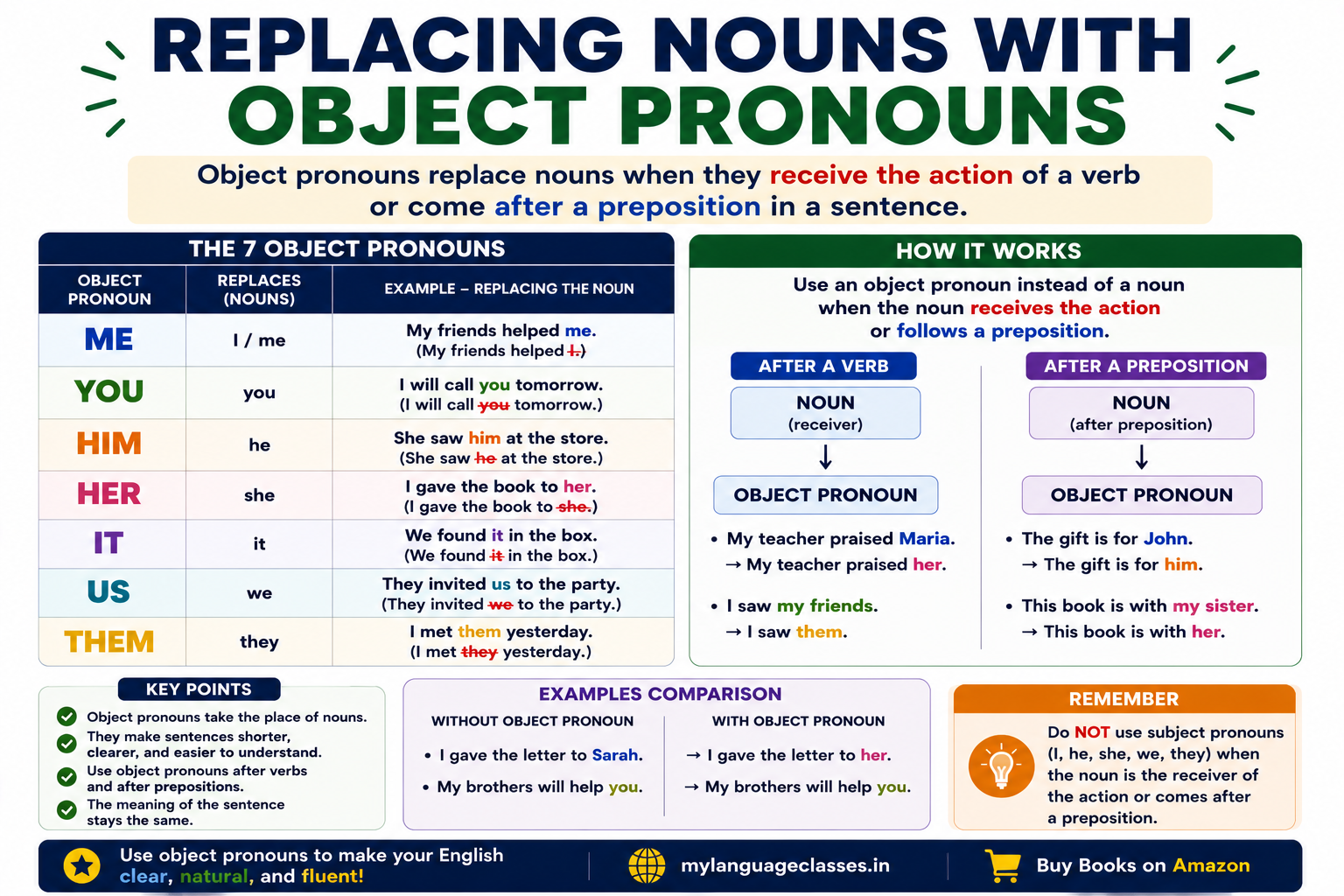
20 Example Sentences Using Object Pronouns
Seeing object pronouns in action is one of the best ways to understand how they work in real life. Below are 20 clear and useful example sentences using all the English object pronouns: me, you, him, her, it, us, and them.
Examples with “me”
- My friend called me last night.
- Can you help me with this homework?
Examples with “you”
- I have something to show you.
- They will meet you at the station.
Examples with “him”
- Jane doesn’t like him very much.
- I saw him at the cafe yesterday.
Examples with “her”
- We invited her to the wedding.
- Don’t forget to thank her for the gift.
Examples with “it”
- I bought a new phone and I love it!
- The dog is hungry. Please feed it.
Examples with “us”
- Our teacher gave us extra homework.
- They want to join us for lunch.
Examples with “them”
- I can’t find the keys. Have you seen them?
- Tell them we’ll be late.
Mixed examples
- She saw him at the park and waved at him.
- I miss them so much.
- He told me a funny story.
- Please give it back to her.
- The coach praised us for our teamwork.
- I’ll meet you at the bus stop.
Exercise: Fill in the Blanks with the Correct Object Pronoun
Choose the correct object pronoun (me, you, him, her, it, us, them) to complete each sentence. Try to answer without looking back if you can—it’s a great way to check your understanding!
Fill in the blanks:
- Can you help ___ with my homework?
- I saw Anna yesterday and gave the book to ___.
- They are waiting for ___ at the bus stop.
- My mom called, and I told ___ the good news.
- This story is amazing. I love ___!
- Where is David? I haven’t seen ___ all day.
- Our teacher gave ___ extra practice sheets.
- Don’t be angry at ___. I didn’t mean it.
- We are going to the mall. Do you want to join ___?
- My sister has a cat. She really loves ___.
- Please ask John and Sarah to call __ when they arrive.
- He knows the answer, but he didn’t tell ___.
- Your shoes are dirty. Clean ___ before going out.
- That movie was boring. I didn’t like ___ at all.
- Could you take this book to Emily? I need to return it to ___.
- My friends invited ___ to their birthday party.
- Tom is behind you. Give the pencil to ___.
- I want to visit grandma. Let’s call ___ now.
- This pizza is delicious! Who made ___?
- She didn’t see us, but we saw ___ at the park.
Answers: Fill in the Blanks with Complete Sentences
- Can you help me with my homework?
- I saw Anna yesterday and gave the book to her.
- They are waiting for you at the bus stop.
- My mom called, and I told her the good news.
- This story is amazing. I love it!
- Where is David? I haven’t seen him all day.
- Our teacher gave us extra practice sheets.
- Don’t be angry at me. I didn’t mean it.
- We are going to the mall. Do you want to join us?
- My sister has a cat. She really loves it.
- Please ask John and Sarah to call me when they arrive.
- He knows the answer, but he didn’t tell us.
- Your shoes are dirty. Clean them before going out.
- That movie was boring. I didn’t like it at all.
- Could you take this book to Emily? I need to return it to her.
- My friends invited me to their birthday party.
- Tom is behind you. Give the pencil to him.
- I want to visit grandma. Let’s call her now.
- This pizza is delicious! Who made it?
- She didn’t see us, but we saw her at the park.
Summary: Key Points on Object Pronouns
- Object pronouns are: me, you, him, her, it, us, and them.
- They replace nouns in sentences and are used to receive the action of the verb or follow prepositions.
- Subject pronouns (I, you, he, she, etc.) do the action, while object pronouns receive it.
Common Usage:
- Me – I gave me the book.
- You – I saw you at the store.
- Him/Her – She helped him with his homework.
- It – I can’t find it anywhere.
- Us – They invited us to the party.
- Them – I saw them at the park yesterday.
Tricky Points to Remember:
- Never use me or I incorrectly as subjects.
- After prepositions (to, for, with, etc.), always use object pronouns (me, him, her, etc.).
- Use “it” for singular objects or animals but not for people.
Common Mistakes:
- Don’t say “Me and John” as the subject of a sentence; say “John and I”.
- Don’t use “it” for people. Use “he” or “she” instead.
- Avoid repeating the same pronoun unnecessarily—just use the correct one.
Conclusion
In this post, we’ve covered everything you need to know about object pronouns in English. Whether you’re learning the basics or brushing up on advanced usage, it’s essential to use the right pronoun in the right place. Now you can practice these tips in real-life conversations and make your English even stronger.

Vikas Kumar is the founder of My Language Classes, a language learning platform dedicated to helping learners develop practical communication skills in Spanish, Japanese, and English through comprehensive grammar guides, structured learning resources, books, and evidence-informed educational content.
At My Language Classes, we believe that successful language learning is built on clarity, consistency, meaningful practice, and a deep understanding of how languages work. Every article is carefully researched and created to simplify complex concepts, provide practical guidance, and help learners develop confidence through real-world communication.
Inspired by the principles behind How Language Learning Really Works, our mission is to make high-quality language learning accessible to learners around the world by providing accurate, trustworthy, and comprehensive resources that support lasting progress, lifelong learning, and meaningful communication.
Leave a Reply