
Learning Spanish grammar from scratch does not have to feel overwhelming. The key is not to study harder or faster. It is to follow a clear learning path where every new concept builds naturally on what you already understand. When grammar is introduced in the right order and explained with practical examples, it becomes much easier to understand, remember, and use in everyday communication.
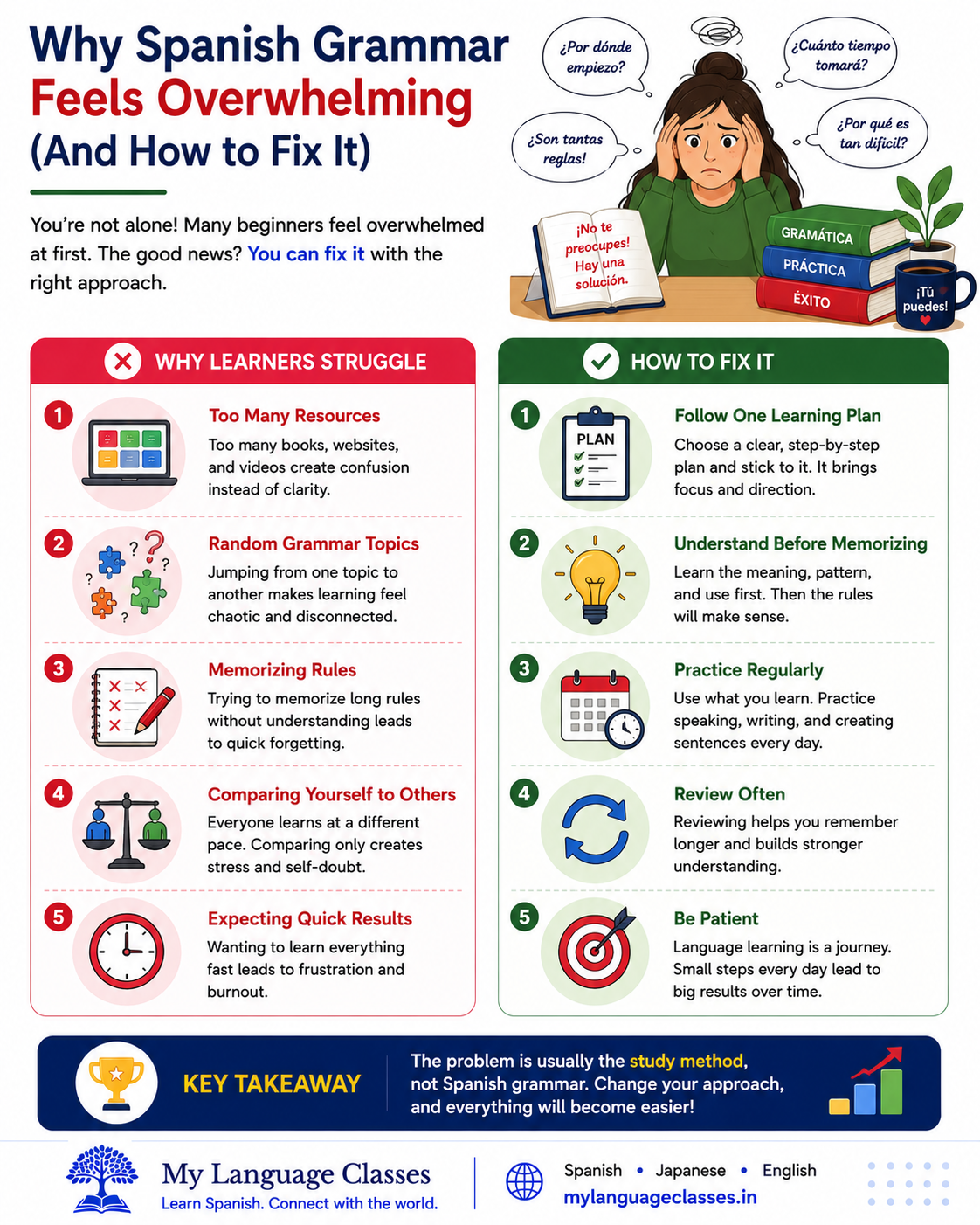
Many beginners believe they struggle because Spanish grammar is difficult. In reality, most learners feel overwhelmed because they are exposed to too much information without a clear structure. One lesson teaches verb conjugations, another introduces pronouns, while a third focuses on sentence patterns. Although each lesson may be useful on its own, they often fail to show how these ideas connect. As a result, learners end up collecting grammar rules instead of building a complete understanding of the language.
At My Language Classes, we believe that language learning should replace confusion with clarity. Grammar is not a collection of isolated rules to memorise. It is a system that helps you understand how a language works. Once you begin seeing the connections between different grammar concepts, learning becomes more logical, more enjoyable, and much less stressful. This learner-first approach reflects our broader educational philosophy of helping learners understand before expecting them to remember.
If you prefer learning with a structured book, Mastering Spanish Grammar for DELE A1 is available as an eBook on the My Language Classes website. It is also available on Amazon in Kindle, Paperback, and Hardcover editions, allowing you to choose the format that best suits your learning style.
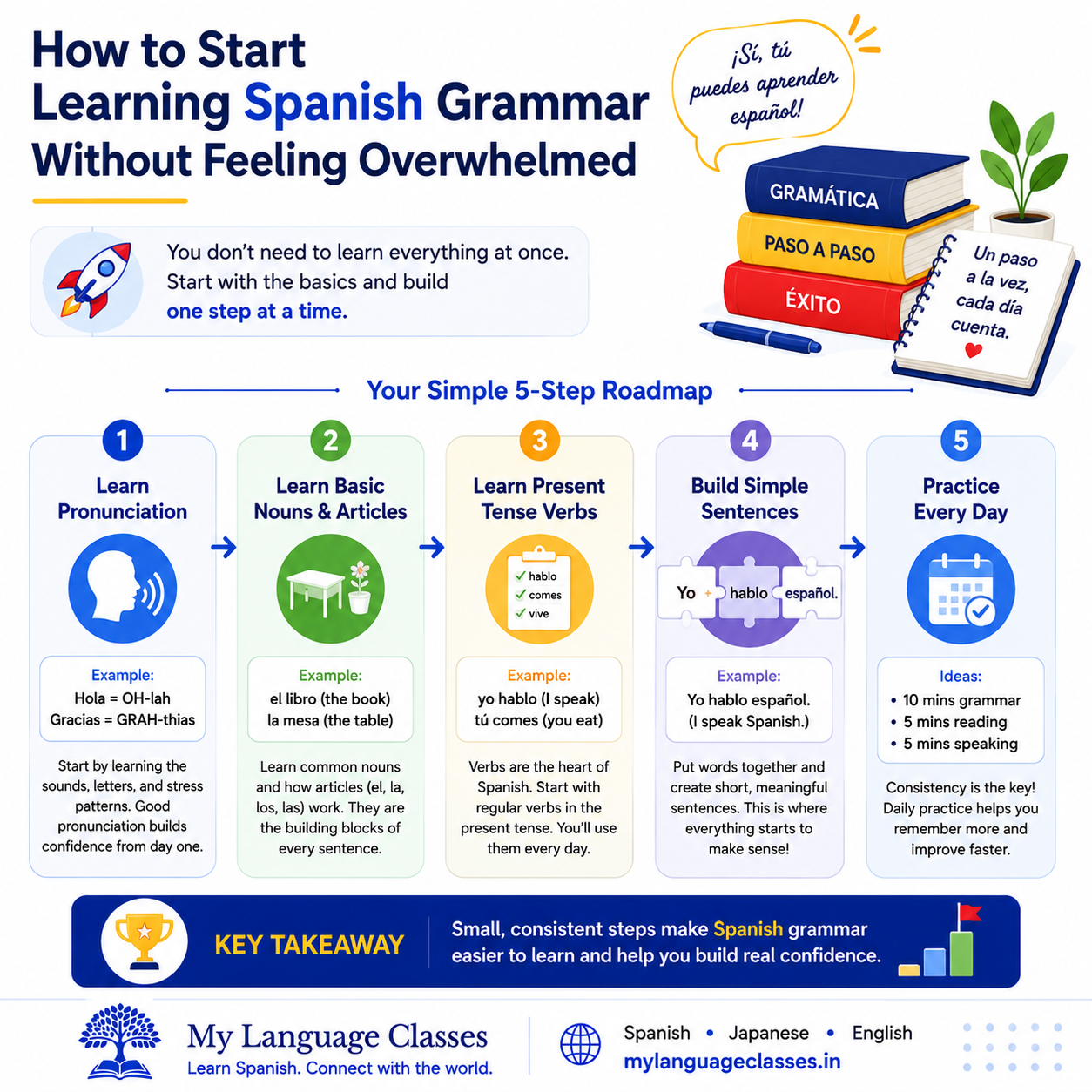
In this guide, you will learn why Spanish grammar often feels overwhelming, how to avoid the most common beginner mistakes, what topics you should study first, and how to create a learning routine that helps you make steady progress without feeling lost. Whether your goal is to prepare for the DELE A1 exam, communicate confidently while travelling, or simply enjoy learning a new language, the principles in this article will help you build a strong foundation.
Why Learning Spanish Grammar Feels Overwhelming for Most Beginners
If you have recently started learning Spanish, you are not alone in feeling uncertain about where to begin. Almost every beginner experiences this at some point. The encouraging news is that the feeling usually comes from the learning process rather than the language itself.
Today, learners have access to more language learning resources than ever before. A quick online search returns thousands of grammar articles, videos, mobile apps, podcasts, and social media posts. While this variety creates many opportunities to learn, it also creates a new challenge. Too much information can make it difficult to know what deserves your attention.
Imagine trying to build a house without a construction plan. You might have all the necessary materials, but without knowing which step comes first, the project quickly becomes confusing. Learning Spanish grammar works in much the same way. Every grammar topic has a place within a larger system, and understanding that sequence makes learning far more effective.
Many beginners begin by searching for the most common Spanish verbs. A few days later, they start learning adjective agreement. After that, they watch a lesson about reflexive verbs before moving to question words or prepositions. None of these topics are unimportant, but studying them in a random order makes it difficult to understand how Spanish sentences are actually formed.
Another common challenge is trying to memorise grammar rules without understanding why they exist. Memorisation may help you answer a few practice questions, but it rarely gives you the confidence to create your own sentences. When learners understand the reason behind a grammar rule, they become much more capable of using it naturally in different situations.
Many learners also place unnecessary pressure on themselves. They expect to understand every grammar concept immediately or compare their progress with people who have been studying for years. Language learning does not work that way. Every learner develops confidence gradually through repeated exposure, meaningful practice, and consistent review.
The internet has also created a habit of jumping between resources. One app introduces vocabulary through games, another teaches grammar through short lessons, while social media offers quick tips that often lack context. Although each resource may provide useful information, constantly switching between them can interrupt your progress. Instead of building one complete picture, you collect many disconnected pieces.
This is one reason why structured learning remains so valuable. A carefully designed learning path removes the need to decide what to study next. Instead of spending time searching for another lesson, you can focus your energy on understanding the concept in front of you and practising it until you feel comfortable moving forward.
It is also worth remembering that grammar is only one part of learning Spanish. Vocabulary, reading, listening, speaking, and writing all support one another. When grammar is studied alongside meaningful examples and practical communication, it becomes much easier to remember because you immediately see how it is used in real life.
Perhaps the biggest misconception is that successful language learners never feel confused. In reality, every learner experiences moments of uncertainty. What separates successful learners is not natural talent but the willingness to continue learning one step at a time. Every new concept strengthens the foundation for the next, and over time those individual pieces begin forming a complete understanding of the language.
Feeling overwhelmed is therefore not a sign that Spanish is too difficult. More often, it is a sign that your learning path needs better organization. Once your study becomes structured, your confidence usually grows much faster than you expect.
Can You Really Learn Spanish Grammar from Scratch?
The simple answer is yes.
You do not need previous experience with Spanish to build a strong understanding of its grammar. Every fluent Spanish speaker once started with their first word, first sentence, and first grammar lesson. The difference between learners who continue progressing and those who give up is rarely intelligence or talent. More often, it comes down to following a learning process that is realistic, consistent, and well organised.
Spanish is often considered one of the most accessible languages for English speakers because many words share similar origins and the pronunciation is generally consistent. Like every language, it has its own grammar patterns that may feel unfamiliar at first, but those patterns become much easier to understand when introduced gradually.
One of the biggest advantages of starting from scratch is that you have the opportunity to build correct habits from the beginning. Instead of correcting years of misunderstandings, you can develop a solid foundation where each new grammar concept naturally connects with what you have already learned.
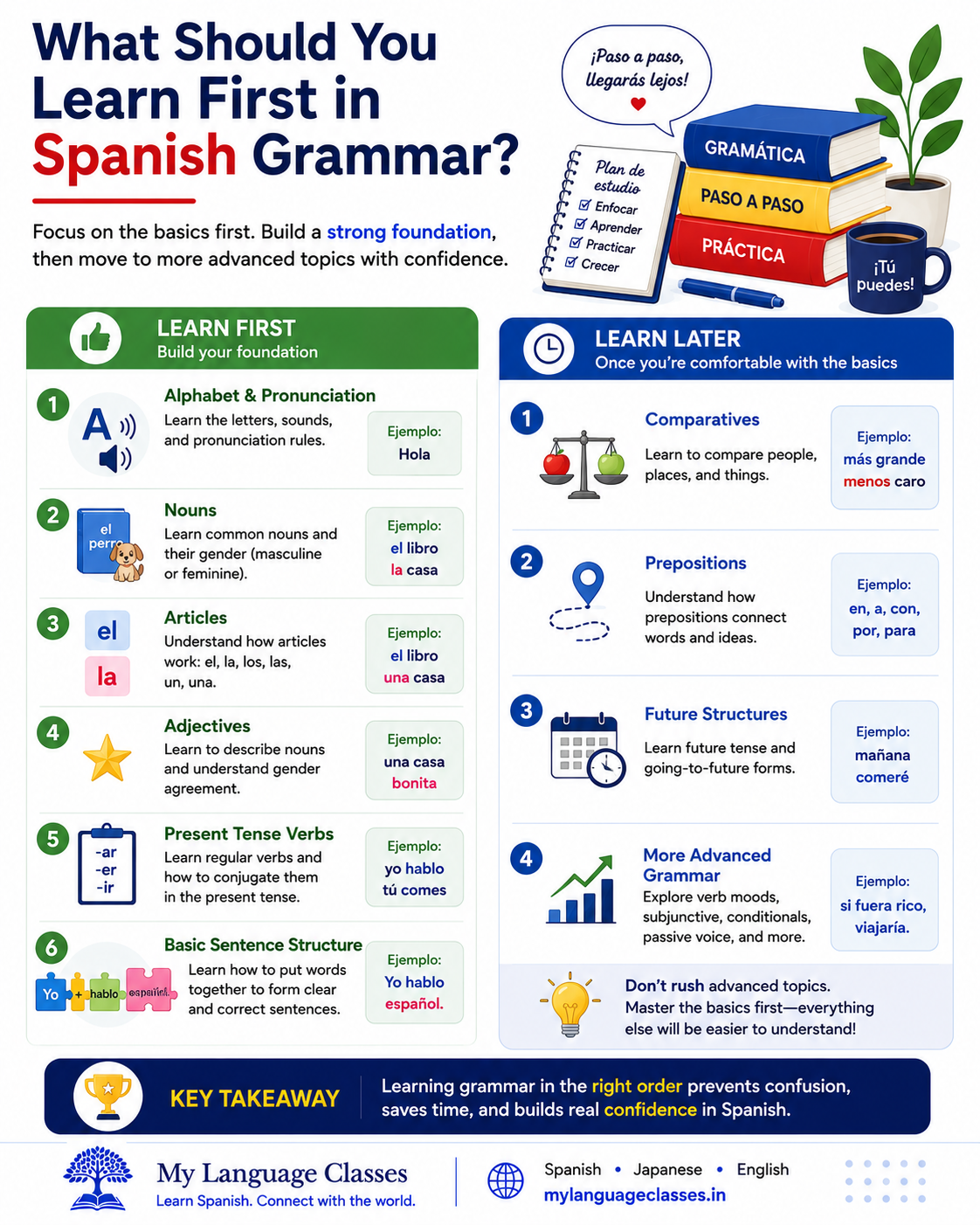
That foundation begins with the basics. Learning the Spanish alphabet and pronunciation helps you read words correctly. Understanding nouns, gender, and articles allows you to recognise how words work together. As you continue, adjectives, pronouns, verbs, and sentence structure gradually become easier because each lesson builds on knowledge you already possess.
This gradual progression is important because language learning is cumulative. You do not master grammar by completing one lesson or memorising one set of rules. You build confidence through repeated exposure, thoughtful practice, and meaningful application. Each small improvement contributes to your overall ability to understand and communicate in Spanish.
It is also important to give yourself permission to learn at your own pace. Some learners move quickly through the basics, while others prefer spending more time reviewing each topic before continuing. Neither approach is better than the other. The goal is not to finish grammar as quickly as possible. The goal is to understand it well enough that you can use it naturally in real communication.
When learners replace the pressure to study everything with the goal of understanding one concept at a time, Spanish grammar becomes far less intimidating. Instead of wondering how much remains to be learned, you begin recognizing how much you already know. That shift in perspective often marks the moment when learning becomes enjoyable rather than overwhelming.
The Best Way to Learn Spanish Grammar from Scratch
If you ask ten Spanish learners how they started studying grammar, you will probably hear ten different answers. Some began with verb conjugations, others memorised vocabulary first, and many relied on mobile apps or short online lessons. While these methods can all contribute to learning, they often leave beginners wondering what they should study next.
The most effective way to learn Spanish grammar is to follow a structured sequence where each new topic builds naturally on the previous one. Grammar is not a collection of independent rules. It is a connected system. When you understand one part of that system, learning the next becomes much easier.
Think of Spanish grammar as building a house. You would never install the roof before laying the foundation. In the same way, advanced grammar becomes much easier when you first understand the essential building blocks of the language.
Let’s look at the order that gives most beginners the best chance of long-term success.
Start with Pronunciation Before Grammar
Many learners are eager to begin forming sentences as quickly as possible, but spending a little time on pronunciation at the beginning can save a great deal of frustration later.
Spanish pronunciation is much more consistent than English pronunciation. Once you understand the alphabet and the sounds associated with each letter, you can usually pronounce new words correctly even if you have never seen them before.
Learning pronunciation early also improves listening skills. When you recognise how words are pronounced, conversations become easier to follow, and reading aloud feels much more natural.
You do not need to achieve perfect pronunciation before moving forward. The goal is simply to become comfortable recognising and producing the basic sounds of the language.
Build Your Foundation with Nouns and Articles
Once you feel comfortable reading Spanish words, the next step is understanding nouns.
Every sentence begins with words that refer to people, places, objects, ideas, or animals. In Spanish, every noun has a grammatical gender, either masculine or feminine. This is one of the first concepts that surprises English speakers because English does not organise nouns in the same way.
At first, remembering grammatical gender may seem challenging. Fortunately, many nouns follow predictable patterns that become easier to recognise through regular practice.
Articles are closely connected to nouns. Instead of learning nouns and articles separately, study them together from the beginning. When you learn “libro,” learn “el libro.” When you learn “casa,” learn “la casa.”
This simple habit strengthens your understanding of sentence structure while reducing mistakes later.
Plural forms should also be introduced at this stage because they naturally extend what you have already learned.
By the end of this stage, you should feel comfortable recognising:
Masculine and feminine nouns.
Singular and plural forms.
Definite and indefinite articles.
Basic noun agreement.
These concepts create the first layer of Spanish grammar and prepare you for everything that follows.
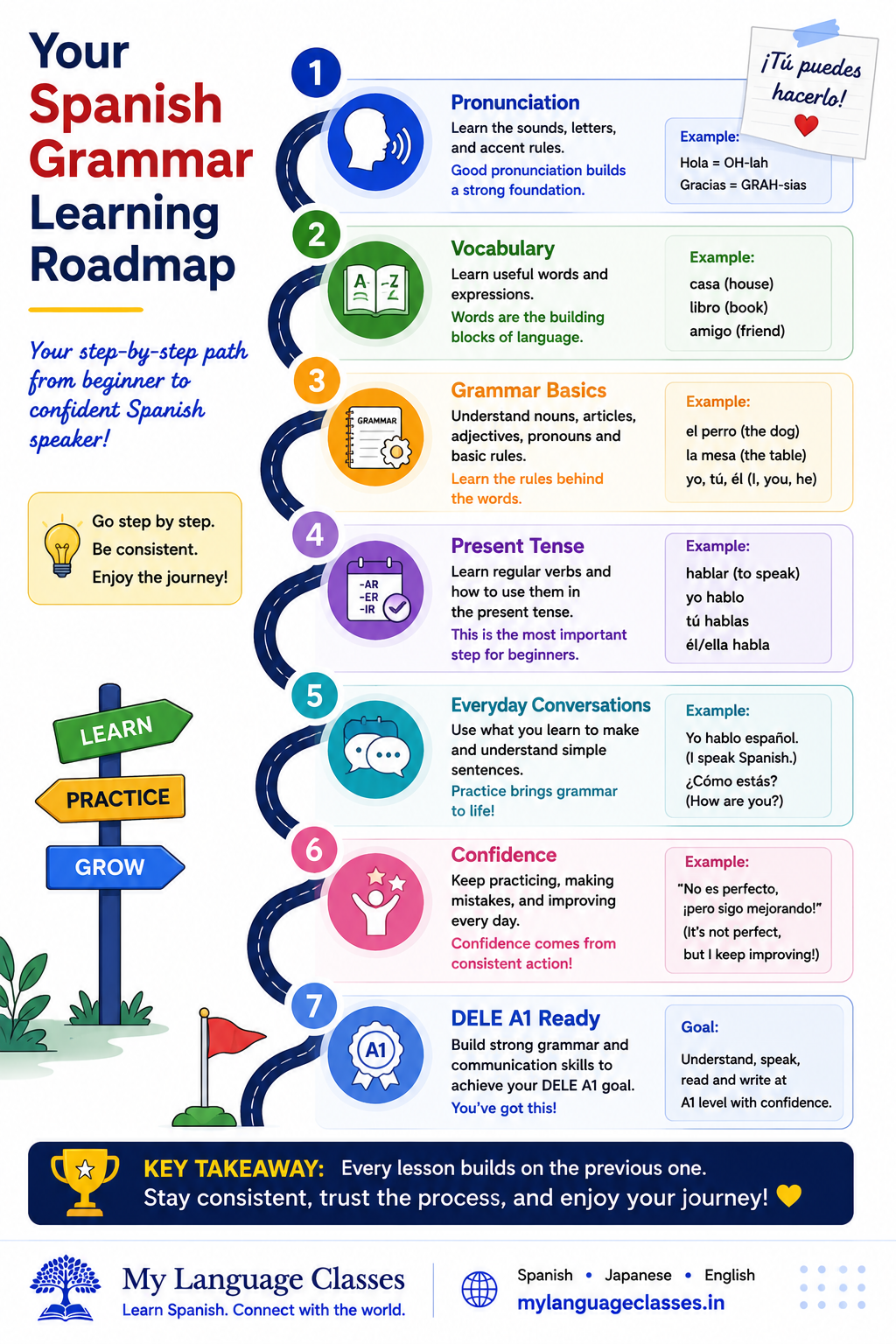
Learn How Adjectives Work with Nouns
After understanding nouns and articles, adjectives become much easier to learn.
Unlike English, Spanish adjectives often change according to the gender and number of the noun they describe.
For example, describing one person may require a different adjective ending than describing several people.
Rather than memorising adjective endings as isolated rules, focus on recognising the relationship between nouns and adjectives.
When you understand that these words work together, agreement becomes much more logical.
This stage also introduces an important principle that appears throughout Spanish grammar.
Words inside a sentence often influence one another.
Recognising these relationships helps learners understand the language instead of simply memorising individual rules.
Build Vocabulary Alongside Grammar
One of the biggest mistakes beginners make is separating grammar from vocabulary.
Grammar provides the structure of a language.
Vocabulary provides the meaning.
Without vocabulary, grammar cannot be applied.
Without grammar, vocabulary cannot form meaningful sentences.
Instead of treating them as separate subjects, learn new words that match the grammar topics you are studying.
For example, while learning nouns and articles, focus on everyday vocabulary related to family, food, occupations, places, colours, and common objects.
When studying adjectives, learn words that naturally describe those nouns.
This approach creates meaningful connections that improve both understanding and memory.
Understand Subject Pronouns Before Verbs
Before studying verb conjugations, spend time understanding subject pronouns.
Words such as “yo,” “tú,” “él,” “ella,” and “nosotros” appear constantly in Spanish.
They tell us who performs an action and help explain why verbs change their endings.
Many beginners rush directly into verb tables without first understanding the relationship between pronouns and conjugation.
Taking a little extra time here makes verb learning much more manageable because every conjugation suddenly has a clear purpose.
You are no longer memorising random endings.
You are learning how verbs change to match the person performing the action.
Learn Present Tense Before Anything Else
If there is one area of grammar that deserves extra attention, it is the present tense.
The present tense allows you to introduce yourself, describe your daily routine, talk about your family, express opinions, discuss hobbies, ask questions, and participate in simple conversations.
In other words, it supports much of the communication beginners need from the very beginning.
Start with regular verbs because they help you recognise common conjugation patterns.
Once those patterns become familiar, irregular verbs become much less intimidating.
Focus first on verbs that appear frequently in everyday communication, such as “ser,” “estar,” “tener,” “ir,” “hacer,” and “haber.”
Although these verbs are irregular, they are also among the most useful words in the language.
Mastering them early gives you immediate practical benefits.
At this stage, do not worry about advanced tenses or complex grammar.
A strong understanding of the present tense provides the confidence needed to continue learning the rest of Spanish grammar successfully.
Continue Building with Everyday Grammar
Once you have a basic understanding of nouns, adjectives, pronouns, and present tense verbs, you are ready to learn the grammar that allows you to communicate naturally in everyday situations.
This is the stage where many learners notice a significant improvement in their confidence. Instead of learning individual words, you begin understanding how complete ideas are expressed in Spanish. Everyday conversations become easier to follow because you recognise the grammar patterns that native speakers use repeatedly.
The goal is not to learn every grammar rule at once. It is to become comfortable with the structures you are most likely to use every day.
Understand the Difference Between Ser and Estar
Few grammar topics receive as much attention as the difference between “ser” and “estar.”
Both verbs mean “to be” in English, but they are used in different situations. This often confuses beginners because English uses a single verb where Spanish uses two.
Rather than memorising long lists of rules, begin by understanding the purpose of each verb.
In general, “ser” is used for characteristics that identify or define someone or something. This includes nationality, profession, identity, relationships, and many permanent or long-lasting characteristics.
“Estar,” on the other hand, is commonly used for locations, temporary conditions, emotions, and physical states.
At first, you will occasionally choose the wrong verb. That is completely normal. Every learner makes this mistake while building familiarity with the language.
The important thing is to recognise that each verb reflects a different way of describing the world. As you read and listen to more Spanish, these patterns gradually become more natural.
Learn How to Express Existence with Hay
Another essential grammar structure is “hay.”
Many beginners confuse “hay” with “está” because both can appear in similar situations.
However, they answer different questions.
“Hay” tells us that something exists.
“Está” tells us where a specific person or object is located.
Understanding this distinction early prevents one of the most common beginner mistakes.
More importantly, it allows you to describe places, ask about facilities, and talk about your surroundings with much greater confidence.
Whether you are describing your home, talking about your city, or asking for directions while travelling, you will use this structure regularly.
Learn to Ask Questions Naturally
Communication begins with curiosity.
If you cannot ask questions, conversations become very limited.
Fortunately, Spanish question formation is quite logical once you understand the basic question words.
Instead of memorising isolated expressions, learn how question words function inside complete sentences.
As your confidence grows, you will naturally begin asking about people, places, time, reasons, quantities, and opinions.
Question formation also strengthens your listening skills because you start recognising these patterns whenever someone asks you something in Spanish.
Learning to ask questions is therefore much more than another grammar topic. It is one of the foundations of meaningful communication.
Learn How Negation Works
Negation is one of the simplest areas of Spanish grammar, yet it appears constantly in everyday conversation.
Whether you are saying that you do not understand, do not have something, or do not want something, negation allows you to express yourself accurately.
Because the basic pattern is straightforward, beginners often gain confidence quickly when learning this topic.
It also combines naturally with grammar you already know.
Instead of learning completely new sentence structures, you simply adapt the ones you have already mastered.
This reinforces previous knowledge while expanding your ability to communicate.
Become Comfortable with Reflexive Verbs
Reflexive verbs often seem more complicated than they really are.
The reason many beginners struggle is that they encounter reflexive pronouns before understanding pronouns in general.
If you have already learned subject pronouns and basic sentence structure, reflexive verbs become much easier to understand.
These verbs are especially useful because they appear in many daily activities.
Talking about waking up, getting dressed, relaxing, going to bed, or preparing for work often requires reflexive verbs.
Instead of treating them as an advanced grammar topic, think of them as another way of describing actions that people perform in their daily lives.
When connected to real situations rather than abstract grammar rules, they become much easier to remember.
Learn Simple Future Expressions
Many beginners believe they need to master the future tense before talking about future plans.
Fortunately, Spanish provides a much easier way to express future intentions.
This structure allows learners to talk about tomorrow, next week, future travel plans, appointments, and personal goals without waiting until they reach a higher level.
Learning this early increases your ability to communicate while keeping grammar manageable.
It also demonstrates an important principle of effective language learning.
You do not need advanced grammar to express useful ideas.
Simple structures often allow you to communicate far more than you expect.
Understand Obligation and Daily Responsibilities
As your conversations become more practical, you will naturally want to talk about responsibilities.
Explaining what you need to do, what you have to do, or what people should generally do is an important part of everyday communication.
These grammar patterns appear frequently at home, at work, while travelling, and in educational settings.
Learning them at the beginner level prepares you for realistic conversations rather than limiting yourself to isolated practice sentences.
Learn Gustar as a Communication Tool
Many learners become frustrated when studying “gustar.”
The challenge usually comes from trying to translate it directly into English.
Instead of asking how the verb translates word for word, focus on how Spanish expresses preferences.
Once you understand the underlying idea, “gustar” becomes much more logical.
Even better, it allows you to discuss hobbies, interests, favourite foods, music, films, sports, and many other everyday topics.
Since conversations often involve sharing opinions, learning this structure early has immediate practical value.
Use Grammar to Talk About Everyday Life
Grammar becomes much more meaningful when it helps you describe your own experiences.
This is why topics such as time, dates, days of the week, months, seasons, daily routines, hobbies, and descriptions are usually introduced during the beginner level.
These grammar structures allow you to answer questions such as:
What time do you wake up?
What do you usually do on weekends?
Where do you work?
What are your hobbies?
What does your city look like?
When grammar is connected to your own life, learning becomes far more engaging.
You stop studying isolated examples and begin expressing real ideas.
This is the point where many learners start feeling that they are genuinely using Spanish rather than simply studying it.
Why Context Makes Grammar Easier to Remember
One of the biggest mistakes beginners make is trying to remember grammar without using it.
Reading a rule once rarely leads to long-term understanding.
Instead, grammar becomes memorable when you encounter it repeatedly in meaningful situations.
This is why example sentences are so valuable.
Each example demonstrates not only how a grammar rule works but also when it is appropriate to use it.
Over time, these repeated encounters help learners recognise patterns automatically.
Instead of stopping to think about every rule, you begin understanding the language more naturally.
This gradual shift from conscious analysis to confident recognition is one of the most rewarding stages of language learning.
It also explains why patience is so important.
Grammar is not something you finish learning.
It is something you continue understanding more deeply every time you read, listen, speak, or write in Spanish.
Common Mistakes That Make Spanish Grammar Feel More Difficult
Many beginners believe they are struggling because they are not good at languages.
In reality, the difficulty often comes from study habits rather than ability.
One common mistake is trying to learn too many grammar topics during a single study session. While enthusiasm is valuable, information overload usually reduces understanding instead of improving it.
Another frequent mistake is changing learning resources every few days. Each book, website, or video series follows its own teaching sequence. Constantly switching between them makes it difficult to build a consistent understanding.
Some learners also spend all their time reading grammar explanations without practising what they have learned. Others do the opposite by completing exercises without taking time to understand why the answers are correct.
Both approaches limit long-term progress.
Effective language learning combines understanding with regular practice.
Finally, many beginners become discouraged because they still make mistakes after learning a grammar topic.
Making mistakes does not mean learning has failed.
It usually means your brain is still building familiarity with the language.
Every correction strengthens your understanding and prepares you for future conversations.
Rather than viewing mistakes as setbacks, treat them as evidence that you are actively learning and using Spanish.
How Much Spanish Grammar Should You Study Each Week?
One of the first questions beginners ask is how much grammar they should study every week. Many hope there is a perfect number of lessons or hours that guarantees quick progress. Unfortunately, language learning does not work that way.
The amount of grammar you study is less important than how consistently you study it.
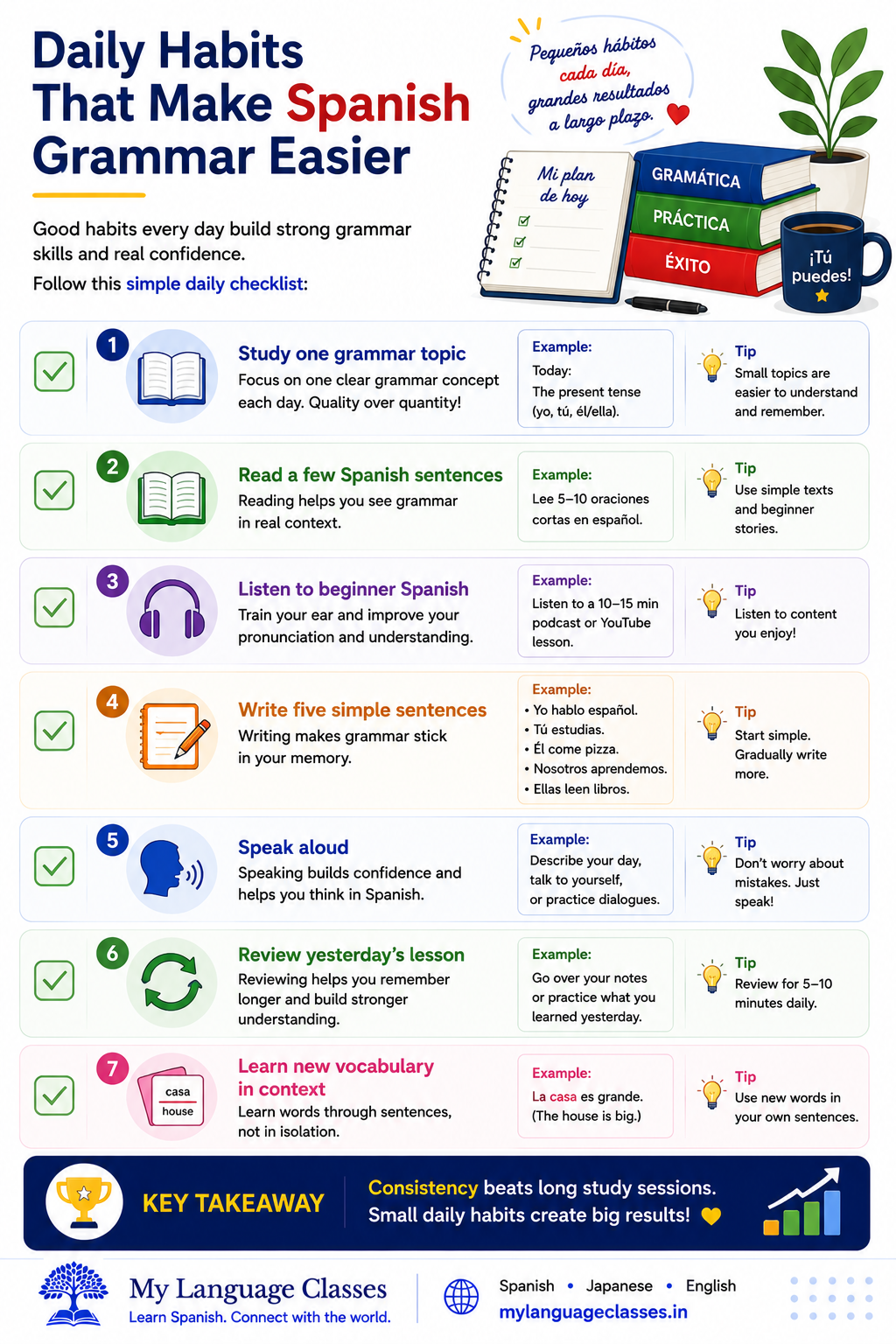
Studying for thirty minutes every day usually produces better results than studying for four or five hours once a week. Regular exposure helps your brain recognise patterns, strengthen memory, and connect new information with concepts you have already learned.
Consistency also prevents one of the biggest causes of frustration. Long gaps between study sessions make learners feel as though they have forgotten everything. In reality, they often need only a short review before previously learned knowledge returns.
Rather than asking, “How much grammar should I finish this week?”, ask a different question.
“How well do I understand what I studied today?”
That small change in mindset encourages deeper learning instead of rushing through lessons.
For complete beginners, even one well-understood grammar topic can represent meaningful progress. If you spend a study session understanding noun gender, practising article agreement, and reading several example sentences, you have moved your Spanish forward in a way that will support every lesson that follows.
Learning more topics is not always better.
Understanding more deeply almost always is.
Create a Study Routine You Can Maintain
Many learners begin with great enthusiasm. They study every day for a week, then become busy with work, university, or family responsibilities and gradually stop altogether.
This pattern is extremely common.
The problem is not motivation. The problem is creating a study routine that is difficult to maintain over the long term.
Instead of building your routine around ideal circumstances, build it around your real life.
Choose a study schedule that you can realistically follow even during busy weeks. Some learners prefer studying before work. Others learn during lunch breaks or in the evening. There is no universal best time.
The best study time is the one you can maintain consistently.
Your study sessions also do not need to be long.
A focused session where you carefully understand one grammar concept, review previous material, and read several example sentences is often more productive than spending hours trying to cover multiple unrelated topics.
As your confidence grows, your study routine will naturally become more efficient because new grammar concepts begin connecting with knowledge you already possess.
Review Is Part of Learning, Not a Sign of Failure
Many beginners worry that reviewing old lessons means they are making slow progress.
Nothing could be further from the truth.
Review is one of the most important parts of language learning.
Grammar is cumulative. Every new lesson depends on concepts you have already studied. Returning to previous material strengthens those connections and helps move knowledge from short-term memory into long-term understanding.
Professional musicians practise familiar pieces.
Athletes repeat fundamental movements.
Pilots regularly review essential procedures.
Language learners benefit from the same principle.
Review does not mean starting again.
It means strengthening the foundation that supports future learning.
Instead of feeling disappointed when you revisit an earlier topic, recognise that every review session increases your confidence and accuracy.
Over time, you will notice that grammar rules which once required careful thought begin feeling completely natural.
That transformation happens through repeated exposure rather than through speed.
Should You Learn Grammar Before Speaking Spanish?
This is one of the most debated questions among language learners.
Some people argue that grammar should come first.
Others believe you should ignore grammar completely and focus only on conversation.
The most effective approach usually lies somewhere between these two extremes.
Grammar and communication support one another.
Grammar helps you understand how sentences are formed.
Speaking gives you opportunities to apply that understanding in meaningful situations.
If you wait until you know every grammar rule before speaking, you may postpone valuable communication practice for months or even years.
On the other hand, trying to speak without understanding any grammar often leads to confusion and unnecessary frustration.
A balanced approach allows both skills to develop together.
For example, after learning present tense verbs, you can immediately begin introducing yourself, talking about your family, describing your daily routine, and asking simple questions.
As your grammar knowledge grows, your conversations naturally become more detailed.
Speaking therefore should not replace grammar.
Grammar should not replace speaking either.
Together, they create a learning process that develops both confidence and accuracy.
Why Reading Helps You Learn Grammar Faster
Many beginners think grammar is learned only through grammar books.
In reality, reading plays an equally important role.
Every sentence you read shows grammar functioning in a real context.
Instead of seeing isolated rules, you observe how nouns, verbs, adjectives, and pronouns work together to communicate meaning.
This repeated exposure gradually strengthens your understanding.
You begin recognising familiar sentence patterns without consciously analysing every word.
Reading also reinforces vocabulary.
When grammar and vocabulary appear together repeatedly, both become easier to remember because they support one another.
For beginners, short texts written at an appropriate level are usually more valuable than attempting advanced novels too early.
Success builds confidence.
Confidence encourages consistency.
Consistency leads to long-term progress.
Listening Reinforces Grammar Naturally
Listening provides another opportunity to strengthen your grammar without memorising additional rules.
As you hear native speakers use familiar sentence structures repeatedly, your brain begins recognising patterns automatically.
For example, after studying present tense verbs, listening to simple conversations allows you to hear those same verb forms in authentic situations.
The grammar you studied on paper gradually becomes part of your listening comprehension.
This process often surprises learners.
Without deliberately trying to memorise another rule, they suddenly recognise structures they previously struggled to understand.
That is one reason grammar should never remain isolated from the other language skills.
Reading, listening, speaking, and writing all reinforce grammatical understanding in different ways.
Together, they help transform knowledge into practical communication.
How to Stay Motivated Without Feeling Overwhelmed
Motivation often receives more attention than consistency, yet consistency usually determines long-term success.
Motivation naturally changes over time.
Some weeks you will feel excited to study.
Other weeks learning may feel slower.
Both experiences are completely normal.
The learners who continue making progress are not necessarily the most motivated.
They are the ones who continue studying even when motivation temporarily decreases.
One helpful strategy is to focus on small achievements rather than distant goals.
Instead of thinking about becoming fluent, celebrate understanding your first paragraph, completing your first grammar chapter, or successfully holding your first simple conversation.
These small milestones create a sense of progress that keeps learning enjoyable.
It is equally important to avoid comparing your progress with other learners.
Every learner begins with different experiences, different study habits, and different goals.
Your only meaningful comparison is with your own progress from last month or last year.
When you recognise how much you have already learned, continuing becomes much easier.
Signs That Your Learning Method Is Working
Many beginners look for dramatic improvements.
In reality, progress usually appears through small changes that gradually become more noticeable.
You begin recognising familiar words while reading.
Grammar explanations become easier to understand.
You spend less time translating every sentence into English.
Simple conversations feel less intimidating.
You make mistakes, but you also recognise them more quickly.
These improvements may seem small individually.
Together, they represent significant progress.
Language learning is rarely about one breakthrough moment.
It is about hundreds of small improvements that gradually build confidence and competence.
As your understanding grows, you spend less energy thinking about grammar rules and more energy communicating your ideas.
That transition is one of the clearest signs that your study method is working.
What Should You Look for in a Beginner Spanish Grammar Resource?
Once you decide to learn Spanish seriously, another important question naturally follows.
What kind of grammar resource should you choose?
This is not always an easy decision. There are countless books, websites, video courses, mobile applications, and online lessons available. Every resource promises to help you learn Spanish, but not every resource follows the same educational approach.
For a complete beginner, the goal should not be to find the resource with the most grammar rules. The goal should be to find one that helps you understand the language clearly and confidently.
A well-designed beginner grammar resource should reduce confusion, not create more of it.
Look for a Logical Learning Sequence
One of the first things to examine is how the lessons are organised.
Grammar should follow a natural progression.
Basic concepts should appear before more complex ones.
For example, it makes sense to understand nouns before adjectives because adjectives describe nouns. It is helpful to learn subject pronouns before studying verb conjugations because verbs change according to the subject performing the action.
When lessons are arranged in a logical order, each new topic feels like a natural extension of what you already know.
Without that progression, learners often feel as though every chapter introduces an entirely new language.
A clear learning sequence allows knowledge to grow steadily instead of becoming fragmented.
Clear Explanations Matter More Than Technical Language
Many beginners assume that detailed explanations must also be complicated.
That is rarely true.
The best educational resources explain grammar in simple, precise language without sacrificing accuracy.
Instead of filling every page with linguistic terminology, they focus on helping learners understand how Spanish works in real communication.
A good explanation answers several questions.
What is this grammar concept?
Why is it used?
When should I use it?
How does it connect with what I have already learned?
When these questions are answered clearly, learners spend less time memorising rules and more time developing genuine understanding.
Real Examples Make Grammar Easier to Understand
Reading a grammar rule by itself is only the beginning.
To understand how that rule functions, you need to see it used naturally.
Example sentences provide that opportunity.
They transform abstract grammar into meaningful communication.
Instead of memorising a definition, you see how people actually use the language.
Examples also reveal patterns that are difficult to explain through rules alone.
As learners encounter similar sentence structures repeatedly, recognising those patterns becomes increasingly automatic.
This is one reason comprehensive example-based learning remains effective long after the lesson itself has ended.
Practice Should Reinforce Understanding
Exercises are valuable, but only when they support understanding.
Some learners complete hundreds of practice questions without fully understanding the grammar they are using.
Others spend hours reading explanations without applying what they have learned.
Neither approach produces the best results.
Effective practice encourages learners to apply concepts immediately after understanding them.
Each exercise becomes another opportunity to strengthen the connection between explanation and communication.
The objective is not simply to complete activities.
The objective is to become increasingly confident using Spanish correctly.
Vocabulary Should Grow Alongside Grammar
Grammar and vocabulary should never develop independently.
Imagine learning how to build sentences but having very few words to place inside those sentences.
Communication would remain extremely limited.
Likewise, knowing hundreds of words without understanding sentence structure makes it difficult to express complete ideas.
An effective beginner resource develops both areas together.
As new grammar concepts are introduced, learners also encounter useful vocabulary that allows them to practise those concepts in realistic situations.
This balanced approach prepares learners for genuine communication instead of isolated grammar exercises.
Choose a Resource That Encourages Independent Learning
One of the most valuable qualities of any educational resource is its ability to help learners become increasingly independent.
A good grammar guide should not create dependence.
Instead, it should gradually develop the confidence needed to continue learning without constant guidance.
This happens when explanations are thorough, examples are meaningful, and lessons connect logically.
As learners understand one concept, they become better prepared to understand the next.
Over time, they begin recognising patterns independently instead of relying on memorisation.
This ability becomes increasingly important as learners progress beyond the beginner level.
Why Structured Learning Produces Better Long-Term Results
Many learners believe learning more resources automatically leads to better results.
In reality, more resources often create more confusion.
Imagine trying to assemble a puzzle using pieces from five different boxes.
Each individual piece may be useful, but they were never designed to fit together.
The same thing happens when learners constantly switch between unrelated grammar books, websites, video channels, and mobile applications.
Every author follows a different teaching sequence.
Different terminology may be used.
Examples may focus on different objectives.
Topics may appear in completely different orders.
Although none of these resources are necessarily wrong, combining too many of them too early often makes learning more difficult.
A structured learning system solves this problem by providing continuity.
Every lesson has a purpose.
Every explanation builds on previous knowledge.
Every example reinforces concepts already introduced.
Instead of repeatedly asking, “What should I study next?”, learners can concentrate on understanding the lesson in front of them.
This approach also reduces decision fatigue.
Making learning decisions every day requires mental energy.
Following a carefully organised pathway allows learners to invest that energy in understanding Spanish itself.
Perhaps the greatest benefit of structured learning is confidence.
When learners recognise that each lesson builds naturally on previous knowledge, they stop worrying about whether they are studying the right topics.
Progress becomes visible.
Confidence grows.
Learning feels purposeful rather than overwhelming.
This educational approach reflects one of the central ideas behind the How Language Learning Really Works philosophy by My Language Classes.
Meaningful language learning is not created by collecting more resources.
It is created by connecting knowledge in ways that help learners genuinely understand the language.
That is the difference between studying grammar and building lasting language proficiency.
A Structured Approach for Beginners
Many beginners eventually realise that they do not need more grammar explanations.
They need better organisation.
This understanding often marks an important turning point in their learning journey.
Instead of searching for another website or another video, they begin looking for one complete resource that guides them from the beginning in a logical sequence.
That is precisely the educational purpose behind Mastering Spanish Grammar for DELE A1.
Rather than presenting grammar as a collection of disconnected rules, the book introduces concepts in the order that beginners naturally need them. Each lesson prepares learners for the next one, allowing understanding to develop gradually instead of forcing learners to memorise isolated information.
The book contains 44 structured grammar lessons covering the complete DELE A1 syllabus and the essential grammar needed for everyday Spanish communication. Every lesson includes clear explanations written in simple English, carefully selected example sentences with English translations, practical exercises to reinforce understanding, and more than 500 essential beginner vocabulary words that support real communication.
This combination allows learners to understand not only what a grammar rule is but also why it matters and how it is used in everyday Spanish.
Instead of rushing through topics, learners gradually build a foundation that supports future reading, listening, speaking, and writing.
For beginners who want to study independently, prepare for the DELE A1 examination, or simply develop a clear understanding of Spanish grammar from the very beginning, Mastering Spanish Grammar for DELE A1 provides a structured learning pathway that reflects the educational philosophy of My Language Classes, where understanding comes before memorization and lasting progress is built one concept at a time.
What You Will Learn Inside Mastering Spanish Grammar for DELE A1
One of the questions learners often ask before choosing a grammar book is whether it covers everything they need or only selected topics.
This is an important question because an incomplete grammar guide often creates learning gaps. Learners may understand individual topics but struggle to connect them into a complete understanding of the language.
For this reason, a beginner grammar book should do more than explain individual rules. It should provide a learning journey where each chapter prepares you for the next stage of your development.
That is exactly how Mastering Spanish Grammar for DELE A1 has been organized.
Instead of presenting grammar as forty-four unrelated lessons, the book groups concepts in a logical progression that reflects how beginners naturally build their understanding of Spanish.
Building Your First Foundation
Every successful language learner starts by understanding the basic building blocks of the language.
The first chapters introduce the Spanish alphabet and pronunciation before moving into nouns, grammatical gender, singular and plural forms, articles, adjectives, professions, nationalities, and numbers.
Although these topics may seem simple, they create the framework that supports everything you study later.
For example, understanding grammatical gender helps you use articles correctly.
Understanding articles makes adjective agreement easier.
Learning adjectives prepares you to describe people, places, and objects naturally.
Each lesson strengthens knowledge introduced in previous chapters.
This gradual progression allows learners to develop confidence without feeling overwhelmed.
Learning How Spanish Sentences Are Built
Once learners understand the basic building blocks, the next step is learning how those pieces work together.
This stage introduces subject pronouns, object pronouns, possessive pronouns, demonstrative pronouns, and reflexive pronouns.
Rather than treating each type of pronoun as an isolated grammar topic, the lessons explain how pronouns make communication more natural and more efficient.
As learners continue, they begin recognising how Spanish sentences are organised and why certain word choices change depending on the situation.
Instead of memorising patterns without context, learners understand the purpose behind each grammatical structure.
That understanding makes future grammar lessons much easier to follow.
Developing Confidence with Spanish Verbs
For many beginners, verbs are the most intimidating part of Spanish grammar.
Fortunately, verbs become much easier when introduced step by step.
The book begins with regular present tense verbs before moving to the most important irregular verbs, including “ser,” “estar,” “tener,” “ir,” “haber,” and “hacer.”
These are among the most frequently used verbs in everyday Spanish.
Learning them early gives learners the ability to express a wide range of ideas from the very beginning.
The lessons then introduce essential communication structures such as the difference between “ser” and “estar,” reflexive verbs, negation, question formation, “hay,” future intention, obligation, and expressions commonly used in everyday conversations.
Because each lesson builds upon previous knowledge, learners develop understanding naturally instead of feeling as though every chapter introduces a completely new concept.
Moving Beyond Individual Rules
As learners gain confidence, the book introduces grammar that supports more natural communication.
Topics such as conjunctions, prepositions, “por” versus “para,” adverbs, comparisons, superlatives, telling time, dates, months, seasons, and daily routines help learners move beyond isolated practice sentences.
Instead of simply completing grammar exercises, learners begin talking about everyday life.
They learn to describe their routine, discuss hobbies, explain future plans, describe people and places, and express ideas that are genuinely useful in real conversations.
This transition from grammar study to practical communication represents one of the most rewarding stages of beginner language learning.
Grammar stops feeling like an academic subject.
It becomes a practical tool for expressing ideas.
Reinforcing Learning Through Practice
Understanding grammar is important.
Applying it is equally important.
For that reason, every chapter includes practice exercises designed to reinforce the concepts introduced in the lesson.
Rather than overwhelming learners with difficult questions immediately, the exercises encourage gradual application.
Each completed activity strengthens confidence while helping learners identify areas that may benefit from additional review.
The book also includes numerous real-life example sentences with English translations.
These examples help learners understand not only the grammar itself but also how native speakers use these structures in everyday communication.
Instead of memorising abstract rules, learners repeatedly encounter grammar within meaningful contexts.
That repeated exposure supports long-term retention and prepares learners to recognise the same patterns while reading, listening, speaking, and writing.
Who Will Benefit Most from Mastering Spanish Grammar for DELE A1?
No single grammar book is suitable for every learner.
The best educational resource is always the one that matches your current level, learning goals, and study needs.
This book has been created specifically for learners who are beginning their Spanish journey.
If you have never studied Spanish before, the structured progression allows you to build your understanding from the ground up without assuming previous knowledge.
If you are preparing for the DELE A1 examination, the lessons cover the grammar topics expected at this level while also helping you understand how those concepts are used beyond the examination itself.
If you are learning independently, the clear explanations, practical examples, and gradual progression provide a complete pathway that can be followed at your own pace.
Returning learners can also benefit from the organised structure.
Many people studied Spanish months or even years ago but are unsure where to restart.
Instead of guessing which grammar topics to review first, they can rebuild their knowledge systematically while strengthening concepts that may have become less familiar over time.
Teachers and tutors may also find the book useful as a classroom reference or supplementary grammar resource because the lessons follow a logical sequence that supports structured teaching.
At the same time, it is important to choose resources that match your current proficiency.
Learners who already have a strong understanding of DELE A1 grammar and are comfortable using present tense verbs, everyday sentence structures, and beginner communication patterns may benefit more from resources designed for higher proficiency levels.
Choosing material that matches your current knowledge keeps learning both productive and enjoyable.
Building a Foundation That Supports Everything Else
Many learners think grammar is the final goal of language learning.
In reality, grammar is the foundation upon which every other language skill is built.
When you understand grammar, reading becomes easier because you recognise sentence structures more quickly.
Listening improves because familiar grammar patterns become easier to identify in natural speech.
Writing becomes more accurate because you understand how words fit together.
Speaking becomes more confident because you can create sentences instead of relying only on memorised phrases.
Grammar therefore should never be viewed as an isolated subject.
It is one part of a much larger learning journey.
A strong foundation supports vocabulary development, reading comprehension, listening ability, and meaningful communication throughout every stage of learning.
That is why beginning with a clear, structured understanding of grammar often makes every future step in language learning easier and more enjoyable.
How This Book Fits into the My Language Classes Learning System
Learning Spanish grammar is an important milestone, but it is only one part of becoming a confident Spanish speaker.
At My Language Classes, we believe that language proficiency develops when different skills support one another. Grammar helps you understand how sentences are formed. Vocabulary gives those sentences meaning. Reading allows you to see grammar used naturally. Listening helps you recognise familiar patterns in authentic speech. Speaking and writing transform understanding into communication.
Each of these skills strengthens the others.
This is why we encourage learners to think of grammar as the beginning of a much larger learning journey rather than the final destination.
A strong grammar foundation makes every future learning resource more valuable because you can understand new vocabulary more easily, recognise sentence structures while reading, and express your own ideas with greater confidence.
This educational approach reflects the How Language Learning Really Works philosophy by My Language Classes. Our goal is not simply to help learners complete grammar lessons. We want to help them build knowledge that continues supporting their progress long after they finish a single book.
As you continue learning, grammar naturally connects with vocabulary development, reading practice, communication activities, and eventually higher proficiency levels. Every stage builds on the one before it, creating a learning experience that remains organised, meaningful, and sustainable over time.
Rather than collecting disconnected resources, learners benefit most from following a learning pathway where each resource has a clear educational purpose.
Is This the Right Resource for You?
Every learner begins with different goals.
Some are preparing for the DELE A1 examination.
Some want to communicate confidently while travelling.
Others are learning Spanish for work, university, personal interest, or the satisfaction of learning another language.
Although these goals differ, they all require one thing in common.
A solid understanding of the fundamentals.
If you are looking for shortcuts, grammar hacks, or ways to memorise rules without understanding them, this may not be the resource you are looking for.
However, if your goal is to understand how Spanish grammar works, build correct sentences with confidence, and develop a foundation that supports long-term progress, this book has been created with those objectives in mind.
It is particularly suitable for learners who appreciate clear explanations, logical progression, practical examples, and the opportunity to build confidence gradually.
You do not need previous knowledge of Spanish.
You do not need classroom experience.
You simply need the willingness to learn one concept at a time and practise it consistently.
That approach produces lasting progress far more effectively than trying to learn everything at once.
Where Can You Get Mastering Spanish Grammar for DELE A1?
If you have decided that a structured learning path is the right approach for you, Mastering Spanish Grammar for DELE A1 is available directly through the My Language Classes website as an eBook.
If you prefer reading on your Kindle, studying from a printed copy, or adding a reference book to your personal library, the book is also available on Amazon in Kindle, Paperback, and Hardcover editions.
This allows you to choose the format that best matches your study habits and learning preferences.
Whether you study for a few minutes each day or dedicate longer sessions each week, having one organised resource can help you spend more time learning and less time deciding what to study next.
Final Thoughts
Learning Spanish grammar from scratch can seem intimidating when you first begin.
There are countless grammar topics to learn, hundreds of online resources to choose from, and no shortage of advice about the “best” way to study. It is understandable that many beginners feel uncertain about where to start.
The good news is that you do not need to learn everything immediately.
You do not need to understand every grammar rule before using the language.
You do not need to compare your progress with anyone else’s.
What you do need is a clear direction, realistic expectations, and a learning approach that allows your knowledge to grow naturally over time.
Start with the fundamentals.
Understand one concept before moving to the next.
Review regularly.
Practise consistently.
Accept mistakes as a normal part of learning.
Most importantly, remember that language learning is not a race.
Every lesson you understand strengthens the foundation for the next lesson. Every sentence you read, every conversation you have, and every exercise you complete contributes to your confidence and your ability to communicate.
Spanish grammar should never feel like an obstacle standing between you and the language.
When it is taught in a logical sequence, supported by meaningful examples, and connected to real communication, it becomes one of the most valuable tools you have for expressing yourself clearly and accurately.
If you have been wondering how to learn Spanish grammar from scratch without feeling overwhelmed, the answer is not to search for more resources.
The answer is to choose a structured learning path, remain consistent, and allow your understanding to develop one step at a time.
That approach may not promise instant results, but it builds something far more valuable.
It builds a foundation that will continue supporting your Spanish learning journey for years to come.

Vikas Kumar is the founder of My Language Classes, a language learning platform dedicated to helping learners develop practical communication skills in Spanish, Japanese, and English through comprehensive grammar guides, structured learning resources, books, and evidence-informed educational content.
At My Language Classes, we believe that successful language learning is built on clarity, consistency, meaningful practice, and a deep understanding of how languages work. Every article is carefully researched and created to simplify complex concepts, provide practical guidance, and help learners develop confidence through real-world communication.
Inspired by the principles behind How Language Learning Really Works, our mission is to make high-quality language learning accessible to learners around the world by providing accurate, trustworthy, and comprehensive resources that support lasting progress, lifelong learning, and meaningful communication.
Leave a Reply