
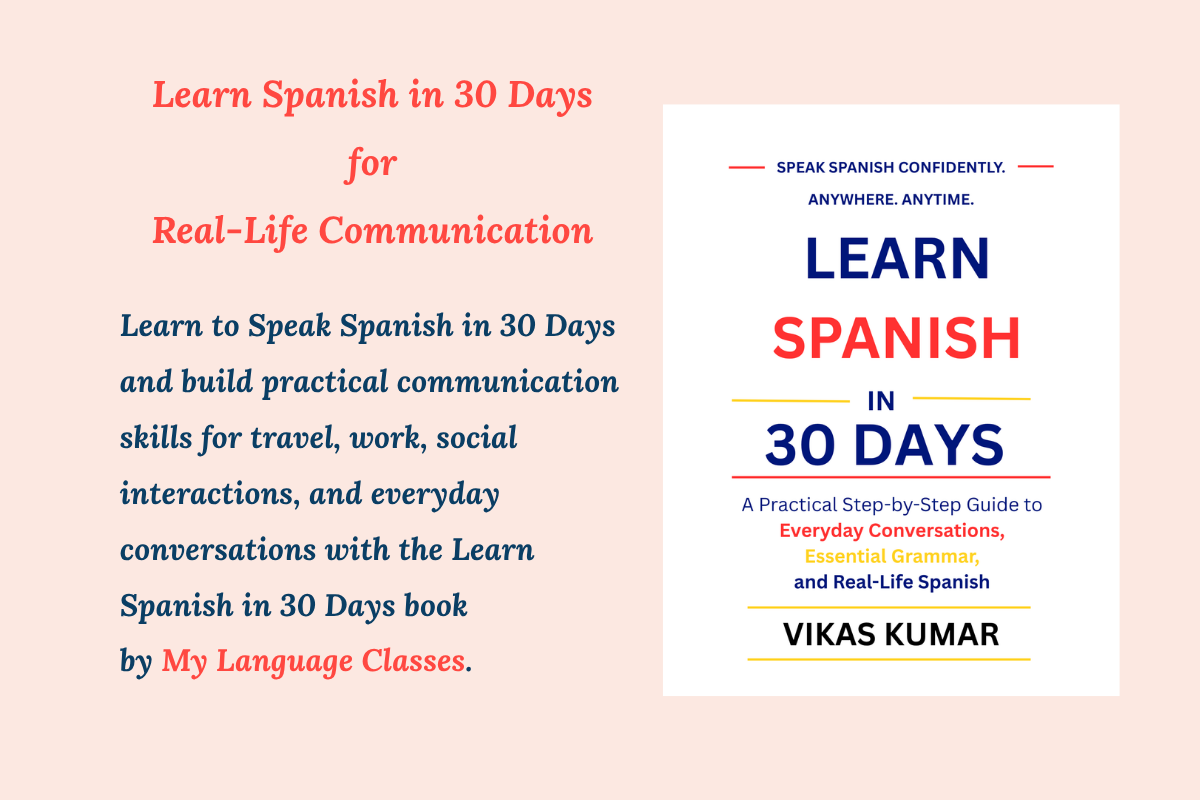
Learn to Speak Spanish in 30 Days is a goal shared by many beginners who want to use Spanish in real situations rather than simply study the language. The Learn Spanish in 30 Days book by My Language Classes is available as an eBook on the My Language Classes website and on Amazon in Kindle, paperback, and hardcover formats.
For most learners, success is not measured by how many grammar rules they know. It is measured by whether they can introduce themselves, ask questions, understand responses, and participate in conversations. These are the skills that make Spanish useful during travel, at work, in social settings, and in everyday life.
The Learn Spanish in 30 Days book by My Language Classes was created with this practical goal in mind. It combines vocabulary, conversations, daily expressions, dialogues, example sentences, and structured lessons into a system designed to help learners build real communication skills through consistent practice.
Why Speaking Spanish Is the Goal for Most Learners
Communication Opens Opportunities
Language creates opportunities that go beyond the classroom. The ability to communicate in Spanish can make travel more comfortable, workplace interactions more productive, and social experiences more rewarding.
People often learn Spanish because they want to connect with others, participate in conversations, and handle everyday situations with greater confidence. Communication becomes the bridge that allows learners to move from studying Spanish to actually using it.
Whether someone is visiting a Spanish-speaking country, working with Spanish-speaking colleagues, or preparing for relocation, practical communication skills are often the most valuable outcome.
Speaking Builds Confidence
Confidence grows through use. The more learners practice understanding and responding in Spanish, the more comfortable they become in conversations.
Many beginners assume confidence comes before speaking. In reality, confidence often develops because of speaking. Every successful interaction helps reinforce vocabulary, sentence patterns, and communication habits.
Even simple conversations can help learners feel more comfortable using Spanish in real-world situations.
Real Conversations Create Real Progress
Vocabulary and grammar become more meaningful when they are used in conversations. Learners retain information more effectively when they see how words and expressions function in practical communication.
This is one reason why conversation-focused learning is so effective. It helps learners move beyond isolated language concepts and understand how Spanish is used naturally.
For learners who want a structured approach to communication, Learn Spanish in 30 Days by My Language Classes provides a practical system designed around real-life usage.
What Real-Life Communication Actually Looks Like
Introducing Yourself
One of the first communication skills learners develop is the ability to introduce themselves.
Real conversations often begin with sharing basic information such as your name, nationality, profession, interests, and background. These exchanges help create connections and establish the foundation for longer conversations.
The ability to introduce yourself comfortably can make social, professional, and travel interactions much easier.
Asking and Answering Questions
Questions are a fundamental part of communication.
Everyday conversations frequently involve asking for information, requesting recommendations, clarifying details, or learning more about other people.
Learners benefit from understanding how to ask questions naturally and how to respond confidently when questions are directed toward them.
Everyday Conversations
Many conversations revolve around familiar topics.
→ Daily routines
→ Work and studies
→ Hobbies and interests
→ Travel experiences
→ Plans and goals
→ Personal preferences
These topics appear regularly in social interactions and provide opportunities for learners to use Spanish in meaningful ways.
Travel and Social Interactions
Spanish becomes especially useful when interacting with people during travel and social activities.
Conversations often occur in:
→ Hotels
→ Restaurants
→ Cafés
→ Transportation systems
→ Shops
→ Tourist attractions
→ Community events
These situations require practical communication skills rather than advanced language knowledge.
Workplace Communication
Professional environments also rely heavily on communication.
Employees may need to interact with colleagues, clients, customers, managers, suppliers, or business partners. Understanding common workplace conversations can help professionals communicate more effectively and participate more actively in multilingual environments.
Common Situations Where Speaking Spanish Helps
Restaurants and Cafés
Restaurants provide some of the most common opportunities to use Spanish.
Ordering meals, asking about menu items, discussing ingredients, making requests, and handling payments all involve practical communication.
A strong foundation in conversational Spanish can make these interactions smoother and more enjoyable.
Hotels and Accommodation
Accommodation-related conversations often include reservations, check-in procedures, requests for assistance, facility information, and local recommendations.
Spanish communication skills help travelers and residents navigate these situations more comfortably.
Shopping and Daily Errands
Everyday tasks frequently involve conversations.
Shopping, visiting pharmacies, using local services, and completing routine errands all create opportunities to communicate in Spanish.
Understanding common vocabulary and expressions helps learners manage these interactions more independently.
Meeting New People
New friendships and professional relationships often begin with simple conversations.
The ability to introduce yourself, ask questions, and discuss common topics can help learners connect with Spanish speakers more naturally.
Life in Spanish-Speaking Countries
For individuals living in Spanish-speaking countries, communication becomes part of everyday life.
Interactions with neighbors, service providers, community members, local businesses, and public services often require practical Spanish skills. Developing these abilities before or shortly after arrival can make daily life significantly easier.
How Learn to Speak Spanish in 30 Days Helps Build Communication Skills
Practical Vocabulary
The Learn Spanish in 30 Days book by My Language Classes includes more than 1000 Spanish vocabulary words supported by meanings, translations, and examples.
This vocabulary foundation helps learners understand and use language that appears frequently in everyday conversations.
Daily Expressions Used in Conversation
The book contains 200 daily Spanish expressions that reflect language commonly used by native speakers.
These expressions help learners become familiar with natural communication patterns and conversational structures.
Real-Life Dialogues
Practical dialogues allow learners to see how Spanish functions in context.
Rather than studying isolated words, learners observe complete conversations and understand how vocabulary and expressions work together.
This creates stronger communication skills and better comprehension.
More Than 1600 Example Sentences
The book includes more than 1600 example sentences covering a wide range of situations.
Repeated exposure to sentence patterns helps learners recognize common structures and communicate more naturally.
Examples also provide valuable context that supports vocabulary retention and understanding.
Structured Daily Learning
Consistency plays an important role in language learning.
The structured 30-day roadmap organizes lessons into manageable stages that gradually build communication skills. This approach helps learners focus on steady progress without feeling overwhelmed.
For learners seeking a practical communication resource, Learn Spanish in 30 Days by My Language Classes combines vocabulary, conversations, exercises, dialogues, and structured learning into one system.
What Can You Realistically Achieve in 30 Days?
Basic Conversational Ability
Thirty days is enough time to build a useful foundation in Spanish when learning is structured and consistent.
Learners can become familiar with common vocabulary, everyday expressions, and basic conversational patterns used in real situations.
Greater Comfort Speaking Spanish
Many beginners hesitate because they are unfamiliar with common language patterns.
As vocabulary and exposure increase, communication often becomes more comfortable. Learners begin recognizing words, understanding common responses, and participating more actively in conversations.
Communication in Real Situations
The goal is practical communication rather than perfection.
Learners can develop skills that help them navigate travel situations, workplace interactions, social conversations, and daily communication with greater confidence.
A Foundation for Continued Growth
The knowledge gained during the first 30 days serves as a starting point for future learning.
Vocabulary, communication habits, and conversational experience provide a solid base that learners can continue building upon over time.
Who Will Benefit Most From This Book?
Travelers
Travelers can use Spanish to communicate in hotels, restaurants, transportation systems, shops, and tourist destinations.
Professionals
Professionals working with Spanish-speaking clients, customers, colleagues, or business partners can benefit from stronger communication skills.
Students
Students participating in study-abroad programs, language exchanges, or international education opportunities often encounter situations where practical Spanish communication is valuable.
New Residents in Spanish-Speaking Countries
Individuals relocating to Spanish-speaking countries can use Spanish in everyday interactions with neighbors, local businesses, service providers, and community members.
Adult Beginners
Adult learners seeking a structured and practical approach to communication can benefit from a system focused on real-world usage rather than academic theory.
Learn to Speak Spanish in 30 Days
A Practical Approach to Speaking
Speaking develops through exposure, repetition, and communication practice.
The Learn Spanish in 30 Days book by My Language Classes focuses on language that learners can apply in everyday situations rather than isolated concepts that remain disconnected from real conversations.
Why Structure Matters
Many learners struggle because they do not know what to study first.
A structured learning path removes uncertainty and allows learners to focus on practical progress. Clear lessons and logical progression make it easier to maintain consistency.
One Resource for Multiple Situations
The communication skills developed through the book can support a variety of goals.
→ Travel
→ Work
→ Social interactions
→ Relocation
→ Daily conversations
→ Life in Spanish-speaking countries
This versatility makes the book relevant for a wide range of learners.
Conclusion
Speaking Spanish is often the primary goal for learners because communication creates opportunities in travel, work, social interactions, and daily life. Practical communication skills allow learners to participate more actively in conversations and feel more comfortable in real-world situations.
The Learn Spanish in 30 Days book by My Language Classes provides a structured learning system built around vocabulary, daily expressions, dialogues, example sentences, and practical communication. For learners who want to start speaking Spanish and using it in everyday situations, Learn Spanish in 30 Days by My Language Classes offers a clear and practical path toward real-life communication.

Vikas Kumar is the founder of My Language Classes, a language learning platform dedicated to helping learners develop practical communication skills in Spanish, Japanese, and English through comprehensive grammar guides, structured learning resources, books, and evidence-informed educational content.
At My Language Classes, we believe that successful language learning is built on clarity, consistency, meaningful practice, and a deep understanding of how languages work. Every article is carefully researched and created to simplify complex concepts, provide practical guidance, and help learners develop confidence through real-world communication.
Inspired by the principles behind How Language Learning Really Works, our mission is to make high-quality language learning accessible to learners around the world by providing accurate, trustworthy, and comprehensive resources that support lasting progress, lifelong learning, and meaningful communication.
Leave a Reply