
Many beginners search for how to learn Spanish in 30 days because they want a clear and realistic way to start speaking the language without feeling lost. Most learners are not looking for complicated study methods. They want a structured plan that tells them what to study each day, how to practice, and how to build confidence gradually.
A good beginner study plan should combine vocabulary, conversations, grammar support, examples, and revision into one manageable system. Consistency matters far more than studying randomly for long hours.
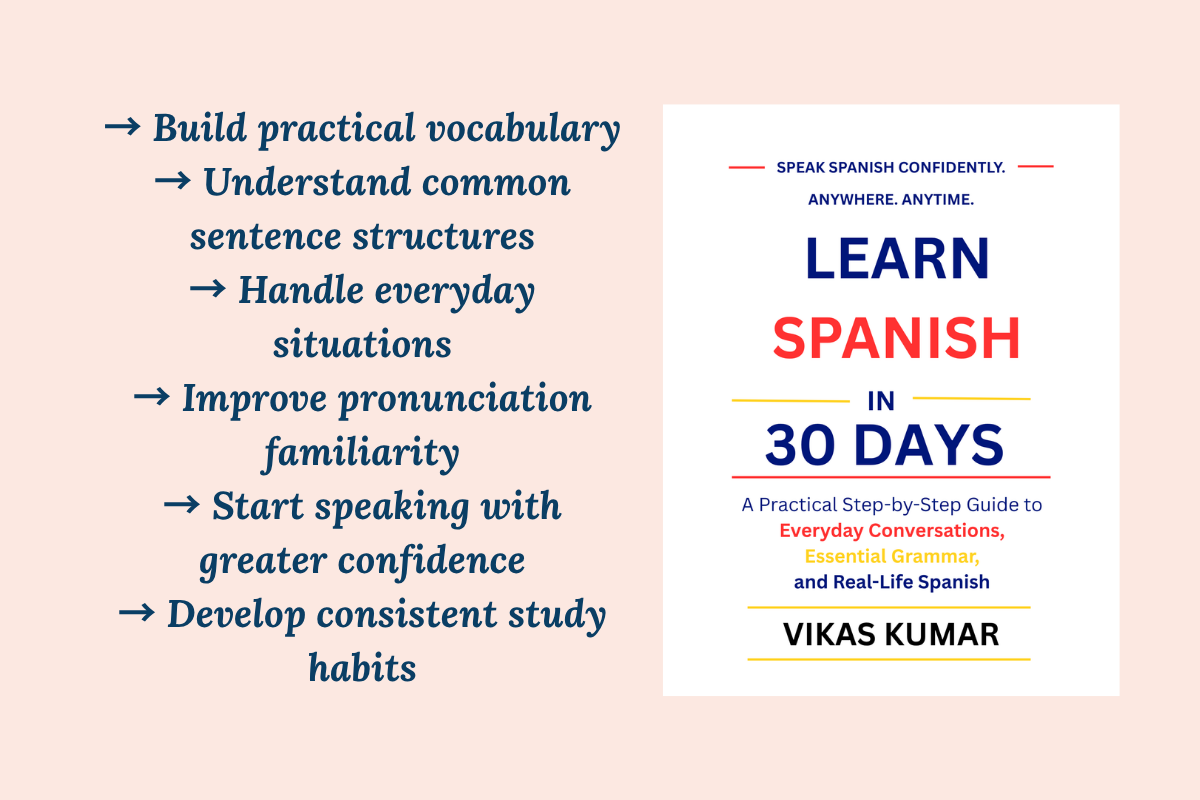
This is where Learning Spanish in 30 Days becomes especially useful for beginners. Learn Spanish in 30 Days: A Complete Beginner’s Guide to Everyday Conversations is designed as a practical 30-day learning system that helps learners move step by step from basic understanding to real communication.
Can You Really Learn Spanish in 30 Days?
Yes, beginners can make meaningful progress in Spanish within 30 days when learning follows a structured and consistent routine.
The goal should not be perfect fluency within one month. Instead, the focus should be on building a strong beginner foundation that allows learners to understand common expressions, form simple sentences, ask questions, and participate in basic conversations.
A realistic 30-day learning plan can help beginners:
→ Build practical vocabulary
→ Understand common sentence structures
→ Handle everyday situations
→ Improve pronunciation familiarity
→ Start speaking with greater confidence
→ Develop consistent study habits
With daily practice and the right learning structure, beginners can achieve noticeable communication improvement within a month.
Why a Structured Daily Study Plan Matters
A structured study plan helps beginners stay organized and consistent while reducing confusion during the early stages of learning.
Reduces Confusion for Beginners
Many beginners feel overwhelmed because they do not know where to begin.
A structured plan solves this problem by creating a clear learning sequence. Instead of jumping between random lessons, learners move through connected topics step by step.
This creates a smoother learning experience and helps learners stay focused.
Builds Consistency More Easily
Short and manageable study sessions are easier to maintain daily.
Studying for 30 to 45 minutes each day often produces better long-term results than occasional long study sessions. Daily repetition helps learners retain vocabulary, sentence patterns, and expressions more effectively.
Helps With Long-Term Retention
Learning Spanish requires repetition and gradual reinforcement.
A progressive study plan revisits earlier concepts while introducing new material gradually. This improves memory retention and helps learners connect vocabulary and sentence structures naturally.
Makes Spanish Feel More Practical
Beginners usually learn faster when lessons focus on real communication instead of isolated theory.
Learning through examples, dialogues, and practical situations makes Spanish easier to understand and apply in everyday conversations.
What a Good 30-Day Spanish Study Plan Should Include
A strong beginner Spanish learning plan should combine multiple learning elements together instead of focusing on only one area.
Vocabulary With Context
Vocabulary becomes easier to remember when words appear inside meaningful examples.
Beginners benefit from learning vocabulary with translations, example sentences, and real usage patterns rather than memorizing isolated word lists.
Everyday Conversations
Conversation practice helps learners understand how Spanish is used naturally.
Daily greetings, introductions, travel interactions, shopping situations, and basic social conversations are essential for building confidence.
Beginner Grammar Support
Grammar helps learners understand how sentences work and how ideas connect together.
For beginners, grammar works best when it supports communication directly through examples and practical usage.
Exercises and Revision
Practice exercises reinforce understanding and help learners identify weak areas.
Regular revision also improves retention and helps beginners feel more confident using the language actively.
Progressive Daily Lessons
Daily lessons should build logically from simple topics to more advanced communication.
This gradual progression keeps learning manageable and prevents beginners from feeling overloaded.
A Practical 30-Day Spanish Learning Structure for Beginners
A well-designed 30-day learning system should guide beginners through different stages of communication development.
Week 1 – Foundations and Basic Communication
The first week should focus on building core foundations.
Beginners typically start with pronunciation, greetings, introductions, numbers, sentence basics, and essential vocabulary. This stage helps learners become comfortable with basic Spanish sounds and sentence patterns.
Week 2 – Building Everyday Communication
The second week usually expands into verbs, sentence structure, common questions, descriptions, and daily interactions.
At this stage, learners begin forming longer sentences and understanding how Spanish functions in practical communication.
Week 3 – Expanding Real-Life Communication
The third week should focus on practical real-world situations.
Topics such as directions, shopping, routines, travel interactions, and everyday conversations help learners apply Spanish more naturally.
Week 4 – Building Speaking Confidence
The final stage should help learners combine earlier concepts into more complete communication.
This includes expressing opinions, discussing plans, speaking about past and future situations, and improving conversational confidence through regular practice.
This progression is one of the reasons many beginners prefer Learn Spanish in 30 Days because the lessons are organized into a clear four-week structure designed specifically for gradual beginner improvement.
How Learn Spanish in 30 Days Supports Daily Learning
A beginner learning system works best when it keeps study organized, practical, and manageable.
Structured Lessons for Daily Study
The book follows a daily lesson structure that helps learners know exactly what to study each day.
This removes uncertainty and creates a smoother learning routine for beginners.
1000+ Vocabulary Words With Examples
Vocabulary is introduced with meanings, translations, and contextual examples.
This helps learners understand how words are used naturally in conversations and sentence formation.
200 Daily Spanish Expressions
The book includes more than 200 common Spanish expressions used in real communication.
These expressions support beginners in daily conversations, travel situations, social interactions, and practical communication.
1600+ Example Sentences With Translation
Repeated exposure to sentence patterns helps beginners understand Spanish more naturally.
The large number of example sentences included throughout the book improves comprehension, sentence building, and communication confidence.
Exercises With Answers
Exercises allow learners to practice actively instead of only reading explanations.
The included answers also make the system suitable for self-study learners who want independent revision support.
Real-Life Dialogues for Speaking Practice
Dialogues show how Spanish works in natural situations.
They help learners become familiar with conversational flow, common responses, and everyday communication patterns.
As a multilingual educator and the founder of My Language Classes, the focus behind Learn Spanish in 30 Days: A Complete Beginner’s Guide to Everyday Conversations is to create a realistic and practical learning system that beginners can follow consistently without confusion.
How Much Time Should You Study Spanish Each Day?
For most beginners, 30 to 45 minutes of focused daily study is enough to create meaningful progress over time.
Consistency matters more than long study sessions.
A practical daily routine may include:
→ Reading the lesson explanation
→ Studying vocabulary and examples
→ Practicing dialogues aloud
→ Completing exercises
→ Reviewing previous lessons briefly
Even short daily sessions become highly effective when repeated consistently across 30 days.
Best Study Habits for Learning Spanish Faster
Good study habits help beginners stay consistent and improve retention.
Study Daily Instead of Occasionally
Daily exposure helps learners remember vocabulary and sentence structures more effectively.
Consistency creates stronger long-term progress.
Review Previous Lessons Every Week
Revision strengthens memory and improves understanding.
Weekly review sessions help learners connect earlier concepts with new material.
Practice Sentences Out Loud
Speaking aloud improves pronunciation familiarity and builds communication confidence.
Repeating example sentences also improves sentence flow naturally.
Focus on Communication First
Beginners often improve faster when they focus on understanding and using practical Spanish rather than trying to memorize every rule perfectly.
Learn Vocabulary Through Context
Contextual learning improves retention because learners understand how vocabulary functions inside real communication.
Who Benefits Most From a Structured Spanish Study Plan?
Complete Beginners
Beginners starting from zero benefit from guided progression and organized lessons.
Busy Professionals
Professionals often need a manageable study system that fits into limited daily schedules.
Students
Students can use structured lessons to support school or independent learning goals.
Travelers
Travelers preparing for Spanish-speaking countries benefit from practical communication practice and real-life dialogues.
Self-Learners
Independent learners often prefer systems that combine vocabulary, conversations, grammar, exercises, and revision in one place.
Common Mistakes Beginners Make While Learning Spanish
Many beginners struggle because their learning process lacks structure and consistency.
Some common mistakes include:
→ Studying irregularly
→ Memorizing isolated vocabulary lists
→ Ignoring speaking practice
→ Trying to learn too much too quickly
→ Switching between too many resources
A structured learning system helps reduce these problems by organizing study into a clear and manageable progression.
What You Can Realistically Achieve in 30 Days
After 30 days of consistent beginner study, learners can expect meaningful foundational improvement.
Most beginners can learn to:
→ Introduce themselves confidently
→ Understand common expressions
→ Ask and answer basic questions
→ Build simple sentences
→ Handle basic travel situations
→ Talk about routines and plans
→ Improve listening familiarity
→ Build communication confidence
The goal is not advanced fluency. The goal is building a reliable beginner foundation for continued improvement.
Is Learn Spanish in 30 Days a Good Choice for Beginners?
For beginners looking for a structured and practical self-study system, this book offers a balanced combination of organization, communication practice, and daily progression.
The learning system includes:
→ Daily structured lessons
→ Vocabulary with contextual examples
→ Real-life dialogues
→ Exercises with answers
→ English translations
→ Progressive communication practice
→ Multiple study formats
The structure is especially useful for learners who want a complete beginner roadmap instead of collecting multiple disconnected resources.
For learners searching for how to learn Spanish in 30 days with a practical and organized study system, Learn Spanish in 30 Days: A Complete Beginner’s Guide to Everyday Conversations provides a beginner-friendly approach focused on real communication and steady daily progress.
Conclusion
Learning Spanish in 30 days becomes far more achievable when beginners follow a structured and consistent study plan. Clear daily lessons, practical communication practice, vocabulary reinforcement, and gradual progression help learners stay focused and motivated.
Learn Spanish in 30 Days combines these elements into one organized beginner learning system designed for self-study learners, students, professionals, and travelers.
With regular daily practice and the right structure, beginners can build meaningful communication skills and a strong Spanish foundation within just one month.

Vikas Kumar is the founder of My Language Classes, a language learning platform dedicated to helping learners develop practical communication skills in Spanish, Japanese, and English through comprehensive grammar guides, structured learning resources, books, and evidence-informed educational content.
At My Language Classes, we believe that successful language learning is built on clarity, consistency, meaningful practice, and a deep understanding of how languages work. Every article is carefully researched and created to simplify complex concepts, provide practical guidance, and help learners develop confidence through real-world communication.
Inspired by the principles behind How Language Learning Really Works, our mission is to make high-quality language learning accessible to learners around the world by providing accurate, trustworthy, and comprehensive resources that support lasting progress, lifelong learning, and meaningful communication.
Leave a Reply