
Learning to speak Spanish in 30 days is possible when you follow a structured system that combines vocabulary, conversations, grammar support, examples, and daily practice. Instead of studying random topics, beginners benefit most from a clear learning path that develops communication skills step by step.
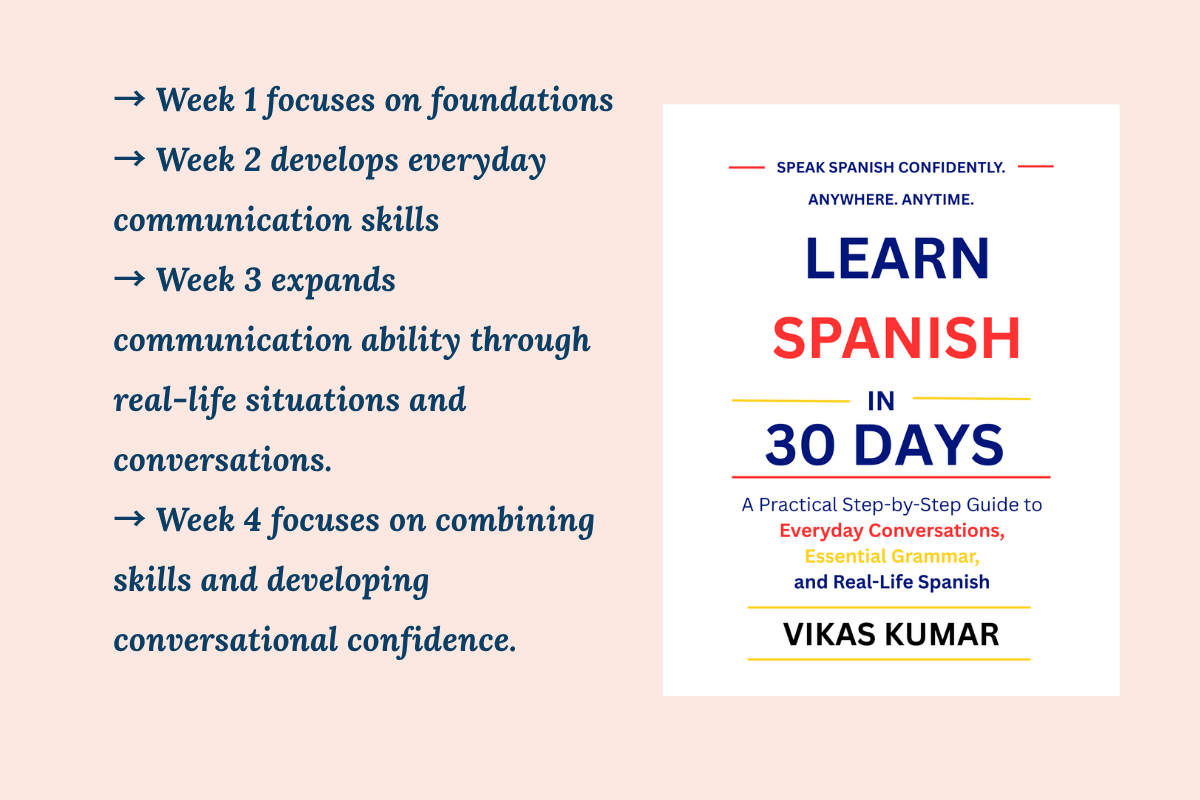
For learners looking for a complete beginner resource, Learn Spanish in 30 Days is available as an eBook on the My Language Classes website and on Amazon in Kindle, paperback, and hardcover formats. Learn Spanish in 30 Days: A Complete Beginner’s Guide to Everyday Conversations is designed to help learners move from basic understanding to practical communication through a structured 30-day learning system.
What Does It Really Mean to Speak Spanish in 30 Days?
When people search for ways to learn to speak Spanish in 30 days, they are often looking for a realistic path toward communication rather than complete mastery.
Speaking Spanish in 30 days means developing the ability to handle common situations, understand frequently used expressions, and participate in simple conversations. It means building a foundation that allows you to continue improving with confidence.
After 30 days of focused study, beginners can realistically expect to:
→ Introduce themselves confidently
→ Ask and answer basic questions
→ Understand common expressions
→ Build simple sentences
→ Participate in everyday conversations
→ Communicate in basic travel situations
The goal is practical communication, not perfection.
Why Most Beginners Want a Complete Learning System
Many beginners quickly discover that speaking Spanish involves more than memorizing a few words or phrases.
Speaking Requires More Than Vocabulary Lists
Vocabulary is important, but learners also need to understand how words work together in real communication.
Learning words through examples and conversations helps learners remember them more effectively and use them naturally.
Conversations Require Sentence Building Skills
Speaking confidently requires more than recognizing vocabulary.
Learners need exposure to sentence structures, common patterns, and real examples that demonstrate how Spanish is used in daily life.
Consistency Is Easier With Structure
One of the biggest challenges for beginners is maintaining consistency.
A structured learning system removes uncertainty and provides a clear study path, making it easier to build a daily learning habit.
Practical Communication Requires Real Examples
Many learners want to use Spanish in real situations such as travel, work, social interactions, and everyday conversations.
Dialogues, practical examples, and conversational scenarios help bridge the gap between learning and actual communication.
What Should a Beginner System Include to Help You Speak Spanish?
Not all beginner resources are designed with speaking goals in mind. A complete beginner system should combine multiple elements that support communication development.
Vocabulary for Everyday Communication
Learners need practical vocabulary they can use immediately in conversations.
Words become easier to remember when they are presented with meanings, examples, and contextual usage.
Common Expressions Used by Native Speakers
Everyday communication relies heavily on common expressions and responses.
Learning these expressions helps beginners participate more naturally in conversations.
Example Sentences With Translation
Example sentences provide learners with models they can follow and adapt.
They also help learners understand sentence patterns without relying entirely on memorization.
Real-Life Dialogues
Dialogues show how conversations flow naturally.
By studying conversations, learners become familiar with common questions, responses, and communication patterns.
Practice Exercises
Exercises help reinforce learning and encourage active participation.
They also provide opportunities to identify and correct mistakes.
Daily Learning Structure
A structured learning plan ensures that concepts build progressively.
This allows learners to develop communication skills gradually rather than feeling overwhelmed by too much information at once.
How Learn Spanish in 30 Days Helps You Build Speaking Confidence
A complete beginner speaking system should provide enough exposure, practice, and structure to help learners communicate with greater confidence.
More Than 1000 Vocabulary Words With Examples
The book includes more than 1000 Spanish vocabulary words supported by meanings, examples, and translations.
This helps learners understand vocabulary in context and apply it more effectively during conversations.
200 Daily Spanish Expressions for Real Conversations
Common expressions are a key part of everyday communication.
The book includes more than 200 frequently used Spanish expressions with translations that learners can begin using immediately.
More Than 1600 Example Sentences
Exposure to a large number of example sentences helps learners recognize common patterns and build communication confidence.
The combination of over 1000 translated examples and more than 600 additional reinforcement sentences provides extensive practical exposure.
Structured 30-Day Learning Roadmap
The book follows a progressive four-week learning structure.
Week 1 focuses on foundations such as pronunciation, greetings, and introductions.
Week 2 develops everyday communication skills through verbs, sentence patterns, and practical usage.
Week 3 expands communication ability through real-life situations and conversations.
Week 4 focuses on combining skills and developing conversational confidence.
Exercises With Answers for Independent Learning
Self-study learners benefit from immediate reinforcement.
Exercises with answers allow learners to review their progress and strengthen their understanding independently.
As a multilingual educator and the founder of My Language Classes, the goal behind Learn Spanish in 30 Days: A Complete Beginner’s Guide to Everyday Conversations is to provide beginners with a complete communication-focused system that combines structure, clarity, and practical usage.
A Practical Path From Beginner to Basic Speaker
Speaking ability develops gradually through consistent exposure and practice.
Learning Essential Words
Every communication journey begins with useful vocabulary.
Learning words that appear frequently in conversations helps learners communicate sooner.
Understanding Common Questions
Questions form a major part of daily communication.
Learners become more comfortable speaking when they can understand and respond to common questions naturally.
Responding Naturally
Understanding common responses helps conversations feel more fluid.
Repeated exposure to practical examples supports this process.
Creating Your Own Sentences
As vocabulary and sentence patterns grow, learners become more capable of expressing their own ideas.
This marks an important step toward conversational independence.
Participating in Everyday Conversations
With regular practice, learners become increasingly comfortable handling greetings, introductions, social interactions, and everyday communication situations.
Who Can Benefit From This Speaking-Focused Learning System?
Complete Beginners
The structured progression makes the book accessible even for learners starting from zero.
Travelers
Travelers can build practical communication skills useful for transportation, accommodation, shopping, dining, and social interactions.
Working Professionals
Professionals often need basic conversational Spanish for workplace communication or international interactions.
The daily lesson structure fits easily into busy schedules.
Students
Students can use the book as a structured learning companion alongside formal studies.
Self-Learners
Independent learners benefit from having vocabulary, conversations, exercises, and explanations organized within one resource.
Language Enthusiasts
Anyone interested in learning Spanish for personal development can use the system to build a strong foundation.
How This Book Supports Real-Life Communication
Practical communication remains the central focus of the learning system.
Introducing Yourself
Learners practice common introductions and greetings used in everyday interactions.
Asking Questions
The book helps learners understand and form common questions that support natural conversations.
Shopping and Daily Interactions
Practical situations help learners apply Spanish beyond the classroom.
Travel Situations
Travel-related dialogues prepare learners for common situations they may encounter in Spanish-speaking environments.
Social Conversations
Everyday conversational examples help learners become more comfortable speaking with other people.
Common Challenges When Learning to Speak Spanish
Most beginners encounter similar obstacles during the learning process.
Common challenges include:
→ Limited vocabulary
→ Lack of confidence
→ Inconsistent study habits
→ Difficulty forming sentences
→ Limited exposure to real conversations
A structured system helps address these challenges by providing clear progression, regular practice, and practical communication examples.
What You Can Expect After 30 Days of Consistent Study
With regular daily practice, learners can achieve meaningful progress within one month.
By completing the program, learners can expect:
→ Stronger vocabulary knowledge
→ Better understanding of sentence patterns
→ Improved conversational confidence
→ Greater familiarity with common expressions
→ Improved ability to participate in basic conversations
→ Better preparation for travel and everyday communication
These outcomes provide a solid foundation for continued Spanish learning.
Is Learn Spanish in 30 Days the Right Choice for Beginners?
For beginners who want to focus on speaking skills, this book offers a structured and practical learning solution.
It combines:
→ Daily lessons
→ Vocabulary with examples
→ Real-life dialogues
→ Common expressions
→ Exercises with answers
→ Progressive learning structure
→ Multiple format options
The book is particularly useful for learners who want a complete communication-focused resource rather than relying on multiple separate materials.
For learners searching for a practical way to learn to speak Spanish in 30 days, Learn Spanish in 30 Days: A Complete Beginner’s Guide to Everyday Conversations provides a clear roadmap that combines vocabulary, conversations, grammar support, examples, and daily practice into one beginner-friendly system.
Conclusion
Speaking Spanish begins with consistent practice, practical exposure, and a structured learning approach. Learners who follow a clear study path often build confidence more quickly because they always know what to focus on next.
Learn Spanish in 30 Days brings together vocabulary, conversations, exercises, examples, and daily lessons in a format designed specifically for beginners.
Whether your goal is travel, work, personal development, or everyday communication, a complete beginner system can help you build the foundation needed to start speaking Spanish with confidence.

Vikas Kumar is the founder of My Language Classes, a language learning platform dedicated to helping learners develop practical communication skills in Spanish, Japanese, and English through comprehensive grammar guides, structured learning resources, books, and evidence-informed educational content.
At My Language Classes, we believe that successful language learning is built on clarity, consistency, meaningful practice, and a deep understanding of how languages work. Every article is carefully researched and created to simplify complex concepts, provide practical guidance, and help learners develop confidence through real-world communication.
Inspired by the principles behind How Language Learning Really Works, our mission is to make high-quality language learning accessible to learners around the world by providing accurate, trustworthy, and comprehensive resources that support lasting progress, lifelong learning, and meaningful communication.
Leave a Reply