

Mastering Japanese Adjectives: A Comprehensive Guide
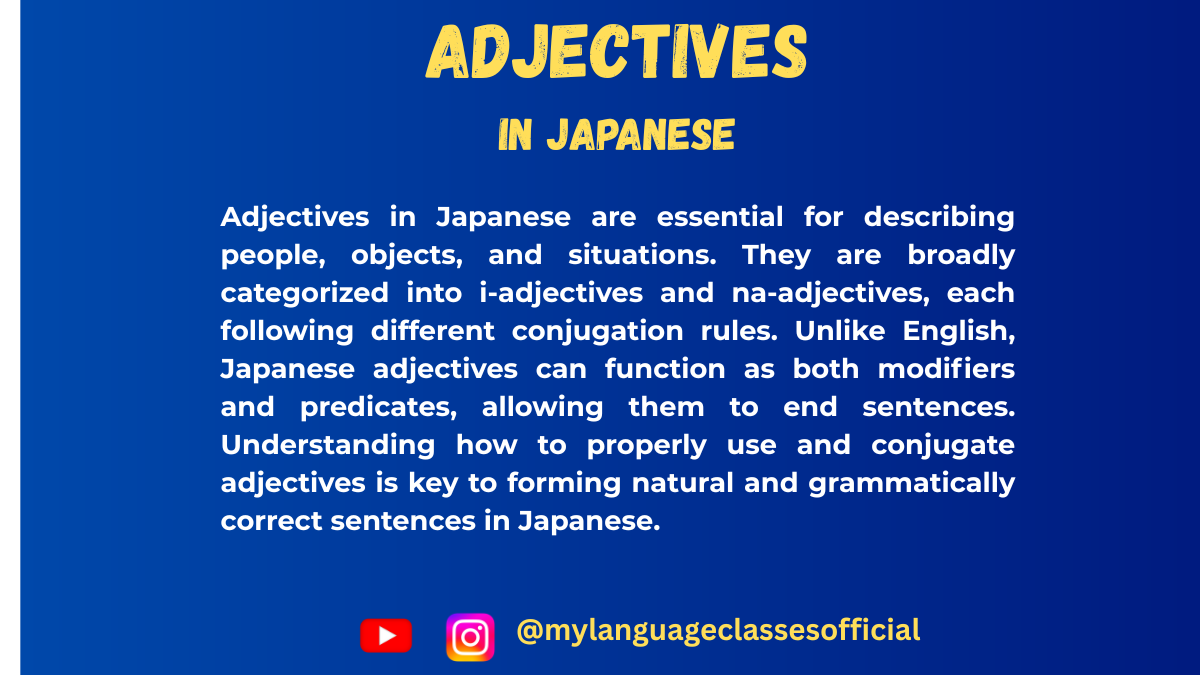
When learning Japanese, adjectives play a key role in describing the world around us. They not only add depth to your vocabulary but also enable you to express emotions, describe objects, and narrate experiences with precision. In this blog post, we will dive into i-adjectives and na-adjectives, exploring their various forms to help you master their usage.
Understanding Japanese Adjectives
Japanese adjectives fall into two main categories:
- I-adjectives (い形容詞): These adjectives end with the syllable い, such as 高い (takai, “high/expensive”).
- Na-adjectives (な形容詞): These adjectives are followed by な when modifying a noun, such as 静か (shizuka, “quiet”).
Both types of adjectives can be conjugated to express tense and polarity (affirmative/negative). Let’s break this down with examples!
I-Adjectives: 高い (takai)
I-adjectives are flexible and straightforward to conjugate. Here’s how to handle them:
1. Present Affirmative: 高い (takai)
This is the dictionary form, used to describe something currently high or expensive.
Example: この山は高いです。 (Kono yama wa takai desu. “This mountain is high.”)
2. Present Negative: 高くない (takakunai)
Replace the final い with くない to express the negative form.
Example: この家は高くないです。 (Kono ie wa takakunai desu. “This house is not expensive.”)
3. Past Affirmative: 高かった (takakatta)
Replace い with かった to describe something that was high or expensive.
Example: 昨日登った山は高かったです。 (Kinō nobotta yama wa takakatta desu. “The mountain we climbed yesterday was high.”)
4. Past Negative: 高くなかった (takakunakatta)
Replace い with くなかった to express the past negative.
Example: このカバンは高くなかったです。 (Kono kaban wa takakunakatta desu. “This bag was not expensive.”)
Quick Summary Table for I-Adjectives:
| Tense | Form | Example |
|---|---|---|
| Present Affirmative | 高い | 高い車 (takai kuruma) – “expensive car” |
| Present Negative | 高くない | 高くない車 (takakunai kuruma) – “not expensive car” |
| Past Affirmative | 高かった | 高かった車 (takakatta kuruma) – “was an expensive car” |
| Past Negative | 高くなかった | 高くなかった車 (takakunakatta kuruma) – “was not an expensive car” |
Na-Adjectives: 静か (shizuka)
Na-adjectives require a little different handling, but they are equally systematic. Here’s the breakdown:
1. Present Affirmative: 静か (shizuka)
The base form is used with です to indicate politeness.
Example: この公園は静かです。 (Kono kōen wa shizuka desu. “This park is quiet.”)
2. Present Negative: 静かじゃない (shizuka janai)
Add じゃない to the base form to negate it.
Example: この部屋は静かじゃないです。 (Kono heya wa shizuka janai desu. “This room is not quiet.”)
3. Past Affirmative: 静かだった (shizuka datta)
Add だった to express that something was quiet.
Example: 昨夜の図書館は静かだったです。 (Sakuya no toshokan wa shizuka datta desu. “The library last night was quiet.”)
4. Past Negative: 静かじゃなかった (shizuka janakatta)
Combine じゃなかった to indicate that something was not quiet.
Example: 昨日のカフェは静かじゃなかったです。 (Kinō no kafe wa shizuka janakatta desu. “The café yesterday was not quiet.”)
Quick Summary Table for Na-Adjectives:
| Tense | Form | Example |
|---|---|---|
| Present Affirmative | 静か | 静かな部屋 (shizuka na heya) – “quiet room” |
| Present Negative | 静かじゃない | 静かじゃない部屋 (shizuka janai heya) – “not a quiet room” |
| Past Affirmative | 静かだった | 静かだった部屋 (shizuka datta heya) – “was a quiet room” |
| Past Negative | 静かじゃなかった | 静かじゃなかった部屋 (shizuka janakatta heya) – “was not a quiet room” |
Tips for Mastery
- Practice daily: Use adjectives to describe your environment. For instance, “The sky is blue” → 空が青いです (Sora ga aoi desu).
- Listen to native speakers: Pay attention to how adjectives are used in Japanese media like dramas, anime, or news.
- Create your own sentences: Experiment with mixing different adjectives to make complex sentences.
- Review conjugation patterns: Regularly revisit charts and examples to solidify your understanding.
Conclusion
Mastering Japanese adjectives—both i-adjectives and na-adjectives—is an essential step toward fluency. With consistent practice and a clear understanding of the conjugation rules, you’ll find it easier to describe the world around you. Start using these forms today, and watch your Japanese skills soar!
Happy learning! 頑張ってください! (Ganbatte kudasai!)

Vikas Kumar is the founder of My Language Classes, a language learning platform dedicated to helping learners develop practical communication skills in Spanish, Japanese, and English through comprehensive grammar guides, structured learning resources, books, and evidence-informed educational content.
At My Language Classes, we believe that successful language learning is built on clarity, consistency, meaningful practice, and a deep understanding of how languages work. Every article is carefully researched and created to simplify complex concepts, provide practical guidance, and help learners develop confidence through real-world communication.
Inspired by the principles behind How Language Learning Really Works, our mission is to make high-quality language learning accessible to learners around the world by providing accurate, trustworthy, and comprehensive resources that support lasting progress, lifelong learning, and meaningful communication.
Leave a Reply