

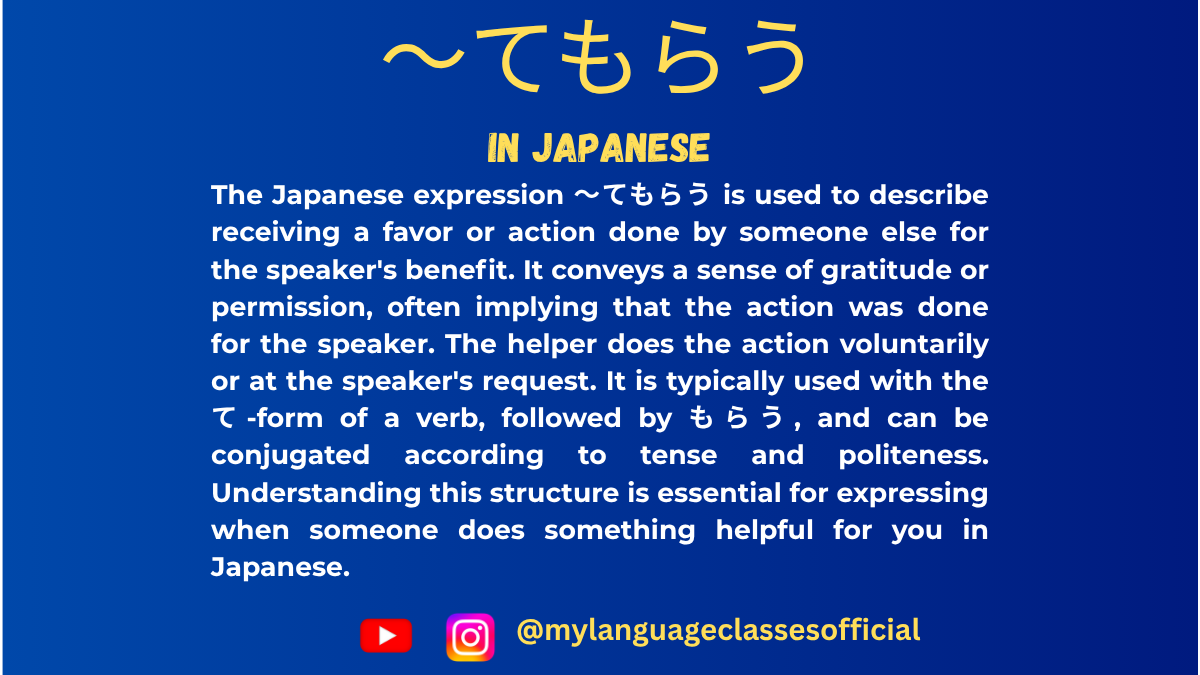
The Japanese Grammar 〜てもらう
The Japanese grammar pattern 〜てもらう is an essential structure used to express receiving a favor from someone. It emphasizes that someone is doing something beneficial for the speaker or a third party. Understanding this grammar is crucial for natural and polite Japanese communication.
This post will explain 〜てもらう in various situations, provide example sentences, and list common contexts where it is used.
Structure of 〜てもらう
The pattern follows this structure:
Person A (receiver) + は/が + Person B (doer) + に + Verb in 〜て form + もらう
- A is the person who benefits from the action.
- B is the person performing the action for A.
- The verb is conjugated into the て-form and followed by もらう (to receive).
Example:
- 私は先生に日本語を教えてもらいました。
(I had my teacher teach me Japanese.)
Difference Between 〜てもらう and 〜てあげる
- 〜てもらう: Focuses on the receiver of the favor.
- 〜てあげる: Focuses on the giver of the favor.
Example:
- 私は先生に日本語を教えてもらいました。 (I received Japanese lessons from my teacher.)
- 私は先生に日本語を教えてあげました。 (I taught Japanese to my teacher.)
Various Situations Where 〜てもらう Is Used
1. Receiving Help
When someone helps you with a task or does something for your benefit.
Example:
- 私は彼氏に財実を送ってもらいました。
(I had my boyfriend send my wallet.)
2. Receiving Permission
Used when asking for permission to do something.
Example:
- 先生にはやく帰らせてもらいました。
(I got permission from my teacher to leave early.)
3. Receiving a Favor Indirectly
You receive a favor, but a third party performs the action.
Example:
- 母は先生にむすこの学校の事を説明してもらいました。
(My mother had the teacher explain about the school to her.)
4. Making Polite Requests
When requesting someone to do something politely.
Example:
- この文章を正しく直してもらえますか。
(Could you please correct this text for me?)
5. Receiving Information
When someone shares knowledge or guidance.
Example:
- 先生にいろいろな情報を教えてもらいました。
(I received a lot of information from my teacher.)
6. Asking for Medical Assistance
Used when getting treatment or medical help from someone.
Example:
- 医者に病治をしてもらいました。
(I got treated by the doctor.)
7. Receiving a Physical Object
Used when someone gives you something.
Example:
- 友人に好きな本を買ってもらいました。
(My friend bought me a book I like.)
8. Receiving Guidance or Instructions
Used when someone teaches you or gives instructions.
Example:
- 先生に作文の書き方を教えてもらいました。
(I had my teacher teach me how to write essays.)
Summary of Situations Where 〜てもらう Is Used
Here’s a quick reference list:
- Receiving help (task-related support)
- Receiving permission
- Receiving a favor indirectly
- Making polite requests
- Receiving information or knowledge
- Asking for medical assistance
- Receiving a physical object
- Receiving guidance or instructions
Conclusion
〜てもらう is a crucial grammar point in Japanese, allowing you to express receiving favors, help, or benefits from others. Mastering this structure enhances your ability to communicate politely and effectively in various situations. Practice using it in conversations to improve fluency and comprehension!
Happy learning! 😊

Vikas Kumar is the founder of My Language Classes, a language learning platform dedicated to helping learners develop practical communication skills in Spanish, Japanese, and English through comprehensive grammar guides, structured learning resources, books, and evidence-informed educational content.
At My Language Classes, we believe that successful language learning is built on clarity, consistency, meaningful practice, and a deep understanding of how languages work. Every article is carefully researched and created to simplify complex concepts, provide practical guidance, and help learners develop confidence through real-world communication.
Inspired by the principles behind How Language Learning Really Works, our mission is to make high-quality language learning accessible to learners around the world by providing accurate, trustworthy, and comprehensive resources that support lasting progress, lifelong learning, and meaningful communication.
Leave a Reply