

Simple Present Tense in English is one of the first verb tenses learners encounter, and it remains important even as their English becomes more advanced. We use it to talk about habits, routines, facts, regular events, states, schedules, and many situations that are part of everyday communication. Learning this tense well gives learners a reliable foundation for building accurate English sentences, especially when they understand how the structure changes with different subjects.
The Simple Present Tense can look easy at first because its basic form is usually simple. However, small details often cause mistakes. Learners may forget the third-person singular ending, use “does” incorrectly, or add “-s” after “does.” Understanding why these changes happen makes the tense much easier to use consistently.
A strong understanding of the Simple Present Tense also helps learners distinguish it from other present and future forms. That distinction becomes increasingly important as sentences become longer and more precise. A structured grammar resource such as Complete English Tenses Mastery Guide can provide a broader framework for understanding how the Simple Present fits into the complete English tense system.
What Is the Simple Present Tense in English?
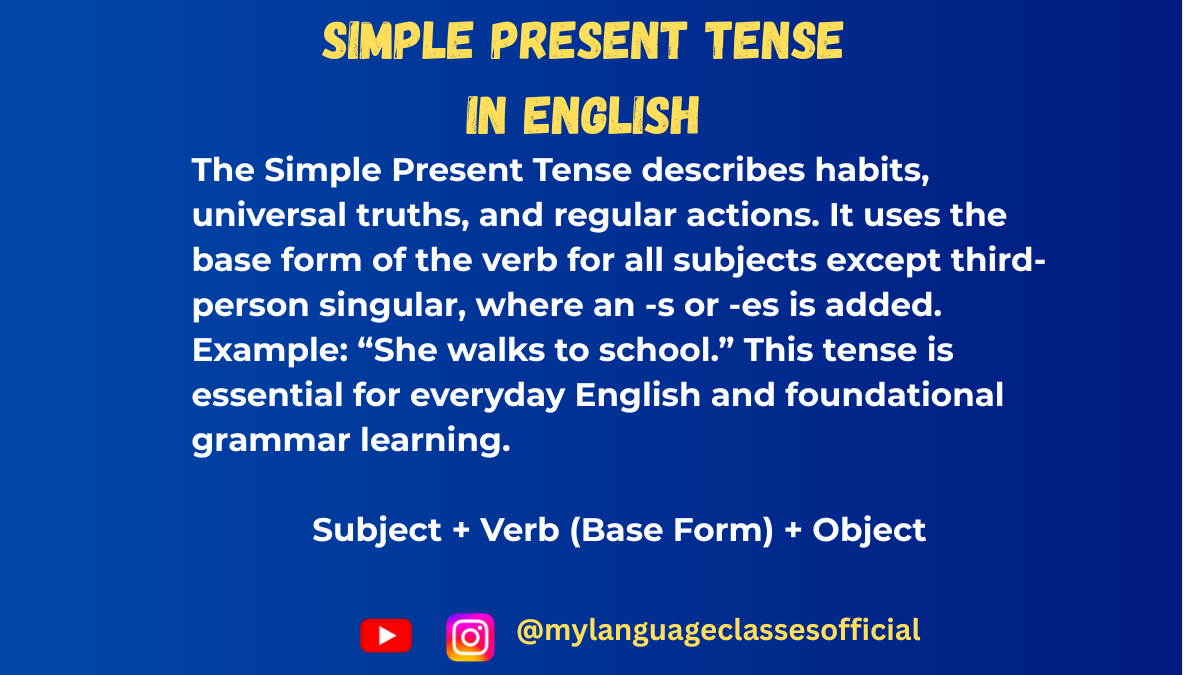
The Simple Present Tense describes actions, situations, and states that are generally true, repeated, regular, or connected to the present. It is commonly used when an action happens as part of a routine or when a situation continues to be true rather than happening only at the moment of speaking.
For example:
I work from home.
She studies English every evening.
Water boils at 100°C.
They live in Chicago.
These sentences describe different kinds of situations, but they all use the Simple Present Tense. The first describes a regular situation, the second describes a routine, the third expresses a general fact, and the fourth describes a situation that is true in the present.
The tense does not necessarily mean that something is happening at the exact moment someone speaks. This is an important distinction. For example, if someone says, “I work at a language school,” the sentence describes their current employment or regular situation. It does not mean that they are teaching a class at that exact second.
The Simple Present Tense is also frequently used with verbs that describe states, such as know, understand, like, want, need, believe, and own. These verbs often describe conditions rather than actions that are taking place moment by moment.
For example:
I understand the question.
She likes Japanese food.
He knows the answer.
We need more time.
Understanding the meaning of the tense is more useful than memorizing a single definition because the Simple Present appears in several important types of English sentences. Its structure becomes much easier to control once learners can connect the form of the verb with the situation being described. A complete reference such as Complete English Tenses Mastery Guide can help place these different uses within the wider English tense system.
What Is the Formula of the Simple Present Tense?
The formula of the Simple Present Tense depends on the type of sentence you want to form. The basic structure changes when you make an affirmative statement, a negative statement, or a question. The subject also matters because third-person singular subjects require a different verb form in affirmative sentences.
Affirmative Sentences
For most subjects, the basic structure is:
Subject + base form of the verb + rest of the sentence
Examples:
I work in an office.
You speak English.
We study together.
They live in New York.
With he, she, and it, the main verb usually takes an -s or -es ending:
Subject + verb with -s or -es + rest of the sentence
Examples:
He works in an office.
She speaks English.
It looks expensive.
The change in the verb is one of the most important features of the Simple Present Tense.
Negative Sentences
Negative sentences use “do not” or “does not” before the main verb.
Subject + do not + base verb + rest of the sentence
Subject + does not + base verb + rest of the sentence
Examples:
I do not work on Sundays.
They do not live here.
She does not work on Sundays.
He does not live here.
Notice that the main verb returns to its base form after “does not.” We say “She does not work,” not “She does not works.”
Yes/No Questions
Questions usually begin with “do” or “does.”
Do + subject + base verb + rest of the sentence?
Does + subject + base verb + rest of the sentence?
Examples:
Do you speak English?
Do they work here?
Does she speak English?
Does he work here?
Again, the main verb remains in its base form after “does.”
WH-Questions
When a question begins with a question word, “do” or “does” normally follows the question word when an ordinary main verb is used.
WH-word + do/does + subject + base verb + rest of the sentence?
Examples:
Where do you live?
What does she teach?
When do they start work?
Why does he study English?
These patterns give learners a practical framework for forming most basic Simple Present sentences. Once the role of the subject and auxiliary verbs is clear, the tense becomes much more predictable and easier to use accurately. A detailed tense reference such as Complete English Tenses Mastery Guide can help learners see how these sentence patterns connect with the structures of other English tenses.
How Do You Form Affirmative Sentences in the Simple Present Tense?
Affirmative sentences in the Simple Present Tense usually have a straightforward structure: the subject comes first, followed by the main verb and the rest of the sentence. The main point to remember is that the verb changes when the subject is he, she, or it.
With I, you, we, and they, use the base form of the main verb:
I read English books.
You work in a bank.
We study Japanese.
They play tennis.
The verb stays in its base form even when the sentence describes a regular habit or a situation that is true in the present.
With he, she, and it, the main verb normally takes an -s or -es ending:
He reads English books.
She works in a bank.
It looks expensive.
The reason for this change is grammatical agreement between the subject and the verb. English marks the third-person singular in the Simple Present by changing the main verb form.
The same pattern applies to many everyday verbs:
I live in Delhi.
She lives in Delhi.
They teach English.
He teaches English.
We watch movies.
She watches movies.
The form of the verb therefore depends on the subject, not on whether the sentence describes a habit, a fact, or another type of present situation.
It is also important to keep the base verb after the subjects I, you, we, and they. For example, “They works here” is incorrect because “works” is the third-person singular form. The correct sentence is “They work here.”
For he, she, and it, learners should pay particular attention to the spelling of the verb because some verbs take -s, while others take -es or undergo a spelling change. These patterns are easier to manage when the subject is identified before the verb is formed.
Once this subject-verb relationship becomes familiar, affirmative sentences in the Simple Present become much easier to produce accurately. A structured resource such as Complete English Tenses Mastery Guide can help learners connect this basic pattern with the wider system of English verb forms.
When Do We Add S or ES to a Verb in the Simple Present Tense?
In the Simple Present Tense, the main verb changes when the subject is he, she, or it, or when the subject is another singular third-person noun. In most cases, we add -s to the base form of the verb.
Examples:
He works in a hospital.
She reads every morning.
The dog needs water.
My brother plays football.
For many verbs, adding -s is all that is needed:
work → works
read → reads
play → plays
need → needs
However, some verbs take -es instead. This commonly happens when the base verb ends in -s, -ss, -sh, -ch, -x, or -o.
Examples:
pass → passes
watch → watches
wash → washes
fix → fixes
go → goes
do → does
For verbs ending in a consonant followed by y, the y changes to i before -es is added:
study → studies
try → tries
carry → carries
When a verb ends in a vowel followed by y, the y remains and we simply add -s:
play → plays
enjoy → enjoys
stay → stays
These spelling patterns apply to affirmative sentences. They do not mean that the main verb keeps the -s or -es form after “does” in negative sentences or questions. For example:
She works here.
She does not work here.
Does she work here?
The verb “work” returns to its base form after “does” because “does” carries the third-person singular marking.
The same principle applies to other verbs:
He watches television.
He does not watch television.
Does he watch television?
Understanding when to add -s or -es is essential because this small change carries important grammatical information. Once learners understand that the change belongs to the affirmative main verb with a third-person singular subject, negative sentences and questions become much easier to form correctly. The wider relationship between these verb forms can be studied systematically in Complete English Tenses Mastery Guide.
How Do You Form Negative Sentences in the Simple Present Tense?
Negative sentences in the Simple Present Tense usually use the auxiliary verbs “do” or “does” followed by “not.” The choice depends on the subject. We use “do not” with I, you, we, and they, and “does not” with he, she, it, and singular third-person nouns.
The basic structure is:
Subject + do not + base verb + rest of the sentence
Examples:
I do not drink coffee.
You do not work here.
We do not watch television every evening.
They do not live in this city.
With he, she, it, and singular third-person nouns, use “does not”:
He does not drink coffee.
She does not work here.
It does not look difficult.
My brother does not watch television every evening.
The main verb remains in its base form after “does not.” This is important because the third-person singular marking has already moved to the auxiliary verb “does.”
For example:
She works here.
She does not work here.
The incorrect form would be “She does not works here.”
The same pattern applies to verbs that normally take “-es” or change their spelling in affirmative sentences:
He watches television.
He does not watch television.
She studies English.
She does not study English.
The negative form therefore has a different appearance from the affirmative form, even though both sentences use the Simple Present Tense.
In everyday English, “do not” and “does not” are often contracted as “don’t” and “doesn’t.” Both forms are grammatically correct, although the full forms can sound more formal or emphatic in some contexts.
Examples:
I do not understand the question.
I don’t understand the question.
She does not like coffee.
She doesn’t like coffee.
The important point is to remember that “do” and “does” carry the grammatical information in negative sentences, while the main verb stays in its base form. This pattern becomes much easier to recognize when the tense is studied as a connected system, as explained in Complete English Tenses Mastery Guide.
How Do You Form Questions in the Simple Present Tense?
Questions in the Simple Present Tense usually use “do” or “does” as an auxiliary verb. The choice depends on the subject. We use “do” with I, you, we, and they, while “does” is used with he, she, it, and singular third-person nouns.
The basic structure for a yes/no question is:
Do + subject + base verb + rest of the sentence?
Examples:
Do you speak English?
Do they live nearby?
Do we need more time?
Does + subject + base verb + rest of the sentence?
Examples:
Does she speak English?
Does he live nearby?
Does your brother work here?
One important rule is that the main verb stays in its base form after “does.” The third-person singular ending belongs to “does,” so we do not add another -s or -es to the main verb.
For example:
Does she work here?
Does he study English?
Does the machine work properly?
The forms “Does she works here?” and “Does he studies English?” are incorrect.
The same principle applies when the main verb normally takes an -es ending:
Does she watch television?
Does he go to school?
Does your father teach English?
The main verbs remain “watch,” “go,” and “teach.”
With “do,” the same base-form rule applies:
Do you watch television?
Do they go to school?
Do your friends teach English?
Questions can also contain objects, places, time expressions, and other information:
Do you read English books every day?
Does she work at a language school?
Do they visit their parents on weekends?
Does he play tennis after work?
Short answers commonly repeat the auxiliary verb:
Do you speak Spanish?
Yes, I do.
No, I do not.
Does she live here?
Yes, she does.
No, she does not.
Understanding the role of “do” and “does” is central to forming accurate Simple Present questions. Once learners recognize that the auxiliary carries the tense and the main verb stays in its base form, question formation becomes much more consistent. This relationship between auxiliaries and main verbs is an important part of the wider tense system explained in Complete English Tenses Mastery Guide.
How Do You Form WH-Questions in the Simple Present Tense?
WH-questions in the Simple Present Tense ask for specific information rather than a simple yes or no answer. Common question words include “what,” “where,” “when,” “why,” “who,” “which,” and “how.”
When an ordinary main verb is used, the usual structure is:
WH-word + do/does + subject + base verb + rest of the sentence?
For example:
Where do you live?
What do they study?
When do you start work?
Why does she learn English?
How does he travel to work?
The choice between “do” and “does” follows the same subject rule used in yes/no questions. Use “do” with I, you, we, and they:
What do you want?
Where do they work?
When do we meet?
Use “does” with he, she, it, and singular third-person nouns:
What does he want?
Where does she work?
When does the train leave?
The main verb stays in its base form after “does.” For example, we say “Where does she live?” rather than “Where does she lives?” The auxiliary “does” already carries the third-person singular form.
Some WH-questions contain a longer noun phrase after the question word:
Which book does she read?
What kind of music do they like?
How many languages does he speak?
How often do you exercise?
The structure becomes slightly different when the question word itself is the subject of the sentence. In such cases, “do” or “does” is usually not needed.
For example:
Who works here?
Who speaks Spanish?
What causes this problem?
Which student knows the answer?
Compare these with questions where the question word asks about the object:
Who does she teach?
What does he need?
Which book does she want?
This distinction matters because the position of the question word changes the grammatical structure of the sentence.
WH-questions are especially useful in everyday English because they allow speakers to ask about people, places, times, reasons, objects, quantities, and habits. Once the difference between subject and object questions is understood, the Simple Present becomes much more flexible in real communication. These patterns form part of the broader tense system covered in Complete English Tenses Mastery Guide.
How Do You Use Do and Does in the Simple Present Tense?
“Do” and “does” have an important role in the Simple Present Tense because they often work as auxiliary verbs when we form negative sentences and questions. The choice depends on the subject, while the main verb normally remains in its base form.
Use “do” with I, you, we, and they:
I do not understand.
Do you understand?
We do not need help.
Do they work here?
Use “does” with he, she, it, and singular third-person nouns:
She does not understand.
Does she understand?
He does not need help.
Does your brother work here?
The difference becomes especially important when forming questions. In an affirmative sentence, a third-person singular subject usually causes the main verb to take an -s or -es ending:
She works here.
He watches television.
When “does” becomes the auxiliary, the main verb returns to its base form:
Does she work here?
Does he watch television?
The same principle applies to negative sentences:
She does not work here.
He does not watch television.
We do not say “She does not works here” or “He does not watches television” because the third-person singular marking is already carried by “does.”
“Do” and “does” can also function as main verbs. In that case, they have their own meaning and are not simply auxiliary verbs:
I do my homework every evening.
She does her homework after dinner.
Do you do your homework before class?
In these sentences, the first “do” or “does” in a question can function as the auxiliary, while the second “do” is the main verb.
The auxiliary “do” can also be used for emphasis in affirmative sentences when the speaker wants to strongly confirm something:
I do understand your point.
She does know the answer.
This use is less common than ordinary affirmative structures, but it shows that “do” and “does” have functions beyond forming questions and negatives.
Understanding whether “do” or “does” is acting as an auxiliary or a main verb helps learners avoid several common errors. More importantly, it shows why the main verb changes form in affirmative sentences but returns to its base form after “do” or “does.” This relationship is part of the larger tense system explained in Complete English Tenses Mastery Guide.
How Do You Use the Verb Be in the Simple Present Tense?
The verb “be” behaves differently from most other verbs in the Simple Present Tense. Instead of using “do” or “does” to form ordinary affirmative sentences, English uses three forms of “be”: “am,” “is,” and “are.” The correct form depends on the subject.
Use “am” with “I”:
I am a teacher.
I am tired.
I am from India.
Use “is” with he, she, it, and singular nouns:
He is a teacher.
She is tired.
It is cold today.
The book is useful.
Use “are” with you, we, they, and plural nouns:
You are ready.
We are students.
They are busy.
The books are expensive.
The verb “be” can connect the subject with a noun, adjective, place, or other information that describes or identifies the subject.
For example:
Maria is a doctor.
The children are happy.
My office is in Delhi.
These sentences do not use “do” or “does” in their affirmative forms. We do not say “Maria does be a doctor” or “The children do be happy.”
The same difference appears in questions. With “be,” the verb comes before the subject:
Am I late?
Is she your sister?
Is the book expensive?
Are you ready?
Are they at home?
We do not normally use “do” or “does” to form these questions.
Negative sentences also place “not” directly after the form of “be”:
I am not tired.
She is not available.
He is not a student.
We are not ready.
They are not at home.
The verb “be” can also describe age, identity, location, condition, and other states:
I am twenty-five years old.
She is my sister.
The keys are on the table.
He is sick today.
They are from Canada.
Because “be” follows its own pattern, learners should study it separately from ordinary verbs such as “work,” “study,” or “play.” Recognizing this difference prevents errors such as using “do” or “does” with “am,” “is,” or “are.” The relationship between “be” and the other verb patterns becomes clearer when the complete tense system is studied in Complete English Tenses Mastery Guide.
When Do We Use the Simple Present Tense?
We use the Simple Present Tense when we want to describe actions, situations, or states that are regular, generally true, or connected to the present. The exact meaning depends on the context, so the tense can describe much more than simple daily routines.
One of its most common uses is for repeated actions and habits:
I drink coffee every morning.
She walks to work.
They visit their grandparents on Sundays.
The tense can also describe facts and general truths:
The Earth moves around the Sun.
Water freezes at 0°C.
Dogs need regular exercise.
We also use the Simple Present for situations that are relatively stable or continue over time:
He lives in Boston.
She works for a publishing company.
I know the answer.
They own a small business.
Another important use appears with schedules and timetables:
The train leaves at 8:30.
The class starts at nine.
The museum opens at 10 a.m.
The Simple Present can also appear in instructions, directions, and descriptions of processes:
First, you heat the oil.
Then you add the vegetables.
You turn left at the traffic light.
It is also common with verbs that describe states, such as “know,” “believe,” “understand,” “like,” “want,” and “need”:
I understand the problem.
She likes classical music.
He needs more time.
These uses have something important in common. The speaker is presenting the action, state, or situation as a regular, general, stable, scheduled, or otherwise established part of the situation being discussed. The Simple Present therefore gives English speakers a flexible way to describe many kinds of present-related meaning. These different uses are easier to organize when studied as part of the complete tense system in Complete English Tenses Mastery Guide.
How Do We Use the Simple Present Tense for Habits and Routines?
The Simple Present Tense is commonly used to describe habits, routines, and actions that happen regularly. These actions may happen every day, every week, or at another repeated interval. The important point is that the action is presented as a regular part of a person’s life rather than as something happening only at the moment of speaking.
For example:
I wake up at 6 a.m. every day.
She takes the bus to work.
We have dinner together on Fridays.
They play tennis every weekend.
The tense can describe very frequent habits as well as actions that happen less often:
He checks his email every morning.
I visit my parents once a month.
She goes to the dentist twice a year.
They travel abroad every summer.
Frequency expressions often make the regular nature of the action clear. Common expressions include “every day,” “every week,” “on Mondays,” “once a month,” “twice a year,” and “from time to time.”
The Simple Present can also describe routines made up of several connected actions:
I get up at seven, make breakfast, and leave for work at eight.
She comes home, prepares dinner, and reads for an hour.
In these sentences, several actions form part of a repeated routine. Each verb remains in the Simple Present because the speaker is describing what normally happens.
Habits do not have to belong to one individual. The tense can describe shared routines or regular behavior within a group:
Our team meets every Monday.
The students study together after class.
My family eats dinner together on Sundays.
The Simple Present can also describe habits that a person has stopped or changed if the sentence establishes the relevant time or context:
Before work, I usually drink coffee.
When I stay with my parents, we eat breakfast together.
The key is that the Simple Present presents the action as a repeated or established pattern. It gives the listener information about what normally happens rather than focusing on one particular occurrence. This makes it one of the most useful structures for talking about everyday life, and its place within the wider tense system is explained in Complete English Tenses Mastery Guide.
How Do We Use the Simple Present Tense for General Facts and Truths?
The Simple Present Tense is commonly used for facts, general truths, scientific principles, and statements that describe how something generally works. These statements are presented as generally valid rather than as temporary events happening at one particular moment.
For example:
The Earth revolves around the Sun.
Water boils at 100°C at standard atmospheric pressure.
Plants need sunlight to grow.
The human heart pumps blood through the body.
The tense is also useful for everyday facts that people accept as generally true:
Winter comes after autumn.
Most people need regular sleep.
English has many irregular verbs.
This use is different from describing a temporary situation. Compare these two sentences:
Water boils at 100°C.
The water is boiling in the kitchen.
The first sentence states a general scientific fact, so the Simple Present is appropriate. The second describes what is happening at a particular time, so the Present Continuous is more suitable.
General facts can also describe characteristics of people, animals, objects, and places:
Cats usually sleep for many hours.
This machine produces less waste.
The library closes at six on weekdays.
The library is crowded today.
The first sentence describes a general characteristic or regular fact. The second describes a particular situation.
The Simple Present can also express facts about systems, processes, and relationships:
A triangle has three sides.
Ice melts when it gets warm.
Plants absorb water through their roots.
The tense allows the speaker to present these statements as established information rather than focusing on when a particular event takes place.
However, “general truth” does not always mean that something is true without exception. In everyday language, the Simple Present can describe patterns that are generally true even when exceptions exist:
Children usually enjoy stories.
People often feel tired after a long journey.
These sentences describe common patterns rather than universal laws. The meaning comes from the combination of the tense and the context.
Using the Simple Present for facts and general truths is one of the clearest examples of how tense choice reflects the speaker’s view of a situation. The same principle becomes useful across many other tense contrasts covered in Complete English Tenses Mastery Guide.
How Do We Use the Simple Present Tense for Permanent or Long-Term Situations?
The Simple Present Tense can describe situations that are stable, long-term, or generally connected with a person, place, organization, or thing. The situation may change someday, but the speaker presents it as an established condition at the time of speaking.
For example:
I live in Chicago.
She works for a publishing company.
They own a small restaurant.
He teaches English at a local school.
These sentences describe situations that are understood as ongoing rather than temporary. The speaker is giving information about where someone lives, where they work, what they own, or what they regularly do as part of their current situation.
The Simple Present is also common when describing characteristics or conditions of things:
This building has three floors.
The company employs more than 200 people.
The school offers evening classes.
The apartment has two bedrooms.
These situations may change in the future, but the Simple Present presents them as current facts.
The tense can also describe long-term relationships or circumstances:
She knows my family.
I belong to a local organization.
He owns a house near the coast.
We live in the same neighborhood.
It is important to distinguish a long-term situation from a temporary one. Compare:
I live in Boston.
I am staying in Boston for two weeks.
The first sentence presents Boston as the speaker’s established place of residence. The second describes a temporary arrangement.
Similarly:
She works at a university.
She is working from home this week.
The first sentence describes her employment. The second describes a temporary work arrangement.
The boundary between permanent and temporary situations is not always absolute. A situation can continue for months or years and still eventually change. What matters is how the speaker views and presents the situation in the context.
This use of the Simple Present shows why tense choice depends on meaning rather than simply on the length of an action or situation. Understanding that distinction helps learners choose the appropriate tense more confidently, especially when comparing present forms in Complete English Tenses Mastery Guide.
How Do We Use the Simple Present Tense for Opinions, Feelings, and States?
The Simple Present Tense is commonly used with verbs that describe thoughts, opinions, feelings, preferences, possession, relationships, and other states. These verbs usually describe a condition rather than an action that is developing at the moment of speaking.
For example:
I know the answer.
She likes classical music.
He wants a new computer.
We understand the problem.
They believe the story.
The Simple Present is especially common with verbs such as “know,” “understand,” “believe,” “like,” “love,” “hate,” “want,” “need,” “remember,” and “prefer.” These verbs describe what someone thinks, feels, knows, or wants.
Possession is another common state:
I own a small apartment.
She has two brothers.
They have a new car.
The Simple Present can also describe relationships and connections:
He knows my parents.
She belongs to a local organization.
We need your help.
The meaning of these sentences is different from an action that is taking place at a particular moment. Compare:
I know the answer.
I am thinking about the answer.
The first sentence describes a state of knowledge. The second describes an activity that is happening around the present time.
Another example is:
She likes coffee.
She is drinking coffee.
The first sentence describes her preference. The second describes an action happening now.
Some verbs can have both state and action meanings depending on the context. For example, “think” can describe an opinion or a mental activity:
I think this book is useful.
I am thinking about the problem.
The first sentence expresses an opinion, while the second describes an activity that is currently taking place.
Similarly, “have” can describe possession or an activity:
I have a car.
I am having lunch.
The first sentence expresses possession, while the second describes an activity.
This is why learners should consider the meaning of the verb and the situation rather than assuming that every present-time action uses the same tense. Recognizing whether a verb describes a state or an activity helps make tense choices more accurate, a distinction developed further in Complete English Tenses Mastery Guide.
How Do We Use the Simple Present Tense for Timetables and Schedules?
The Simple Present Tense is commonly used for fixed timetables, schedules, and programmed events. This use is especially common when the time of an event is determined by an official schedule rather than by a person’s immediate decision.
For example:
The train leaves at 7:30 tomorrow morning.
The flight arrives at 6 p.m.
The class starts at nine.
The store opens at 10 a.m.
The conference begins on Monday.
Although these events may happen in the future, the Simple Present is appropriate because the speaker is referring to a fixed schedule. The focus is on the established timetable rather than on the speaker’s personal plan.
This use is particularly common with transportation:
The bus leaves at 8:15.
The train arrives at noon.
The flight departs at 11:40 tonight.
It is also common for classes, programs, performances, meetings, and other scheduled events:
The English course starts next week.
The meeting begins at three.
The movie starts at 8 p.m.
The museum closes at five tomorrow.
The Simple Present can also be used in questions about scheduled events:
What time does the train leave?
When does the class start?
What time does the flight arrive?
Does the bus stop here?
The meaning becomes clearer when we compare a fixed schedule with a personal arrangement:
The train leaves at 8 tomorrow.
I am leaving at 8 tomorrow.
The first sentence refers to the train’s published schedule. The second focuses on the speaker’s planned or arranged action.
This distinction is useful because both sentences can refer to the future, but they present the future in different ways. The Simple Present emphasizes a fixed timetable or programmed event, while other future forms can emphasize personal plans, arrangements, intentions, or predictions.
Understanding this scheduled-future use helps learners see why the Simple Present is not limited to habits and facts. It can also refer to future events when those events are part of an established timetable, an important distinction within the wider system presented in Complete English Tenses Mastery Guide.
How Do We Use the Simple Present Tense in Instructions and Directions?
The Simple Present Tense is often used when giving instructions, explaining procedures, describing directions, or presenting a sequence of actions. This use is common when the speaker wants to explain what someone normally does at each stage of a process.
For example:
First, you open the document.
Then, you select the file.
Next, you enter your name.
Finally, you click the Save button.
These sentences describe a sequence that someone should follow. The Simple Present presents each step clearly and directly.
The tense is also useful when explaining how something works:
First, the machine receives the information.
Then, it processes the data.
Finally, it sends the result to the user.
This style is common in educational writing, manuals, explanations, and technical descriptions because it makes a process easier to follow.
The Simple Present can also describe directions:
You walk straight for two blocks.
Then, you turn left at the bank.
You cross the street and enter the building.
In everyday conversation, speakers may also use the imperative form for direct instructions:
Walk straight for two blocks.
Turn left at the bank.
Enter the building through the main door.
The imperative directly tells someone what to do, while the Simple Present can describe the steps as part of a process or explain what happens when someone follows those steps.
The Simple Present is also common when explaining recipes:
First, you heat the oil.
Then, you add the onions.
You cook them for five minutes.
Finally, you add the tomatoes.
In these contexts, the tense helps organize actions into a clear sequence. It allows the writer or speaker to describe each stage without focusing on the exact moment when the actions occur.
This use is especially valuable in educational and instructional writing because the same grammatical structure can explain procedures, directions, recipes, processes, and systems. Understanding how the Simple Present works in these contexts gives learners another practical use of the tense to add to the broader framework in Complete English Tenses Mastery Guide.
How Do We Use Frequency Adverbs With the Simple Present Tense?
Frequency adverbs help show how often an action happens. They are especially common with the Simple Present Tense because this tense frequently describes habits, routines, and repeated actions.
Common frequency adverbs include “always,” “usually,” “normally,” “often,” “sometimes,” “rarely,” “seldom,” and “never.” They allow speakers to give more precise information about a routine.
For example:
I always drink coffee in the morning.
She usually walks to work.
They often eat dinner together.
He rarely watches television.
We never arrive late.
With ordinary verbs, frequency adverbs usually come before the main verb:
I usually study at night.
She often reads before bed.
They always arrive on time.
He never eats breakfast.
When the sentence uses the verb “be,” the frequency adverb normally comes after “am,” “is,” or “are”:
I am always careful.
She is usually busy.
They are often late.
He is never rude.
This difference is important because placing the adverb incorrectly can make a sentence sound unnatural.
Some expressions of frequency can also appear at the beginning or end of a sentence, depending on the expression and the emphasis:
Sometimes I work from home.
I work from home sometimes.
Every day, she walks to school.
She walks to school every day.
Expressions such as “every day,” “once a week,” and “twice a month” are not usually classified as frequency adverbs in the same grammatical sense as “always” or “never.” They are frequency expressions that give more specific information about how often something happens.
The choice of frequency word also affects the meaning:
I always exercise in the morning.
I usually exercise in the morning.
I sometimes exercise in the morning.
I rarely exercise in the morning.
I never exercise in the morning.
These sentences use the same basic tense structure, but each one communicates a different frequency.
Frequency adverbs are therefore useful because they add detail without changing the basic tense. They help speakers describe routines and repeated behavior more precisely, making the Simple Present more informative in everyday communication. Their placement and meaning are part of the broader tense patterns explained in Complete English Tenses Mastery Guide.
How Do We Use Time Expressions With the Simple Present Tense?
Time expressions help show when or how often an action happens. They are especially useful with the Simple Present Tense because they can make routines, repeated events, and regular situations more specific.
Common time expressions include “every day,” “every week,” “every month,” “on Mondays,” “in the morning,” “once a week,” “twice a year,” and “three times a month.”
For example:
I study English every day.
She goes to the gym three times a week.
They visit their parents once a month.
We have a team meeting on Mondays.
These expressions can appear at different positions in a sentence, although they commonly appear at the end:
I read before bed every night.
She works from home on Fridays.
They play soccer every weekend.
Some expressions can also appear at the beginning when the speaker wants to establish the time clearly:
Every morning, I walk to work.
On Sundays, we have lunch with our family.
Once a month, she visits her doctor.
The choice of expression depends on the type of information you want to give. “Every day” describes a regular daily pattern, while “once a week” gives a specific frequency. “On Mondays” identifies a particular day, and “in the morning” identifies a general part of the day.
The Simple Present can also be used with expressions that describe how long a regular situation has a particular schedule:
The store opens at 9 a.m. every day.
The class starts at 10 and ends at noon.
The bus leaves every thirty minutes.
In these examples, the time expressions help clarify the regular schedule associated with the action.
It is useful to distinguish “everyday” from “every day.” “Every day” is a time expression meaning each day:
I study English every day.
“Everyday” is an adjective meaning ordinary or usual:
These are my everyday shoes.
This small spelling difference can change the grammatical role and meaning of the expression.
Time expressions give the Simple Present more precise meaning by showing when or how frequently something normally happens. Learning to combine them naturally with the tense helps make everyday English clearer and more specific, which is an important part of the complete tense framework in Complete English Tenses Mastery Guide.
What Is the Difference Between the Simple Present and the Present Continuous?
The Simple Present and Present Continuous both describe situations connected with the present, but they present those situations in different ways. The Simple Present commonly describes habits, routines, general facts, stable situations, and states. The Present Continuous usually focuses on an action or situation that is happening around the time of speaking or is temporary.
Compare these sentences:
I work from home.
I am working from home today.
The first sentence describes an established work situation. The second focuses on a temporary arrangement.
The difference is also clear when talking about regular activities and actions happening now:
She reads every evening.
She is reading a book now.
The first sentence describes a routine. The second describes an activity taking place at the present time.
The Simple Present can describe general facts:
Water boils at 100°C.
The Present Continuous can describe a particular situation happening now:
The water is boiling.
The same distinction applies to longer situations:
They live in New York.
They are staying in New York for a month.
The first sentence presents New York as their established place of residence. The second describes a temporary stay.
Frequency expressions often support the Simple Present:
I usually walk to work.
She often studies at night.
The Present Continuous can appear with expressions that identify the current period:
I am working from home this week.
She is studying for an exam this month.
Another important difference concerns state verbs. Verbs such as “know,” “believe,” “understand,” “want,” and “need” commonly use the Simple Present when they describe states:
I understand the question.
She wants more information.
We know the answer.
The Present Continuous is generally more appropriate when the verb has an action meaning that can develop over time:
I am thinking about the problem.
She is having lunch.
The choice between these two tenses therefore depends on how the speaker views the situation. The Simple Present presents something as a habit, fact, state, or established situation, while the Present Continuous focuses more on an activity or temporary situation in progress. Understanding this contrast is essential for using the wider English tense system accurately, as covered in Complete English Tenses Mastery Guide.
Can the Simple Present Tense Talk About the Future?
The Simple Present Tense can refer to future events in certain situations, particularly when the future event is part of a fixed schedule, timetable, or established sequence. In these cases, the speaker presents the event as something arranged or determined by a schedule rather than as a personal decision made at the moment.
For example:
The train leaves at 7:30 tomorrow morning.
The flight arrives at 6 p.m.
The semester begins next Monday.
The store opens at 10 a.m. tomorrow.
These sentences refer to future events, but the Simple Present is natural because the events are connected to a fixed schedule.
The Simple Present is also common in time clauses that refer to the future. Time expressions such as “when,” “after,” “before,” “until,” and “as soon as” can introduce these clauses:
I will call you when I arrive.
She will start cooking after she gets home.
We will leave as soon as the rain stops.
They will wait until the teacher comes.
Notice that the main clause can use a future form, while the time clause uses the Simple Present. In standard English, we generally do not use “will” in the time clause when the clause refers to a future time:
I will call you when I arrive.
I will call you when I will arrive.
The first sentence is the standard form.
The Simple Present also appears in conditional clauses that refer to possible future situations:
If it rains tomorrow, we will stay home.
If she arrives early, we will have coffee together.
If you need help, I will call you.
Here, the condition uses the Simple Present, while the result can use “will” or another appropriate future structure.
This does not mean that the Simple Present is a general replacement for future forms. Its future meaning depends on the structure and context. For personal plans, intentions, predictions, and other future meanings, English has several other forms that may be more appropriate.
Understanding these limited but important future uses helps learners avoid the assumption that the Simple Present always refers only to the present. The tense can express future meaning when English grammar presents the event as scheduled or places it inside certain time and conditional structures, as part of the wider system explained in Complete English Tenses Mastery Guide.
What Are the Common Mistakes With the Simple Present Tense?
One of the most common mistakes with the Simple Present Tense is forgetting the third-person singular ending in affirmative sentences. With he, she, it, and singular third-person nouns, the main verb normally takes -s or -es.
Incorrect: She work in a bank.
Correct: She works in a bank.
Incorrect: He watch television every evening.
Correct: He watches television every evening.
Another frequent mistake is adding -s to the main verb after “does”:
Incorrect: Does she works here?
Correct: Does she work here?
Incorrect: He does not likes coffee.
Correct: He does not like coffee.
After “does,” the main verb returns to its base form because “does” already carries the third-person singular marking.
Learners also sometimes use “do” and “does” with the wrong subject:
Incorrect: She do not understand.
Correct: She does not understand.
Incorrect: They does not live here.
Correct: They do not live here.
Another problem occurs when learners use the Simple Present for an action that is clearly happening at the moment of speaking:
Incorrect: I read a book now.
Correct: I am reading a book now.
The Simple Present is appropriate when the sentence describes a habit or regular activity:
I read books every evening.
Confusion between general situations and temporary situations can also lead to incorrect tense choices:
He works from home.
He is working from home this week.
The first sentence describes an established work situation, while the second focuses on a temporary arrangement.
Another mistake is using “will” incorrectly in future time clauses:
Incorrect: I will call you when I will arrive.
Correct: I will call you when I arrive.
The Simple Present is normally used in the time clause when it refers to a future event.
Learners can also overlook the special structure of the verb “be”:
Incorrect: She does not be tired.
Correct: She is not tired.
Incorrect: Does he be a teacher?
Correct: Is he a teacher?
The verb “be” forms questions and negatives differently from ordinary verbs.
These mistakes usually come from treating the Simple Present as a collection of isolated rules. A better approach is to understand how the subject, auxiliary verb, main verb, and meaning work together. Once those relationships are clear, many common errors become easier to recognize and avoid. A complete reference to the English tense system can reinforce these patterns through Complete English Tenses Mastery Guide.
How to Use the Simple Present Tense Correctly in English
Using the Simple Present Tense correctly requires more than remembering that it describes habits or routines. The form of the verb must match the subject, and the structure must change when the sentence becomes negative or interrogative.
Start by checking the subject. With I, you, we, and they, use the base form of the main verb:
I work here.
They study English.
With he, she, it, and singular third-person nouns, add the appropriate third-person singular ending:
She works here.
He studies English.
Next, check whether the sentence is affirmative, negative, or interrogative. In affirmative sentences, the third-person singular ending appears on the main verb. In negative sentences and questions, “does” carries that grammatical information, so the main verb returns to its base form:
She works here.
She does not work here.
Does she work here?
This distinction is one of the most useful patterns to remember when forming Simple Present sentences.
The meaning of the sentence also matters. Use the Simple Present for habits, routines, general facts, stable situations, states, scheduled events, and certain future time and conditional clauses. Do not choose the tense simply because the situation is connected with the present.
For example:
I usually walk to work.
The train leaves at 8 a.m.
I know the answer.
If she arrives early, we will start the meeting.
Each sentence uses the Simple Present for a different reason.
Finally, pay attention to the difference between the Simple Present and the Present Continuous. If you are describing a regular or established situation, the Simple Present is often appropriate. If you are focusing on an activity happening around the present time or a temporary situation, the Present Continuous may be more suitable.
A reliable way to improve is to study the structure and meaning together. When learners understand why a sentence uses the Simple Present, rather than memorizing isolated examples, they can apply the tense more accurately in new situations. The complete relationship between this tense and the other major English tenses is organized in Complete English Tenses Mastery Guide.
Key Takeaway
The Simple Present Tense is used for several important kinds of meaning in English. Understanding the relationship between its form and its meaning makes the tense much easier to use accurately.
→ Use the base form of the verb with I, you, we, and they.
→ Use the third-person singular form with he, she, it, and singular third-person nouns.
→ Add -s, -es, or make the appropriate spelling change with third-person singular verbs.
→ Use “do” and “does” to form most negative sentences and questions.
→ After “do” or “does,” use the base form of the main verb.
→ Use “am,” “is,” and “are” when the verb is “be.”
→ Use the Simple Present for habits and routines.
→ Use it for general facts and truths.
→ Use it for stable or long-term situations.
→ Use it with many verbs that describe opinions, feelings, knowledge, possession, and other states.
→ Use it for fixed timetables and schedules, including some scheduled future events.
→ Use it in certain time and conditional clauses that refer to the future.
→ Use frequency adverbs and time expressions to give more precise information about regular actions.
→ Distinguish the Simple Present from the Present Continuous by considering whether the situation is regular, stable, or generally true, or whether it is temporary or happening around the present time.
The most important step is to understand how the structure and meaning work together. Once the basic system is clear, learners can use the Simple Present more naturally across everyday conversations, descriptions, explanations, and written English. These patterns also become easier to compare with other tenses through Complete English Tenses Mastery Guide.
Conclusion
The Simple Present Tense is one of the most important foundations of English grammar because it appears in everyday speech and writing across many different situations. It describes habits, routines, general facts, stable situations, states, schedules, instructions, and certain future and conditional structures.
Its basic structure is straightforward, but accuracy depends on small details. Learners need to recognize when a third-person singular subject requires an -s or -es ending, when “do” or “does” is needed, and why the main verb returns to its base form after these auxiliary verbs.
The meaning of the sentence should also guide tense choice. A routine, general fact, or established situation may require the Simple Present, while a temporary activity happening around the present may require the Present Continuous. Understanding this difference helps learners move beyond memorizing formulas and start making better tense choices in real communication.
A strong command of the Simple Present provides a foundation for understanding the other English tenses. When learners study each tense as part of a connected system, they can see how English expresses time, repetition, duration, states, plans, and completed events with greater precision. The complete system is brought together in Complete English Tenses Mastery Guide.

Vikas Kumar is the founder of My Language Classes, a language learning platform dedicated to helping learners develop practical communication skills in Spanish, Japanese, and English through comprehensive grammar guides, structured learning resources, books, and evidence-informed educational content.
At My Language Classes, we believe that successful language learning is built on clarity, consistency, meaningful practice, and a deep understanding of how languages work. Every article is carefully researched and created to simplify complex concepts, provide practical guidance, and help learners develop confidence through real-world communication.
Inspired by the principles behind How Language Learning Really Works, our mission is to make high-quality language learning accessible to learners around the world by providing accurate, trustworthy, and comprehensive resources that support lasting progress, lifelong learning, and meaningful communication.
Leave a Reply