

Obligation and Permission in Japanese
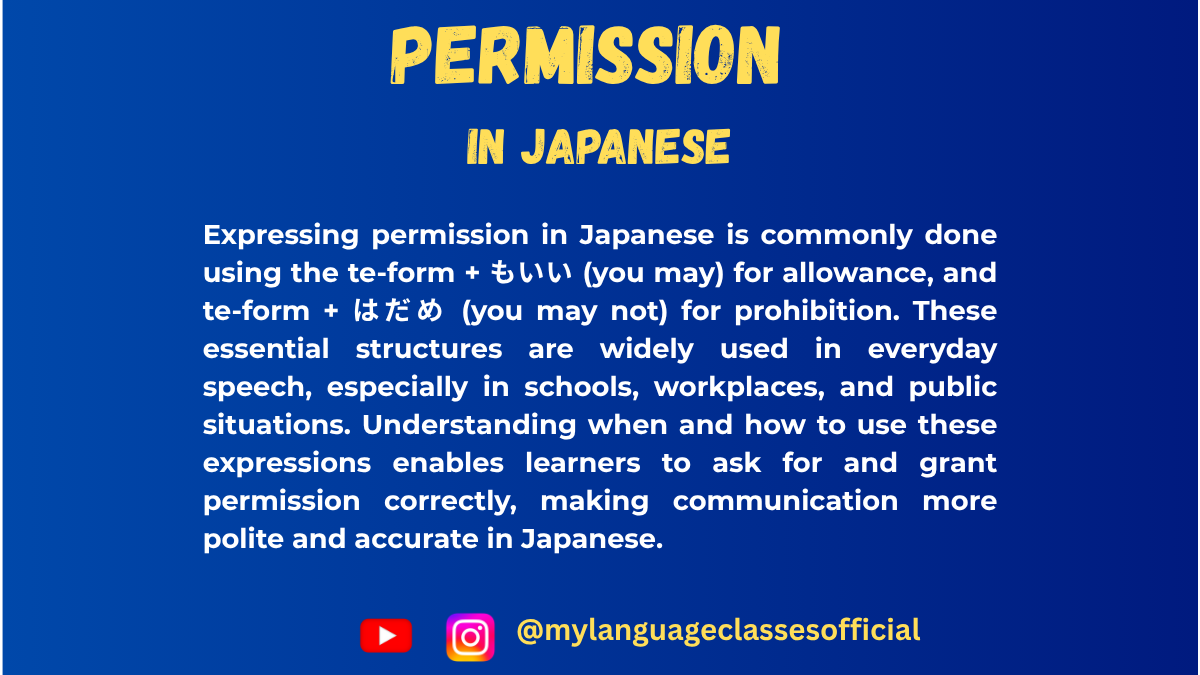
Understanding how to express obligation and permission is crucial when learning Japanese. These concepts allow you to navigate everyday situations, from asking for approval to understanding rules. In this blog, we’ll explore two essential structures: Verb te-form + もいい (“May”) and Verb te-form + はだめ (“Must not”).
1. Verb te-form + もいい: Expressing Permission (“May”)
The structure Verb te-form + もいい is used to ask for or give permission to do something. It translates to “May I…?” or “You may…” in English.
How It Works:
- Conjugate the verb into its te-form.
- Add もいい to grant or inquire about permission.
Examples:
- ここでたべてもいいですか?
(Koko de tabete mo ii desu ka?)
“May I eat here?” - はい、たべてもいいです。
(Hai, tabete mo ii desu.)
“Yes, you may eat.” - しゃしんをとってもいいです。
(Shashin o totte mo ii desu.)
“You may take a photo.”
Casual Form:
- ここにすわってもいい?
(Koko ni suwatte mo ii?)
“Can I sit here?”
2. Verb te-form + はだめ: Prohibiting Actions (“Must not”)
The structure Verb te-form + はだめ is used to express prohibition. It translates to “You must not…” in English.
How It Works:
- Conjugate the verb into its te-form.
- Add はだめ to indicate that an action is not allowed.
Examples:
- ここでたばこをすってはだめです。
(Koko de tabako o sutte wa dame desu.)
“You must not smoke here.” - さわってはだめです。
(Sawatte wa dame desu.)
“You must not touch.” - ここにゴミをすててはだめです。
(Koko ni gomi o sutete wa dame desu.)
“You must not throw trash here.”
Casual Form:
- ここでねてはだめ。
(Koko de nete wa dame.)
“You can’t sleep here.”
3. Combining Both Structures
These expressions often come in handy together when discussing what is allowed and what is prohibited. For example:
- このほんをよんでもいいですが、かえしてはだめです。
(Kono hon o yonde mo ii desu ga, kaeshite wa dame desu.)
“You may read this book, but you must not take it home.”
4. Cultural Notes
In Japan, these expressions are frequently used in formal and informal situations. Here are some important points to remember:
- When asking for permission, it’s polite to add ですか or いいですか to maintain politeness.
- はだめ is direct, so in formal situations, you might soften it with phrases like いけません (ikenai) for “not allowed.”
5. Practice Time
Try forming sentences using these structures:
- Ask if you can use your phone in class.
- Prohibit someone from running in the hallway.
- Give permission to drink coffee at your home.
Post your sentences in the comments, and I’ll correct them!
Mastering these grammar points will make you more confident in your Japanese conversations. Whether you’re asking for permission or ensuring you follow rules, these structures are indispensable for fluency.
Happy learning! 😊

Vikas Kumar is the founder of My Language Classes, a language learning platform dedicated to helping learners develop practical communication skills in Spanish, Japanese, and English through comprehensive grammar guides, structured learning resources, books, and evidence-informed educational content.
At My Language Classes, we believe that successful language learning is built on clarity, consistency, meaningful practice, and a deep understanding of how languages work. Every article is carefully researched and created to simplify complex concepts, provide practical guidance, and help learners develop confidence through real-world communication.
Inspired by the principles behind How Language Learning Really Works, our mission is to make high-quality language learning accessible to learners around the world by providing accurate, trustworthy, and comprehensive resources that support lasting progress, lifelong learning, and meaningful communication.
Leave a Reply