

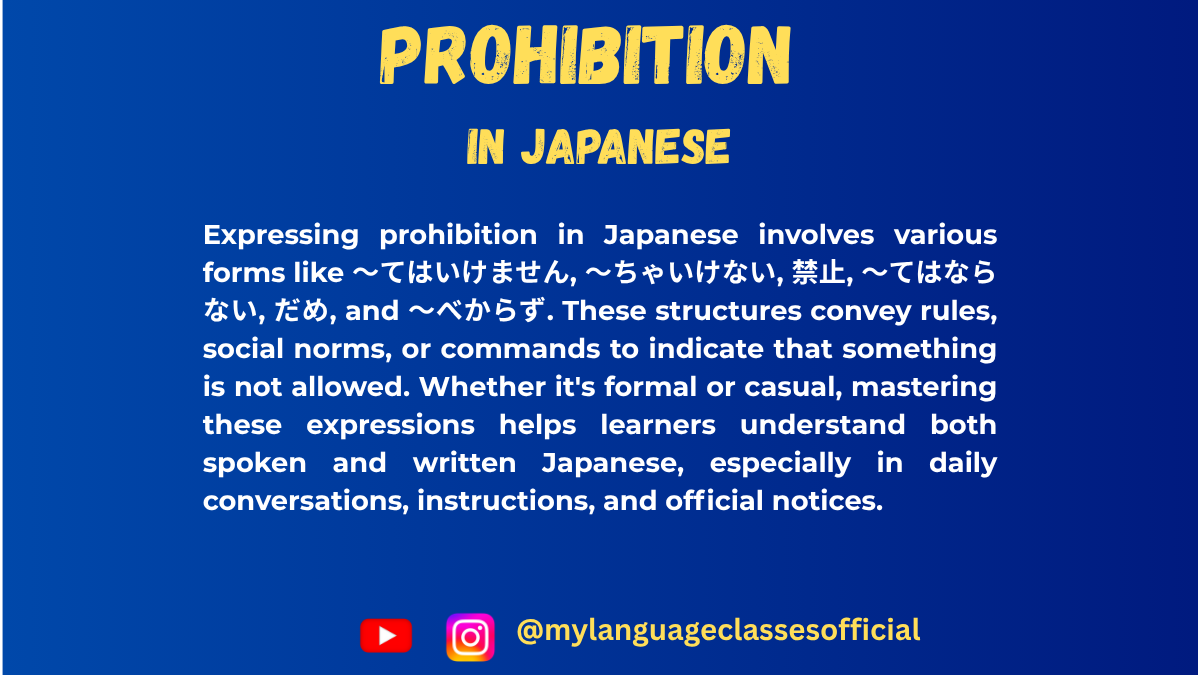
Expressing Prohibition in Japanese
If you’re learning Japanese, mastering how to express prohibition (saying what cannot or should not be done) is an essential step toward fluency. Japanese has a rich tapestry of expressions for prohibition, each carrying different nuances based on politeness levels, context, and the strength of the prohibition. In this blog, I’ll guide you through the most common ways to express prohibition in Japanese and help you understand when to use them.
1. ~てはいけません (Te wa ikemasen)
This is one of the most commonly used and polite ways to express prohibition in Japanese. It translates roughly to “You must not…” or “It’s not allowed to…”.
Formation:
Take the te-form of the verb and attach ~てはいけません.
Example:
- ここでたばこを吸ってはいけません。
(Koko de tabako o sutte wa ikemasen.)
“You must not smoke here.”
This phrase is often used in formal situations, such as school rules, workplace guidelines, or signs in public spaces.
2. ~ちゃダメ / ~ちゃいけない (Casual Forms)
In casual settings, Japanese speakers often use ~ちゃダメ or ~ちゃいけない to express prohibition. These are informal contractions of ~てはいけません.
Example:
- ここでゲームしちゃダメだよ。
(Koko de geemu shicha dame da yo.)
“You can’t play games here.” - あそこで走っちゃいけない。
(Asoko de hashiccha ikenai.)
“You must not run over there.”
Use these with close friends, family members, or peers, but avoid them in formal contexts.
3. 禁止 (Kinshi) – The Formal, Written Prohibition
When expressing prohibition in written form, especially on signs or official notices, the word 禁止 (kinshi, meaning “prohibited”) is frequently used.
Example:
- 飲酒禁止 (Inshu kinshi)
“Drinking alcohol is prohibited.” - 駐車禁止 (Chuusha kinshi)
“No parking.”
This construction is direct and impersonal, commonly used in public spaces to state clear rules.
4. ~てはならない (Te wa naranai)
This is a more formal and literary way of expressing prohibition. It is less common in daily conversation but can be seen in legal documents or formal writings.
Example:
- 嘘をついてはならない。
(Uso o tsuite wa naranai.)
“You must not tell lies.”
5. Use of だめ (Dame)
The word だめ (dame) itself means “no good,” “not allowed,” or “forbidden.” It’s highly versatile and can stand alone as an expression of prohibition.
Examples:
- それはだめです。 (Sore wa dame desu.)
“That’s not allowed.” - 今はだめ。 (Ima wa dame.)
“Not now.”
Depending on the tone and situation, だめ can range from strict to soft and conversational.
6. ~べからず (Bekarazu) – Traditional and Strict
This archaic phrase is rarely used in modern conversation but appears in traditional, formal, or poetic contexts.
Example:
- 立ち入りべからず。
(Tachiiri bekarazu.)
“No trespassing.”
It carries an old-fashioned and authoritative tone, reminiscent of samurai-era language.
Choosing the Right Expression
When deciding how to express prohibition in Japanese, consider the following factors:
- Formality: Use ~てはいけません for polite conversations and signs, and ~ちゃダメ for casual settings.
- Authority: Use 禁止 or ~てはならない for official or serious prohibitions.
- Audience: Adapt your language based on whether you’re speaking to a friend, a stranger, or a group.
Practice Makes Perfect!
Understanding prohibition in Japanese is only the first step; using it naturally requires practice. Try creating your own sentences using these structures, and pay attention to how native speakers use them in real life. The more you immerse yourself, the more intuitive these expressions will become.
So, what are you waiting for? Share your practice sentences in the comments, and let’s refine your skills together!
あなたはどの禁止表現をよく使いますか?コメントで教えてください!
(Anata wa dono kinshi hyougen o yoku tsukaimasu ka? Komento de oshiete kudasai!)
Which prohibition expression do you use most often? Let me know in the comments!
Happy learning! 😊

Vikas Kumar is the founder of My Language Classes, a language learning platform dedicated to helping learners develop practical communication skills in Spanish, Japanese, and English through comprehensive grammar guides, structured learning resources, books, and evidence-informed educational content.
At My Language Classes, we believe that successful language learning is built on clarity, consistency, meaningful practice, and a deep understanding of how languages work. Every article is carefully researched and created to simplify complex concepts, provide practical guidance, and help learners develop confidence through real-world communication.
Inspired by the principles behind How Language Learning Really Works, our mission is to make high-quality language learning accessible to learners around the world by providing accurate, trustworthy, and comprehensive resources that support lasting progress, lifelong learning, and meaningful communication.
Leave a Reply