
Possessive Pronouns in English: Master This Beginner Grammar With Examples and Exercises
Have you ever been confused by phrases like “That book is mine” or “Is this your bag?”? You’re not alone! Possessive pronouns in English can feel tricky at first, but once you understand how they work, they become one of the easiest and most powerful tools to show ownership, belonging, and relationships in a sentence.
In this guide, you’ll discover everything you need to know about possessive pronouns in English grammar. Whether you’re a beginner learning English or someone who wants to brush up your grammar skills, this article will walk you through what possessive pronouns are, when to use them, and how to avoid common mistakes. With clear examples, fun practice, and easy-to-follow rules, you’ll feel confident using them in no time!
Possessive pronouns are an essential part of everyday English. You hear them all the time—in conversations, books, movies, and even on signs. They help us show who owns what, without repeating the same noun over and over again. For example:
- This pen is mine.
- Is that your phone or hers?
- The house on the corner is ours.
As you can see, these tiny words carry a lot of meaning!
In this blog post, we’ll explore:
- The most common possessive pronouns
- How to use them naturally in real conversations
- Tricky grammar rules and exceptions to watch out for
- Simple exercises to test your understanding
By the end of this post, you’ll not only understand possessive pronouns—you’ll own them (pun intended)!
Ready to become a pro at possessive pronouns? Let’s dive in!
Common Expressions Using Possessive Pronouns in Real Life
To truly understand how possessive pronouns work, let’s look at how they appear in everyday English. These short words—like mine, yours, his, hers, ours, and theirs—help us talk about what belongs to whom, without repeating nouns.
Here are 10 real-life sentences using possessive pronouns in natural, clear, and practical ways:
- That backpack isn’t mine — I think it’s yours.
- Is this phone hers or yours?
- This jacket looks just like mine, but it’s actually his.
- These snacks are ours, not theirs.
- I lost my pen, so I used hers.
- That dog is not ours; it belongs to the neighbors.
- This seat is mine — I saved it earlier!
- The blue car is his, and the red one is mine.
- Your idea was great, but theirs worked better for the project.
- We brought our lunch, but they forgot theirs.
Why these sentences work:
- They use possessive pronouns to avoid repeating the nouns (phone, jacket, car, idea, etc.).
- They clearly show who owns what, helping the listener understand relationships and belongings easily.
Possessive pronouns are short, powerful, and super useful in making your sentences sound natural and fluent. The more you see and use them in real life, the easier they become!
When Do We Use Possessive Pronouns in English?
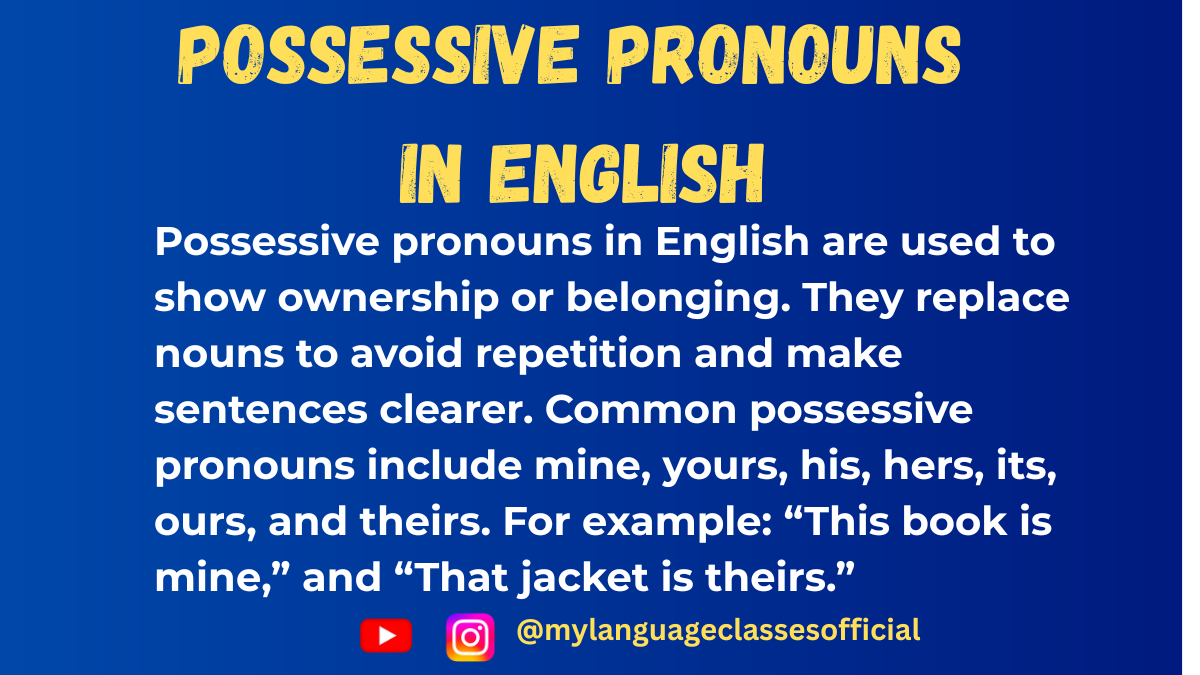
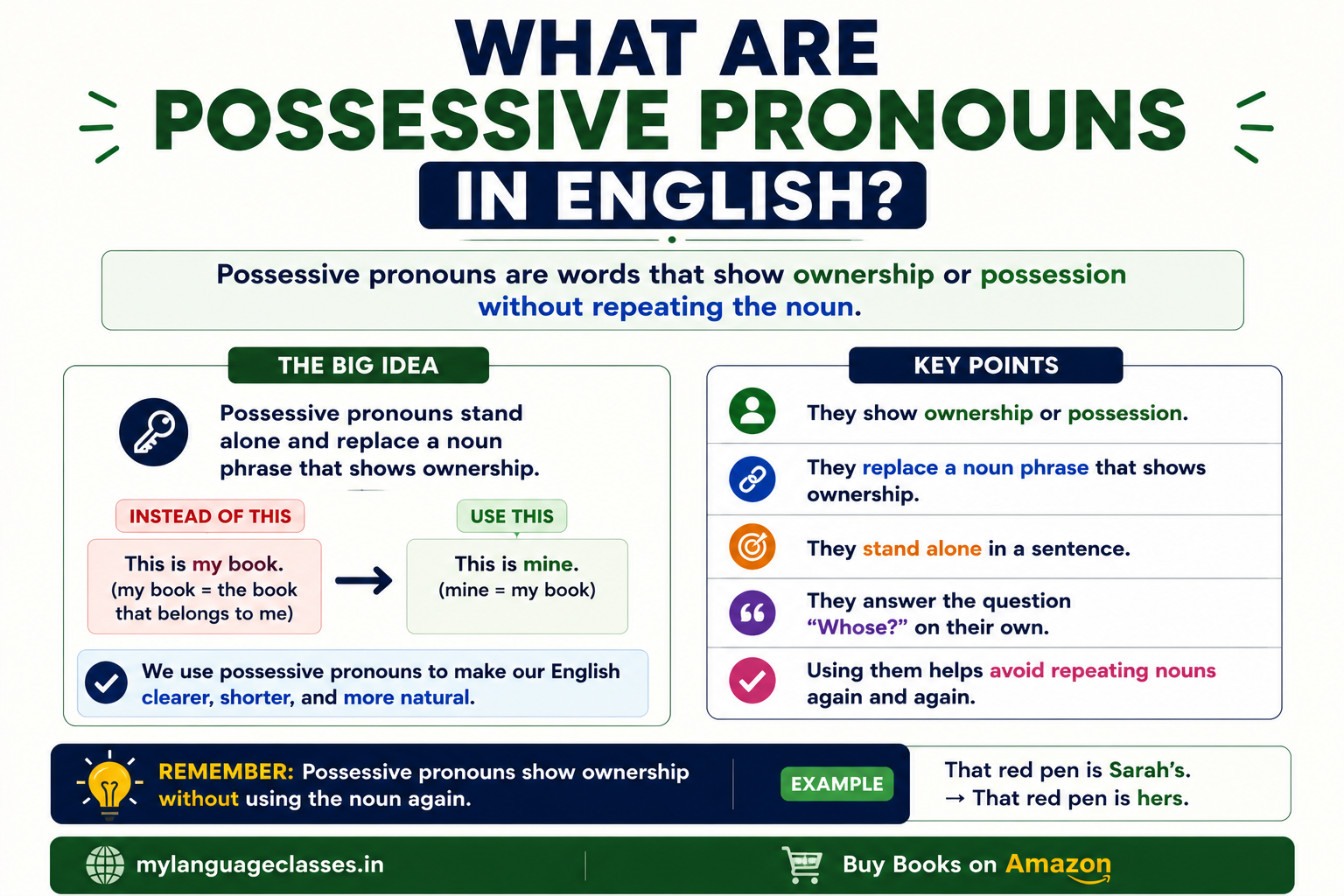
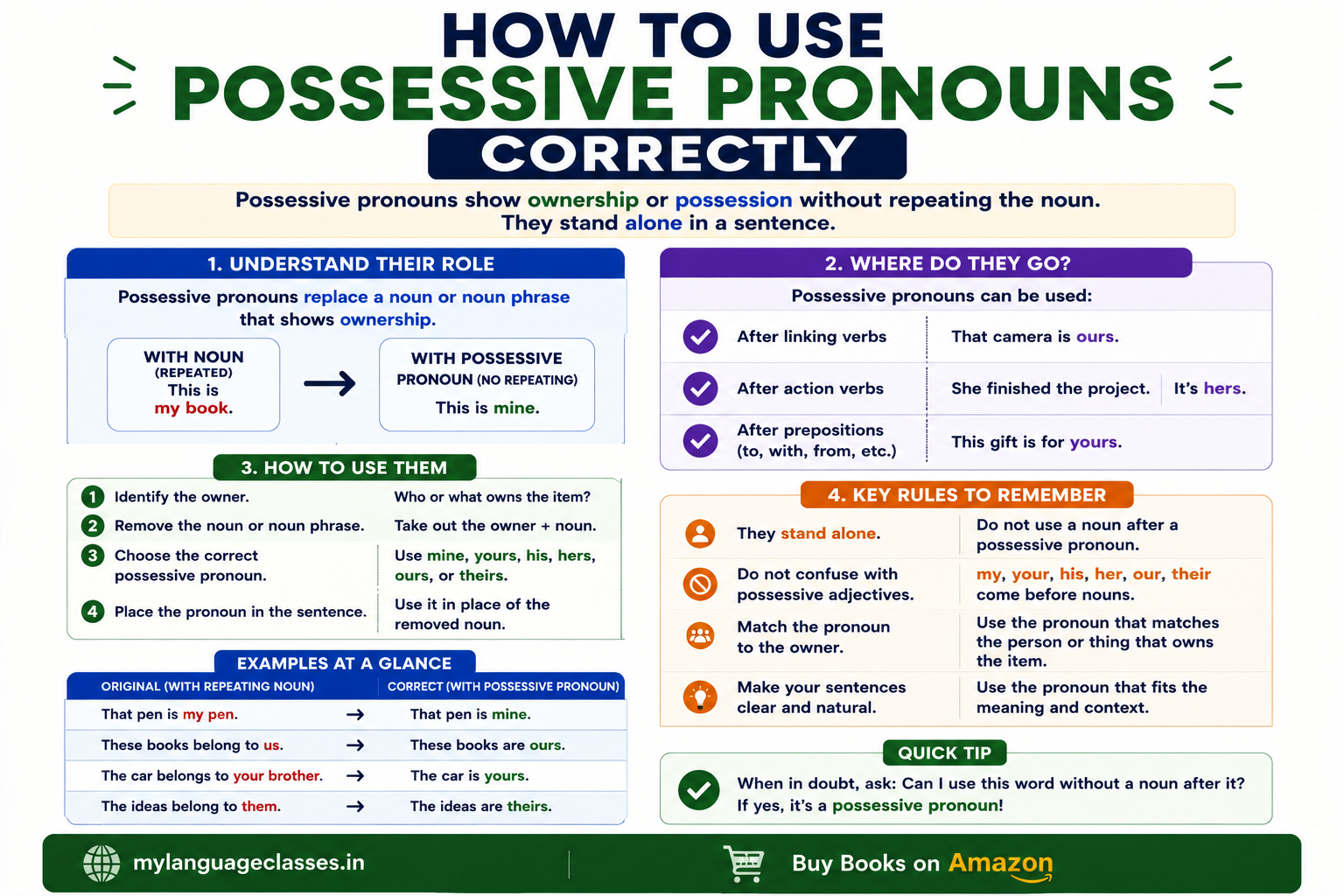
Possessive pronouns are used to show ownership or possession. They help us avoid repeating the same noun again and again. These pronouns take the place of nouns and help keep our sentences clear, short, and smooth.
Here are the main situations where we use possessive pronouns:
1. To Show Ownership Without Repeating the Noun
We use possessive pronouns to replace a noun already mentioned.
- This is my bag. That one is yours.
- (Instead of: That one is your bag.)
2. To Compare Belongings
They help us compare what belongs to different people.
- My room is bigger than his.
- Her phone is newer than mine.
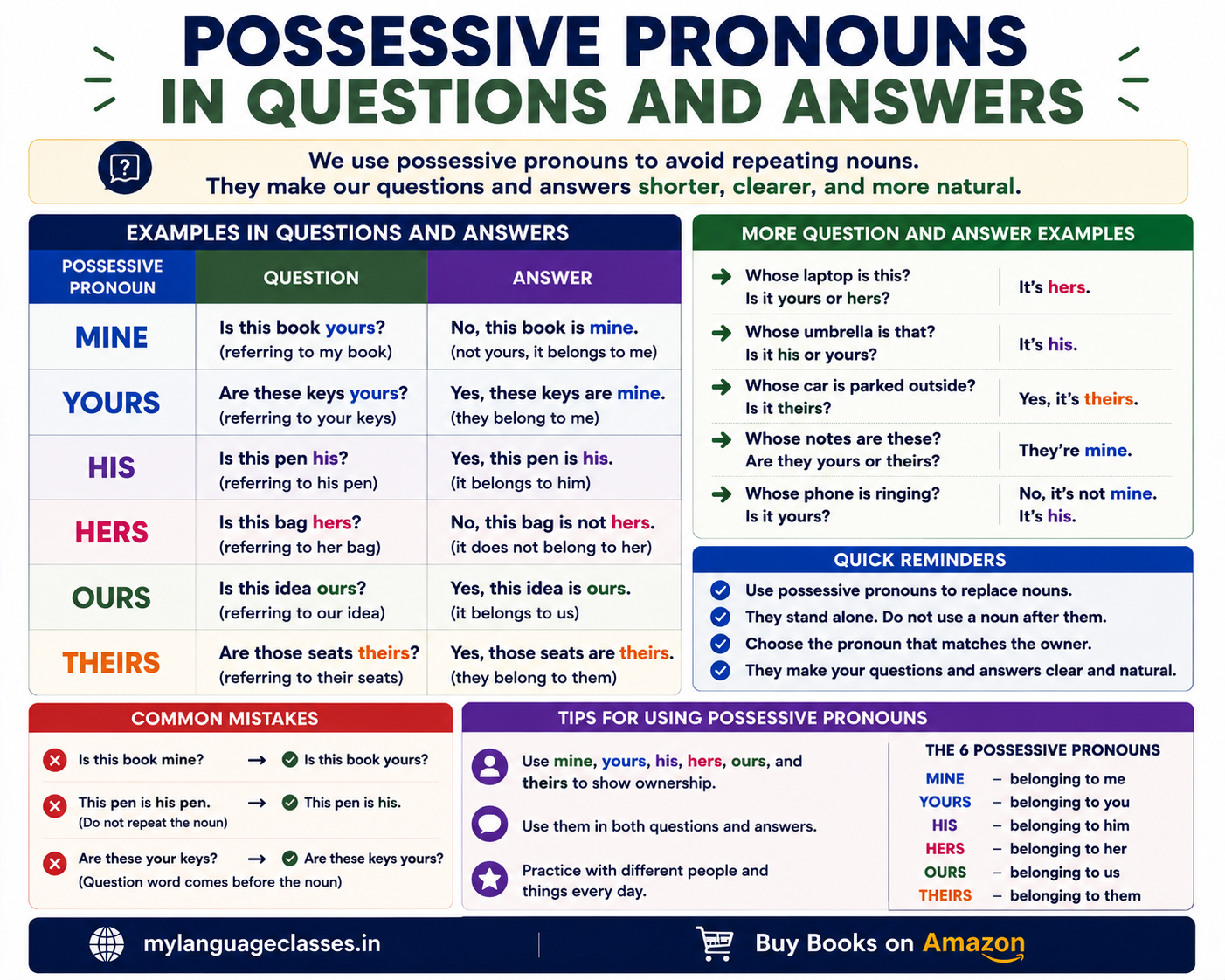
3. To Answer Questions About Ownership
When someone asks a question like “Whose is this?”, we answer using a possessive pronoun.
- Whose book is this?
It’s hers.
4. To Avoid Repeating the Same Word
When a noun has already been used or is clear from the context, we use possessive pronouns to keep things simple.
- I like your dog. Do you like mine?
- (No need to say: Do you like my dog?)
5. To Show Shared Belongings
Use possessive pronouns to talk about things owned together.
- This house is ours.
- The toys are theirs.
6. To End Sentences Naturally
Possessive pronouns often come at the end of sentences.
- That pen isn’t mine.
- Those shoes are hers.
7. With No Noun After
Remember: Possessive pronouns stand alone. They are not followed by a noun.
- ✔ That bag is mine.
- ❌ That bag is mine bag (Wrong!)
Understanding where and when to use possessive pronouns helps you speak and write with clarity and confidence. The more you use them in the right situations, the more natural your English will sound!
Possessive Pronouns: Conjugation Rules Made Simple
Unlike some other grammar forms in English, possessive pronouns do not change form based on tense, number, or gender of the person using them. This makes them super easy to learn and remember!
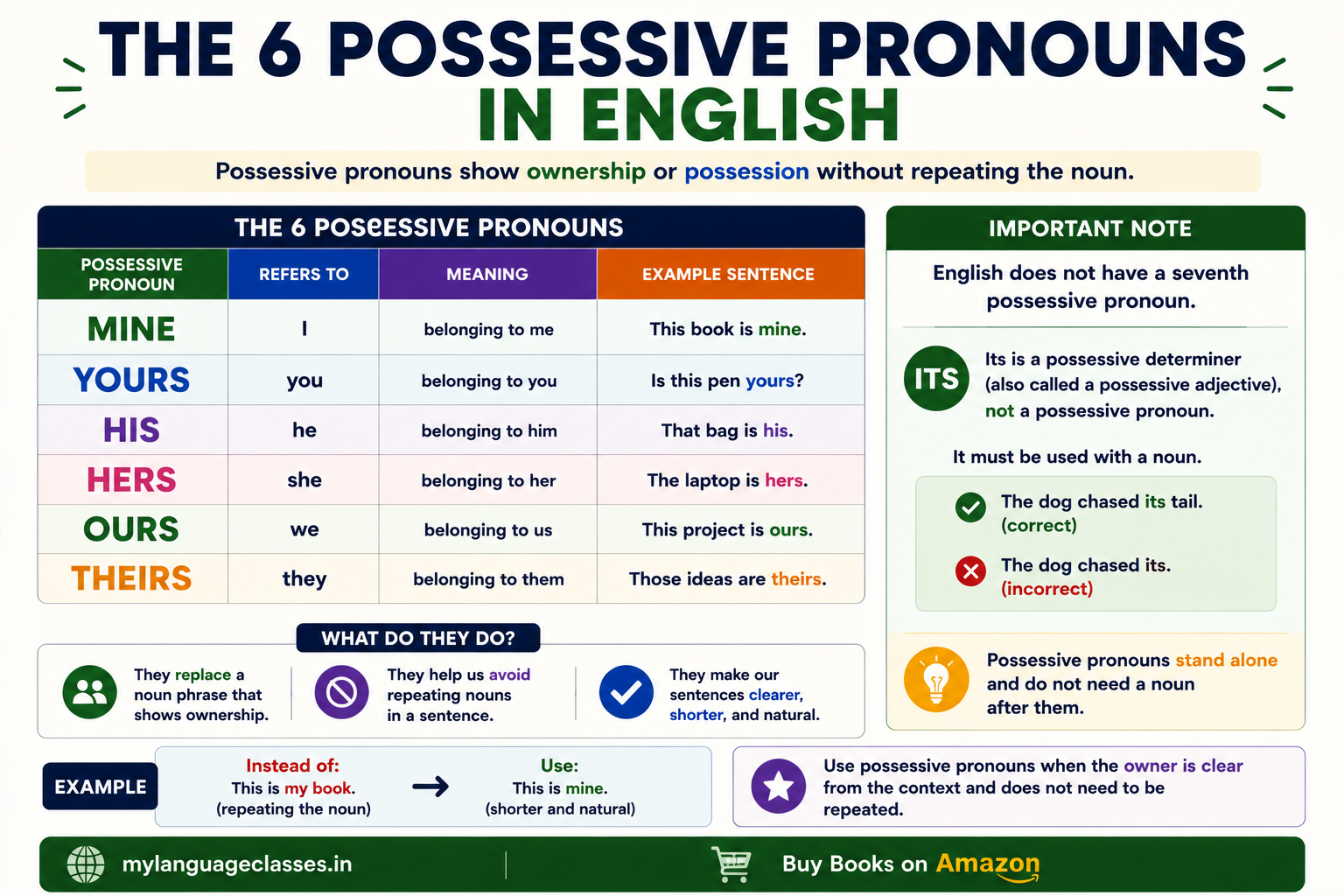
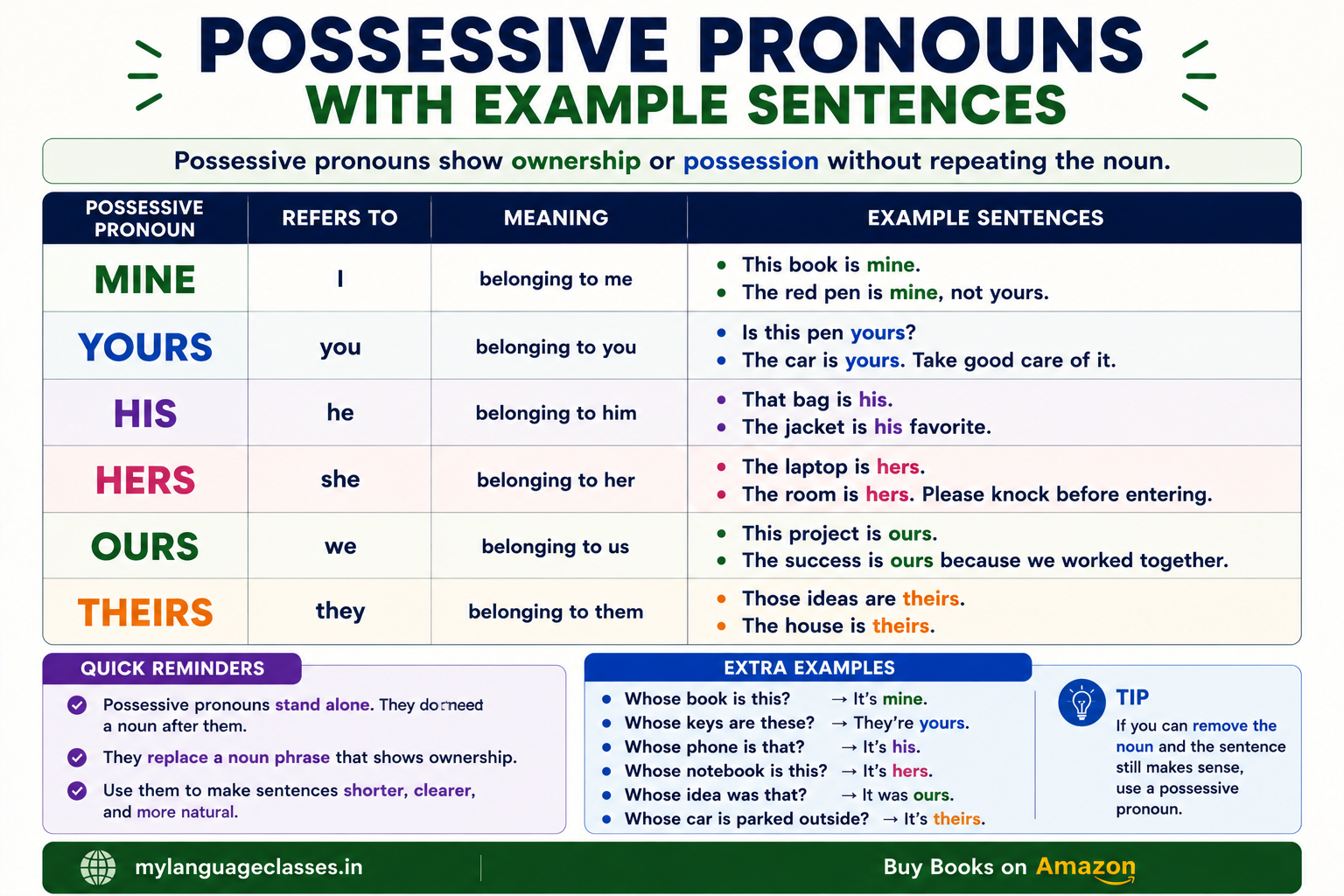
Here’s a simple chart that shows each subject pronoun and its matching possessive pronoun:
| Subject Pronoun | Possessive Pronoun | Example Sentence |
|---|---|---|
| I | mine | That pencil is mine. |
| You | yours | Is this notebook yours? |
| He | his | The shoes are his. |
| She | hers | That dress is hers. |
| It | its* | The dog wagged its tail. |
| We | ours | This house is ours. |
| They | theirs | Those bikes are theirs. |
Important Things to Know
- Possessive pronouns never use apostrophes.
✔ That book is hers.
❌ That book is her’s. - They stand alone. Unlike possessive adjectives (my, your, his), these pronouns do not come before a noun. They replace the noun completely.
- Its is the only one that often confuses learners.
Its is a possessive pronoun — not to be confused with “it’s” (it is).
Quick Tip to Remember:
Think of possessive pronouns as the words you use instead of repeating the thing someone owns.
- This bag is mine, not yours.
- (Instead of: This bag is my bag, not your bag.)
Possessive pronouns are fixed — they don’t change form. So once you learn them, you’re set for life!
Grammar Rules for Using Possessive Pronouns in English
Possessive pronouns follow simple and straightforward grammar rules, but they must be used correctly to avoid confusion. Here’s your go-to guide for understanding and using them with confidence and clarity.
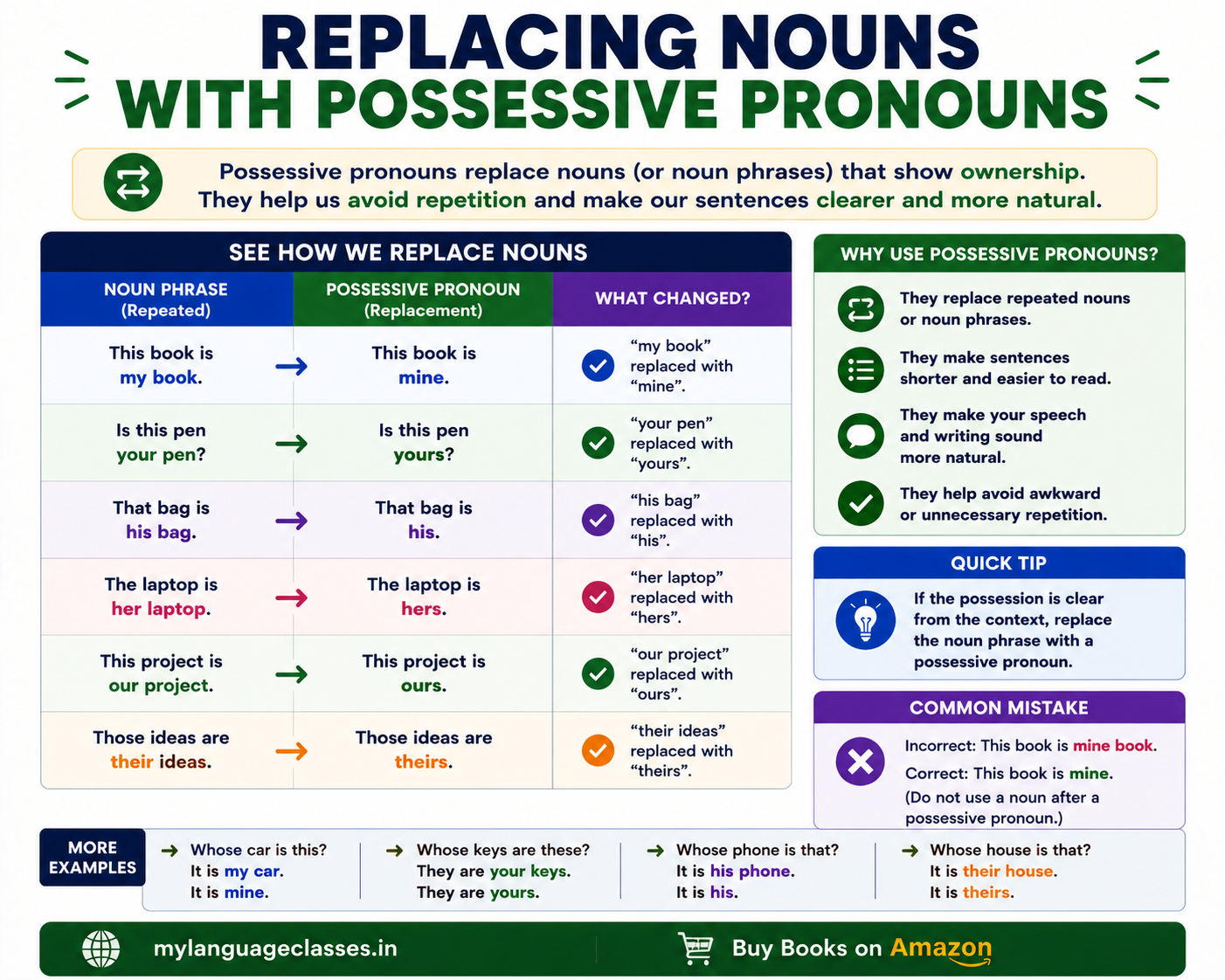
Rule 1: Possessive Pronouns Replace a Noun + Possessive Adjective
Possessive pronouns stand alone and replace the noun phrase (possessive adjective + noun).
- This is my book → This book is mine.
- That is your jacket → That jacket is yours.
Rule 2: They Never Come Before a Noun
Unlike possessive adjectives (my, your, his, her, etc.), possessive pronouns do not come before nouns.
- ✔ This bag is mine.
- ❌ This is mine bag. (Incorrect)
Rule 3: No Apostrophes — Ever!
Possessive pronouns never take an apostrophe. One of the most common mistakes is adding an apostrophe to “its,” which changes the meaning completely.
- ✔ The dog wagged its tail.
- ❌ The dog wagged it’s tail. (This means it is)
Rule 4: They Must Match the Subject in Person and Number
The possessive pronoun must agree with the owner — not the item being owned.
- This is her coat. That one is mine.
(Even though “coat” is the same in both, the owners are different.)
Rule 5: Can Be Used in Comparisons
Possessive pronouns help us compare ownership without repeating the noun.
- My phone is newer than yours.
- Their house is bigger than ours.
Rule 6: Often Appear at the End of Sentences
In natural speech and writing, possessive pronouns usually come at the end of a sentence or clause.
- Whose umbrella is this? It’s hers.
- I forgot my notebook, but I brought yours.
Rule 7: “Its” vs. “It’s” – Know the Difference
This is a grammar classic. Here’s how to remember it:
- Its = Possessive pronoun (ownership)
Example: The cat licked its paw. - It’s = It is (contraction)
Example: It’s raining outside.
Trick: Try replacing “it’s” with “it is” — if it works, you’re correct!
Mastering these rules makes your writing smoother, your speaking clearer, and your understanding of English stronger.
Things to Keep in Mind About Possessive Pronouns
Possessive pronouns may seem simple, but even native speakers sometimes get tripped up by small details. Here are the tricky points, exceptions, and important tips every learner should keep in mind.
1. “Its” vs. “It’s” – Don’t Confuse Them!
This is the most common mistake.
- Its = Belongs to it. (Possessive pronoun)
✔ The bird cleaned its feathers. - It’s = It is / It has. (Contraction)
✔ It’s going to rain soon.
❌ The bird cleaned it’s feathers. (WRONG)
Tip: If you can replace it with “it is” or “it has”, use “it’s.” Otherwise, it’s “its.”
2. Don’t Use Possessive Pronouns Before a Noun
This is another common issue. Possessive pronouns replace the noun — they don’t come before one.
- ✔ That car is mine.
- ❌ That is mine car.
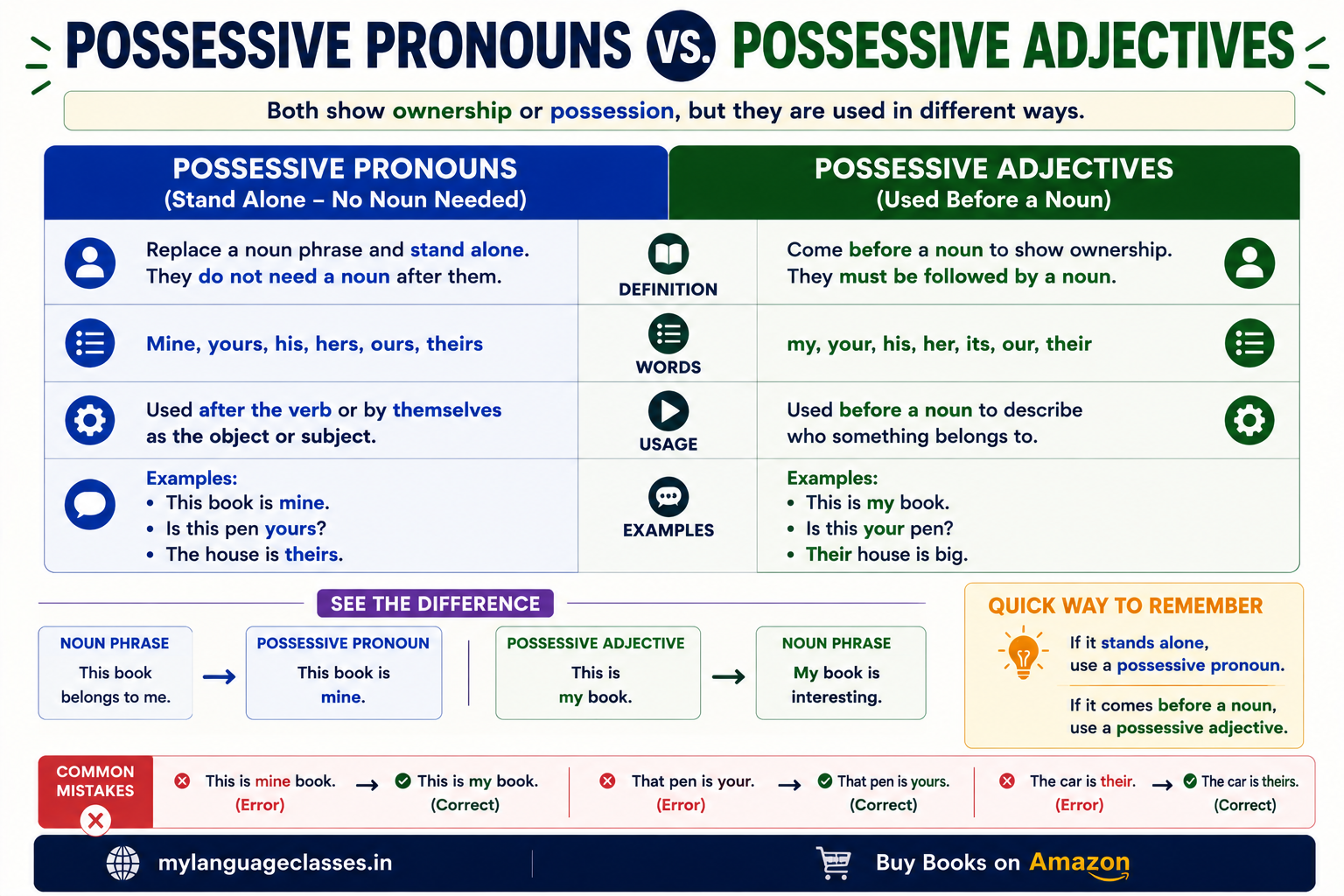
3. Don’t Confuse Possessive Pronouns with Possessive Adjectives
Here’s a quick side-by-side to clear it up:
| Possessive Adjective | Possessive Pronoun |
|---|---|
| my | mine |
| your | yours |
| his | his |
| her | hers |
| our | ours |
| their | theirs |
| its | its |
- This is my chair. That one is yours.
(NOT: That one is your.)
4. “Whose” Is a Different Word Entirely
“Whose” asks about possession, but it’s not a possessive pronoun.
- Whose coat is this? It’s hers.
- (Don’t say: It’s whose.)
5. Gender-Specific Forms: His / Hers
Remember that English uses gender for his and hers, but not for yours, ours, or theirs.
- That’s his lunchbox, not hers.
- This laptop is mine.
6. “Ours” and “Theirs” Show Shared Ownership
These pronouns are often used when talking about something shared by a group.
- This is our project → This project is ours.
- These books are theirs. (belonging to a group)
Quick Reminders:
- No apostrophes in possessive pronouns.
- Possessive pronouns do not need a noun after them.
- Always match the owner, not the object.
- They are never used with articles like the, a, or an.
Understanding these fine points helps you avoid mistakes and speak with clarity and confidence.
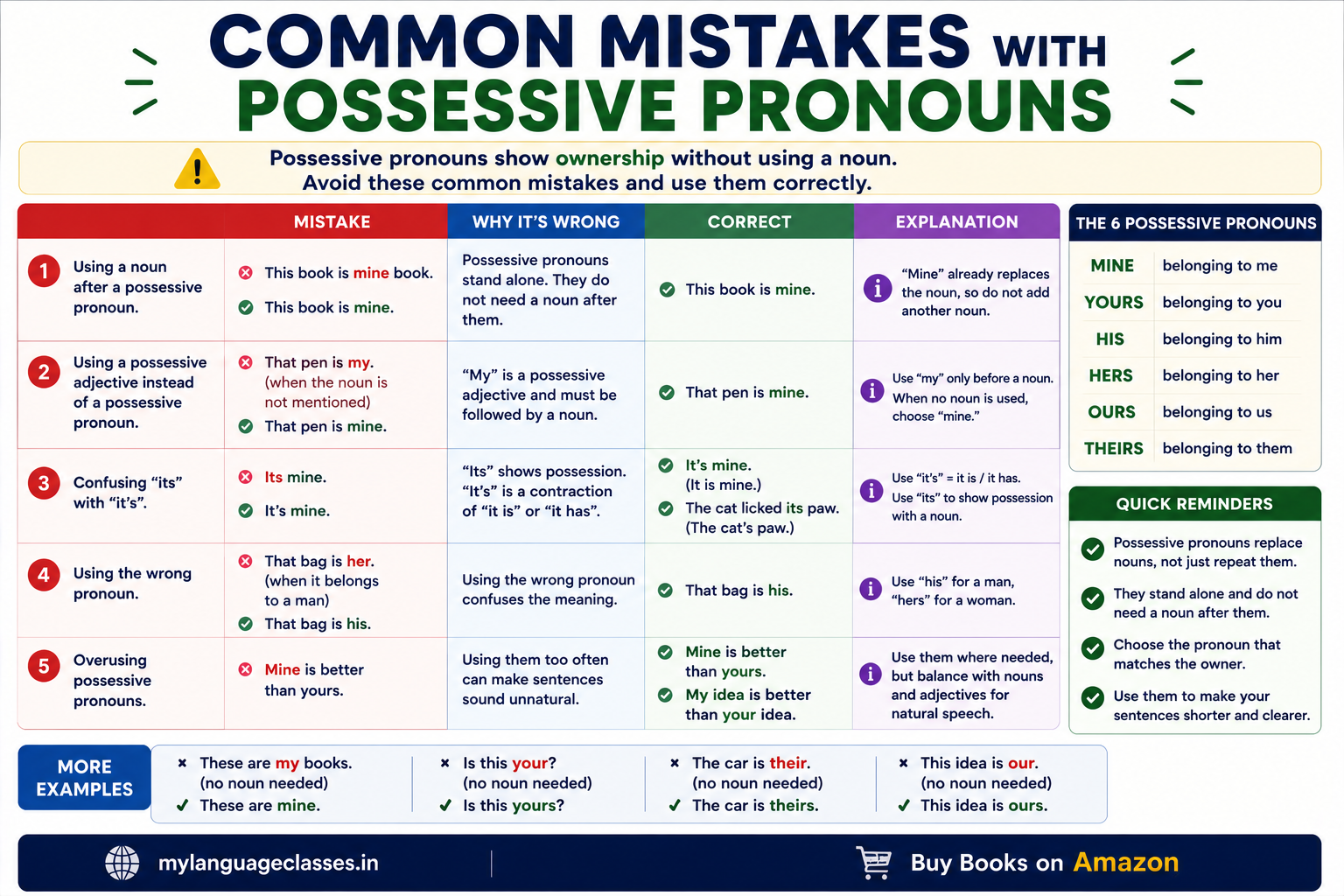
Common Mistakes with Possessive Pronouns (And How to Avoid Them)
Even experienced English learners can slip up with possessive pronouns. Let’s look at the top mistakes and learn how to correct them so you can avoid confusion and speak with more confidence.
Mistake 1: Using Apostrophes in Possessive Pronouns
Wrong: The cat licked it’s paw.
Right: The cat licked its paw.
Why it’s wrong: “It’s” means it is or it has. Possessive pronouns like its, hers, theirs, etc., never have apostrophes.
Mistake 2: Mixing Up Possessive Adjectives and Possessive Pronouns
Wrong: That book is your.
Right: That book is yours.
Tip: If there’s no noun after the word, use a possessive pronoun (yours, mine, ours). If there is a noun, use a possessive adjective (your, my, our).
Mistake 3: Putting a Noun After the Possessive Pronoun
Wrong: This is mine phone.
Right: This is my phone. / This phone is mine.
Fix it: Never put a noun directly after a possessive pronoun. They stand alone.
Mistake 4: Confusing “Whose” and “Who’s”
Wrong: Who’s shoes are these?
Right: Whose shoes are these?
Why it’s wrong: “Who’s” = Who is / “Whose” = Shows possession
Whose is related to possessive pronouns, but who’s is a contraction.
Mistake 5: Using the Wrong Pronoun with Gender
Wrong: That’s Sarah’s. Give it to his.
Right: That’s Sarah’s. Give it to her / hers.
Tip: Use his for boys/men, hers for girls/women. Stay consistent with the owner’s identity.
Mistake 6: Using “Them’s” or “Their’s” (Non-standard English)
Wrong: This toy is them’s.
Right: This toy is theirs.
Why it’s wrong: Words like “them’s” and “their’s” don’t exist in proper English. Stick with standard possessive pronouns.
How to Avoid These Mistakes
- Double-check the form: Is the noun still in the sentence? If not, use the pronoun form.
- Practice aloud: Speaking the correct sentences helps reinforce the right form.
- Read more English: Look out for possessive pronouns in books, shows, and conversations.
- Write your own examples: Replace noun phrases with possessive pronouns to test yourself.
20 Example Sentences Using Possessive Pronouns
These examples will show you how possessive pronouns like mine, yours, his, hers, ours, and theirs are used in real-life conversations. Try reading them out loud!
Personal Belongings
- That pencil case is mine, not yours.
- Is this water bottle yours or hers?
- The phone on the table is his.
- I brought my backpack, and he brought his.
- That bright red bike is ours!
Home and Family
- Our house is smaller than theirs.
- This garden used to be hers before she moved.
- We’ve cleaned our room; have they cleaned theirs?
- That baby stroller is theirs, I think.
- This comfy chair is mine—I sit here every morning!
School and Learning
- My homework is done. Is yours ready too?
- She forgot her textbook, but I still have mine.
- His answers were better than mine on the test.
- That notebook is hers; she left it on the desk.
- Our teacher said the best project was theirs.
Work and Other Daily Use
- I brought my lunch, but he forgot his.
- These files are yours; mine are already sorted.
- The seat by the window is mine—I always sit there.
- Is this charger yours?
- We each have our own lockers. That one is mine.
These examples cover a range of real-life contexts, from school to work to home. Notice how each possessive pronoun replaces a noun that’s already been mentioned or understood in the conversation.
Exercise: Fill in the Blanks with the Correct Possessive Pronoun
Choose the correct possessive pronoun to complete each sentence: mine, yours, his, hers, ours, theirs, or its.
Fill in the blanks:
- I lost my pen. Can I borrow ______?
- That phone is not ______. It belongs to Sarah.
- We built this treehouse together. It’s ______.
- My dog is smaller than ______.
- This book is ______. I wrote my name on the cover.
- These cookies are ______. We baked them this morning.
- Is this backpack ______ or someone else’s?
- My dress is blue, but ______ is red.
- That toy is broken. It lost ______ wheels.
- These jackets belong to the boys. They are ______.
- I know this car. It’s definitely ______.
- Jack has his keys. Do you have ______?
- She forgot her umbrella, but I have ______.
- This camera isn’t ______. I think it belongs to Tom.
- You brought your notebooks. Where are ______?
- Our house is cozy, but ______ is bigger.
- His voice is louder than ______.
- That bicycle isn’t hers; it’s ______.
- I’ll take my lunch, and you can take ______.
- This bird is feeding ______ chicks.
Answers: Fill in the Blanks with Possessive Pronouns
- I lost my pen. Can I borrow yours?
- That phone is not mine. It belongs to Sarah.
- We built this treehouse together. It’s ours.
- My dog is smaller than his.
- This book is mine. I wrote my name on the cover.
- These cookies are ours. We baked them this morning.
- Is this backpack yours or someone else’s?
- My dress is blue, but hers is red.
- That toy is broken. It lost its wheels.
- These jackets belong to the boys. They are theirs.
- I know this car. It’s definitely mine.
- Jack has his keys. Do you have yours?
- She forgot her umbrella, but I have mine.
- This camera isn’t mine. I think it belongs to Tom.
- You brought your notebooks. Where are theirs?
- Our house is cozy, but theirs is bigger.
- His voice is louder than mine.
- That bicycle isn’t hers; it’s mine.
- I’ll take my lunch, and you can take yours.
- This bird is feeding its chicks.
How did you do?
If you got most of them right, you’re on your way to mastering possessive pronouns! Don’t worry if you missed a few—just keep practicing and the rules will become second nature.
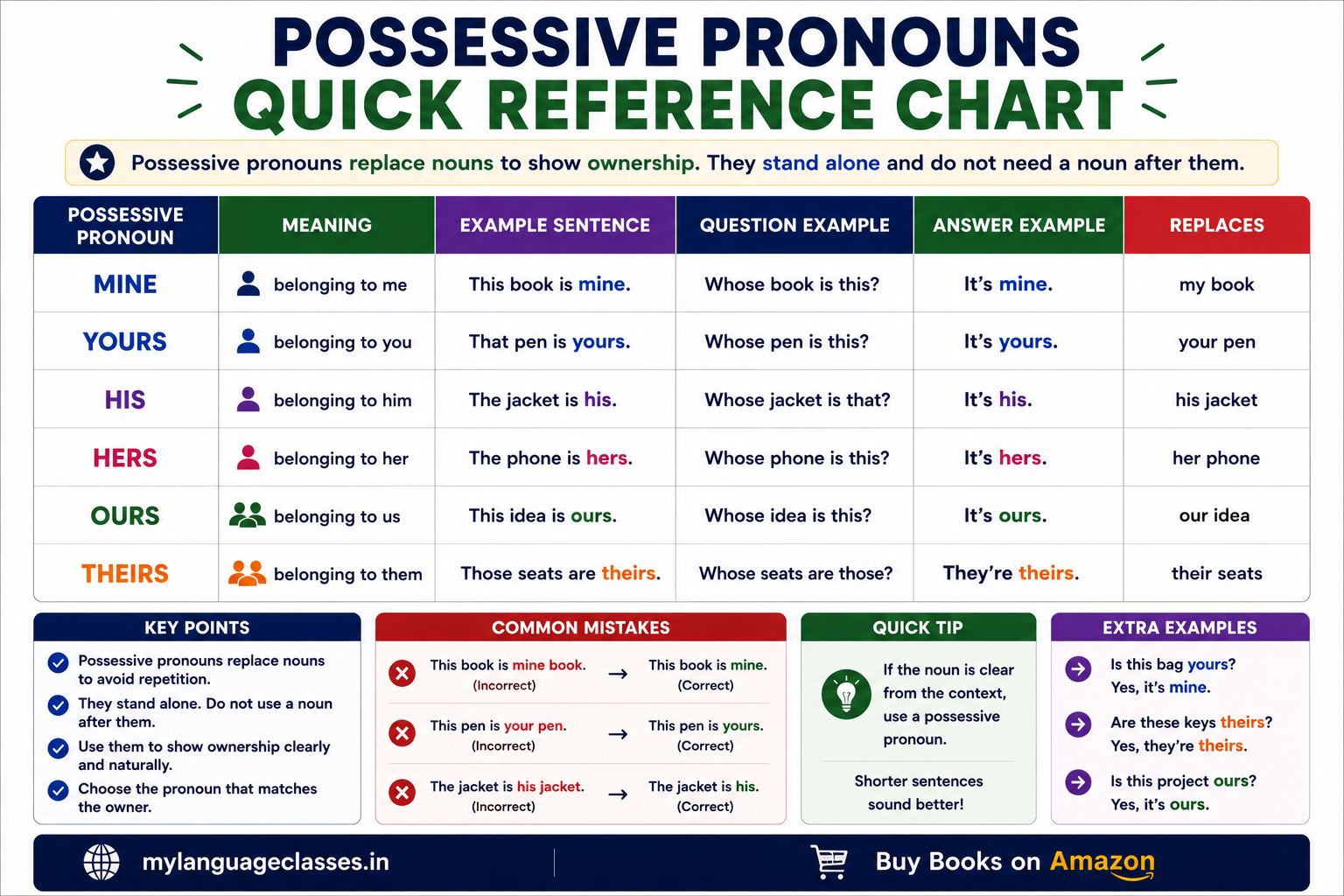
Summary of Key Points
- Possessive pronouns replace nouns to show ownership (mine, yours, his, hers, ours, theirs, its).
- They do not require a noun to follow them, unlike possessive adjectives (my, your, his, etc.).
- No apostrophes: possessive pronouns never use apostrophes (e.g., its, not it’s).
- They must match the owner, not the object. For example, This book is mine (not my).
- Common mistakes include confusing possessive pronouns with possessive adjectives and misusing apostrophes.
- Practice with real-world examples to reinforce how these pronouns work in daily life.
Conclusion: Master Possessive Pronouns for Better English
Possessive pronouns are essential to expressing ownership and making your sentences more natural and clear. Once you understand the basic rules and practice with real-life examples, you’ll feel more confident using them in your conversations and writing.

Vikas Kumar is the founder of My Language Classes, a language learning platform dedicated to helping learners develop practical communication skills in Spanish, Japanese, and English through comprehensive grammar guides, structured learning resources, books, and evidence-informed educational content.
At My Language Classes, we believe that successful language learning is built on clarity, consistency, meaningful practice, and a deep understanding of how languages work. Every article is carefully researched and created to simplify complex concepts, provide practical guidance, and help learners develop confidence through real-world communication.
Inspired by the principles behind How Language Learning Really Works, our mission is to make high-quality language learning accessible to learners around the world by providing accurate, trustworthy, and comprehensive resources that support lasting progress, lifelong learning, and meaningful communication.
Leave a Reply