

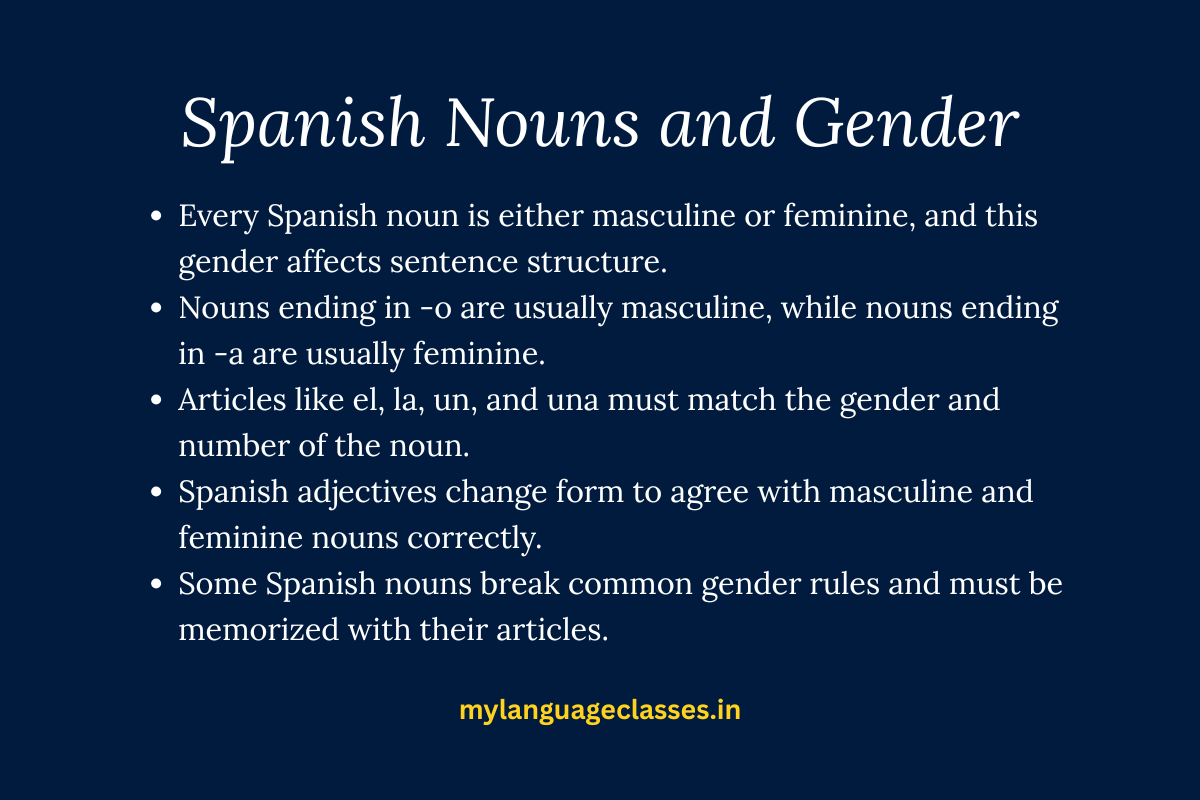
Spanish nouns and gender are one of the first grammar topics every learner must understand. Every Spanish noun is either masculine or feminine. This system affects articles, adjectives, and sentence structure. Unlike English, Spanish nouns always carry grammatical gender.
For example, el libro means “the book,” while la casa means “the house.” The article changes based on the gender of the noun. Masculine nouns usually use el, while feminine nouns usually use la.
Many Spanish nouns follow predictable patterns. Words ending in -o are often masculine. Words ending in -a are usually feminine. Still, there are important exceptions learners must memorize.
Spanish noun gender also affects adjectives. You say niño pequeño for “small boy” and niña pequeña for “small girl.” The adjective changes to match the noun.
Understanding Spanish nouns and gender improves sentence accuracy from the beginning. It also helps learners avoid common DELE A1 grammar mistakes. Learners who want structured grammar lessons on this topic often use Spanish DELE A1 Grammar Practice Book: Part 1: Nouns, Articles & Adjectives to practice noun agreement and article usage in detail.
What Are Spanish Nouns?
Definition of a Noun in Spanish
A noun is a word that names a person, place, thing, animal, or idea. Spanish nouns work similarly to English nouns, but they also have grammatical gender.
Examples:
| Spanish | English |
|---|---|
| libro | book |
| casa | house |
| perro | dog |
| ciudad | city |
In Spanish, every noun belongs to either the masculine or feminine category.
Examples:
| Spanish | English |
|---|---|
| el libro | the book |
| la casa | the house |
Types of Spanish Nouns
Spanish nouns can belong to different categories.
| Spanish Noun | Type | English Meaning |
|---|---|---|
| perro | Common noun | dog |
| Madrid | Proper noun | Madrid |
| mesa | Concrete noun | table |
| amor | Abstract noun | love |
Common nouns refer to general things. Proper nouns refer to names. Concrete nouns are physical objects. Abstract nouns express ideas or emotions.
What Is Gender in Spanish Grammar?
Masculine and Feminine Gender Explained
Spanish nouns and gender are closely connected. Every noun is masculine or feminine.
Masculine nouns usually use:
el
un
Feminine nouns usually use:
la
una
Examples:
| Spanish | English |
|---|---|
| el coche | the car |
| la ventana | the window |
| un amigo | a friend |
| una amiga | a female friend |
Gender affects many parts of Spanish grammar.
Biological Gender vs Grammatical Gender
Some nouns reflect biological gender.
Examples:
| Spanish | English |
|---|---|
| el hombre | the man |
| la mujer | the woman |
Other nouns have grammatical gender only.
Examples:
| Spanish | English |
|---|---|
| la silla | the chair |
| el problema | the problem |
A chair is not biologically female. The noun is simply feminine in Spanish grammar.
Why Gender Matters in Spanish Sentences
Spanish noun gender affects:
articles
adjectives
pronouns
sentence agreement
Examples:
| Spanish | English |
|---|---|
| El libro es interesante. | The book is interesting. |
| La casa es grande. | The house is big. |
Incorrect agreement creates grammar mistakes.
Incorrect:
La libro
Correct:
El libro
Masculine Nouns in Spanish
Common Masculine Noun Endings
Many masculine nouns follow common endings.
| Ending | Example | English Meaning |
|---|---|---|
| -o | libro | book |
| -ma | problema | problem |
| -or | color | color |
| -aje | viaje | trip |
| -ambre | hambre | hunger |
Most nouns ending in -o are masculine.
Examples:
el libro
el perro
el vaso
Many nouns ending in -ma are also masculine because of Greek origin.
Examples:
el sistema
el programa
el idioma
Masculine Nouns for Male People and Animals
Male people and animals usually use masculine nouns.
Examples:
| Spanish | English |
|---|---|
| el profesor | the male teacher |
| el hermano | the brother |
| el gato | the male cat |
These nouns often change form for feminine versions.
Examples:
| Masculine | Feminine |
|---|---|
| profesor | profesora |
| gato | gata |
Masculine Nouns With Irregular Endings
Some masculine nouns do not end in -o.
Examples:
| Spanish | English |
|---|---|
| el lápiz | the pencil |
| el hotel | the hotel |
| el árbol | the tree |
| el color | the color |
Learners should memorize these nouns with their articles.
Common Masculine Nouns Beginners Should Memorize
| Spanish Noun | English Meaning | Example Sentence | English Translation |
|---|---|---|---|
| el libro | book | El libro es nuevo. | The book is new. |
| el coche | car | El coche es rojo. | The car is red. |
| el amigo | male friend | Mi amigo vive aquí. | My friend lives here. |
| el perro | dog | El perro duerme. | The dog sleeps. |
| el problema | problem | El problema es difícil. | The problem is difficult. |
Feminine Nouns in Spanish
Common Feminine Noun Endings
Many feminine nouns follow predictable endings.
| Ending | Example | English Meaning |
|---|---|---|
| -a | casa | house |
| -ción | canción | song |
| -sión | televisión | television |
| -dad | ciudad | city |
| -tad | libertad | freedom |
| -ie | serie | series |
Most nouns ending in -a are feminine.
Examples:
la mesa
la puerta
la ventana
Nouns ending in -ción and -dad are almost always feminine.
Feminine Nouns for Female People and Animals
Female people and animals usually use feminine nouns.
Examples:
| Spanish | English |
|---|---|
| la profesora | the female teacher |
| la hermana | the sister |
| la gata | the female cat |
The noun ending often changes from -o to -a.
Feminine Nouns With Irregular Endings
Some feminine nouns do not end in -a.
Examples:
| Spanish | English |
|---|---|
| la mano | the hand |
| la flor | the flower |
| la imagen | the image |
These nouns are important exceptions.
Common Feminine Nouns Beginners Should Memorize
| Spanish Noun | English Meaning | Example Sentence | English Translation |
|---|---|---|---|
| la casa | house | La casa es grande. | The house is big. |
| la mesa | table | La mesa está limpia. | The table is clean. |
| la ciudad | city | La ciudad es bonita. | The city is beautiful. |
| la mano | hand | La mano está fría. | The hand is cold. |
| la mujer | woman | La mujer trabaja aquí. | The woman works here. |
Spanish Articles and Gender Agreement
Definite Articles in Spanish
Spanish definite articles mean “the.”
| Article | Gender | Number | Example |
|---|---|---|---|
| el | Masculine | Singular | el libro |
| la | Feminine | Singular | la mesa |
| los | Masculine | Plural | los libros |
| las | Feminine | Plural | las mesas |
Indefinite Articles in Spanish
Spanish indefinite articles mean “a” or “some.”
| Article | Gender | Number | Example |
|---|---|---|---|
| un | Masculine | Singular | un perro |
| una | Feminine | Singular | una casa |
| unos | Masculine | Plural | unos libros |
| unas | Feminine | Plural | unas mesas |
How Articles Change With Gender
Articles must match noun gender and number.
| Singular | Plural | English |
|---|---|---|
| el libro | los libros | the book / the books |
| la casa | las casas | the house / the houses |
Common Mistakes With Articles
Many beginners confuse masculine and feminine articles.
Incorrect:
la problema
Correct:
el problema
Incorrect:
el mano
Correct:
la mano
Many learners improve article agreement using Mastering Spanish Grammar for DELE A1, especially when practicing noun patterns and sentence agreement together.
Adjective Agreement With Spanish Nouns
How Adjectives Change in Spanish
Spanish adjectives must match nouns in gender and number.
Examples:
| Spanish | English |
|---|---|
| niño alto | tall boy |
| niña alta | tall girl |
Plural forms also change.
Examples:
| Spanish | English |
|---|---|
| niños altos | tall boys |
| niñas altas | tall girls |
Masculine and Feminine Adjective Forms
| Masculine | Feminine | English Meaning |
|---|---|---|
| bonito | bonita | pretty |
| pequeño | pequeña | small |
| alto | alta | tall |
| nuevo | nueva | new |
Examples:
| Spanish | English |
|---|---|
| La casa nueva | The new house |
| El coche nuevo | The new car |
Adjectives That Do Not Change
Some adjectives stay the same for masculine and feminine nouns.
Examples:
| Spanish | English |
|---|---|
| El libro es interesante. | The book is interesting. |
| La película es interesante. | The movie is interesting. |
Common unchanged adjective endings:
-e
-consonants
Examples:
difícil
fácil
popular
Common Rules for Identifying Gender in Spanish
Nouns Ending in -O Are Usually Masculine
Most nouns ending in -o are masculine.
Examples:
el libro
el vaso
el zapato
Important exceptions exist.
Example:
la mano
Nouns Ending in -A Are Usually Feminine
Most nouns ending in -a are feminine.
Examples:
la casa
la escuela
la silla
Some exceptions are masculine.
Examples:
el día
el mapa
Important Gender Exceptions Beginners Must Learn
| Noun | Gender | English |
|---|---|---|
| el día | Masculine | the day |
| el mapa | Masculine | the map |
| el problema | Masculine | the problem |
| la mano | Feminine | the hand |
| la foto | Feminine | the photo |
Memorizing exceptions is essential for accurate Spanish grammar.
Special Cases in Spanish Noun Gender
Nouns With Different Meanings Based on Gender
Some nouns change meaning depending on gender.
| Spanish | English |
|---|---|
| el capital | money |
| la capital | capital city |
Another example:
| Spanish | English |
|---|---|
| el cura | priest |
| la cura | cure |
Nouns With the Same Form for Both Genders
Some nouns use the same form for masculine and feminine.
Examples:
| Spanish | English |
|---|---|
| el estudiante | the male student |
| la estudiante | the female student |
Only the article changes.
Nouns Beginning With Stressed “A”
Some feminine nouns use el in singular form for pronunciation reasons.
Examples:
el agua
el águila
These nouns are still feminine.
Examples:
| Spanish | English |
|---|---|
| el agua fría | the cold water |
| las aguas frías | the cold waters |
The adjective remains feminine.
Singular and Plural Forms of Spanish Nouns
How to Form Plurals
Most nouns form plurals by adding -s or -es.
| Singular | Plural | English |
|---|---|---|
| libro | libros | books |
| casa | casas | houses |
| papel | papeles | papers |
| ciudad | ciudades | cities |
Gender and Plural Agreement Together
Articles and adjectives must also match plural nouns.
Examples:
| Spanish | English |
|---|---|
| los libros nuevos | the new books |
| las casas blancas | the white houses |
This agreement is essential in Spanish sentence structure.
Most Common Mistakes With Spanish Noun Gender
Translating Directly From English
English nouns do not have grammatical gender. Many learners incorrectly guess Spanish gender based on English patterns.
Incorrect:
el leche
Correct:
la leche
Memorizing Words Without Articles
Learners should memorize nouns with articles.
Correct learning method:
el libro
la mesa
el coche
This method improves accuracy quickly.
Ignoring Adjective Agreement
Incorrect:
la casa bonito
Correct:
la casa bonita
Incorrect adjective agreement is very common at the beginner level.
Tips to Remember Spanish Noun Gender Easily
Learn Nouns With Articles Together
Always memorize nouns with their article.
Learn:
la ciudad
Not:
ciudad
Group Words by Ending Patterns
Grouping nouns by endings improves memory.
Examples:
-ción words are usually feminine
-ma words are often masculine
Read Simple Spanish Daily
Reading simple Spanish texts helps learners notice noun patterns naturally. Structured beginner materials like The Complete Spanish DELE A1 Package for Beginners (7 book series) help learners see noun gender repeatedly in grammar, vocabulary, and reading contexts.
Key Takeaways
Every Spanish noun has grammatical gender.
Masculine nouns usually use:
el
un
Feminine nouns usually use:
la
una
Noun endings often help identify gender.
Articles and adjectives must agree with nouns.
Some nouns follow irregular gender patterns.
Memorizing nouns with articles improves accuracy.
Gender agreement is essential for DELE A1 Spanish grammar.
Spanish Vocabulary for Nouns and Gender
| Spanish Word | English Meaning | Example Sentence | English Translation |
|---|---|---|---|
| el libro | book | El libro es interesante. | The book is interesting. |
| la casa | house | La casa es pequeña. | The house is small. |
| el coche | car | El coche es rápido. | The car is fast. |
| la mesa | table | La mesa está limpia. | The table is clean. |
| el problema | problem | El problema es difícil. | The problem is difficult. |
| la mano | hand | La mano está fría. | The hand is cold. |
| el estudiante | student | El estudiante estudia mucho. | The student studies a lot. |
| la estudiante | female student | La estudiante lee un libro. | The student reads a book. |
| el perro | dog | El perro duerme. | The dog sleeps. |
| la gata | female cat | La gata come pescado. | The female cat eats fish. |
| el día | day | El día es largo. | The day is long. |
| la ciudad | city | La ciudad es bonita. | The city is beautiful. |
| el árbol | tree | El árbol es alto. | The tree is tall. |
| la flor | flower | La flor es roja. | The flower is red. |
| el agua | water | El agua está fría. | The water is cold. |
| la foto | photo | La foto es vieja. | The photo is old. |
| el amigo | male friend | Mi amigo trabaja aquí. | My friend works here. |
| la amiga | female friend | Mi amiga vive en Madrid. | My friend lives in Madrid. |
| el hotel | hotel | El hotel es moderno. | The hotel is modern. |
| la canción | song | La canción es famosa. | The song is famous. |
Conclusion
Spanish nouns and gender are essential parts of Spanish grammar. Every noun belongs to either the masculine or feminine category. This system affects articles, adjectives, and sentence agreement.
Most noun endings follow predictable patterns, but learners must also memorize common exceptions. Understanding these rules improves accuracy in both writing and speaking.
Strong control of Spanish nouns and gender is especially important for DELE A1 learners. Consistent reading, vocabulary review, and article practice help learners recognize gender patterns naturally over time.

Vikas Kumar is the founder of My Language Classes, a language learning platform dedicated to helping learners develop practical communication skills in Spanish, Japanese, and English through comprehensive grammar guides, structured learning resources, books, and evidence-informed educational content.
At My Language Classes, we believe that successful language learning is built on clarity, consistency, meaningful practice, and a deep understanding of how languages work. Every article is carefully researched and created to simplify complex concepts, provide practical guidance, and help learners develop confidence through real-world communication.
Inspired by the principles behind How Language Learning Really Works, our mission is to make high-quality language learning accessible to learners around the world by providing accurate, trustworthy, and comprehensive resources that support lasting progress, lifelong learning, and meaningful communication.
Leave a Reply