

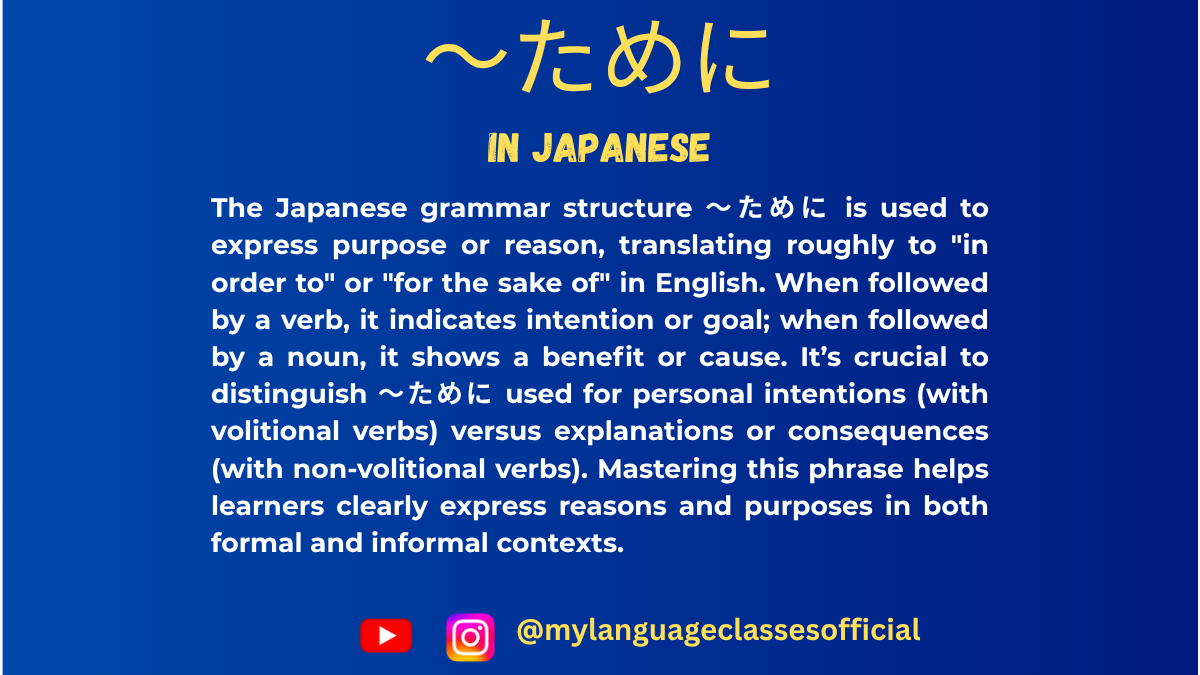
Understanding 〜ために in Japanese
In Japanese, “〜ために” (tame ni) is a highly versatile grammatical structure used to indicate purpose, reason, or benefit. Understanding its different meanings and contexts is crucial for mastering the Japanese language.
This article will explain all the possible uses of “ために” along with example sentences and a list of situations where it is commonly used.
**1. Expressing Purpose (目的)
The most common use of “ために” is to express purpose or intention. In this case, it is used with dictionary form verbs or nouns.**
Structure:
- Verb (dictionary form) + ために
- Noun + の + ために
Examples:
- 体重を減らすために歩いています。 (I walk in order to lose weight.)
- 簡単な日本語を勉強するためにこのアプリを使う。 (I use this app to study simple Japanese.)
- 健康のために毎日ヨガをしています。 (For my health, I do yoga every day.)
Note:
- “ために” is used for intentional actions performed by someone with a goal in mind.
2. Expressing Reason or Cause (原因)
“ために” can also be used to express a reason or cause for a particular event, similar to “because of” in English.
Structure:
- Verb (plain past form) + ために
- Noun + の + ために
Examples:
- 天気が悪かったためにゲームが中止された。 (Because of bad weather, the game was canceled.)
- 病気のために休んだ。 (I took a break because of illness.)
- 仕事が大変だったためにとても疲れています。 (Because work was difficult, I am very tired.)
Note:
- In this case, the outcome is not controlled by the speaker and is often negative.
3. Expressing Benefit or Effect (利益)
Another meaning of “ために” is to indicate the benefit or positive effect of something.
Structure:
- Noun + の + ために
Examples:
- 子供のために私たちは最良の教育を提供したい。 (For the benefit of children, we want to provide the best education.)
- 世界のために安全な環境を作りましょう。 (For the benefit of the world, let’s create a safe environment.)
Note:
- This use of “ために” is often found in formal speech, policies, and slogans.
4. “ために” vs. “ように” (Comparison)
Both “ために” and “ように” express purpose, but they have different uses:
| Phrase | Used with | Meaning |
|---|---|---|
| ために | Dictionary-form verbs (intentional) | Purpose (the subject can control the action) |
| ように | Potential-form verbs or non-intentional actions | Purpose (the subject cannot directly control the action) |
Examples:
- ために: 体重を減らすために歩いています。 (I walk in order to lose weight.)
- ように: 日本語を話せるように勉強している。 (I study so that I can speak Japanese.)
Key difference: “ために” is used when the subject can control the outcome, while “ように” is used for situations where the outcome depends on ability or an external factor.
Situations Where 〜ために is Used
| Situation | Example |
| Expressing Purpose | 旅行するためにお金を貯めています。 |
| Expressing Reason | 天気が悪かったためにコンサートが中止された。 |
| Expressing Benefit | 社会のために活動しています。 |
Conclusion
The structure “ために” is an essential part of Japanese grammar, used to express purpose, reason, and benefit. Mastering its different uses will greatly improve your ability to form complex and meaningful sentences in Japanese.
Understanding the differences between “ために” and similar expressions like “ように” will help you sound more natural in Japanese conversations. Keep practicing and using “ために” in different contexts!
Happy learning! 😊

Vikas Kumar is the founder of My Language Classes, a language learning platform dedicated to helping learners develop practical communication skills in Spanish, Japanese, and English through comprehensive grammar guides, structured learning resources, books, and evidence-informed educational content.
At My Language Classes, we believe that successful language learning is built on clarity, consistency, meaningful practice, and a deep understanding of how languages work. Every article is carefully researched and created to simplify complex concepts, provide practical guidance, and help learners develop confidence through real-world communication.
Inspired by the principles behind How Language Learning Really Works, our mission is to make high-quality language learning accessible to learners around the world by providing accurate, trustworthy, and comprehensive resources that support lasting progress, lifelong learning, and meaningful communication.
Leave a Reply