

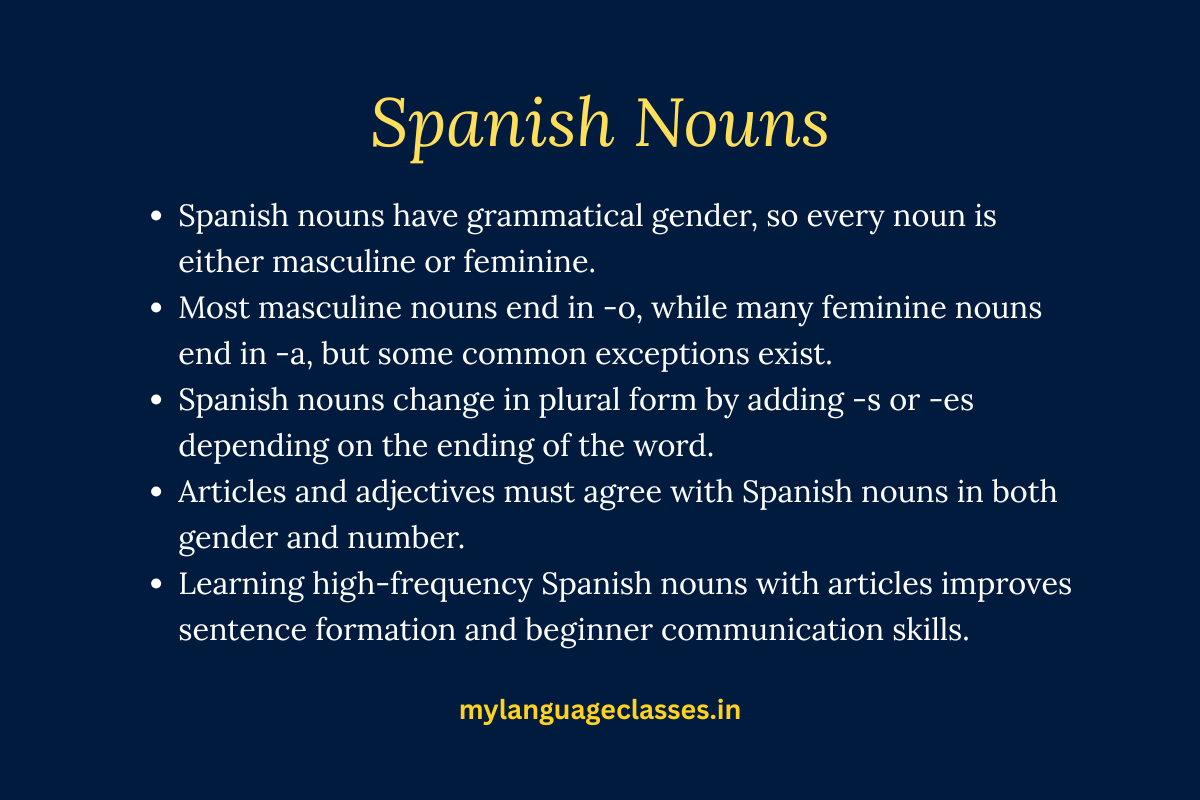
100 essential Spanish nouns are the foundation of beginner Spanish communication. Every basic Spanish sentence uses nouns to talk about people, places, things, ideas, food, time, and daily activities. Learning common Spanish nouns helps beginners understand conversations, form sentences, and improve vocabulary faster.
Spanish nouns are different from English nouns because they have gender. Every noun is either masculine or feminine. Spanish nouns also change in singular and plural forms. Beginners must learn nouns together with their articles to speak correctly.
For example:
la casa → the house
el libro → the book
la comida → the food
These nouns appear in daily Spanish conversations. They also appear often in DELE A1 exams, beginner textbooks, and beginner listening exercises.
If you want structured beginner grammar lessons on nouns, articles, and adjective agreement, the book Spanish DELE A1 Grammar Practice Book: Part 1: Nouns, Articles & Adjectives covers the most important beginner grammar topics in detail.
Learning high-frequency Spanish nouns first helps beginners understand basic Spanish faster. It also improves sentence formation and vocabulary retention.
What Are Spanish Nouns?
Spanish nouns are words used for people, places, animals, objects, feelings, and ideas. Nouns are one of the most important parts of Spanish grammar.
Examples:
el estudiante → the student
la ciudad → the city
el perro → the dog
la felicidad → happiness
Spanish nouns usually appear with articles. These articles show gender and number.
Examples:
el coche → the car
los coches → the cars
la mesa → the table
las mesas → the tables
Spanish nouns help create complete sentences.
Examples:
La profesora habla español.
The teacher speaks Spanish.
El niño come pan.
The boy eats bread.
Examples of Spanish Nouns
Here are some beginner Spanish nouns used daily.
| Spanish Noun | English Meaning |
|---|---|
| casa | house |
| escuela | school |
| amigo | friend |
| comida | food |
| libro | book |
| ciudad | city |
| trabajo | work |
| teléfono | phone |
| música | music |
| familia | family |
Examples in sentences:
La casa es grande.
The house is big.
Mi amigo vive en Madrid.
My friend lives in Madrid.
La música es bonita.
The music is beautiful.
Why Spanish Nouns Matter for Beginners
Spanish nouns appear in almost every sentence. Beginners cannot build useful Spanish sentences without nouns.
Nouns help learners:
understand conversations
describe people and places
ask questions
talk about daily routines
build vocabulary naturally
prepare for DELE A1 exams
A beginner may know verbs and adjectives, but nouns give meaning to the sentence.
Example:
Tengo un libro.
I have a book.
Without the noun libro, the sentence becomes incomplete.
Masculine and Feminine Spanish Nouns
Every Spanish noun has grammatical gender. Spanish nouns are either masculine or feminine.
Masculine nouns usually use:
el → the
un → a
Feminine nouns usually use:
la → the
una → a
Examples:
el perro → the dog
la gata → the female cat
un coche → a car
una mesa → a table
Common Masculine Noun Endings
Many masculine nouns end in -o.
Examples:
| Spanish Noun | English Meaning | Example Sentence | English Translation |
|---|---|---|---|
| libro | book | El libro es interesante. | The book is interesting. |
| perro | dog | El perro duerme. | The dog sleeps. |
| chico | boy | El chico estudia. | The boy studies. |
| trabajo | work | El trabajo es difícil. | The work is difficult. |
| teléfono | telephone | El teléfono suena. | The telephone rings. |
Some masculine nouns end with consonants.
Examples:
el hotel
el color
el papel
Common Feminine Noun Endings
Many feminine nouns end in -a.
| Spanish Noun | English Meaning | Example Sentence | English Translation |
|---|---|---|---|
| casa | house | La casa es blanca. | The house is white. |
| mesa | table | La mesa está limpia. | The table is clean. |
| escuela | school | La escuela es grande. | The school is big. |
| amiga | female friend | La amiga canta bien. | The female friend sings well. |
| comida | food | La comida está caliente. | The food is hot. |
Many feminine nouns also end in:
-ción
-sión
-dad
Examples:
la información
la televisión
la ciudad
Common Exceptions to Gender Rules
Some nouns do not follow normal patterns.
| Spanish Noun | English Meaning | Gender |
|---|---|---|
| el día | day | Masculine |
| la mano | hand | Feminine |
| el mapa | map | Masculine |
| el problema | problem | Masculine |
| la foto | photo | Feminine |
Examples:
El día es largo.
The day is long.
La mano está fría.
The hand is cold.
These nouns should be memorized with their articles.
Singular and Plural Spanish Nouns
Spanish nouns change form in the plural.
Most nouns follow simple rules.
Nouns That Add -s
If a noun ends in a vowel, add -s.
| Singular | Plural | English Meaning |
|---|---|---|
| casa | casas | house |
| libro | libros | book |
| mesa | mesas | table |
| amigo | amigos | friend |
| escuela | escuelas | school |
Examples:
Las casas son bonitas.
The houses are beautiful.
Los libros están aquí.
The books are here.
Nouns That Add -es
If a noun ends in a consonant, add -es.
| Singular | Plural | English Meaning |
|---|---|---|
| hotel | hoteles | hotel |
| profesor | profesores | teacher |
| ciudad | ciudades | city |
| color | colores | color |
| papel | papeles | paper |
Examples:
Los hoteles son modernos.
The hotels are modern.
Las ciudades son grandes.
The cities are big.
Singular and Plural Sentence Examples
| Singular | Plural | English Meaning |
|---|---|---|
| el coche | los coches | the car / the cars |
| la puerta | las puertas | the door / the doors |
| el estudiante | los estudiantes | the student / the students |
| la lección | las lecciones | the lesson / the lessons |
Examples:
El estudiante habla español.
The student speaks Spanish.
Los estudiantes hablan español.
The students speak Spanish.
100 Essential Spanish Nouns for Beginners
Family and People Nouns
Family vocabulary is very common in beginner Spanish.
| Spanish Noun | English Meaning | Example Sentence | English Translation |
|---|---|---|---|
| madre | mother | Mi madre cocina bien. | My mother cooks well. |
| padre | father | Mi padre trabaja mucho. | My father works a lot. |
| hermano | brother | Mi hermano estudia inglés. | My brother studies English. |
| hermana | sister | Mi hermana vive aquí. | My sister lives here. |
| amigo | friend | Mi amigo es amable. | My friend is kind. |
| profesora | teacher | La profesora habla despacio. | The teacher speaks slowly. |
| estudiante | student | El estudiante escribe rápido. | The student writes fast. |
| niño | child | El niño juega. | The child plays. |
| mujer | woman | La mujer trabaja en Madrid. | The woman works in Madrid. |
| hombre | man | El hombre lee el periódico. | The man reads the newspaper. |
House and Furniture Nouns
These nouns are useful for daily conversations.
| Spanish Noun | English Meaning | Example Sentence | English Translation |
|---|---|---|---|
| casa | house | La casa es pequeña. | The house is small. |
| habitación | room | La habitación está limpia. | The room is clean. |
| cocina | kitchen | La cocina es moderna. | The kitchen is modern. |
| mesa | table | La mesa es grande. | The table is big. |
| silla | chair | La silla es cómoda. | The chair is comfortable. |
| puerta | door | La puerta está abierta. | The door is open. |
| ventana | window | La ventana es nueva. | The window is new. |
| cama | bed | La cama es blanca. | The bed is white. |
| sofá | sofa | El sofá es cómodo. | The sofa is comfortable. |
| lámpara | lamp | La lámpara está encendida. | The lamp is on. |
School and Work Nouns
These nouns appear often in beginner Spanish courses and exams.
| Spanish Noun | English Meaning | Example Sentence | English Translation |
|---|---|---|---|
| escuela | school | La escuela es famosa. | The school is famous. |
| libro | book | El libro es interesante. | The book is interesting. |
| cuaderno | notebook | El cuaderno está aquí. | The notebook is here. |
| examen | exam | El examen es difícil. | The exam is difficult. |
| trabajo | work | El trabajo termina tarde. | The work ends late. |
| oficina | office | La oficina está cerrada. | The office is closed. |
| computadora | computer | La computadora funciona bien. | The computer works well. |
| profesor | teacher | El profesor explica la lección. | The teacher explains the lesson. |
| estudiante | student | La estudiante estudia mucho. | The student studies a lot. |
| lección | lesson | La lección es fácil. | The lesson is easy. |
For deeper explanations of beginner grammar and sentence formation, Mastering Spanish Grammar for DELE A1 covers essential noun usage, agreement rules, and common beginner structures.
Food and Drink Nouns
Food nouns are important for restaurants and daily life.
| Spanish Noun | English Meaning | Example Sentence | English Translation |
|---|---|---|---|
| agua | water | El agua está fría. | The water is cold. |
| café | coffee | El café está caliente. | The coffee is hot. |
| pan | bread | El pan es fresco. | The bread is fresh. |
| arroz | rice | El arroz está listo. | The rice is ready. |
| fruta | fruit | La fruta es saludable. | The fruit is healthy. |
| leche | milk | La leche está en la cocina. | The milk is in the kitchen. |
| comida | food | La comida es deliciosa. | The food is delicious. |
| pescado | fish | El pescado está bueno. | The fish tastes good. |
| carne | meat | La carne es cara. | The meat is expensive. |
| desayuno | breakfast | El desayuno empieza temprano. | Breakfast starts early. |
Travel and Transportation Nouns
Travel vocabulary is useful for beginners and tourists.
| Spanish Noun | English Meaning | Example Sentence | English Translation |
|---|---|---|---|
| coche | car | El coche es rojo. | The car is red. |
| autobús | bus | El autobús llega tarde. | The bus arrives late. |
| calle | street | La calle es larga. | The street is long. |
| aeropuerto | airport | El aeropuerto está lejos. | The airport is far away. |
| hotel | hotel | El hotel es moderno. | The hotel is modern. |
| estación | station | La estación está abierta. | The station is open. |
| ciudad | city | La ciudad es bonita. | The city is beautiful. |
| mapa | map | El mapa está en la mesa. | The map is on the table. |
| tren | train | El tren sale ahora. | The train leaves now. |
| viaje | trip | El viaje es corto. | The trip is short. |
Time and Weather Nouns
These nouns help beginners discuss dates and weather.
| Spanish Noun | English Meaning | Example Sentence | English Translation |
|---|---|---|---|
| día | day | El día es soleado. | The day is sunny. |
| semana | week | La semana es larga. | The week is long. |
| mes | month | El mes termina pronto. | The month ends soon. |
| año | year | El año empieza en enero. | The year starts in January. |
| hora | hour | La hora es importante. | The hour is important. |
| lluvia | rain | La lluvia cae fuerte. | The rain falls heavily. |
| sol | sun | El sol brilla mucho. | The sun shines a lot. |
| viento | wind | El viento está frío. | The wind is cold. |
| tiempo | weather | El tiempo es bueno. | The weather is good. |
| verano | summer | El verano es caluroso. | Summer is hot. |
Technology and Communication Nouns
Modern Spanish conversations often use these nouns.
| Spanish Noun | English Meaning | Example Sentence | English Translation |
|---|---|---|---|
| teléfono | phone | El teléfono suena mucho. | The phone rings a lot. |
| internet | internet | El internet es rápido. | The internet is fast. |
| mensaje | message | El mensaje es importante. | The message is important. |
| música | music | La música es relajante. | The music is relaxing. |
| televisión | television | La televisión está apagada. | The television is off. |
| correo | El correo llega hoy. | The email arrives today. | |
| video | video | El video es interesante. | The video is interesting. |
| foto | photo | La foto es bonita. | The photo is beautiful. |
| radio | radio | La radio funciona bien. | The radio works well. |
| aplicación | app | La aplicación es útil. | The app is useful. |
Clothing and Shopping Nouns
These nouns are useful in stores and shopping situations.
| Spanish Noun | English Meaning | Example Sentence | English Translation |
|---|---|---|---|
| camisa | shirt | La camisa es azul. | The shirt is blue. |
| zapato | shoe | El zapato es nuevo. | The shoe is new. |
| dinero | money | El dinero está aquí. | The money is here. |
| tienda | store | La tienda abre temprano. | The store opens early. |
| bolso | bag | El bolso es negro. | The bag is black. |
| pantalón | pants | El pantalón es cómodo. | The pants are comfortable. |
| vestido | dress | El vestido es elegante. | The dress is elegant. |
| chaqueta | jacket | La chaqueta está limpia. | The jacket is clean. |
| precio | price | El precio es bajo. | The price is low. |
| mercado | market | El mercado está lleno. | The market is crowded. |
Common Abstract Spanish Nouns
Abstract nouns express ideas and feelings.
| Spanish Noun | English Meaning | Example Sentence | English Translation |
|---|---|---|---|
| amor | love | El amor es importante. | Love is important. |
| felicidad | happiness | La felicidad es importante. | Happiness is important. |
| problema | problem | El problema es pequeño. | The problem is small. |
| idea | idea | La idea es buena. | The idea is good. |
| paz | peace | La paz es necesaria. | Peace is necessary. |
| verdad | truth | La verdad es clara. | The truth is clear. |
| ayuda | help | La ayuda llega pronto. | The help arrives soon. |
| miedo | fear | El miedo desaparece. | Fear disappears. |
| sueño | dream | El sueño es bonito. | The dream is beautiful. |
| suerte | luck | La suerte cambia rápido. | Luck changes quickly. |
How to Use Spanish Nouns Correctly in Sentences
Spanish nouns must agree with articles and adjectives.
Examples:
la casa blanca
the white house
los libros nuevos
the new books
Using Articles With Spanish Nouns
Spanish articles match gender and number.
| Article | Usage | Example |
|---|---|---|
| el | masculine singular | el coche |
| la | feminine singular | la mesa |
| los | masculine plural | los libros |
| las | feminine plural | las casas |
| un | masculine singular indefinite | un amigo |
| una | feminine singular indefinite | una profesora |
Examples:
La profesora habla español.
The teacher speaks Spanish.
Los amigos estudian juntos.
The friends study together.
Using Adjectives With Spanish Nouns
Adjectives usually follow nouns in Spanish.
Examples:
el coche rojo
the red car
la mesa grande
the big table
los estudiantes inteligentes
the intelligent students
las casas blancas
the white houses
Adjectives must agree in gender and number.
Common Beginner Mistakes With Spanish Nouns
Many beginners make similar mistakes.
Common errors:
using the wrong article
forgetting plural endings
mixing masculine and feminine nouns
translating directly from English
incorrect adjective agreement
Incorrect:
el mesa
Correct:
la mesa
Incorrect:
los casa
Correct:
las casas
Incorrect:
la libro interesante
Correct:
el libro interesante
Tips to Remember Spanish Nouns Faster
Learning Spanish nouns becomes easier with organized methods.
Useful strategies:
learn nouns by category
memorize nouns with articles
read simple Spanish sentences
repeat nouns daily
use nouns in conversations
practice with images
Learn Nouns With Articles
Always learn nouns together with articles.
Correct:
la casa
Incorrect:
casa
Correct:
el problema
Incorrect:
problema
Learning nouns with articles improves grammar accuracy.
Learn Nouns Through Daily Situations
Connect nouns to real situations.
Examples:
kitchen vocabulary
school vocabulary
travel vocabulary
shopping vocabulary
family vocabulary
Reading beginner Spanish material also improves noun retention. The Complete Spanish DELE A1 Package for Beginners (7 book series) combines grammar, vocabulary, structures, and beginner reading material for complete A1-level preparation.
Key Takeaways
Spanish nouns are essential for beginner communication
Every Spanish noun has gender
Most masculine nouns end in -o
Most feminine nouns end in -a
Spanish nouns change in plural form
Articles must match nouns
Adjectives must agree with nouns
Learning high-frequency nouns improves fluency faster
Beginners should memorize nouns with articles
Category-based learning improves vocabulary retention
Vocabulary Section
| Spanish Word | English Meaning | Example Sentence | English Translation |
|---|---|---|---|
| casa | house | La casa es grande. | The house is big. |
| libro | book | El libro está aquí. | The book is here. |
| amigo | friend | Mi amigo estudia español. | My friend studies Spanish. |
| escuela | school | La escuela es nueva. | The school is new. |
| comida | food | La comida está lista. | The food is ready. |
| coche | car | El coche es blanco. | The car is white. |
| ciudad | city | La ciudad es bonita. | The city is beautiful. |
| trabajo | work | El trabajo termina tarde. | The work ends late. |
| teléfono | phone | El teléfono es moderno. | The phone is modern. |
| familia | family | Mi familia vive aquí. | My family lives here. |
| profesor | teacher | El profesor explica bien. | The teacher explains well. |
| estudiante | student | La estudiante lee mucho. | The student reads a lot. |
| ventana | window | La ventana está abierta. | The window is open. |
| agua | water | El agua está fría. | The water is cold. |
| pan | bread | El pan es fresco. | The bread is fresh. |
| aeropuerto | airport | El aeropuerto es grande. | The airport is big. |
| hotel | hotel | El hotel está cerca. | The hotel is nearby. |
| mensaje | message | El mensaje llega hoy. | The message arrives today. |
| música | music | La música es tranquila. | The music is calm. |
| camisa | shirt | La camisa es negra. | The shirt is black. |
| dinero | money | El dinero está en la bolsa. | The money is in the bag. |
| amor | love | El amor es fuerte. | Love is strong. |
| problema | problem | El problema es serio. | The problem is serious. |
| idea | idea | La idea parece buena. | The idea seems good. |
| suerte | luck | La suerte cambia rápido. | Luck changes quickly. |
Conclusion
Learning 100 essential Spanish nouns gives beginners a strong vocabulary foundation. These nouns help learners build sentences, understand conversations, and communicate in daily situations.
Spanish nouns also help beginners improve article usage, adjective agreement, and sentence structure. High-frequency nouns appear constantly in beginner Spanish lessons and DELE A1 exams.
A strong understanding of Spanish nouns makes future grammar topics easier. Beginners who master noun gender, plural forms, and article agreement improve accuracy and comprehension much faster.

Vikas Kumar is the founder of My Language Classes, a language learning platform dedicated to helping learners develop practical communication skills in Spanish, Japanese, and English through comprehensive grammar guides, structured learning resources, books, and evidence-informed educational content.
At My Language Classes, we believe that successful language learning is built on clarity, consistency, meaningful practice, and a deep understanding of how languages work. Every article is carefully researched and created to simplify complex concepts, provide practical guidance, and help learners develop confidence through real-world communication.
Inspired by the principles behind How Language Learning Really Works, our mission is to make high-quality language learning accessible to learners around the world by providing accurate, trustworthy, and comprehensive resources that support lasting progress, lifelong learning, and meaningful communication.
Leave a Reply