

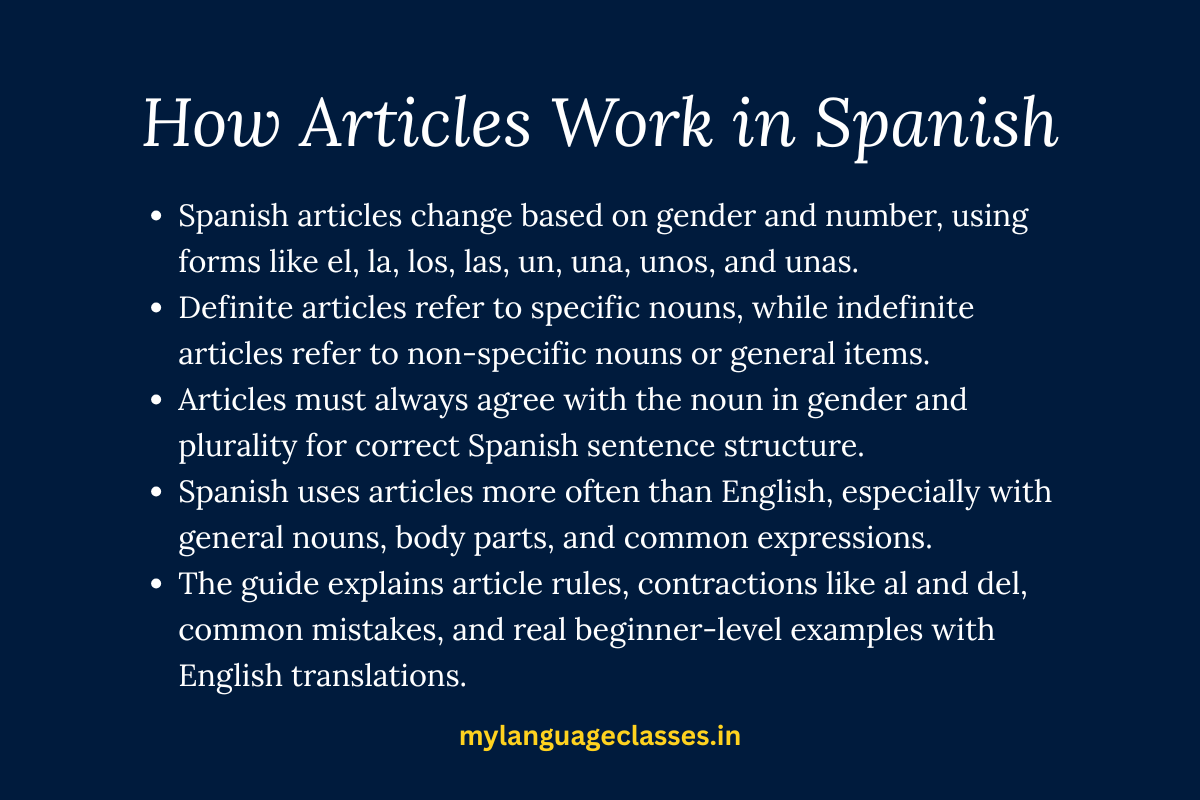
How articles work in Spanish is one of the first grammar topics every beginner must understand. Articles appear before nouns and help identify gender, number, and meaning. Spanish articles change depending on whether a noun is masculine, feminine, singular, or plural.
English mainly uses “the,” “a,” and “an.” Spanish uses more article forms because nouns follow gender and number rules. This is why learners must understand agreement from the beginning.
Look at these examples:
el libro = the book
la casa = the house
unos amigos = some friends
las estudiantes = the female students
Spanish articles also appear more often than in English. Spanish speakers use articles with general nouns, body parts, and many common expressions.
If you want structured beginner grammar lessons on nouns, articles, and adjective agreement, Spanish DELE A1 Grammar Practice Book: Part 1: Nouns, Articles & Adjectives covers these topics step by step with beginner-focused explanations.
What Are Articles in Spanish?
Articles are small words placed before nouns. They give information about the noun.
Spanish articles show:
Gender
Number
Specificity
For example:
el coche = the car
una mesa = a table
In the first sentence, the speaker refers to a specific car. In the second sentence, the speaker refers to any table.
Spanish articles must match the noun. This agreement is one of the most important parts of Spanish grammar.
Why Articles Matter in Spanish Grammar
Articles help identify nouns clearly. They also make sentences sound natural.
Without articles, many Spanish sentences sound incomplete or incorrect.
Compare these examples:
Tengo libro ❌
Tengo un libro ✅
I have a book.
Spanish articles also help listeners understand:
whether the noun is singular or plural
whether the noun is masculine or feminine
whether the noun is specific or general
Types of Articles in Spanish
Spanish has two main types of articles.
| Type | Spanish Example | English Meaning |
|---|---|---|
| Definite article | el libro | the book |
| Indefinite article | una casa | a house |
Definite articles refer to specific nouns.
Indefinite articles refer to non-specific nouns.
Definite Articles in Spanish
Definite articles mean “the” in English. Spanish has four forms because articles must agree with nouns.
Definite Articles Table
| Article | Gender | Number | English |
|---|---|---|---|
| el | masculine | singular | the |
| la | feminine | singular | the |
| los | masculine | plural | the |
| las | feminine | plural | the |
How to Use El in Spanish
“El” is used with masculine singular nouns.
Examples:
el libro = the book
el chico = the boy
el teléfono = the telephone
el perro = the dog
Many masculine nouns end in -o.
Examples:
el carro = the car
el vaso = the glass
However, not all masculine nouns follow this pattern.
Examples:
el problema = the problem
el mapa = the map
These words end in -a but are masculine.
How to Use La in Spanish
“La” is used with feminine singular nouns.
Examples:
la mesa = the table
la casa = the house
la silla = the chair
la ventana = the window
Many feminine nouns end in -a.
Examples:
la puerta = the door
la comida = the food
Some feminine nouns do not end in -a.
Examples:
la ciudad = the city
la mujer = the woman
How to Use Los and Las in Spanish
“Los” is used with masculine plural nouns.
Examples:
los libros = the books
los chicos = the boys
“Las” is used with feminine plural nouns.
Examples:
las mesas = the tables
las amigas = the female friends
Mixed groups normally use masculine plural articles.
Examples:
los estudiantes = the students
los amigos = the friends
When Spanish Uses Definite Articles More Than English
Spanish often uses definite articles in places where English does not.
With General Nouns
Me gusta el café.
I like coffee.
Estudio el español.
I study Spanish.
With Days of the Week
Trabajo los lunes.
I work on Mondays.
With Body Parts
Me lavo las manos.
I wash my hands.
Spanish uses definite articles instead of possessive adjectives in many body-part expressions.
Indefinite Articles in Spanish
Indefinite articles mean “a,” “an,” or “some.”
They refer to non-specific nouns.
Indefinite Articles Table
| Article | Gender | Number | English |
|---|---|---|---|
| un | masculine singular | singular | a/an |
| una | feminine singular | singular | a/an |
| unos | masculine plural | plural | some |
| unas | feminine plural | plural | some |
How to Use Un in Spanish
“Un” is used with masculine singular nouns.
Examples:
un libro = a book
un perro = a dog
un coche = a car
un estudiante = a student
How to Use Una in Spanish
“Una” is used with feminine singular nouns.
Examples:
una silla = a chair
una ciudad = a city
una amiga = a female friend
una mochila = a backpack
How to Use Unos and Unas in Spanish
“Unos” and “unas” mean “some.”
Examples:
unos amigos = some friends
unos libros = some books
unas flores = some flowers
unas casas = some houses
These articles are common in everyday conversation.
Common Situations for Indefinite Articles
Indefinite articles are common when introducing something for the first time.
Tengo un coche.
I have a car.
Ella tiene una hermana.
She has a sister.
They are also used with descriptions.
Es una profesora excelente.
She is an excellent teacher.
Gender Agreement in Spanish Articles
Spanish nouns have gender. Articles must match that gender.
This agreement affects every sentence.
Masculine Nouns and Articles
Many masculine nouns end in:
-o
-or
-aje
-ma
Examples:
el libro = the book
el profesor = the teacher
el viaje = the trip
el problema = the problem
Important exceptions exist.
Examples:
el día = the day
el mapa = the map
Feminine Nouns and Articles
Many feminine nouns end in:
-a
-ción
-dad
-tad
Examples:
la casa = the house
la nación = the nation
la ciudad = the city
la libertad = freedom
Important exceptions also exist.
Examples:
la mano = the hand
la foto = the photo
Words That Change Meaning With Gender
Some words change meaning depending on the article.
| Word | Meaning |
|---|---|
| el capital | money |
| la capital | capital city |
| el cura | priest |
| la cura | cure |
These words require attention because article choice changes the meaning completely.
Singular and Plural Articles in Spanish
Spanish articles change when nouns become plural.
Forming Plurals With Articles
Most nouns add -s.
el libro → los libros
the book → the books
la mesa → las mesas
the table → the tables
Words ending in consonants often add -es.
la mujer → las mujeres
the woman → the women
el profesor → los profesores
the teacher → the teachers
Article Agreement Rules
Articles must match both gender and number.
| Correct | Incorrect |
|---|---|
| la casa | el casa |
| los libros | las libros |
| unas mesas | unos mesas |
Agreement mistakes are very common among beginners.
Always check:
gender
number
article form
Contractions With Spanish Articles
Spanish has two important contractions involving articles.
Al in Spanish
“Al” comes from:
a + el = al
Examples:
Voy al mercado.
I am going to the market.
Llegamos al hotel.
We arrived at the hotel.
Del in Spanish
“Del” comes from:
de + el = del
Examples:
El libro del profesor.
The teacher’s book.
La puerta del coche.
The car door.
When Contractions Do Not Happen
Contractions only happen with “el.”
Examples:
Voy a la escuela.
I go to the school.
Voy a El Salvador.
I am going to El Salvador.
In proper names beginning with “El,” contractions do not happen.
Common Mistakes With Spanish Articles
Many learners make the same article mistakes.
Understanding these errors helps improve accuracy faster.
Using the Wrong Gender
Incorrect gender agreement is extremely common.
| Incorrect | Correct |
|---|---|
| el mesa | la mesa |
| la libro | el libro |
Always learn nouns together with their articles.
Forgetting Plural Agreement
Plural nouns need plural articles.
| Incorrect | Correct |
|---|---|
| los casa | las casas |
| la libros | los libros |
Omitting Articles Incorrectly
English speakers often skip articles because English sometimes allows this structure.
Incorrect:
Tengo coche. ❌
Correct:
Tengo un coche. ✅
I have a car.
Overusing Articles
Spanish sometimes removes articles in professions and identities.
| Incorrect | Correct |
|---|---|
| Soy un estudiante | Soy estudiante |
| Ella es una médica | Ella es médica |
However, adjectives can change this pattern.
Es una médica excelente.
She is an excellent doctor.
Spanish Articles in Everyday Sentences
Spanish articles appear constantly in daily communication. Beginners should practice them in realistic sentences.
If you want a broader beginner grammar reference with detailed explanations on sentence formation and article agreement, Mastering Spanish Grammar for DELE A1 covers essential grammar structures used in everyday Spanish.
Articles With Food
Quiero una pizza.
I want a pizza.
El café está caliente.
The coffee is hot.
Compramos unas manzanas.
We bought some apples.
Articles With Family and People
La madre de Ana vive aquí.
Ana’s mother lives here.
Tengo un amigo español.
I have a Spanish friend.
Las estudiantes llegan temprano.
The female students arrive early.
Articles With Places and Objects
La escuela está cerca.
The school is nearby.
Necesito un teléfono nuevo.
I need a new phone.
Los libros están en la mesa.
The books are on the table.
Quick Rules to Remember About Spanish Articles
Masculine singular nouns use el or un
Feminine singular nouns use la or una
Plural nouns need plural articles
Articles must match gender and number
Spanish uses articles more often than English
Only el forms contractions
Always learn nouns together with articles
Mixed groups usually use masculine plural articles
Key Takeaways
How articles work in Spanish becomes easier once learners understand agreement rules. Articles must match nouns in gender and number.
Spanish has definite articles:
el
la
los
las
Spanish also has indefinite articles:
un
una
unos
unas
Definite articles refer to specific nouns. Indefinite articles refer to non-specific nouns.
Spanish uses articles more often than English. This is especially common with general nouns and body parts.
Contractions only happen with “el”:
al
del
Learning articles together with nouns improves accuracy and sentence formation.
For a complete beginner learning system that combines grammar, vocabulary, sentence building, and structured progression, The Complete Spanish DELE A1 Package for Beginners (7 book series) provides a full A1-level roadmap for Spanish learners.
Vocabulary Section
| Spanish Word | English Meaning | Example Sentence | English Translation |
|---|---|---|---|
| el libro | the book | El libro es interesante. | The book is interesting. |
| la mesa | the table | La mesa es grande. | The table is big. |
| un coche | a car | Tengo un coche rojo. | I have a red car. |
| una casa | a house | La casa es bonita. | The house is beautiful. |
| los estudiantes | the students | Los estudiantes estudian mucho. | The students study a lot. |
| las amigas | the female friends | Las amigas hablan español. | The female friends speak Spanish. |
| unos libros | some books | Compré unos libros ayer. | I bought some books yesterday. |
| unas flores | some flowers | Ella tiene unas flores. | She has some flowers. |
| el perro | the dog | El perro duerme aquí. | The dog sleeps here. |
| la ciudad | the city | La ciudad es moderna. | The city is modern. |
| el profesor | the teacher | El profesor explica bien. | The teacher explains well. |
| la profesora | the female teacher | La profesora habla despacio. | The female teacher speaks slowly. |
| el mercado | the market | Voy al mercado hoy. | I am going to the market today. |
| la ventana | the window | La ventana está abierta. | The window is open. |
| el café | coffee | El café está caliente. | The coffee is hot. |
| la comida | food | La comida es deliciosa. | The food is delicious. |
| el teléfono | the telephone | Necesito el teléfono. | I need the telephone. |
| la mochila | the backpack | La mochila es nueva. | The backpack is new. |
| los amigos | the friends | Los amigos juegan fútbol. | The friends play football. |
| las casas | the houses | Las casas son pequeñas. | The houses are small. |
| el mapa | the map | El mapa está en la mesa. | The map is on the table. |
| la mano | the hand | Me lavo la mano. | I wash my hand. |
| el problema | the problem | El problema es difícil. | The problem is difficult. |
| la foto | the photo | La foto es antigua. | The photo is old. |
| la escuela | the school | La escuela está cerrada. | The school is closed. |
| el día | the day | El día es largo. | The day is long. |
| la puerta | the door | La puerta está abierta. | The door is open. |
| el viaje | the trip | El viaje fue corto. | The trip was short. |
| la mujer | the woman | La mujer trabaja aquí. | The woman works here. |
| el chico | the boy | El chico corre rápido. | The boy runs fast. |
Conclusion
Understanding how articles work in Spanish is essential for building correct sentences. Articles affect gender, number, and meaning in every part of Spanish grammar.
Beginners should always learn nouns together with their articles. This habit improves agreement and reduces common mistakes.
Spanish articles become easier through repeated exposure to real sentences. Paying attention to noun gender and plural forms helps learners speak and write more naturally from the beginning.

Vikas Kumar is the founder of My Language Classes, a language learning platform dedicated to helping learners develop practical communication skills in Spanish, Japanese, and English through comprehensive grammar guides, structured learning resources, books, and evidence-informed educational content.
At My Language Classes, we believe that successful language learning is built on clarity, consistency, meaningful practice, and a deep understanding of how languages work. Every article is carefully researched and created to simplify complex concepts, provide practical guidance, and help learners develop confidence through real-world communication.
Inspired by the principles behind How Language Learning Really Works, our mission is to make high-quality language learning accessible to learners around the world by providing accurate, trustworthy, and comprehensive resources that support lasting progress, lifelong learning, and meaningful communication.
Leave a Reply