

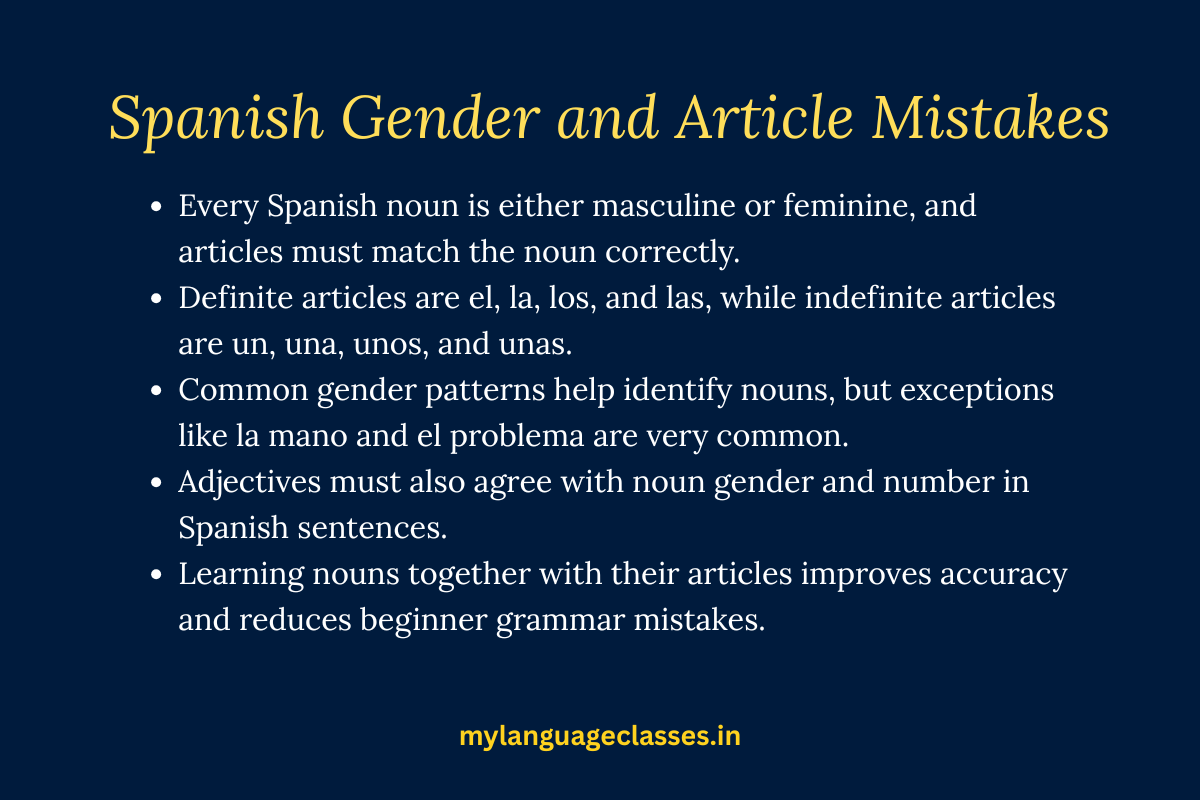
Common mistakes of gender and articles with Spanish nouns are among the biggest problems for beginner learners. Spanish nouns are either masculine or feminine, and the articles must match them correctly. Many learners translate directly from English, which creates errors with words like el libro, la mesa, un problema, and una casa.
Spanish uses articles far more consistently than English. A noun usually appears with an article, especially in beginner-level sentences. This makes article agreement an essential part of Spanish grammar.
Many nouns follow predictable gender patterns. Others are exceptions that learners must memorize carefully. Mistakes often happen when learners guess the gender from the word ending or from English meaning.
For example:
| Incorrect | Correct | English |
|---|---|---|
| la problema | el problema | the problem |
| el mano | la mano | the hand |
| un casa | una casa | a house |
| la libro | el libro | the book |
Understanding these patterns early improves sentence accuracy and reading comprehension. Learners preparing for DELE A1 often study these structures in Spanish DELE A1 Grammar Practice Book: Part 1: Nouns, Articles & Adjectives because noun agreement appears constantly in beginner Spanish.
Understanding Gender and Articles in Spanish
What Is Gender in Spanish Nouns?
Every Spanish noun has grammatical gender. A noun is either masculine or feminine.
This gender affects:
Examples:
| Spanish | English | Gender |
|---|---|---|
| el libro | the book | Masculine |
| la mesa | the table | Feminine |
| el coche | the car | Masculine |
| la casa | the house | Feminine |
Gender does not always depend on biological sex.
For example:
| Spanish | English | Gender |
|---|---|---|
| la mano | the hand | Feminine |
| el problema | the problem | Masculine |
These are grammatical rules, not logical categories.
What Are Definite Articles in Spanish?
Definite articles mean “the” in English.
Spanish has four definite articles.
| Article | Gender | Number |
|---|---|---|
| el | Masculine | Singular |
| la | Feminine | Singular |
| los | Masculine | Plural |
| las | Feminine | Plural |
Examples:
| Spanish Sentence | English Translation |
|---|---|
| El libro es nuevo. | The book is new. |
| La mesa es grande. | The table is big. |
| Los estudiantes estudian. | The students study. |
| Las casas son bonitas. | The houses are pretty. |
The article must always match the noun.
What Are Indefinite Articles in Spanish?
Indefinite articles mean “a,” “an,” or “some.”
| Article | Gender | Number |
|---|---|---|
| un | Masculine | Singular |
| una | Feminine | Singular |
| unos | Masculine | Plural |
| unas | Feminine | Plural |
Examples:
| Spanish Sentence | English Translation |
|---|---|
| Tengo un coche. | I have a car. |
| Ella tiene una mochila. | She has a backpack. |
| Compré unos libros. | I bought some books. |
| Necesitamos unas sillas. | We need some chairs. |
Common Mistakes of Gender and Articles with Spanish Nouns
Using the Wrong Article With a Noun
This is the most common beginner mistake.
Learners often use the wrong article because they memorize nouns without gender.
Examples:
| Incorrect | Correct | English |
|---|---|---|
| el casa | la casa | the house |
| la libro | el libro | the book |
| un mesa | una mesa | a table |
| una problema | un problema | a problem |
The noun and article must always agree.
Guessing Gender From English Instead of Spanish
English nouns do not have grammatical gender. Spanish nouns do.
This creates confusion for beginners.
Examples:
| Spanish | English | Actual Gender |
|---|---|---|
| la mano | hand | Feminine |
| el mapa | map | Masculine |
| el idioma | language | Masculine |
| la foto | photo | Feminine |
Many learners think:
- words ending in “a” are always feminine
- words ending in “o” are always masculine
These rules help often, but not always.
A better strategy is learning nouns together with their articles:
- la mano
- el mapa
- la foto
Forgetting Plural Article Agreement
Articles must also match plural nouns.
Common mistakes include:
| Incorrect | Correct | English |
|---|---|---|
| el libros | los libros | the books |
| las estudiante | las estudiantes | the students |
| unos silla | unas sillas | some chairs |
Plural agreement changes both the noun and the article.
| Singular | Plural |
|---|---|
| el libro | los libros |
| la casa | las casas |
| un coche | unos coches |
| una mesa | unas mesas |
Mixing Masculine and Feminine Adjectives
Adjectives must agree with noun gender.
Examples:
| Incorrect | Correct | English |
|---|---|---|
| el coche roja | el coche rojo | the red car |
| la casa bonito | la casa bonita | the pretty house |
| los libros pequeña | los libros pequeños | the small books |
Agreement affects sentence accuracy immediately.
Basic Gender Rules Every Beginner Should Know
Masculine Noun Endings
Many masculine nouns end in:
- -o
- -ma
- consonants
- accented vowels
Examples:
| Spanish | English |
|---|---|
| el libro | the book |
| el chico | the boy |
| el problema | the problem |
| el sofá | the sofa |
Nouns ending in “-ma” are often masculine because of Greek origin.
Examples:
- el sistema
- el programa
- el tema
Feminine Noun Endings
Many feminine nouns end in:
- -a
- -ción
- -dad
- -tad
- -umbre
Examples:
| Spanish | English |
|---|---|
| la mesa | the table |
| la estación | the station |
| la ciudad | the city |
| la libertad | freedom |
| la costumbre | the habit |
Example sentences:
| Spanish Sentence | English Translation |
|---|---|
| La ciudad es grande. | The city is big. |
| La estación está cerca. | The station is nearby. |
Nouns That Can Be Predicted Easily
These patterns usually work well:
| Ending | Usually |
|---|---|
| -o | Masculine |
| -a | Feminine |
| -ción | Feminine |
| -dad | Feminine |
| -ma | Masculine |
These patterns improve recognition speed, especially in reading exercises. Many learners review these structures deeply in Mastering Spanish Grammar for DELE A1 because article agreement appears in nearly every beginner sentence.
Important Gender Exceptions in Spanish
Feminine Nouns That Use “El”
Some feminine nouns use “el” in singular form.
Examples:
- el agua
- el águila
- el alma
This happens for pronunciation reasons.
The noun remains feminine.
Examples:
| Spanish | English |
|---|---|
| el agua fría | the cold water |
| el águila blanca | the white eagle |
Notice the adjective remains feminine.
In plural form, the normal feminine article returns.
| Singular | Plural |
|---|---|
| el agua | las aguas |
| el águila | las águilas |
Masculine Nouns Ending in “A”
These nouns confuse many beginners.
Examples:
| Spanish | English |
|---|---|
| el problema | the problem |
| el sistema | the system |
| el mapa | the map |
| el idioma | the language |
Most come from Greek-origin words.
Feminine Nouns Ending in “O”
Some feminine nouns end in “o.”
Examples:
| Spanish | English |
|---|---|
| la mano | the hand |
| la foto | the photo |
| la radio | the radio |
“Foto” comes from “fotografía.”
“Radio” comes from “radiodifusión.”
These shortened forms keep feminine gender.
Nouns With Different Meanings by Gender
Some nouns change meaning with gender.
Examples:
| Masculine | Feminine | English |
|---|---|---|
| el capital | la capital | capital money / capital city |
| el policía | la policía | policeman / police force |
These differences are important for reading comprehension.
Common Article Mistakes Beginners Make
Omitting Articles Completely
English speakers often remove articles.
Incorrect examples:
| Incorrect | Correct |
|---|---|
| Tengo coche. | Tengo un coche. |
| Necesito mochila. | Necesito una mochila. |
Spanish usually requires articles more consistently.
Overusing Articles in Spanish
Some learners add articles where Spanish normally avoids them.
Examples:
| Correct Spanish | English |
|---|---|
| Estudio español. | I study Spanish. |
| Hablo inglés. | I speak English. |
Language names often appear without articles after verbs like:
- hablar
- estudiar
- aprender
Confusing “Un” and “Una”
Agreement mistakes are common.
Examples:
| Incorrect | Correct |
|---|---|
| un casa | una casa |
| una libro | un libro |
Confusing “Los” and “Las”
Plural gender agreement also creates problems.
| Incorrect | Correct |
|---|---|
| los mesas | las mesas |
| las libros | los libros |
Gender Agreement With Professions and Nationalities
Profession Nouns
Many professions change according to gender.
| Masculine | Feminine |
|---|---|
| profesor | profesora |
| médico | médica |
| abogado | abogada |
Some professions use the same form.
Examples:
- estudiante
- artista
Example sentences:
| Spanish Sentence | English Translation |
|---|---|
| Ella es profesora. | She is a teacher. |
| Él es estudiante. | He is a student. |
Nationality Words
Nationality adjectives also change.
| Masculine | Feminine |
|---|---|
| español | española |
| japonés | japonesa |
| francés | francesa |
Examples:
| Spanish Sentence | English Translation |
|---|---|
| Ella es española. | She is Spanish. |
| Él es japonés. | He is Japanese. |
Strategies to Avoid Gender and Article Mistakes
Learn Nouns Together With Articles
Do not memorize isolated nouns.
Learn:
- la mesa
- el libro
- la ciudad
This builds automatic agreement recognition.
Use Ending Patterns Carefully
Patterns help, but exceptions exist.
Examples:
- el problema
- la mano
Always verify uncertain nouns.
Read and Listen to Repeated Structures
Repeated exposure improves article recognition naturally.
Beginners often notice patterns faster after reading simple dialogues and stories repeatedly.
Build Gender Associations Visually
Visual grouping improves memory.
Examples:
- masculine nouns in one notebook section
- feminine nouns in another section
Many beginners combine structured grammar review with beginner reading material from The Complete Spanish DELE A1 Package for Beginners (7 book series) because repeated sentence exposure improves gender recognition significantly.
Most Common Beginner Errors and Corrections
| Incorrect Spanish | Correct Spanish | English Translation |
|---|---|---|
| la problema | el problema | the problem |
| el mano | la mano | the hand |
| una mapa | un mapa | a map |
| la idioma | el idioma | the language |
| el casa | la casa | the house |
| una libro | un libro | a book |
| las libro | los libros | the books |
| los mesas | las mesas | the tables |
| el agua fríao | el agua fría | the cold water |
| la sofá | el sofá | the sofa |
| un silla | una silla | a chair |
| las estudiante | las estudiantes | the students |
| el foto | la foto | the photo |
| una sistema | un sistema | a system |
| el estación | la estación | the station |
| la día | el día | the day |
| los mujer | las mujeres | the women |
| el ciudad | la ciudad | the city |
| una problema grande | un problema grande | a big problem |
| el águila blanco | el águila blanca | the white eagle |
Quick Summary of Spanish Gender and Article Rules
| Rule | Example |
|---|---|
| Most nouns ending in -o are masculine | el libro |
| Most nouns ending in -a are feminine | la casa |
| Nouns ending in -ción are feminine | la canción |
| Many nouns ending in -ma are masculine | el problema |
| Articles must match gender | la mesa |
| Articles must match number | los libros |
| Adjectives must agree too | la casa bonita |
| Some feminine nouns use “el” | el agua fría |
Key Takeaways
- Every Spanish noun has grammatical gender
- Articles must agree with nouns
- Plural nouns also require matching articles
- Adjectives change according to gender and number
- Word endings help identify gender
- Exceptions are very common in beginner Spanish
- Learning nouns with articles improves accuracy
- Repeated exposure strengthens agreement recognition
Spanish Vocabulary Related to Gender and Articles
| Spanish Word | English Meaning | Example Sentence | English Translation |
|---|---|---|---|
| artículo | article | El artículo es correcto. | The article is correct. |
| sustantivo | noun | El sustantivo es masculino. | The noun is masculine. |
| género | gender | El género cambia la forma. | Gender changes the form. |
| masculino | masculine | “Libro” es masculino. | “Libro” is masculine. |
| femenino | feminine | “Mesa” es femenina. | “Mesa” is feminine. |
| singular | singular | La palabra está en singular. | The word is singular. |
| plural | plural | Los libros están en plural. | The books are plural. |
| idioma | language | El idioma es español. | The language is Spanish. |
| problema | problem | Tengo un problema. | I have a problem. |
| estación | station | La estación está abierta. | The station is open. |
| agua | water | El agua está fría. | The water is cold. |
| mapa | map | El mapa es nuevo. | The map is new. |
| ciudad | city | La ciudad es grande. | The city is big. |
| mano | hand | La mano está limpia. | The hand is clean. |
| profesor | teacher | El profesor habla español. | The teacher speaks Spanish. |
| estudiante | student | La estudiante estudia mucho. | The student studies a lot. |
| mesa | table | La mesa es blanca. | The table is white. |
| libro | book | El libro es interesante. | The book is interesting. |
| casa | house | La casa es pequeña. | The house is small. |
| coche | car | El coche es rápido. | The car is fast. |
Conclusion
Common mistakes of gender and articles with Spanish nouns usually come from incorrect agreement and unreliable guessing patterns. Spanish articles must always match the noun in gender and number.
Most nouns follow recognizable patterns, but important exceptions appear frequently in beginner Spanish. Words like la mano, el problema, and el agua require special attention.
Strong article agreement improves sentence accuracy immediately. Learners who study nouns together with their articles usually develop faster recognition and fewer grammar mistakes over time.

Vikas Kumar is the founder of My Language Classes, a language learning platform dedicated to helping learners develop practical communication skills in Spanish, Japanese, and English through comprehensive grammar guides, structured learning resources, books, and evidence-informed educational content.
At My Language Classes, we believe that successful language learning is built on clarity, consistency, meaningful practice, and a deep understanding of how languages work. Every article is carefully researched and created to simplify complex concepts, provide practical guidance, and help learners develop confidence through real-world communication.
Inspired by the principles behind How Language Learning Really Works, our mission is to make high-quality language learning accessible to learners around the world by providing accurate, trustworthy, and comprehensive resources that support lasting progress, lifelong learning, and meaningful communication.
Leave a Reply