

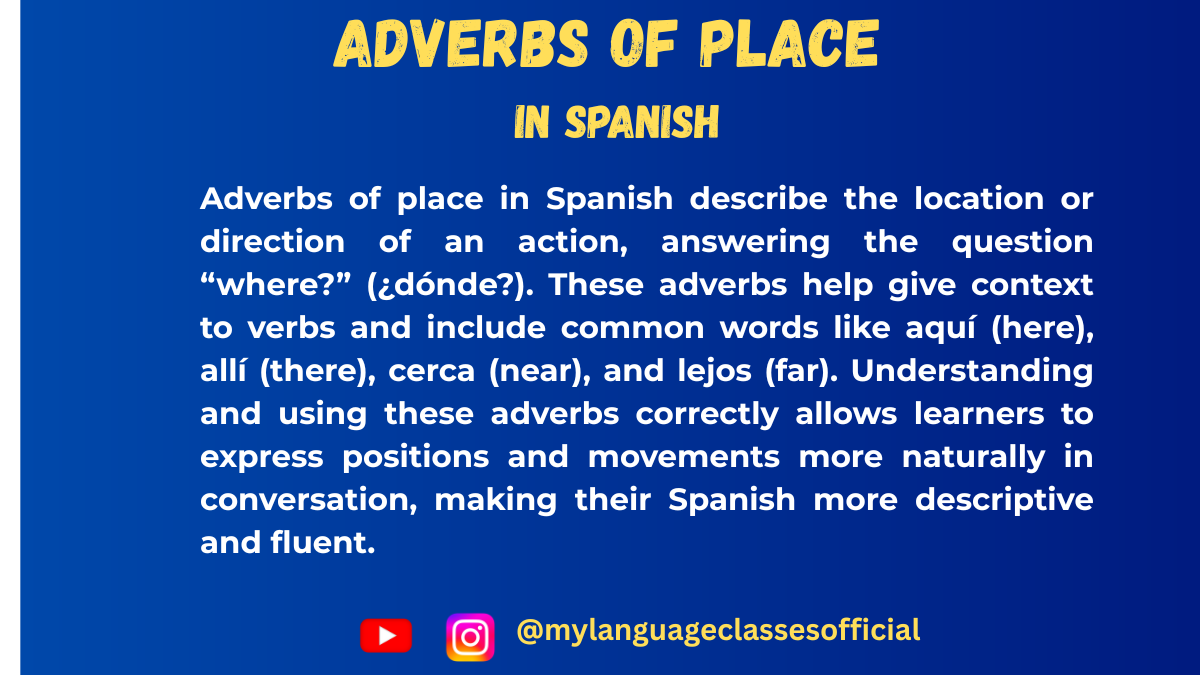
Adverbs of place (adverbios de lugar) are essential in Spanish to indicate where an action takes place. They help provide spatial context and are frequently used in daily conversations. In this blog, we will explore the most common adverbs of place, their meanings, and how to use them correctly in sentences.
Understanding Adverbs of Place
Adverbs of place describe the location of an action or object. They answer the questions: Where? (¿Dónde?) and To where? (¿Adónde?)
These adverbs do not change in gender or number, as adjectives do, but their placement and meaning depend on the sentence context.
Common Adverbs of Place and Their Meanings
| Spanish Adverb | Meaning |
|---|---|
| Aquí | Here |
| Allí | There (not too far) |
| Allá | Over there (far away) |
| Cerca | Near |
| Lejos | Far |
| Encima | On top |
| Debajo | Below, under |
| Enfrente | In front |
| Detrás | Behind |
| Dentro | Inside |
| Fuera | Outside |
| Al lado | Next to, beside |
| Entre | Between |
| Alrededor | Around |
Common Expressions with Adverbs of Place
Here are some daily expressions using adverbs of place with their meanings and example sentences:
1. Aquí (Here)
- Estoy aquí. (I am here.)
- Pon el libro aquí. (Put the book here.)
- Aquí se come bien. (Here, one eats well.)
2. Allí / Allá (There / Over there)
- El coche está allí. (The car is there.)
- Allí vive mi abuela. (My grandmother lives there.)
- Vamos allá para ver la fiesta. (Let’s go over there to see the party.)
3. Cerca / Lejos (Near / Far)
- El supermercado está cerca. (The supermarket is near.)
- El aeropuerto está lejos de aquí. (The airport is far from here.)
- Mi casa está cerca del parque. (My house is near the park.)
4. Encima / Debajo (On top / Under)
- El libro está encima de la mesa. (The book is on top of the table.)
- El perro está debajo de la silla. (The dog is under the chair.)
- Las llaves están encima del escritorio. (The keys are on top of the desk.)
5. Enfrente / Detrás (In front / Behind)
- El cine está enfrente del restaurante. (The cinema is in front of the restaurant.)
- Juan está detrás de la puerta. (Juan is behind the door.)
6. Dentro / Fuera (Inside / Outside)
- Los niños están dentro de la casa. (The children are inside the house.)
- Voy a esperar fuera. (I will wait outside.)
How to Use Adverbs of Place Correctly?
1. Articles and Agreement
- Unlike adjectives, adverbs of place do not agree in gender or number.
- However, they often require a definite article (el, la, los, las) when specifying the location:
- Encima de la mesa (On top of the table)
- Debajo del coche (Under the car)
2. Adverbs with Prepositions
- Some adverbs need prepositions like de to clarify their meaning:
- Encima de, debajo de, detrás de, delante de
- El gato está debajo de la cama. (The cat is under the bed.)
3. Position in a Sentence
- Adverbs of place typically come after the verb or at the end of the sentence:
- El niño juega afuera. (The boy plays outside.)
- Nos vemos allí. (See you there.)
- In questions, adverbs of place often come at the beginning:
- ¿Dónde está tu mochila? (Where is your backpack?)
Adverbs of Place in Different Contexts
1. Motion vs. Static Position
- When describing movement towards a place, use hacia or para:
- Voy hacia allá. (I am going over there.)
- Camina para dentro. (Walk inside.)
- When indicating a fixed position, use adverbs alone:
- Estoy aquí. (I am here.)
2. Expressing Approximate Location
- Por aquí / Por allí (Around here / around there):
- Debe estar por aquí. (It must be around here.)
Conclusion
Adverbs of place are fundamental for effective communication in Spanish. By mastering their meanings, correct usage, and placement in sentences, you can confidently express spatial relationships in everyday conversations. Practice using them with different verbs and prepositions to sound more fluent and natural in Spanish!
Do you have any questions or need more examples? Let me know in the comments below!

Vikas Kumar is the founder of My Language Classes, a language learning platform dedicated to helping learners develop practical communication skills in Spanish, Japanese, and English through comprehensive grammar guides, structured learning resources, books, and evidence-informed educational content.
At My Language Classes, we believe that successful language learning is built on clarity, consistency, meaningful practice, and a deep understanding of how languages work. Every article is carefully researched and created to simplify complex concepts, provide practical guidance, and help learners develop confidence through real-world communication.
Inspired by the principles behind How Language Learning Really Works, our mission is to make high-quality language learning accessible to learners around the world by providing accurate, trustworthy, and comprehensive resources that support lasting progress, lifelong learning, and meaningful communication.
Leave a Reply