

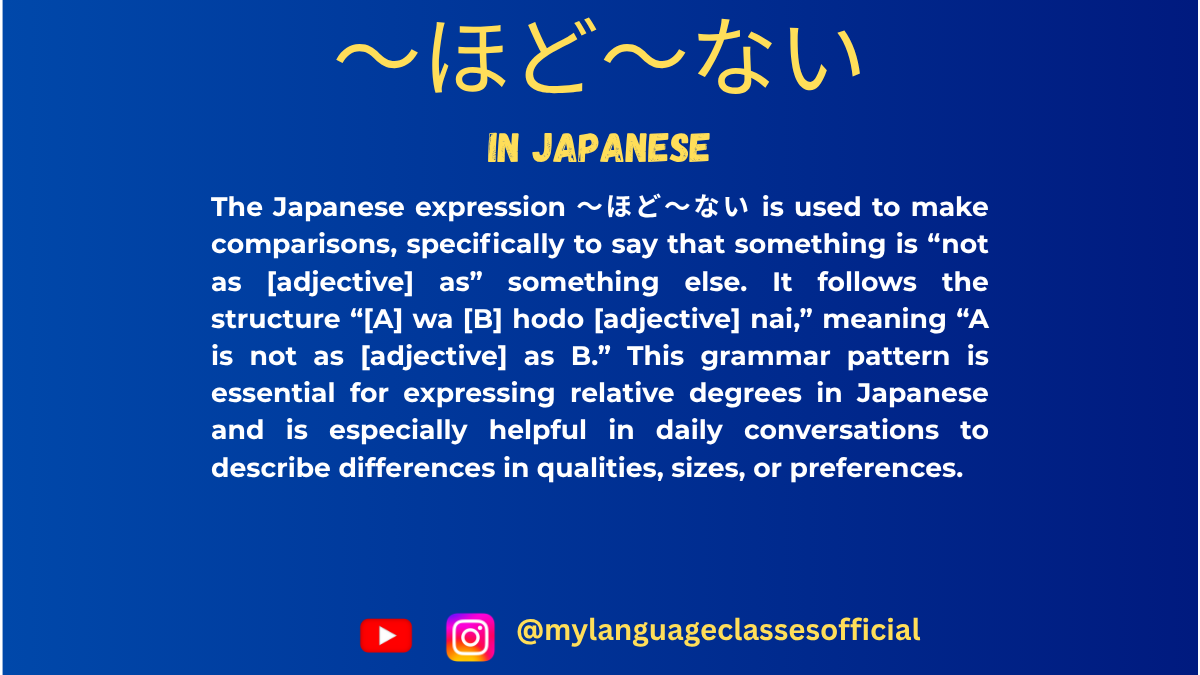
Understanding 〜ほど〜ない in Japanese
The Japanese grammar pattern 「〜ほど〜ない」 is commonly used for making comparisons and expressing degree or extent. It implies that something is “not as much as” something else. This phrase is often translated as “not as… as…” in English.
Basic Structure of 〜ほど〜ない
The structure of this grammar pattern is as follows:
Noun + ほど + Adjective (ない-form)
or
Verb (dictionary form) + ほど + Adjective (ない-form)
General Meaning
「A ほど B ない」 means that B is not as A.
- A is the standard of comparison.
- B is the thing being compared.
Examples:
- この町は東京ほど賑やかではない。
(Kono machi wa Tōkyō hodo nigiyaka de wa nai.)
→ This town is not as lively as Tokyo. - 彼は私ほど速く走れない。
(Kare wa watashi hodo hayaku hashirenai.)
→ He cannot run as fast as I do. - この問題は思ったほど難しくない。
(Kono mondai wa omotta hodo muzukashiku nai.)
→ This problem is not as difficult as I thought.
Situations Where 〜ほど〜ない is Used
1. Comparing Extent or Degree
- Used when two things are compared, but the second one (B) has less intensity than the first (A).
Example:
北海道の冬は東京の冬ほど寒くない。
(Hokkaidō no fuyu wa Tōkyō no fuyu hodo samuku nai.)
→ Hokkaido’s winter is not as cold as Tokyo’s winter.
2. Expressing Subjective Opinions
- Often used to express personal opinions about differences in perception.
Example:
数学は国語ほど難しくないと思います。
(Sūgaku wa kokugo hodo muzukashiku nai to omoimasu.)
→ I think math is not as difficult as Japanese.
3. Negative Comparison in Abilities or Characteristics
- Used when comparing someone’s ability or characteristics with another’s.
Example:
彼の英語は先生ほど上手ではない。
(Kare no eigo wa sensei hodo jōzu de wa nai.)
→ His English is not as good as the teacher’s.
4. Comparing Expectations vs Reality
- Used when expectations were high, but the actual situation is not as expected.
Example:
この映画は評判ほど面白くない。
(Kono eiga wa hyōban hodo omoshiroku nai.)
→ This movie is not as interesting as its reputation suggests.
5. Comparing Feelings and Emotions
- Used when talking about feelings that are not as strong as expected.
Example:
彼は私が思ったほど優しくない。
(Kare wa watashi ga omotta hodo yasashiku nai.)
→ He is not as kind as I thought.
6. Comparing Physical Condition or Health
- Used to compare health conditions or physical states.
Example:
風邪は思ったほどひどくない。
(Kaze wa omotta hodo hidoku nai.)
→ The cold is not as bad as I thought.
7. Comparing Amount or Frequency
- Used when comparing quantity or frequency of actions.
Example:
今日は昨日ほど忙しくない。
(Kyō wa kinō hodo isogashiku nai.)
→ Today is not as busy as yesterday.
8. Comparing Importance or Necessity
- Used when comparing levels of importance or necessity.
Example:
宿題はテストほど大事ではない。
(Shukudai wa tesuto hodo daiji de wa nai.)
→ Homework is not as important as tests.
9. Comparing Strength of Desire or Preference
- Used to compare desires, preferences, or interests.
Example:
私は映画を見るのが好きですが、本を読むほど好きではない。
(Watashi wa eiga o miru no ga suki desu ga, hon o yomu hodo suki de wa nai.)
→ I like watching movies, but not as much as reading books.
Key Points to Remember About 〜ほど〜ない
- It is used for making comparisons where the second element has less intensity.
- It is often used to express subjective opinions.
- It is used to compare expectations vs reality.
- It can be used in various contexts: ability, frequency, amount, physical conditions, and emotions.
- It follows a simple pattern: “A ほど B ない”, where A is the standard, and B is the thing being compared.
Conclusion
The 「〜ほど〜ない」 grammar pattern is an essential part of Japanese when making negative comparisons. Mastering it will help you express your opinions, compare things effectively, and sound more natural in conversations. Make sure to practice using this structure in daily life to reinforce your understanding!
Happy learning! 😊

Vikas Kumar is the founder of My Language Classes, a language learning platform dedicated to helping learners develop practical communication skills in Spanish, Japanese, and English through comprehensive grammar guides, structured learning resources, books, and evidence-informed educational content.
At My Language Classes, we believe that successful language learning is built on clarity, consistency, meaningful practice, and a deep understanding of how languages work. Every article is carefully researched and created to simplify complex concepts, provide practical guidance, and help learners develop confidence through real-world communication.
Inspired by the principles behind How Language Learning Really Works, our mission is to make high-quality language learning accessible to learners around the world by providing accurate, trustworthy, and comprehensive resources that support lasting progress, lifelong learning, and meaningful communication.
Leave a Reply