

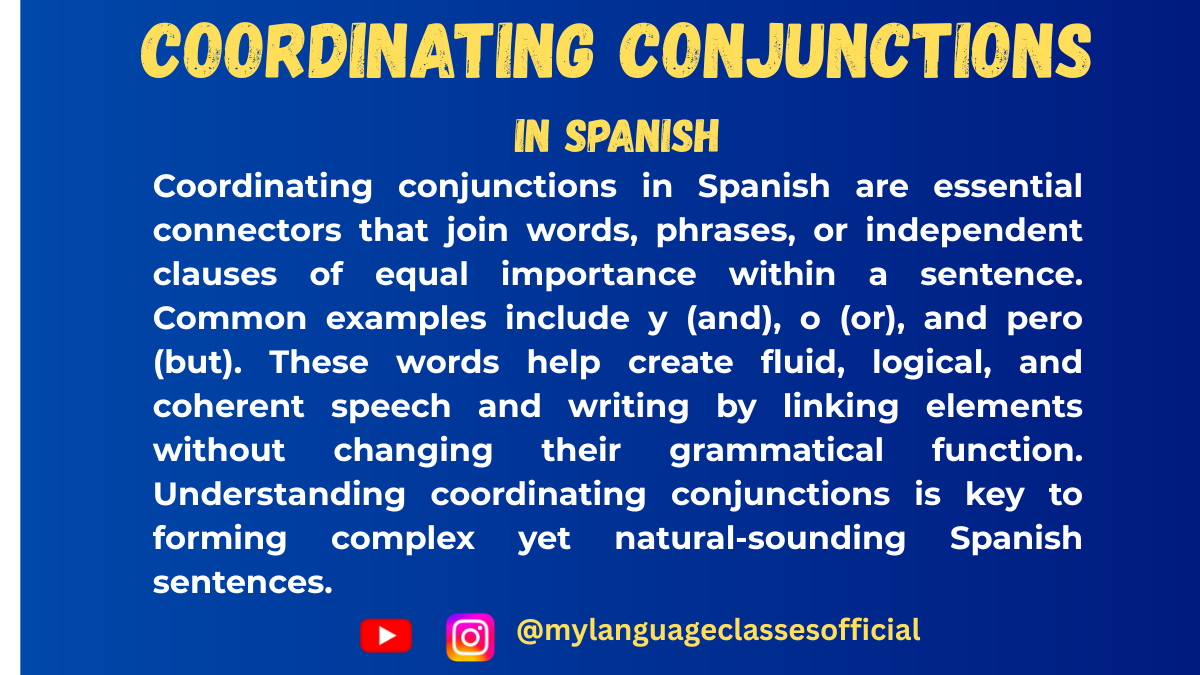
Coordinating conjunctions (conjunciones coordinantes) in Spanish are essential for connecting words, phrases, and clauses that are grammatically equal. They help create fluid and coherent speech and writing. This article will explain the main coordinating conjunctions in Spanish, their uses, and common expressions that feature them in everyday conversation.
Types of Coordinating Conjunctions
Spanish coordinating conjunctions are categorized into four main types:
- Copulative Conjunctions (Conjunciones Copulativas) – Used to add information.
- Disjunctive Conjunctions (Conjunciones Disyuntivas) – Used to offer alternatives.
- Adversative Conjunctions (Conjunciones Adversativas) – Used to express contrast.
- Distributive Conjunctions (Conjunciones Distributivas) – Used to indicate alternation or distribution.
List of Common Coordinating Conjunctions with Examples
| Conjunction | Type | Meaning | Example Sentences |
|---|---|---|---|
| y | Copulative | and | Me gusta el café y el té. (I like coffee and tea.) |
| e | Copulative | and (used before words starting with ‘i’ or ‘hi’) | Estudia inglés e italiano. (He studies English and Italian.) |
| ni | Copulative | neither/nor | No quiero comer ni beber. (I don’t want to eat or drink.) |
| o | Disjunctive | or | ¿Quieres café o té? (Do you want coffee or tea?) |
| u | Disjunctive | or (used before words starting with ‘o’ or ‘ho’) | Prefieres ocho u once manzanas? (Do you prefer eight or eleven apples?) |
| pero | Adversative | but | Quiero ir, pero no tengo tiempo. (I want to go, but I don’t have time.) |
| sino | Adversative | but rather | No quiero café, sino té. (I don’t want coffee, but rather tea.) |
| mas | Adversative | but (formal) | Tengo dinero, mas no lo gastaré. (I have money, but I will not spend it.) |
| bien… bien… | Distributive | either… or… | Bien estudias, bien trabajas. (Either you study or you work.) |
| ya… ya… | Distributive | sometimes… sometimes… | Ya canta, ya baila. (Sometimes he sings, sometimes he dances.) |
Detailed Explanation of Key Coordinating Conjunctions
1. Copulative Conjunctions: y, e, ni
- Used to add elements in a sentence.
- ‘e’ is used instead of ‘y’ when the next word starts with ‘i’ or ‘hi’ to avoid phonetic confusion.
- ‘ni’ is used in negative sentences to mean “neither… nor.”
✅ Examples:
- Compré pan y leche. (I bought bread and milk.)
- Estudia francés e italiano. (He studies French and Italian.)
- No tengo hambre ni sed. (I am neither hungry nor thirsty.)
- No quiero ver televisión ni escuchar música. (I don’t want to watch TV nor listen to music.)
2. Disjunctive Conjunctions: o, u
- Used to offer choices or alternatives.
- ‘u’ replaces ‘o’ when the next word starts with ‘o’ or ‘ho’.
✅ Examples:
- ¿Quieres jugo o agua? (Do you want juice or water?)
- Prefieres ocho u once años. (Do you prefer eight or eleven years?)
- ¿Tomamos el autobús o caminamos? (Shall we take the bus or walk?)
3. Adversative Conjunctions: pero, sino, mas
- Used to contrast ideas.
- ‘Sino’ is used after a negative phrase to mean “but rather.”
- ‘Mas’ is a formal way to say “but” (used in literary contexts).
✅ Examples:
- Me gusta la pizza, pero prefiero la pasta. (I like pizza, but I prefer pasta.)
- No compré el vestido, sino los zapatos. (I didn’t buy the dress, but rather the shoes.)
- Quería ir, mas no tenía coche. (I wanted to go, but I didn’t have a car.)
- No es rojo, sino azul. (It’s not red, but rather blue.)
More Example Sentences:
1.María y Juan fueron al cine anoche. (María and Juan went to the movies last night.) – Copulative (y)
2.Pedro e Isabel son hermanos. (Pedro and Isabel are siblings.) – Copulative (e, used before ‘i’ sound)
3.No me gusta el fútbol ni el baloncesto. (I don’t like soccer nor basketball.) – Copulative (ni)
4.¿Quieres leer un libro o ver una película? (Do you want to read a book or watch a movie?) – Disjunctive (o)
5.Necesitamos siete u ocho sillas para la fiesta. (We need seven or eight chairs for the party.) – Disjunctive (u, used before ‘o’ sound)
6.Estaba cansado, pero siguió trabajando. (He was tired, but he kept working.) – Adversative (pero)
7.No compré la manzana, sino la pera. (I didn’t buy the apple, but rather the pear.) – Adversative (sino, after a negative clause)
8.Quería llamarte, mas no tenía batería en el teléfono. (I wanted to call you, but I had no battery on my phone.) – Adversative (mas, formal use of ‘but’)
9.Bien cocina, bien limpia la casa. (Either he cooks, or he cleans the house.) – Distributive (bien… bien…)
10.Ya duerme, ya mira televisión. (Sometimes she sleeps, sometimes she watches TV.) – Distributive (ya… ya…)
These sentences showcase various coordinating conjunctions in different contexts. Let me know in comment if you need more!
Fill in the Blanks Questions:
- Me gustan los perros __ los gatos. (and)
- No quiero sopa __ ensalada. (but rather)
- ¿Quieres agua __ jugo? (or)
- No tengo hambre __ sed. (nor)
- No solo canta, __ también baila. (but also)
- Puedes comer pollo __ pescado. (or)
- No compré un coche, __ una bicicleta. (but rather)
- Salimos temprano, __ llegamos tarde. (but)
- No es un problema fácil, __ difícil. (but rather)
- __ llueve, __ hace sol. (Sometimes… sometimes…)
Answers
- y
- sino
- o
- ni
- sino
- o
- sino
- pero
- sino
- Ya… ya…
Conclusion
Mastering coordinating conjunctions will help you improve sentence flow, coherence, and clarity in Spanish. Keep practicing these expressions in daily conversations!
| Conjunctions in Spanish |
| Coordinating Conjunctions in Spanish: y, o, pero, sino, and Others |
| Subordinating Conjunctions in Spanish: porque, que, cuando, aunque, and Others |

Vikas Kumar is the founder of My Language Classes, a language learning platform dedicated to helping learners develop practical communication skills in Spanish, Japanese, and English through comprehensive grammar guides, structured learning resources, books, and evidence-informed educational content.
At My Language Classes, we believe that successful language learning is built on clarity, consistency, meaningful practice, and a deep understanding of how languages work. Every article is carefully researched and created to simplify complex concepts, provide practical guidance, and help learners develop confidence through real-world communication.
Inspired by the principles behind How Language Learning Really Works, our mission is to make high-quality language learning accessible to learners around the world by providing accurate, trustworthy, and comprehensive resources that support lasting progress, lifelong learning, and meaningful communication.
Leave a Reply