

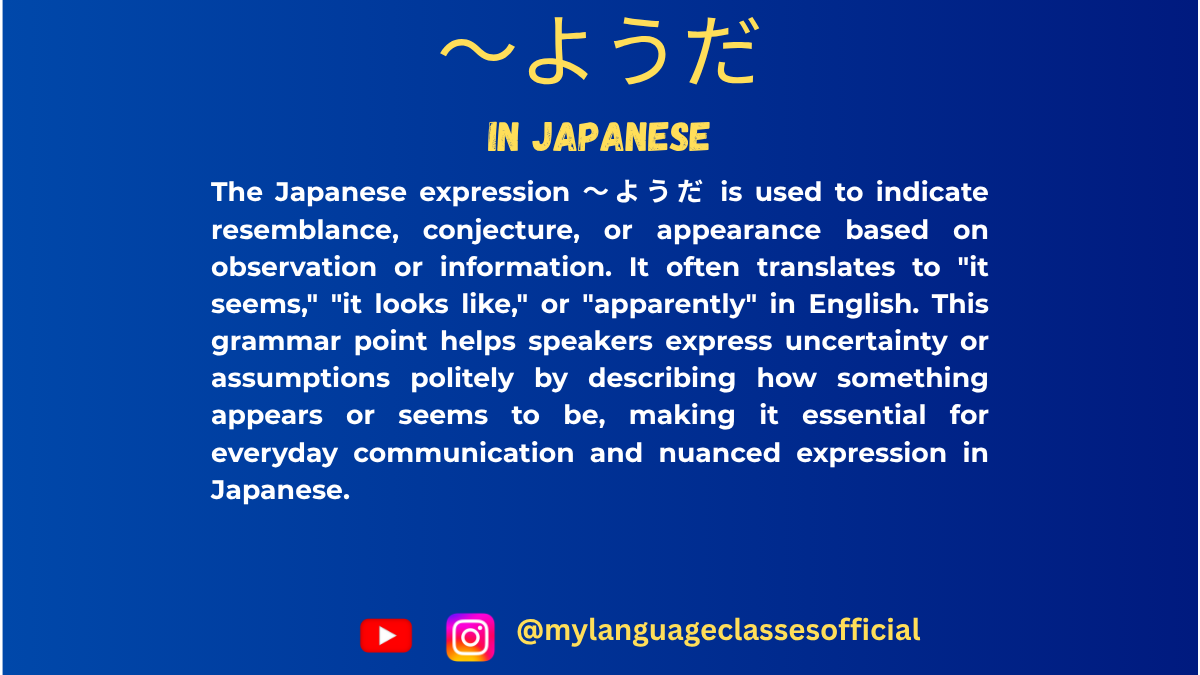
Understanding 〜ようだ in Japanese
The Japanese expression 〜ようだ (you da) is used to indicate resemblance, assumption, or conjecture based on observable evidence. It often translates to “seems like,” “appears to be,” or “looks like” in English. This form is frequently used in both spoken and written Japanese to express an impression based on visual or contextual clues rather than firsthand knowledge.
Formation of 〜ようだ
1. With Verbs:
- Formation:
- Verb (dictionary form) + ようだ
- Verb (ta-form) + ようだ (past tense)
2. With Nouns:
- Formation:
- Noun + のようだ
3. With Adjectives:
- i-Adjectives:
- Adjective (plain form) + ようだ
- na-Adjectives:
- Adjective (stem) + なようだ
Usage of 〜ようだ
- Expressing Appearance – Used when something visually appears a certain way.
- Expressing Similarity – Used to compare something to another thing.
- Expressing Assumption – Used to make an educated guess based on observed facts.
- Expressing Uncertainty – Used to indicate something that is not confirmed.
Situations where 〜ようだ is used
- When making an assumption based on visual clues.
- When describing a person’s behavior resembling something.
- When comparing one thing to another.
- When describing a feeling or state that is not directly observable.
- When indicating a metaphorical expression.
Examples of Verbs, Nouns, and Adjectives with 〜ようだ
| Word Type | Base Word | 〜ようだ Form | Example Sentence | Romaji | Meaning |
|---|---|---|---|---|---|
| Verb | 食べる (taberu) | 食べるようだ | あの子はよく食べるようだ。 | Ano ko wa yoku taberu you da. | That child seems to eat a lot. |
| Verb | 雨が降る (ame ga furu) | 雨が降るようだ | 突然暑くなったから雨が降るようだ。 | Totsuzen atsuku natta kara ame ga furu you da. | It suddenly got hot, so it looks like it’s going to rain. |
| Verb | 走る (hashiru) | 走るようだ | 子供が快速に走るようだ。 | Kodomo ga kaisoku ni hashiru you da. | The child seems to be running fast. |
| Noun | 神様 (kami-sama) | 神様のようだ | 他の行動は神様のようだ。 | Kare no koudou wa kami-sama no you da. | His actions are like those of a god. |
| Adjective | 青い (aoi) | 青いようだ | 水が青いようだ。 | Mizu ga aoi you da. | The water seems to be blue. |
More Example Sentences
- 他の思い通りのようだ。
Tano omoi doori no you da. (It seems to be just as he thought.) - 子供はおなかがすいたようだ。
Kodomo wa onaka ga suita you da. (The child seems to be hungry.) - 家の外は非常に冷たいようだ。
Ie no soto wa hijou ni tsumetai you da. (It seems to be extremely cold outside.)
Things to Keep in Mind
- 〜ようだ is different from 〜そうだ, which is used for hearsay or direct appearance.
- It cannot be used for one’s own direct experiences.
- 〜ようだ can be formal or casual depending on context.
Fill in the Blanks
- 大きな壁が倒れる\u_____
- その人はエンジニア\uの\u_____
- 雨が降りそう\u_____
- 私の猫は子猫の\u_____
- その子は疲れている\u_____
- その風は強い\u_____
- かれの勝利は確実の_____
Answers
- ようだ
- ようだ
- ようだ
- ようだ
- ようだ
- ようだ
- ようだ
Conclusion
〜ようだ is a crucial structure in Japanese that allows speakers to express assumptions, resemblance, and indirect knowledge. Mastering this form helps in making more natural and nuanced statements in Japanese conversations and writing.
Happy learning! 😊

Vikas Kumar is the founder of My Language Classes, a language learning platform dedicated to helping learners develop practical communication skills in Spanish, Japanese, and English through comprehensive grammar guides, structured learning resources, books, and evidence-informed educational content.
At My Language Classes, we believe that successful language learning is built on clarity, consistency, meaningful practice, and a deep understanding of how languages work. Every article is carefully researched and created to simplify complex concepts, provide practical guidance, and help learners develop confidence through real-world communication.
Inspired by the principles behind How Language Learning Really Works, our mission is to make high-quality language learning accessible to learners around the world by providing accurate, trustworthy, and comprehensive resources that support lasting progress, lifelong learning, and meaningful communication.
Leave a Reply