

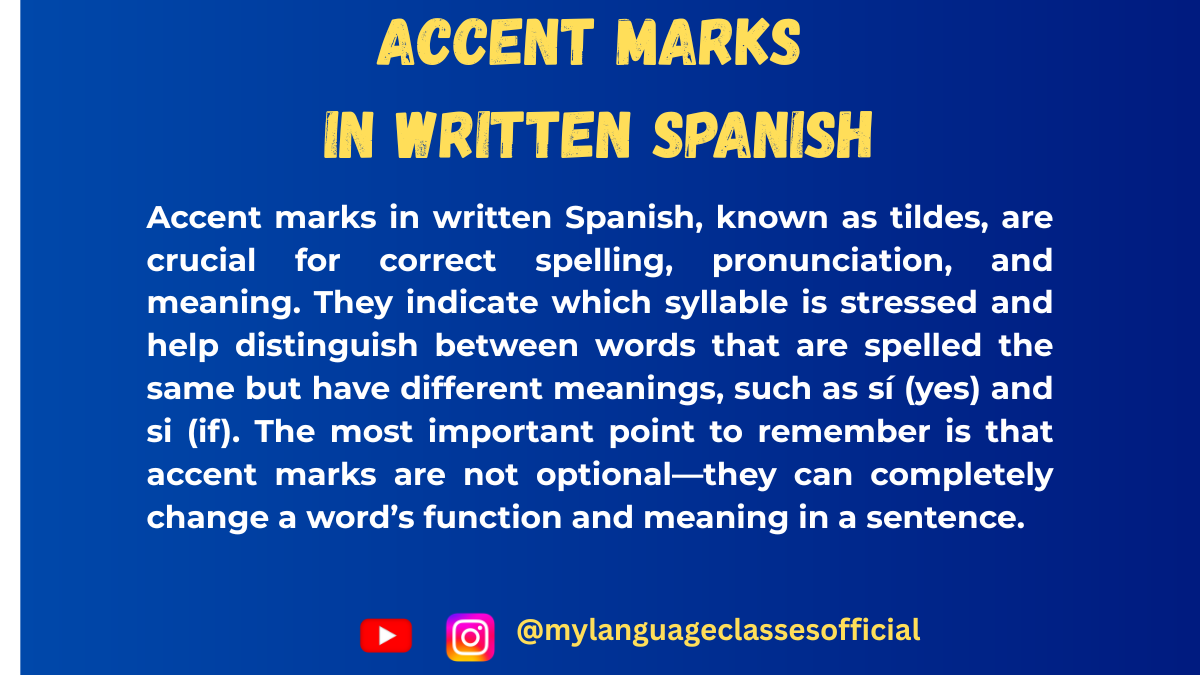
Spanish is a phonetic language, meaning words are pronounced as they are written. However, the correct use of accent marks (tildes) is crucial to ensuring clarity and avoiding misunderstandings. Accent marks in Spanish are not just decorative; they indicate stress and, in some cases, distinguish words that are otherwise spelled the same but have different meanings. Let’s explore how to use accent marks correctly and why they are so important.
The Importance of Accent Marks in Written Spanish
Accent marks can completely change the meaning of a word. For example:
- tú (you) vs. tu (your)
- Tú tienes un coche nuevo. (You have a new car.)
- Tu coche es nuevo. (Your car is new.)
- sí (yes) vs. si (if)
- Sí, quiero ir al cine. (Yes, I want to go to the movies.)
- Si quieres, podemos ir al cine. (If you want, we can go to the movies.)
- más (more) vs. mas (but)
- Quiero más azúcar en mi café. (I want more sugar in my coffee.)
- Quería ir, mas no pude. (I wanted to go, but I couldn’t.)
As you can see, missing an accent mark or placing one where it doesn’t belong can lead to confusion and change the meaning of a sentence entirely.
Rules for Using Accent Marks in Spanish
1. Words That Follow Natural Stress Rules (No Accent Mark Needed)
Spanish words naturally follow two stress rules:
- If a word ends in a vowel, ‘n’, or ‘s’, the stress falls on the second-to-last syllable.
- Example: casa (house), lápices (pencils), comen (they eat)
- If a word ends in any other consonant (except ‘n’ or ‘s’), the stress falls on the last syllable.
- Example: hotel (hotel), reloj (watch)
When words do not follow these natural stress rules, an accent mark is needed.
2. Words That Break the Natural Stress Rules (Require an Accent Mark)
- Example: canción (song), teléfono (telephone), inglés (English)
3. Differentiating Homonyms (Diacritical Marks)
Certain words have the same spelling but different meanings, distinguished by an accent mark:
- tú (you) vs. tu (your)
- sí (yes) vs. si (if)
- éste (this one) vs. este (this)
- qué (what) vs. que (that)
Example Sentences:
- ¿Qué quieres hacer? (What do you want to do?)
- Dijo que vendría. (He said that he would come.)
4. Interrogative and Exclamatory Words Need an Accent
Question words always have an accent mark:
- ¿Cómo te llamas? (What’s your name?)
- ¡Qué sorpresa! (What a surprise!)
5. Monosyllabic Words Usually Do Not Carry an Accent
Single-syllable words generally do not take an accent, except when distinguishing homonyms:
- tú (you) vs. tu (your)
- mí (me) vs. mi (my)
6. Accent Marks in Verb Forms
Verbs in the preterite and commands often require accents:
- está (he/she/it is) vs. esta (this)
- dé (give) vs. de (of, from)
Things to Keep in Mind
- Accent marks are essential and can change the meaning of a word completely.
- Follow natural stress rules and apply accents when needed.
- Learn and memorize common homonyms with accents.
- Question words always require an accent.
- Verb forms often require accents to maintain clarity.
Fill in the Blanks
- ___ (Tu/Tú) eres muy amable.
- No sé ___ (si/sí) puedo ir mañana.
- Me gusta este libro, pero prefiero ___ (aquel/aquél).
- No entiendo qué quiere decir ___ (mas/más).
- Voy a comprar ___ (mi/mí) coche nuevo.
- ¿___ (Que/Qué) hora es?
- Espero que Juan me ___ (dé/de) un consejo.
- No sé si ella está aquí ___ (aun/aún).
- ¿Te gusta el ___ (café/cafe)?
- Mi hermano siempre ___ (está/esta) ocupado.
Answers
- Tú eres muy amable.
- No sé si puedo ir mañana.
- Me gusta este libro, pero prefiero aquel.
- No entiendo qué quiere decir más.
- Voy a comprar mi coche nuevo.
- ¿Qué hora es?
- Espero que Juan me dé un consejo.
- No sé si ella está aquí aún.
- ¿Te gusta el café?
- Mi hermano siempre está ocupado.
Conclusion
Mastering accent marks in Spanish is essential for clear communication. A missing or misplaced accent can change the meaning of a word completely and lead to confusion. By understanding the rules and practicing regularly, you can improve your written Spanish and avoid common mistakes. Always double-check accent marks, especially in homonyms and verbs, to ensure your writing is accurate and professional. ¡Buena suerte!

Vikas Kumar is the founder of My Language Classes, a language learning platform dedicated to helping learners develop practical communication skills in Spanish, Japanese, and English through comprehensive grammar guides, structured learning resources, books, and evidence-informed educational content.
At My Language Classes, we believe that successful language learning is built on clarity, consistency, meaningful practice, and a deep understanding of how languages work. Every article is carefully researched and created to simplify complex concepts, provide practical guidance, and help learners develop confidence through real-world communication.
Inspired by the principles behind How Language Learning Really Works, our mission is to make high-quality language learning accessible to learners around the world by providing accurate, trustworthy, and comprehensive resources that support lasting progress, lifelong learning, and meaningful communication.
Leave a Reply