

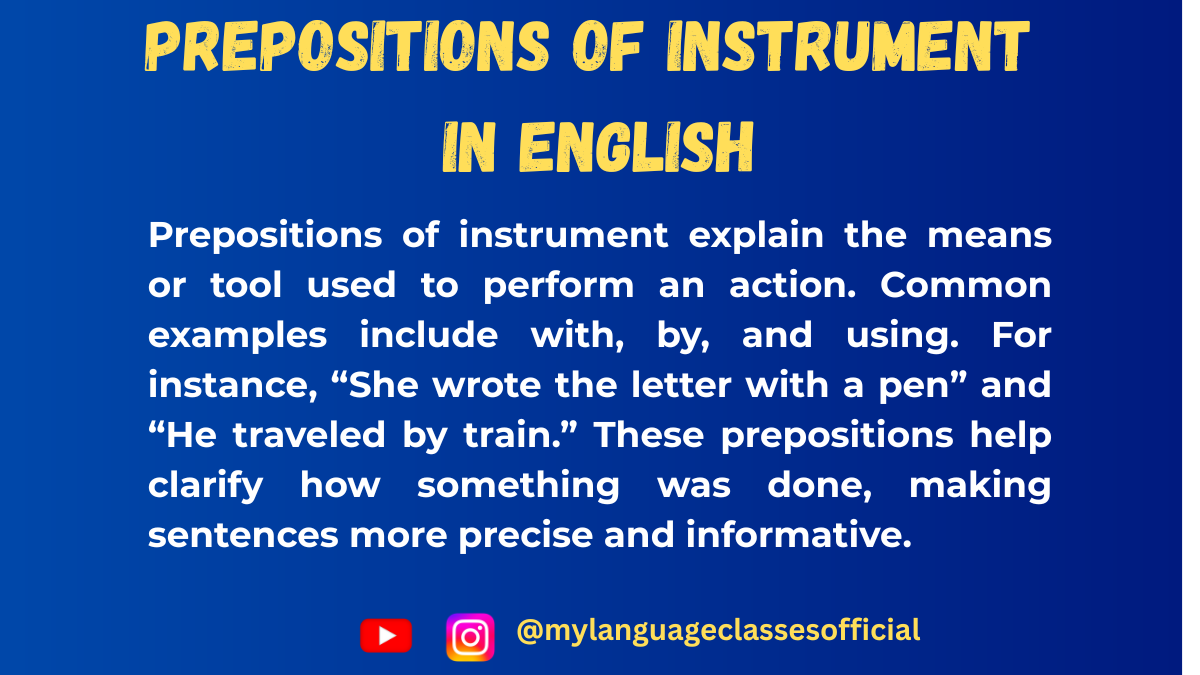
Prepositions of Instrument in English
Prepositions of instrument are used to indicate the means or tools used to perform an action. These prepositions show how something happens or is achieved. They are crucial in English grammar, as they help provide clarity in sentences.
Usage of Prepositions of Instrument
Prepositions of instrument are used in various situations, such as:
- With Tools or Instruments – Used when referring to a tool or instrument that helps complete an action.
- With Modes of Transport – Used when talking about how someone travels.
- With Means of Communication – Used when referring to ways of sending or receiving information.
- With Body Parts – Used when describing actions performed using body parts.
- With Natural Forces – Used when mentioning how something is affected by nature.
- With Materials or Substances – Used to describe the material used to create something.
- With Assistance – Used when referring to a person or thing that helps achieve something.
- With Measurement and Currency – Used when expressing amounts or ways of measuring.
List of Prepositions of Instrument
| Preposition | Example Sentence 1 | Example Sentence 2 |
|---|---|---|
| by | She wrote the letter by hand. | He traveled by car. |
| with | He cut the paper with scissors. | She painted the wall with a brush. |
| through | They communicated through email. | The water flows through the pipe. |
| using | He solved the problem using a calculator. | She opened the door using a key. |
| by means of | The data was transferred by means of a USB drive. | He escaped by means of a secret tunnel. |
| via | The message was sent via email. | We traveled via London. |
| on | She swore on her mother’s life. | He played a song on the piano. |
| in | The message was written in ink. | She expressed her feelings in words. |
| through the use of | The document was signed through the use of an electronic pen. | The problem was solved through the use of technology. |
| by way of | They reached the village by way of the river. | He sent the package by way of courier. |
More Example Sentences
- She cut the vegetables with a sharp knife.
- He sent me a message via WhatsApp.
- The report was written in pencil.
- We traveled to the city by train.
- He operates the machine using a remote control.
- She delivered the speech through a microphone.
- The bridge collapsed by means of an explosion.
- The poem was written on a piece of parchment.
- The artist sketched the portrait with charcoal.
- They recorded the lecture through the use of a digital recorder.
Fill in the Blanks
- He fixed the broken chair ___ a hammer.
- She traveled to Paris ___ plane.
- The students communicated ___ email.
- He ate the soup ___ a spoon.
- The announcement was made ___ a loudspeaker.
- The letter was written ___ a ballpoint pen.
- They cut the paper ___ scissors.
- The transaction was completed ___ an online payment system.
- The thief entered the house ___ a secret passage.
- The message was transmitted ___ radio waves.
Answers
- with
- by
- through
- with
- through
- in
- with
- using
- by means of
- via
Things to Keep in Mind
- Prepositions of instrument often indicate the method, means, or tools used to perform an action.
- Some prepositions, like by and with, are commonly interchangeable but depend on context.
- The choice of preposition can sometimes depend on the verb in the sentence.
- Articles (a, an, the) may be required before the instrument (e.g., “with a knife”).
- Gender does not play a role in English prepositions, unlike some other languages.
Conclusion
Prepositions of instrument are essential in English to convey how actions are performed. Understanding their correct usage will help improve clarity and precision in communication. By mastering these prepositions, learners can express themselves more effectively in various situations, whether discussing tools, travel, communication, or assistance.

Vikas Kumar is the founder of My Language Classes, a language learning platform dedicated to helping learners develop practical communication skills in Spanish, Japanese, and English through comprehensive grammar guides, structured learning resources, books, and evidence-informed educational content.
At My Language Classes, we believe that successful language learning is built on clarity, consistency, meaningful practice, and a deep understanding of how languages work. Every article is carefully researched and created to simplify complex concepts, provide practical guidance, and help learners develop confidence through real-world communication.
Inspired by the principles behind How Language Learning Really Works, our mission is to make high-quality language learning accessible to learners around the world by providing accurate, trustworthy, and comprehensive resources that support lasting progress, lifelong learning, and meaningful communication.
Leave a Reply