

Understanding aquí, ahí, allí in Spanish is one of the most important early steps for any learner. These three small words help you point to people, objects, and places. They show where things are. Yet many beginners feel confused about which one to use. This guide will help you understand them in a clear and friendly way, with simple examples that feel natural and easy to remember.
What These Words Really Mean
When you speak Spanish, you often need to talk about things that are close to you, a little far, or very far. These words help you do exactly that:
- Aquí → Here
- Ahí → There (near the listener or slightly away)
- Allí → There (farther away)
They seem similar, but each one shows a different level of distance. Spanish uses these distance markers much more clearly than English. Once you learn the pattern, everything becomes simple and fun.
Understanding “Aquí” — When Something Is Close to You
Aquí means here. Use it for things very close to you. Imagine something you can touch or reach easily. In daily life, Spanish speakers use aquí when an object is right in front of them.
Examples
- “El libro está aquí.” → The book is here.
- “Pon tu mochila aquí.” → Put your backpack here.
- “Estoy aquí.” → I am here.
Easy way to remember
Think of aquí as your personal space. If you can stretch your arm and almost touch the object, aquí is the right word.
More helpful examples
- “Mis llaves están aquí en la mesa.”
- “Ven aquí, por favor.”
When reading Spanish books or watching Spanish shows, you’ll notice aquí used in moments when someone calls another person close to them. It’s simple and very common in conversations.
Understanding “Ahí” — When Something Is a Short Distance Away
Ahí means there, but only a little bit away. Think of something near the listener or in the same room, but not next to you. This tiny change in distance matters in Spanish conversation.
Examples
- “La botella está ahí.” → The bottle is there.
- “Tu teléfono está ahí en el sofá.”
- “Siéntate ahí.” → Sit there.
Easy way to remember
If you can point to something without moving from your spot, ahí is often the correct choice. You see it. You can point to it. But it’s not right next to you.
More helpful examples
- “El perro está ahí, junto a la puerta.”
- “Mira, hay un mensaje ahí.”
Many Spanish learners notice that native speakers use ahí in shops, restaurants, and classrooms. It’s the word people choose when giving simple directions indoors.
Understanding “Allí” – When Something Is Farther Away
Allí also means there, but it refers to something far from both the speaker and listener. Imagine something on the other side of the room, across a street, or at some distance outdoors. Native speakers use allí when the distance feels clear.
Examples
- “La escuela está allí.” → The school is there.
- “Puedes ver el parque allí.”
- “Ellos viven allí, en esa casa grande.”
Easy way to remember
If you need to walk toward something, it’s usually allí. Think of a spot that is visible but not reachable from where you stand.
More helpful examples
- “Mis amigos están allí esperando.”
- “Los niños juegan allí, en la esquina.”
Writers and teachers often explain allí using scenes from daily life—like pointing to mountains or buildings visible from far away. This helps learners build a strong mental picture.
Comparing Aquí, Ahí, and Allí Side by Side
A simple comparison can help you see everything clearly:
| Word | Meaning | Distance | Example Sentence |
|---|---|---|---|
| Aquí | Here | Very close | “Estoy aquí contigo.” |
| Ahí | There | A short distance | “Tu cuaderno está ahí.” |
| Allí | There | Far away | “El restaurante está allí.” |
This pattern repeats across many Spanish conversations. Once you get used to the idea of distance, choosing the right word feels natural.
Mini Practice: Choose the Right Word
Try these quick practice lines. Say the answers out loud to build confidence.
- You are holding a pen. “El bolígrafo está ___.”
- Your friend sees a chair across the room. “La silla está ___.”
- You point to a bag next to your friend. “La bolsa está ___.”
Suggested answers:
- aquí
- allí
- ahí
If your answers match, you already understand the idea. Keep practicing for a few minutes daily, and you’ll master these words faster than you expect.
How Native Speakers Use These Words in Real Conversations
Spanish speakers often use body language with these words. They may point, nod, or gesture. You will see aquí, ahí, and allí used often in markets, schools, neighborhoods, and even in casual chats.
Real-life snippets
- A teacher in class might say: “Escribe tu nombre aquí.”
- A shopkeeper may point and say: “La leche está ahí.”
- A friend showing you a landmark might say: “El museo está allí.”
If you notice how people move when they say these words, you’ll learn even faster.
Some Spanish textbooks and language resources explain these terms with maps and diagrams. This approach works because distance is the main idea behind them. You can also explore beginner-friendly Spanish guides from trusted educational platforms when you want more visual examples.
Common Mistakes and How to Avoid Them
Beginners often mix up ahí and allí because both translate to the same English word: “there.” To avoid mistakes, focus on distance, not English translations.
Helpful tips
- Use aquí only when something is right next to you.
- Use ahí for something near the listener or within the same close area.
- Use allí when something is farther away and clearly separated by distance.
Watch out for this
Sometimes you may hear allá, which is similar to allí, but often used for even farther or general areas. This guide focuses only on aquí, ahí, and allí to keep things simple.
Quick Memory Trick
Here’s a simple way to remember the order:
- Aquí → Around you
- Ahí → Almost close
- Allí → Away
Since they all begin with “A,” attach them to the world around you and think of the increasing distance.
Practice With Daily Objects
Here’s a short activity you can do at home. It helps your brain link the Spanish word to the real position of objects.
Pick five things in your room:
- Phone
- Glass
- Bag
- Laptop
- Book
Place one near you, one a little away, and one at a far point. Then make simple sentences:
- “El teléfono está aquí.”
- “El vaso está ahí.”
- “La bolsa está allí.”
Repeating this daily builds strong habits and improves your confidence.
Key Takeaways
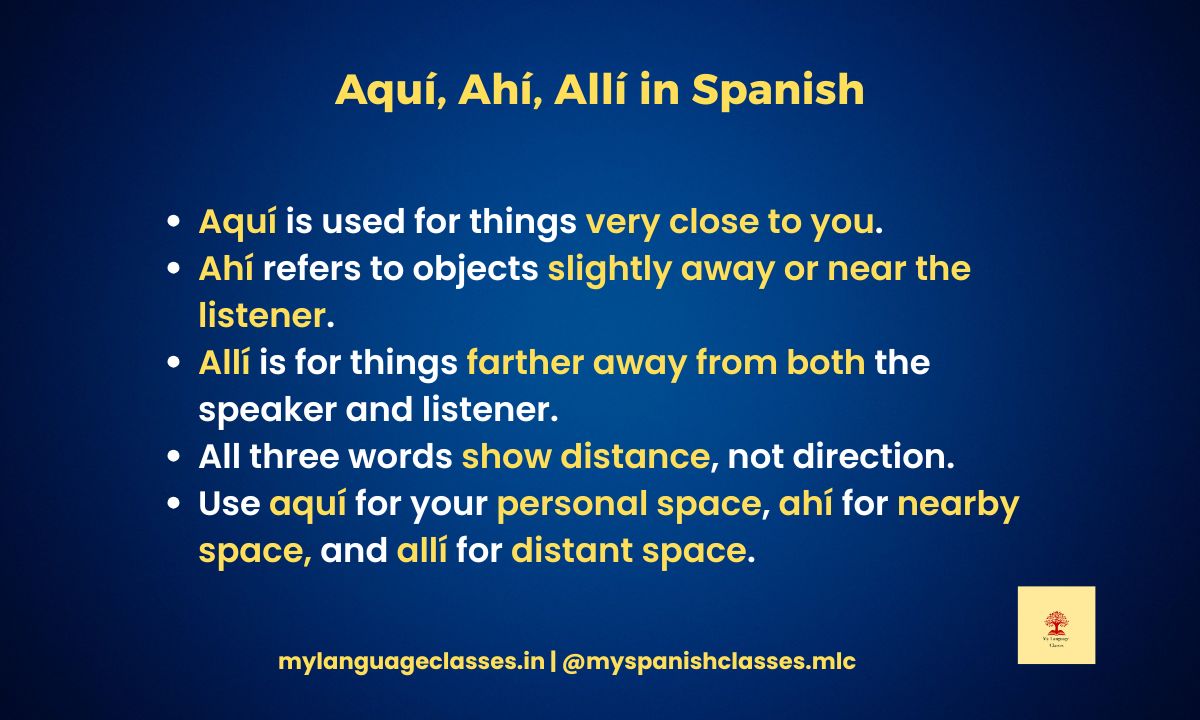
- Aquí is used for things very close to you.
- Ahí refers to objects slightly away or near the listener.
- Allí is for things farther away from both the speaker and listener.
- All three words show distance, not direction.
- Use aquí for your personal space, ahí for nearby space, and allí for distant space.
- Practice with real objects around you to build strong habits.
- Pay attention to gestures when native speakers use these words.
- Choosing the right word becomes easier when you focus on the level of distance.
Final Wrap-Up
Now you know how to use aquí, ahí, and allí in simple, clear ways. These small words are big helpers in Spanish conversation. With practice, you’ll use them naturally when talking about places, objects, and directions. Keep listening to native speakers, observe their gestures, and practice with real-life objects around you.

Vikas Kumar is the founder of My Language Classes, a language learning platform dedicated to helping learners develop practical communication skills in Spanish, Japanese, and English through comprehensive grammar guides, structured learning resources, books, and evidence-informed educational content.
At My Language Classes, we believe that successful language learning is built on clarity, consistency, meaningful practice, and a deep understanding of how languages work. Every article is carefully researched and created to simplify complex concepts, provide practical guidance, and help learners develop confidence through real-world communication.
Inspired by the principles behind How Language Learning Really Works, our mission is to make high-quality language learning accessible to learners around the world by providing accurate, trustworthy, and comprehensive resources that support lasting progress, lifelong learning, and meaningful communication.
Leave a Reply