

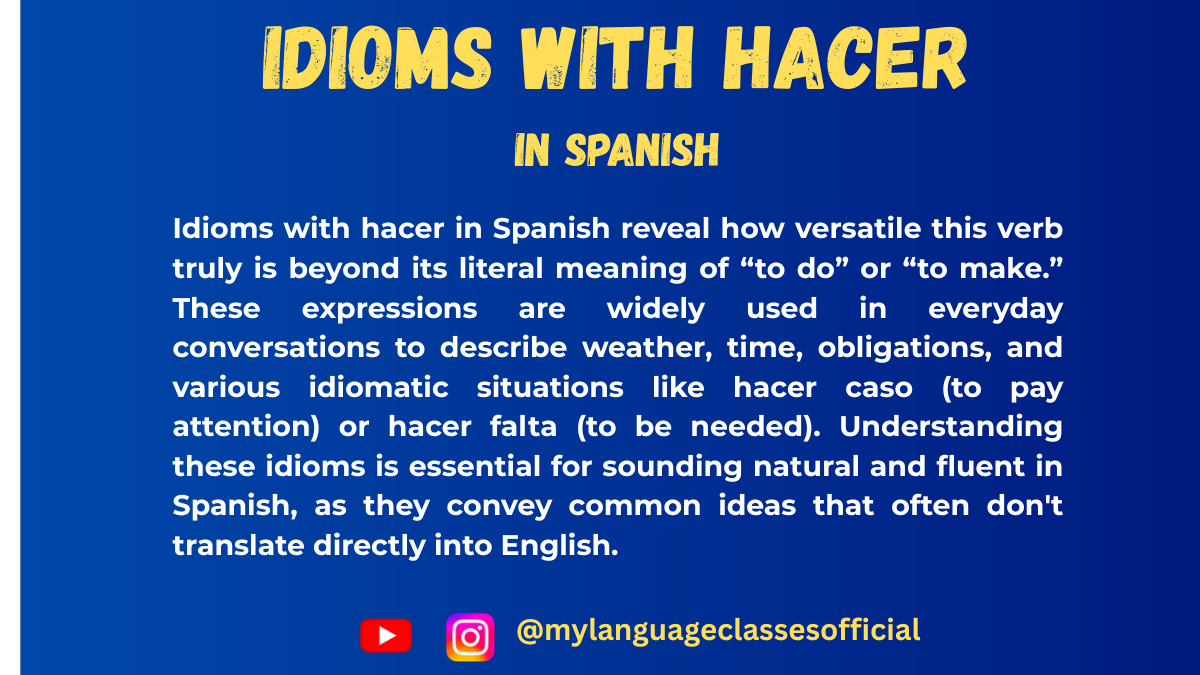
Expressions, Idioms, and Proverbs with the Verb “Hacer”
When learning Spanish, understanding the verb hacer (to do or to make) is essential due to its versatile use in daily conversation. Beyond its literal meanings, hacer is also deeply ingrained in various idiomatic expressions and proverbs, which add richness and nuance to the language. Below, we’ll explore common expressions with hacer, their meanings, example sentences, and usage considerations.
1. Basic Uses of Hacer
Hacer can mean “to do” or “to make,” depending on the context. It conjugates irregularly, so it’s crucial to memorize its forms.
Present tense conjugation:
- Yo hago
- Tú haces
- Él/Ella/Usted hace
- Nosotros/Nosotras hacemos
- Vosotros/Vosotras hacéis
- Ellos/Ellas/Ustedes hacen
Examples:
- Yo hago la cena. (I make dinner.)
- ¿Qué haces? (What are you doing?)
2. Common Expressions with Hacer
These are widely used in everyday life and add a natural touch to your Spanish.
Hacer falta – To need/lack
- Meaning: Indicates something is missing or needed.
- Example: Nos hace falta más tiempo para terminar.
(We need more time to finish.)
Hacer caso (de/a) – To pay attention (to)
- Meaning: To heed or follow advice/instructions.
- Example: No hizo caso de mis advertencias.
(He didn’t pay attention to my warnings.)
Hacer daño – To harm/hurt
- Meaning: Refers to causing physical or emotional harm.
- Example: Comer tantos dulces te hará daño.
(Eating so many sweets will harm you.)
Hacer cola – To stand in line
- Meaning: To queue up.
- Example: Tuvimos que hacer cola durante dos horas.
(We had to stand in line for two hours.)
Hacer el papel de – To play the role of
- Meaning: Used in the context of acting or pretending.
- Example: En la obra, ella hace el papel de la reina.
(In the play, she plays the role of the queen.)
Hacer las paces – To make peace
- Meaning: To reconcile after a conflict.
- Example: Decidieron hacer las paces después de la discusión.
(They decided to make peace after the argument.)
Hacer ejercicio – To exercise
- Meaning: Refers to physical activity.
- Example: Hago ejercicio todos los días para mantenerme en forma.
(I exercise every day to stay in shape.)
Hacer buen/mal tiempo – To have good/bad weather
- Meaning: Describes the weather conditions.
- Example: Hoy hace buen tiempo; vamos a la playa.
(The weather is nice today; let’s go to the beach.)
Hacer una pregunta – To ask a question
- Meaning: Standard way of expressing “to ask.”
- Example: ¿Puedo hacerte una pregunta?
(Can I ask you a question?)
Hacer la vista gorda – To turn a blind eye
- Meaning: To ignore something intentionally.
- Example: El profesor hizo la vista gorda ante el ruido en clase.
(The teacher turned a blind eye to the noise in class.)
Hacer de las suyas – To be up to one’s usual antics
- Meaning: Indicates mischief or habitual behavior.
- Example: Juan está haciendo de las suyas otra vez.
(Juan is up to his usual antics again.)
Hacer hincapié en – To emphasize
- Meaning: To stress or underline importance.
- Example: Debemos hacer hincapié en la calidad del proyecto.
(We must emphasize the quality of the project.)
3. Proverbs with Hacer
These proverbs reflect cultural wisdom and are used in both formal and informal contexts.
El que algo quiere, algo le cuesta.
(If you want something, it will cost you something.)
- Highlights the effort required to achieve goals.
Hacerse el tonto.
(To play dumb.)
- Used to describe someone pretending not to understand.
Hacer de tripas corazón.
(To make a heart out of guts.)
- Means to muster courage in difficult times.
Hacer la cama y acostarse en ella.
(Make the bed and lie in it.)
- Suggests accepting the consequences of one’s actions.
4. Things to Keep in Mind
Gender and Number Agreement
While hacer itself doesn’t change based on gender or number, the articles or adjectives accompanying nouns do. For instance:
- Hice una pregunta interesante. (I asked an interesting question.)
- Hicimos muchas tareas complicadas. (We did many complicated tasks.)
Tense Considerations
The meaning of expressions with hacer can vary depending on the tense:
- Present: ¿Qué haces? (What are you doing?)
- Preterite: Hice una llamada. (I made a call.)
- Future: Haré lo necesario. (I will do what is necessary.)
Reflexive Use
Some expressions use the reflexive form:
- Hacerse tarde – (To become late)
- Example: Se está haciendo tarde; vámonos.
(It’s getting late; let’s go.)
- Example: Se está haciendo tarde; vámonos.
5. Practice Tips
- Context is key: Pay attention to the situation to determine the correct meaning of hacer.
- Memorize expressions: Learn idioms in chunks, as they often don’t translate literally.
- Immerse yourself: Use these expressions in conversation to solidify their meanings.
By mastering hacer and its many uses, you’ll enrich your Spanish vocabulary and sound more fluent in everyday conversations. Happy learning!

Vikas Kumar is the founder of My Language Classes, a language learning platform dedicated to helping learners develop practical communication skills in Spanish, Japanese, and English through comprehensive grammar guides, structured learning resources, books, and evidence-informed educational content.
At My Language Classes, we believe that successful language learning is built on clarity, consistency, meaningful practice, and a deep understanding of how languages work. Every article is carefully researched and created to simplify complex concepts, provide practical guidance, and help learners develop confidence through real-world communication.
Inspired by the principles behind How Language Learning Really Works, our mission is to make high-quality language learning accessible to learners around the world by providing accurate, trustworthy, and comprehensive resources that support lasting progress, lifelong learning, and meaningful communication.
Leave a Reply