

If you want to become confident in Spanish, building a strong grammar foundation is one of the best investments you can make. A solid foundation is not created by learning hundreds of grammar rules or finishing dozens of lessons as quickly as possible. It is built by understanding the fundamentals, practicing them regularly, and allowing each new concept to grow naturally from the previous one.
Many beginners believe they need to study more to improve. In reality, they often need a better learning structure instead. When grammar is introduced in a logical sequence, it becomes much easier to understand, remember, and use in real conversations. Instead of feeling like a collection of disconnected rules, Spanish begins to feel like a language that follows clear and predictable patterns.
At My Language Classes, we believe that long-term success comes from understanding how the language works rather than memorizing isolated grammar points. This learner-first approach is reflected in the How Language Learning Really Works philosophy by My Language Classes. Every grammar concept should answer three questions. What does it do? When should you use it? How does it connect with everything you have already learned? Once learners begin thinking this way, grammar becomes far less intimidating and much more practical.
For learners who prefer studying with a structured grammar resource, Mastering Spanish Grammar for DELE A1 is available as an eBook on the My Language Classes website. It is also available on Amazon in Kindle, Paperback, and Hardcover formats, giving learners the flexibility to choose the format that best matches their study habits.
In this guide, you will learn what a strong grammar foundation actually looks like, why many beginners unintentionally build weak foundations, how to study grammar in the right order, and the daily habits that help learners develop lasting confidence in Spanish. Whether your goal is to prepare for the DELE A1 examination, communicate comfortably while traveling, or simply enjoy learning Spanish, these principles will help you build skills that continue supporting your progress for years to come.
What Does a Strong Foundation in Spanish Grammar Actually Mean?
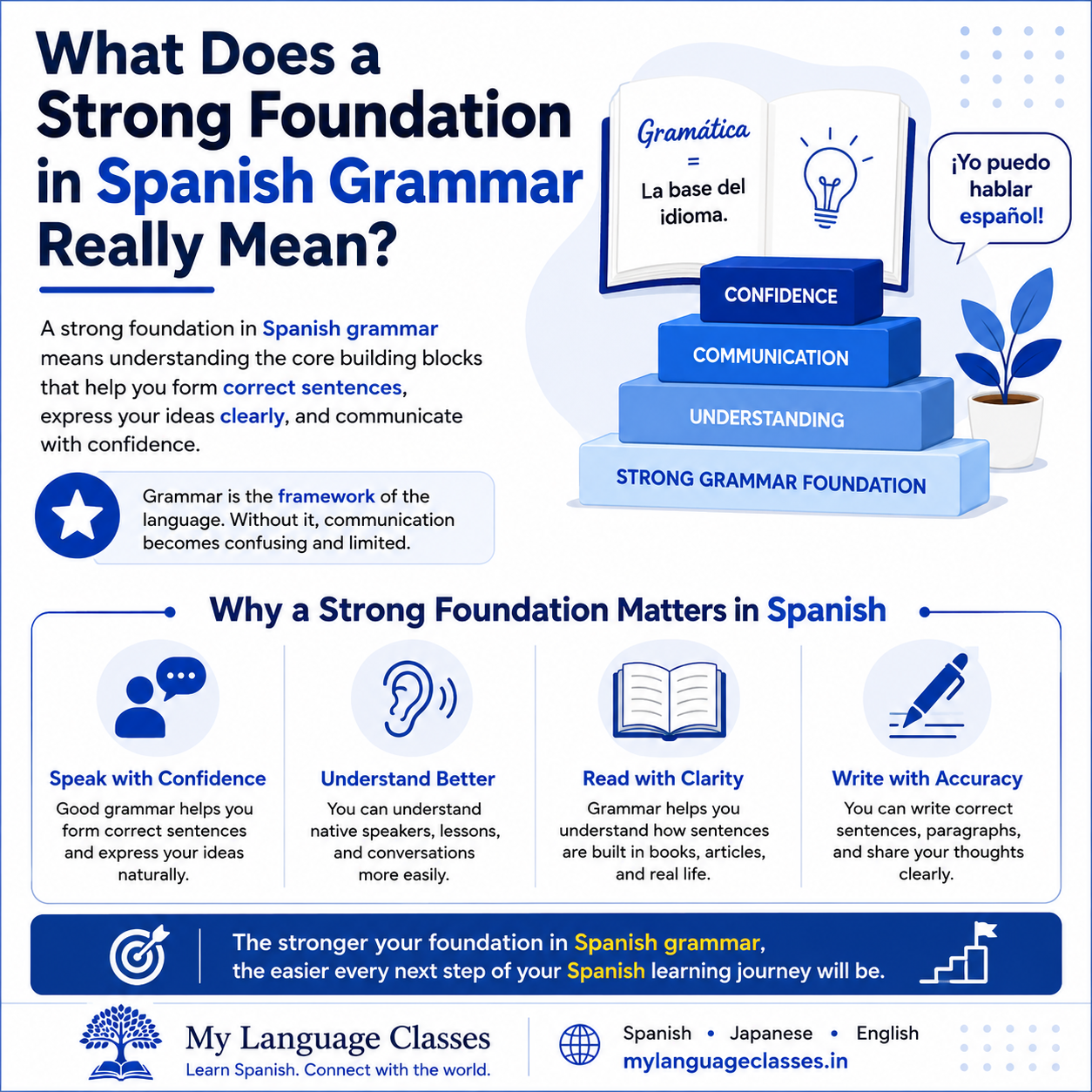
When people hear the phrase “strong grammar foundation,” they often imagine someone who has memorized every verb table and every grammar rule. While grammar knowledge is certainly important, that is not what a strong foundation truly means.
A strong grammar foundation means understanding how Spanish sentences are built and why they are built that way. It means recognizing relationships between words instead of viewing grammar as hundreds of separate rules. When learners understand those relationships, they become much more confident because they can apply grammar in situations they have never practiced before.
Think about constructing a building.
The strength of the building depends on the quality of its foundation. If the foundation is weak, every additional floor becomes more difficult to support. The same principle applies to language learning. Advanced grammar becomes much easier when the basic concepts underneath are clear and well understood.
For example, understanding grammatical gender helps you choose the correct articles and adjective endings. Learning subject pronouns makes verb conjugation easier because you understand why verbs change. Mastering present tense verbs prepares you to describe daily routines, hobbies, work, family, and personal experiences. Every topic supports another.
This is why experienced language teachers often encourage beginners to slow down during the first stages of learning. Spending extra time understanding the fundamentals saves countless hours later because future grammar lessons become easier to understand.
A strong grammar foundation also improves every other language skill.
Reading becomes easier because you recognize familiar sentence structures instead of translating every word individually.
Listening improves because you begin hearing grammar patterns that previously went unnoticed.
Writing becomes more accurate because you understand how sentences should be organized.
Speaking becomes more natural because you are creating sentences instead of relying entirely on memorized phrases.
Many beginners think grammar exists only to pass examinations.
In reality, grammar exists to make communication possible.
Every time you introduce yourself, ask a question, describe your day, express an opinion, or explain your plans, grammar helps organize your thoughts into sentences that other people can understand.
This is why grammar should never be viewed as an academic subject separate from communication.
Grammar is communication.
The stronger your grammar foundation becomes, the easier it becomes to express increasingly complex ideas with confidence.
Another characteristic of a strong grammar foundation is flexibility.
Instead of remembering one fixed sentence, learners understand the pattern behind the sentence.
That understanding allows them to create new sentences independently.
For example, after learning how present tense verbs work, you are no longer limited to repeating examples from a textbook. You can begin describing your own routine, your own interests, your own family, and your own experiences.
This shift from repetition to independent communication is one of the clearest signs that your grammar foundation is becoming stronger.
Perhaps most importantly, a strong grammar foundation reduces anxiety.
Many beginners hesitate to speak because they worry about making mistakes.
While mistakes remain a natural part of learning, understanding the basic structure of the language gives learners confidence to communicate even when they do not know every word.
Confidence grows when learners understand why a sentence works instead of hoping they have remembered it correctly.
That confidence becomes one of the greatest advantages of building a solid foundation from the very beginning.
Why Building a Strong Foundation Matters More Than Learning Quickly
Modern language learning often encourages speed.
Many advertisements promise that you can become fluent in weeks or master grammar in just a few hours. Although these messages are attractive, they rarely reflect how language learning actually works.
Languages are not built through shortcuts.
They are built through understanding.
Trying to learn Spanish grammar as quickly as possible often creates the opposite result. Learners move rapidly through lessons without fully understanding them, only to discover later that they cannot build even simple sentences with confidence.
This experience is surprisingly common.
A learner may complete several grammar chapters and still struggle to introduce themselves naturally because the individual lessons never became connected into one complete system.
Learning quickly is not the same as learning well.
The goal of beginner grammar should never be finishing a chapter.
The goal should be understanding a concept well enough to recognize it, use it, and build upon it in future lessons.
That is why steady progress almost always produces better long-term results than rushed progress.
Every grammar topic you understand today becomes part of the foundation supporting tomorrow’s learning.
Imagine trying to build the second floor of a house before allowing the concrete foundation to set properly.
Even if the construction continues quickly, problems will eventually appear.
Language learning follows the same principle.
Weak fundamentals eventually make advanced grammar feel much more difficult than it needs to be.
On the other hand, learners who invest time building a solid foundation often notice that later topics become easier rather than harder.
They recognize familiar sentence patterns.
They understand why grammar rules exist.
They remember vocabulary more effectively because it appears within meaningful contexts.
Most importantly, they become increasingly independent learners.
Instead of searching for explanations every time they encounter new grammar, they begin connecting new information with concepts they already understand.
That ability to recognize patterns is one of the defining characteristics of successful language learners.
A strong foundation therefore does much more than improve beginner grammar.
It prepares you for every future stage of your Spanish learning journey.
Why Many Beginners Build a Weak Grammar Foundation
Most people who start learning Spanish are highly motivated. They buy books, install language apps, watch online lessons, and begin practicing every day. Yet after several weeks or months, many feel as though they are not making the progress they expected.
This usually does not happen because Spanish grammar is too difficult.
It happens because the foundation was never built properly.
Fortunately, understanding the most common mistakes can help you avoid them from the very beginning.
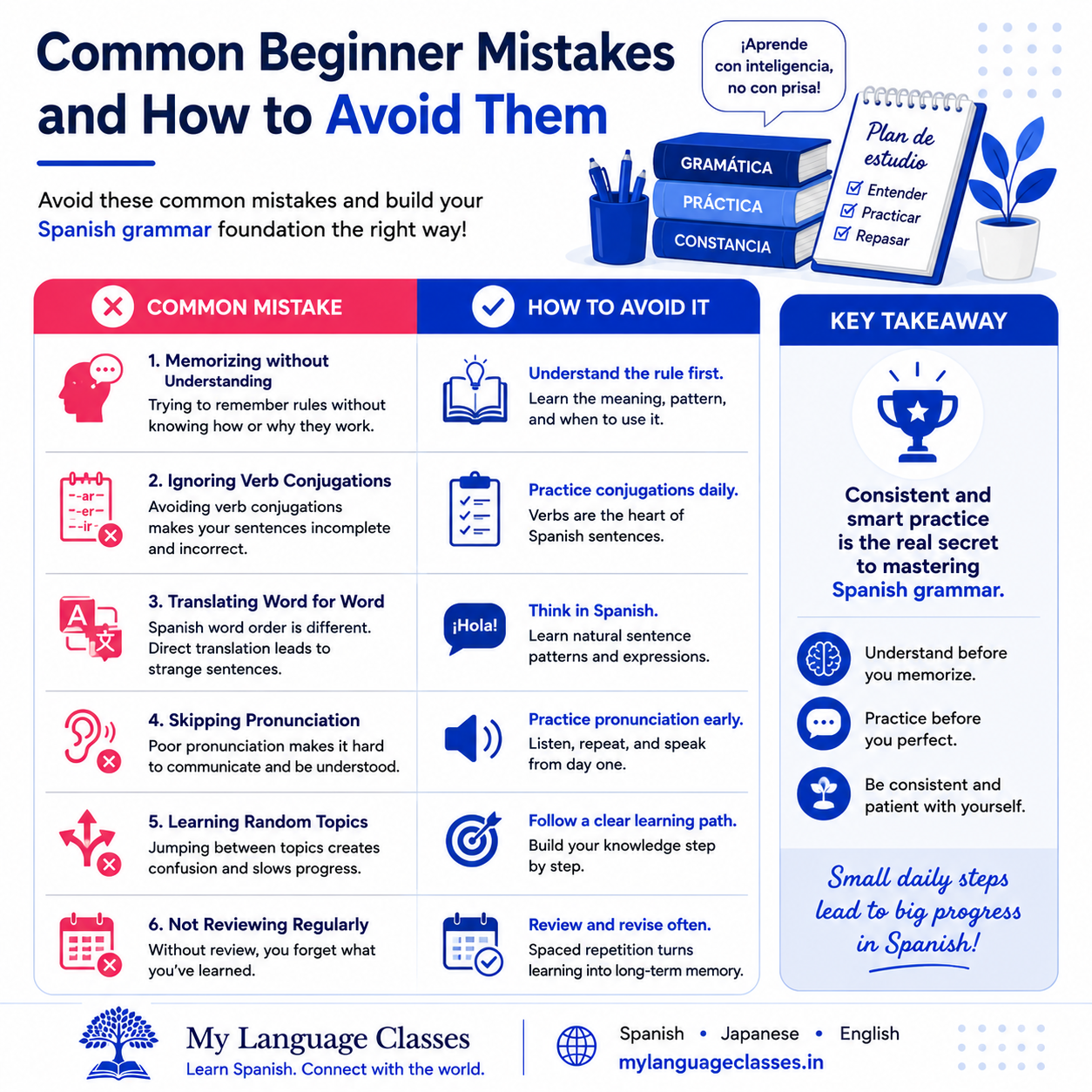
Learning Grammar in a Random Order
One of the biggest reasons beginners struggle is that they learn whatever topic happens to appear in front of them.
One day they study present tense verbs.
The next day they watch a lesson about reflexive verbs.
A few days later they begin learning the difference between “por” and “para.”
Each lesson may be accurate, but accuracy alone is not enough.
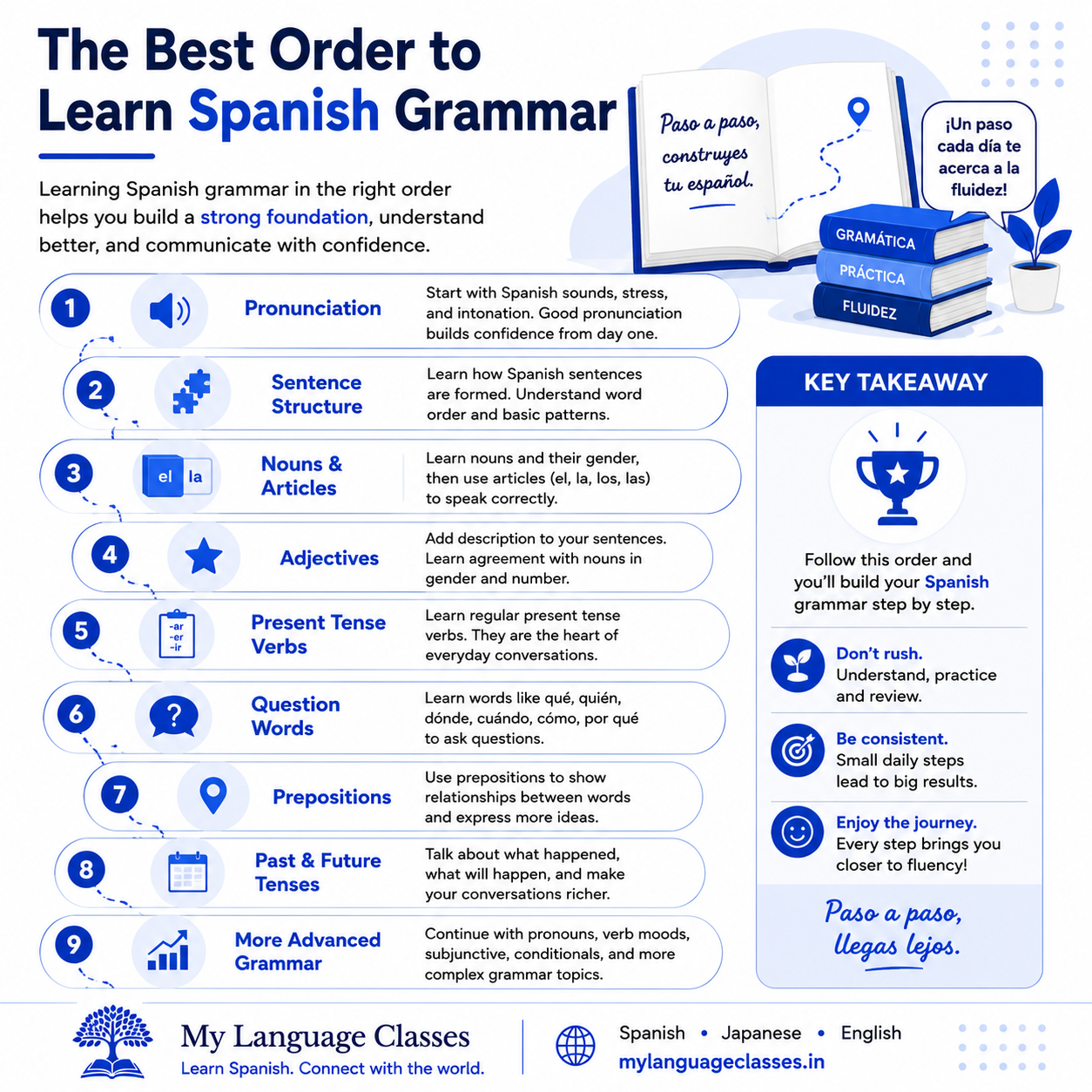
Grammar works best when every topic prepares you for the next one.
For example, understanding nouns makes learning adjectives easier because adjectives describe nouns. Understanding subject pronouns makes verb conjugation much easier because verbs change according to the subject. Learning present tense verbs first makes future communication structures much easier to understand.
When these connections are missing, learners often feel as though every lesson starts from zero.
Instead of building knowledge, they simply collect information.
Memorizing Rules Instead of Understanding Them
Another common mistake is treating grammar like a list of facts that must be memorized.
Many learners believe success comes from remembering every rule exactly as it appears in a textbook.
Although memorization has its place, it cannot replace understanding.
Imagine memorizing the formula for solving a mathematics problem without understanding why the formula works.
You might answer familiar questions correctly, but as soon as the problem changes, you become uncertain.
Language learning works in a similar way.
If you understand why Spanish adjectives change according to gender and number, you can apply that knowledge in thousands of new situations.
If you only memorize one example sentence, your progress remains limited.
Understanding gives you flexibility.
Memorization alone rarely does.
Depending Too Much on Mobile Apps
Language learning apps have made studying more accessible than ever.
They are convenient, engaging, and useful for developing regular study habits.
However, many apps are designed to help learners complete short activities rather than build a complete understanding of grammar.
Lessons are often brief and highly focused.
While this keeps learners motivated, it can also leave important gaps between topics.
Apps work best when they reinforce a structured learning plan instead of replacing one.
Think of them as one tool within a larger learning system rather than the entire learning system itself.
Constantly Changing Learning Resources
Many beginners spend almost as much time searching for the perfect resource as they spend studying.
After completing a few lessons in one book, they discover a new YouTube channel.
A few days later they download another app.
Then they purchase another course because someone recommended it online.
Although every resource may contain valuable information, constantly switching between them interrupts the learning process.
Each author follows a different teaching sequence.
Each explains grammar from a different perspective.
Each assumes a different level of previous knowledge.
As a result, learners often spend more time adjusting to new teaching styles than actually learning Spanish.
Consistency usually produces better results than constantly searching for something better.
A well-organized resource that you complete is far more valuable than five excellent resources that you only use occasionally.
Skipping the Fundamentals
Some learners become impatient with beginner grammar.
They want to speak fluently as quickly as possible, so they skip topics that appear too simple.
Unfortunately, those “simple” topics often become the source of future mistakes.
Grammatical gender.
Articles.
Subject pronouns.
Basic sentence structure.
Present tense verbs.
These concepts may not seem exciting, but they support almost every sentence you will ever create in Spanish.
Skipping them is similar to skipping the foundations of a building because you want to reach the upper floors more quickly.
Eventually, the missing foundation begins creating problems that are much harder to correct.
Avoiding Practice
Reading grammar explanations is important.
Practicing them is equally important.
Some learners enjoy reading about grammar but rarely apply what they have learned.
Others complete exercises without taking time to understand the grammar behind the answers.
Both approaches slow long-term progress.
Grammar develops through repeated use.
Every sentence you read, write, hear, or speak reinforces patterns that gradually become familiar.
Over time, these repeated experiences reduce the amount of conscious effort required to produce correct sentences.
That is why regular practice remains one of the most effective ways to strengthen your grammar foundation.
Expecting Perfect Accuracy Too Early
Many beginners become discouraged because they still make mistakes after studying grammar for several weeks.
This expectation creates unnecessary pressure.
No learner reaches complete accuracy immediately.
Making mistakes is one of the ways your brain tests and strengthens new knowledge.
Every correction helps you understand the language more deeply.
Instead of asking yourself whether you made a mistake, ask a different question.
Did you understand why it was a mistake?
If the answer is yes, then your grammar foundation is already becoming stronger.
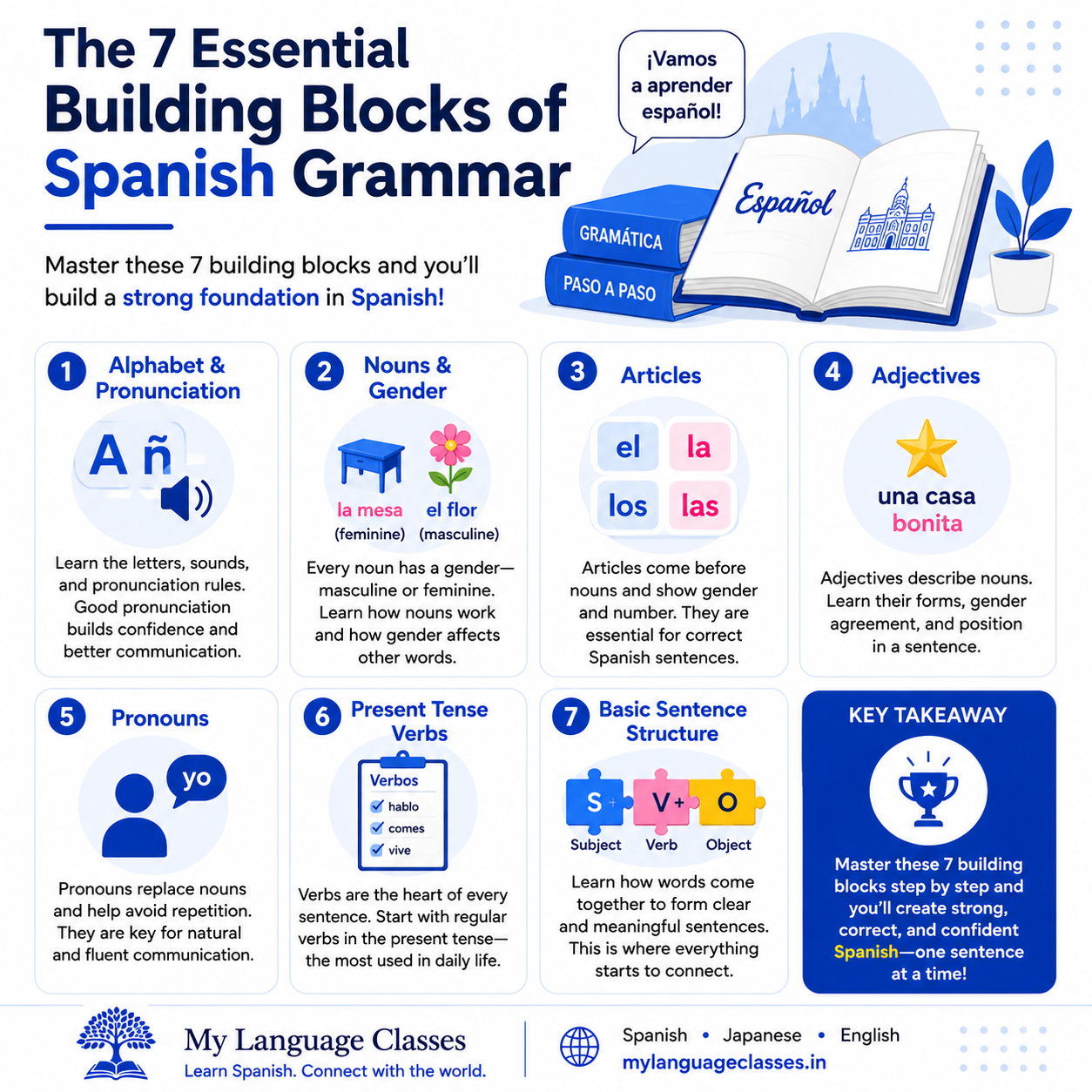
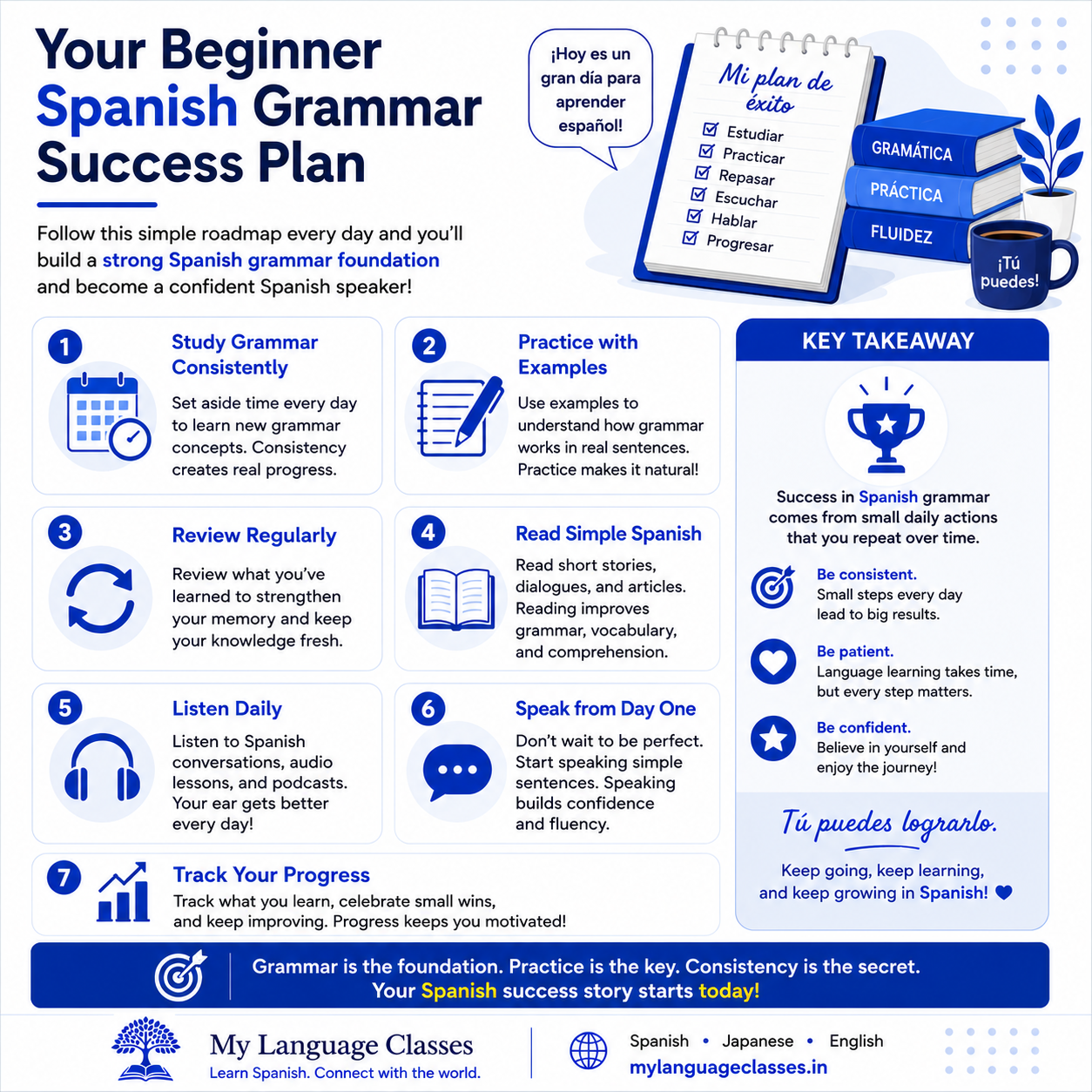
The Seven Building Blocks of a Strong Spanish Grammar Foundation
If avoiding mistakes is the first step, following a clear learning path is the second.
A strong grammar foundation is not created by studying random topics.
It is built by developing one skill at a time in an order that allows each concept to support the next.
Think of these building blocks as layers.
Each layer strengthens the one above it.
When one layer is weak, future learning becomes more difficult.
When every layer is strong, progress becomes smoother and far more enjoyable.
1. Build Confidence with Pronunciation First
Grammar and pronunciation are often taught separately, but they support each other from the beginning.
If you can pronounce Spanish words confidently, reading becomes easier.
Listening becomes clearer.
Vocabulary becomes easier to remember.
Learning the Spanish alphabet and pronunciation patterns also reduces hesitation when speaking because you spend less time wondering how words should sound.
You do not need perfect pronunciation before moving forward.
You simply need enough confidence to read Spanish comfortably and recognize common sound patterns.
That confidence supports every grammar lesson that follows.
2. Master the Core Building Blocks of Every Sentence
Every Spanish sentence begins with simple building blocks.
Nouns.
Articles.
Gender.
Singular and plural forms.
Adjectives.
These topics may appear basic, but they are among the most important concepts in beginner grammar.
Understanding how these elements work together helps learners recognize sentence patterns much more quickly.
Instead of memorizing isolated words, you begin understanding how complete phrases are formed.
This foundation also prepares you for more advanced grammar because many future lessons assume you already understand agreement between different parts of a sentence.
3. Learn How Sentences Work Before Making Them More Complex
Once you understand the building blocks, the next step is learning how they connect.
Subject pronouns introduce the person performing the action.
Object pronouns help avoid unnecessary repetition.
Reflexive pronouns prepare learners for many everyday expressions.
Learning these concepts early helps learners recognize the structure behind Spanish sentences rather than simply reading words one after another.
That understanding makes every future grammar topic much easier to learn.
4. Develop Confidence with Present Tense Verbs
Once you understand how Spanish sentences are structured, the next step is learning how to express actions.
This is where verbs become the center of communication.
Many beginners feel intimidated by verb conjugation because Spanish verbs change depending on the subject. While this may seem challenging at first, it becomes much easier when you have already learned subject pronouns and basic sentence structure.
Instead of trying to memorize dozens of verb tables at once, begin with regular present tense verbs.
Regular verbs help you recognize the patterns that appear throughout the language. Once those patterns become familiar, learning irregular verbs becomes much less difficult because you already understand how conjugation works.
After becoming comfortable with regular verbs, focus on the most frequently used irregular verbs such as “ser,” “estar,” “tener,” “ir,” “hacer,” and “haber.” These verbs appear constantly in everyday communication, making them far more valuable than learning advanced grammar too early.
The present tense allows beginners to introduce themselves, describe their family, talk about work, discuss hobbies, explain daily routines, and ask simple questions.
In other words, it provides everything needed to begin communicating in Spanish.
For this reason, spending extra time mastering the present tense is one of the smartest investments a beginner can make.
5. Learn the Grammar You Will Use Every Day
Once you have a basic understanding of verbs, your grammar study should shift toward communication.
Instead of learning isolated rules, begin studying the structures that appear repeatedly in everyday conversations.
One of the first topics most learners encounter is the difference between “ser” and “estar.”
Although both verbs translate as “to be” in English, they are used in different situations. Understanding the purpose of each verb is much more useful than memorizing long lists of rules. As you continue reading and listening to Spanish, you will gradually recognize the situations where each verb is naturally used.
Another essential structure is “hay.”
Learning when to use “hay” instead of “está” allows you to describe places, ask about locations, and talk about your surroundings with greater confidence.
Question formation is another important milestone because conversations depend on asking as well as answering questions.
Understanding how to ask about people, places, time, reasons, and quantities allows you to participate much more actively in real communication.
As your confidence grows, you should also become familiar with negation, reflexive verbs, future intention, obligation, and verbs such as “gustar.”
These structures appear so frequently in everyday Spanish that learning them early provides immediate practical benefits.
Rather than viewing them as separate grammar topics, think of them as communication tools that help you express increasingly complex ideas.
6. Connect Grammar with Everyday Life
A strong grammar foundation is not measured by how many rules you remember.
It is measured by how well you can use those rules to communicate.
This is why beginner grammar should gradually move beyond isolated exercises and into real-life situations.
Learning to tell the time.
Talking about dates and seasons.
Describing your daily routine.
Discussing hobbies.
Describing people and places.
Expressing preferences.
These are the situations where grammar becomes meaningful.
Instead of completing another exercise, you begin describing your own experiences.
That shift makes learning much more enjoyable because grammar becomes a practical skill rather than an academic subject.
It also strengthens long-term memory because personal experiences are naturally easier to remember than abstract examples.
The more frequently you use grammar to talk about your own life, the more naturally those grammar patterns become part of your communication.
7. Strengthen Every Lesson Through Practice
Understanding grammar is only the beginning.
Confidence develops through regular practice.
Many learners underestimate how important practice is because they assume reading explanations is enough.
In reality, understanding and application work together.
Each time you complete an exercise, write a sentence, read a short paragraph, or participate in a conversation, you reinforce the grammar you have already learned.
Over time, these repeated experiences create automatic recognition.
Instead of stopping to think about every grammar rule, you begin producing correct sentences more naturally.
Practice also reveals areas that need additional attention.
Making mistakes during practice is not a setback.
It is one of the most valuable forms of feedback available because it shows exactly which concepts require further review.
This is why effective practice is never about getting every answer correct immediately.
It is about gradually improving your understanding until correct grammar becomes a natural part of communication.
Why Spanish Grammar Should Be Learned as One Connected System
One reason many beginners become frustrated is that they treat grammar as a collection of independent lessons.
They learn nouns during one week, verbs the next week, and prepositions sometime later without understanding how these topics relate to one another.
As a result, every new lesson feels like starting over.
Spanish grammar is much easier to learn when it is viewed as one connected system.
Each grammar topic supports another.
Nouns work together with articles.
Articles influence adjective agreement.
Pronouns connect with verb conjugation.
Verb conjugation supports sentence building.
Sentence building allows meaningful communication.
When learners recognize these connections, grammar becomes much more logical.
Instead of memorizing hundreds of unrelated rules, they begin recognizing patterns that appear repeatedly throughout the language.
This pattern recognition is one of the most important skills a beginner can develop.
It allows learners to understand unfamiliar sentences because they recognize the grammar behind them.
It also makes future learning easier.
Every new grammar concept becomes another piece that fits naturally into a system they already understand.
This learner-centered approach reflects the How Language Learning Really Works philosophy by My Language Classes.
Rather than encouraging learners to collect grammar rules, the goal is to help them understand how the language functions as a complete system.
When learners understand those relationships, they spend less time memorizing and more time communicating.
That is one reason structured learning consistently produces better long-term results than studying disconnected lessons from multiple sources.
Instead of repeatedly asking what to study next, learners can focus on developing a deeper understanding of the concepts already in front of them.
Over time, those individual concepts combine to create something much more valuable than grammar knowledge alone.
They create confidence.
Daily Habits That Build Strong Grammar Skills
Building a strong grammar foundation is not about finding the perfect study schedule or spending several hours every day with textbooks.
It is about creating simple habits that you can maintain consistently over time.
Many successful language learners do not study longer than everyone else.
They simply study more consistently.
Small daily improvements may not seem significant at first, but they gradually create a level of understanding that is difficult to achieve through occasional intensive study sessions.
The following habits help beginners strengthen their grammar while keeping learning enjoyable and sustainable.
Study a Little Every Day
One of the biggest mistakes beginners make is believing they need long study sessions to make meaningful progress.
While longer sessions can certainly be helpful, they are not essential.
A focused twenty or thirty-minute study session every day often produces better results than spending several hours studying only once each week.
Daily exposure helps your brain recognize grammar patterns more quickly because you encounter them regularly.
Instead of repeatedly starting from the beginning, each study session builds upon the previous one.
Over time, this consistency creates steady progress without making learning feel overwhelming.
Review Before Moving Forward
Many learners are eager to begin the next chapter as soon as possible.
Although enthusiasm is valuable, constantly moving forward without reviewing previous lessons often creates weak foundations.
Grammar should be reviewed regularly.
Each review strengthens connections between different concepts and helps transfer knowledge from short-term memory into long-term understanding.
Reviewing does not mean reading every chapter again from the beginning.
Sometimes reviewing a few example sentences or completing a small number of practice exercises is enough to refresh your understanding.
These short review sessions prevent earlier topics from being forgotten while making future lessons much easier to understand.
Read Spanish Every Day
Reading is one of the simplest ways to reinforce grammar naturally.
Every sentence you read demonstrates grammar working in context.
Instead of studying isolated rules, you see how nouns, verbs, adjectives, and pronouns work together to communicate meaning.
As your reading ability improves, you begin recognizing familiar grammar patterns without consciously analyzing every sentence.
This repeated exposure strengthens both grammar and vocabulary at the same time.
Beginners do not need advanced novels to experience these benefits.
Short articles, graded readers, simple dialogues, and beginner stories provide plenty of opportunities to reinforce grammar while gradually expanding comprehension.
Listen to Spanish Regularly
Listening supports grammar in a different but equally important way.
When learners hear familiar grammar patterns repeatedly, they begin recognizing them automatically during conversations.
For example, after studying present tense verbs, listening to beginner conversations helps reinforce those same verb forms in real situations.
Instead of memorizing another grammar rule, you hear grammar functioning naturally.
Over time, listening reduces the effort required to understand spoken Spanish because familiar sentence structures become easier to recognize.
Listening also improves pronunciation, rhythm, and overall confidence.
Together with grammar study, it creates a much more complete learning experience.
Write Short Sentences
Writing encourages active learning.
Instead of simply recognizing grammar, you begin producing it yourself.
This process often reveals small gaps in understanding that may not appear while reading or listening.
For beginners, writing does not need to be complicated.
Simple descriptions of your family, your daily routine, your hobbies, your work, or your weekend plans provide valuable opportunities to practice beginner grammar.
As your knowledge grows, your writing naturally becomes more detailed.
The important point is not writing perfectly.
It is practicing regularly.
Speak from the Beginning
Many beginners postpone speaking because they believe their grammar is not good enough.
Unfortunately, waiting for perfect grammar often delays valuable communication practice.
You do not need advanced grammar to begin speaking Spanish.
Even simple sentences help reinforce grammar because they require you to apply what you have learned.
Introducing yourself.
Talking about your family.
Describing your daily routine.
Discussing your hobbies.
These everyday conversations provide meaningful opportunities to strengthen grammar while building confidence.
The more frequently you use Spanish, the more natural grammar becomes.
Learn Vocabulary Together with Grammar
Grammar without vocabulary cannot create meaningful communication.
Vocabulary without grammar cannot organize ideas clearly.
This is why the two should always be learned together.
For example, when studying adjectives, learn vocabulary that allows you to describe people and places.
When studying present tense verbs, learn words connected with everyday activities.
When studying time expressions, learn vocabulary related to daily routines.
This approach allows new grammar concepts to become immediately useful.
Instead of completing artificial exercises, you begin expressing ideas that are relevant to your own life.
How to Measure Whether Your Grammar Foundation Is Improving
Many learners judge their progress by asking one question.
“How much grammar have I finished?”
A better question is this.
“What can I do today that I could not do last month?”
Language learning is not measured by the number of chapters you complete.
It is measured by the skills you develop.
One sign of progress is that reading becomes easier.
Instead of translating every word individually, you begin understanding complete sentences more naturally.
Another sign is that listening becomes less stressful.
You recognize familiar grammar patterns even when you do not know every vocabulary word.
Your speaking also begins changing.
Instead of repeating memorized phrases, you start creating your own sentences.
They may still contain mistakes, but they are your own ideas expressed through the language.
Writing provides another clear indication of improvement.
You spend less time thinking about sentence structure because familiar grammar patterns become easier to produce.
Even your mistakes become more productive.
Rather than making completely random errors, you begin making small mistakes that reflect genuine progress.
Perhaps the strongest indicator of all is confidence.
You stop worrying about every grammar rule and begin focusing on communication.
Instead of wondering whether you know enough grammar to speak, you begin using the grammar you already know while continuing to improve.
That shift represents one of the most important milestones in beginner language learning.
A strong grammar foundation is not demonstrated by perfection.
It is demonstrated by growing confidence, increasing independence, and the ability to communicate more effectively than before.
Common Mistakes That Prevent a Strong Grammar Foundation
Even motivated learners can slow their progress by developing study habits that work against them.
The encouraging news is that these mistakes are common and, more importantly, they are easy to correct once you recognize them.
Building a strong grammar foundation is often less about finding better resources and more about avoiding habits that create confusion.
Trying to Learn Too Much Too Soon
It is easy to become excited when learning a new language.
Many beginners try to study several grammar topics in one sitting because they want to progress as quickly as possible.
Unfortunately, learning too much at once often has the opposite effect.
Your brain needs time to process new information, recognize patterns, and connect new concepts with what you already know.
If every study session introduces five or six completely different grammar topics, very little of that knowledge has the opportunity to become permanent.
Instead of asking how many chapters you can complete this week, focus on how well you understand the chapter you are studying today.
A smaller amount of well-understood grammar will always be more valuable than a large amount of partially understood grammar.
Comparing Yourself with Other Learners
Language learning is a personal process.
Every learner begins with different experiences, different goals, and different amounts of available study time.
Comparing your progress with someone who has studied for several years rarely provides useful information.
Instead, compare yourself with your past self.
Can you understand more than you could a month ago?
Can you write longer sentences?
Can you recognize grammar patterns that once seemed confusing?
These are the comparisons that matter.
Consistent personal improvement is a far better measure of success than keeping pace with someone else’s learning journey.
Translating Every Sentence into English
Translation is a helpful learning tool during the early stages of study.
However, relying on translation for every sentence eventually becomes a limitation.
The goal of grammar study is to understand how Spanish expresses ideas, not simply how Spanish words match English words.
As your understanding grows, try reading simple sentences without translating every individual word.
Instead, focus on understanding the overall meaning.
This habit encourages your brain to process Spanish more naturally and strengthens your ability to think directly in the language.
That transition happens gradually, but it begins with reducing unnecessary dependence on translation.
Ignoring Real Communication
Some learners spend months studying grammar without using it.
They read explanations, memorize rules, and complete written exercises, but they rarely apply those concepts in meaningful situations.
Grammar becomes much easier to remember when it supports communication.
Writing short paragraphs.
Reading simple stories.
Listening to beginner conversations.
Speaking with other learners.
These activities reinforce grammar naturally because every rule becomes connected with a real purpose.
Communication transforms grammar from theoretical knowledge into practical ability.
Looking for the Perfect Resource
Many learners believe there is one perfect book, one perfect app, or one perfect course that will solve every learning challenge.
As a result, they spend more time searching than studying.
The truth is that no resource can replace consistent effort.
A good resource provides guidance.
Your daily practice creates progress.
Instead of constantly changing materials, choose a structured learning path and allow yourself enough time to benefit from it.
Long-term consistency almost always produces better results than constantly beginning again with new resources.
What Makes a Good Beginner Spanish Grammar Book?
Choosing the right grammar book is an important decision because it often becomes the foundation for everything you study afterward.
A beginner grammar book should do much more than explain grammar rules.
It should guide learners through the language in a logical, organized, and encouraging way.
It Should Follow a Clear Learning Progression
Every lesson should build naturally on the one before it.
Beginners should not encounter advanced grammar before they understand the fundamentals.
Instead, topics should be introduced in an order that reflects how language skills naturally develop.
This progression allows learners to build confidence gradually instead of feeling overwhelmed by information that depends on concepts they have not yet learned.
It Should Explain Concepts Clearly
Good explanations make grammar easier, not more complicated.
A beginner resource should use simple language while remaining accurate.
Rather than overwhelming learners with technical terminology, it should focus on helping them understand how Spanish works in everyday communication.
The best explanations answer practical questions.
What does this grammar structure do?
When should I use it?
Why is it used this way?
How does it connect with previous lessons?
When learners understand these answers, grammar becomes much easier to remember.
It Should Include Meaningful Examples
Examples bring grammar to life.
Reading a rule explains the concept.
Seeing that rule used in real sentences demonstrates how it functions in actual communication.
Well-chosen examples also expose learners to useful vocabulary, natural sentence patterns, and realistic situations.
Over time, repeated exposure helps learners recognize familiar grammar automatically.
It Should Provide Opportunities to Practice
Understanding develops through application.
Exercises encourage learners to use the grammar they have just studied while identifying areas that may need additional review.
Effective practice is not about testing memory alone.
It is about strengthening understanding through repeated use.
A grammar book should therefore balance explanations with opportunities to apply new concepts in meaningful ways.
It Should Support Independent Learning
Many beginners study Spanish on their own.
For these learners, a grammar book should function almost like a personal teacher.
Lessons should be easy to follow.
Progress should feel natural.
Review should be straightforward.
Learners should feel confident moving from one chapter to the next without constantly searching for outside explanations.
That independence becomes increasingly valuable as learners continue developing their language skills.
How Mastering Spanish Grammar for DELE A1 Helps You Build the Right Foundation
The ideas discussed throughout this guide form the educational principles behind Mastering Spanish Grammar for DELE A1.
The book was created for learners who want to understand Spanish grammar instead of simply memorizing it.
Rather than presenting grammar as a collection of disconnected lessons, it follows a carefully structured progression where every chapter prepares learners for the concepts that follow.
The journey begins with the Spanish alphabet and pronunciation before introducing nouns, articles, grammatical gender, adjectives, and sentence building.
From there, learners gradually develop confidence with pronouns, present tense verbs, essential communication structures, and the grammar needed for everyday conversations.
Each lesson explains not only what a grammar concept is but also why it matters and how it is used in real communication.
This approach reduces confusion because learners understand the purpose behind each new topic.
The book also includes practical exercises that reinforce every lesson through application rather than memorization alone.
Real-life example sentences with English translations help learners see grammar functioning naturally, while more than 500 carefully selected vocabulary words support both grammar development and everyday communication.
Because the lessons follow the complete DELE A1 syllabus, learners preparing for the examination can study with confidence while also developing practical language skills that extend beyond the exam itself.
More importantly, the structured progression supports the kind of long-term learning discussed throughout this article.
Instead of rushing through grammar, learners gradually build a foundation that prepares them for every future stage of learning Spanish.
Learning Progression Inside Mastering Spanish Grammar for DELE A1
One of the biggest advantages of following a structured grammar book is that you no longer have to decide what to study next.
Every lesson has a purpose.
Every chapter prepares you for the next stage of learning.
Instead of presenting forty-four independent grammar topics, the book guides you through a complete learning progression that mirrors how beginners naturally develop their understanding of Spanish.
The journey begins with pronunciation and the basic building blocks of the language. From there, learners develop confidence with nouns, articles, adjectives, grammatical gender, and sentence formation before moving into pronouns and present tense verbs.
Once these fundamentals are in place, the focus shifts toward communication.
Learners explore essential grammar structures such as “ser” and “estar,” “hay,” negation, question formation, reflexive verbs, future intention, obligation, and other patterns that appear frequently in everyday conversations.
The final stages connect grammar with practical communication.
Topics such as time, dates, routines, hobbies, descriptions, comparisons, and everyday situations allow learners to apply grammar while expressing their own ideas.
Because every lesson builds upon previous knowledge, learners are never expected to understand advanced grammar before they are ready.
This gradual progression helps reduce confusion while building confidence one concept at a time.
Who Will Benefit Most from Mastering Spanish Grammar for DELE A1?
Although every language learner is different, some learners benefit particularly well from a structured grammar approach.
If you are starting Spanish from the beginning, this book provides a clear learning pathway without assuming any previous knowledge.
If you are preparing for the DELE A1 examination, the book covers the complete grammar required at this level while also helping you understand how those grammar structures are used in everyday communication.
If you are learning independently, the lessons are written in clear English and organized so that you can progress comfortably at your own pace.
Many adult learners also return to language study after several years away from the classroom.
For them, a structured review of beginner grammar often provides the confidence needed to continue learning without feeling overwhelmed.
Teachers and tutors may also find the book valuable as a classroom reference because it presents grammar topics in a logical order that supports systematic instruction.
At the same time, choosing the right resource also means selecting one that matches your current level.
Learners who already have a solid understanding of beginner grammar and can confidently use present tense verbs, everyday sentence structures, and common communication patterns may benefit more from resources designed for higher proficiency levels.
Selecting material that matches your current knowledge helps maintain steady progress while keeping learning both productive and enjoyable.
Building a Strong Foundation Today Makes Every Future Step Easier
Many learners think of grammar as something they need to complete before moving on to speaking, reading, listening, or writing.
In reality, grammar supports every one of those skills throughout your language learning journey.
When your grammar foundation becomes stronger, reading becomes more enjoyable because you recognize sentence patterns more quickly.
Listening becomes easier because familiar grammar structures stand out naturally during conversations.
Writing becomes more accurate because you understand how ideas should be organized.
Speaking becomes more confident because you can create your own sentences instead of relying only on memorized expressions.
Vocabulary also becomes easier to remember because you understand how new words function within complete sentences.
This is one reason grammar should never be studied in isolation.
It works together with every other language skill.
At My Language Classes, this interconnected approach forms the basis of the How Language Learning Really Works philosophy by My Language Classes.
Rather than treating grammar as a separate subject, we see it as the framework that supports meaningful communication throughout every stage of language learning.
The stronger your foundation becomes today, the easier every future lesson becomes tomorrow.
Where Can You Get Mastering Spanish Grammar for DELE A1?
If you are looking for a structured resource that follows the learning principles discussed throughout this guide, Mastering Spanish Grammar for DELE A1 is available as an eBook on the My Language Classes website.
The book is also available on Amazon in Kindle, Paperback, and Hardcover formats, allowing you to choose the format that best fits your preferred way of studying.
Whether you enjoy learning digitally or prefer studying from a printed book, the content remains the same. The goal is to provide a clear, structured, and practical learning experience that helps beginners build lasting confidence in Spanish grammar.
Final Thoughts
Building a strong foundation in Spanish grammar is not about learning the greatest number of grammar rules.
It is about understanding the right concepts in the right order and giving yourself enough time to practice them consistently.
Every learner begins with simple building blocks.
Pronunciation.
Nouns.
Articles.
Adjectives.
Pronouns.
Present tense verbs.
From there, every new grammar concept becomes easier because it connects with knowledge you already have.
That is how confidence develops.
Not through shortcuts.
Not through memorizing hundreds of isolated rules.
But through understanding, regular practice, and steady progress.
Remember that language learning is not measured by how quickly you finish a grammar book.
It is measured by how confidently you can use what you have learned in real communication.
If you focus on building a strong foundation today, every future stage of learning Spanish will become more enjoyable and more rewarding.
Take your time.
Study consistently.
Review regularly.
Allow each lesson to strengthen the one before it.
A strong foundation does not simply help you pass an exam.
It helps you become a more confident and capable Spanish learner for years to come.

Vikas Kumar is the founder of My Language Classes, a language learning platform dedicated to helping learners develop practical communication skills in Spanish, Japanese, and English through comprehensive grammar guides, structured learning resources, books, and evidence-informed educational content.
At My Language Classes, we believe that successful language learning is built on clarity, consistency, meaningful practice, and a deep understanding of how languages work. Every article is carefully researched and created to simplify complex concepts, provide practical guidance, and help learners develop confidence through real-world communication.
Inspired by the principles behind How Language Learning Really Works, our mission is to make high-quality language learning accessible to learners around the world by providing accurate, trustworthy, and comprehensive resources that support lasting progress, lifelong learning, and meaningful communication.
Leave a Reply