
If you’re starting Spanish for the first time, deciding what to learn first can feel more difficult than learning the language itself. A quick search online brings up hundreds of grammar lessons, videos, apps, and study plans. Some tell you to memorise verb conjugations immediately, while others recommend learning vocabulary before grammar. The result is often confusion rather than progress.
The truth is that Spanish grammar becomes much easier when you study it in a logical order. Every topic builds on the one before it. When you understand the fundamentals first, each new concept feels like a natural next step instead of another rule to memorise.
Many beginners struggle because they jump between random lessons without understanding how the pieces fit together. They might learn the present tense one day, reflexive verbs the next, and prepositions a week later. Although they are studying regularly, they are not building a complete understanding of the language.
A structured learning path solves this problem. It helps you focus on the right grammar topics at the right time, giving you the confidence to form correct Spanish sentences from the beginning. Instead of wondering what to study next, you always know your next step.
If you’re looking for a complete learning program that follows this structured approach, The Complete Spanish DELE A1 Course is available on the My Language Classes website. If you prefer learning from books, the Complete Spanish DELE A1 Course Series (3 book series) is available on Amazon in Kindle, Paperback, and Hardcover formats.
In this guide, you’ll learn the correct order for studying beginner Spanish grammar, understand why that order matters, discover which topics should come later, and avoid some of the most common mistakes that slow down new learners.
Section 1
Why the Order of Learning Spanish Grammar Matters
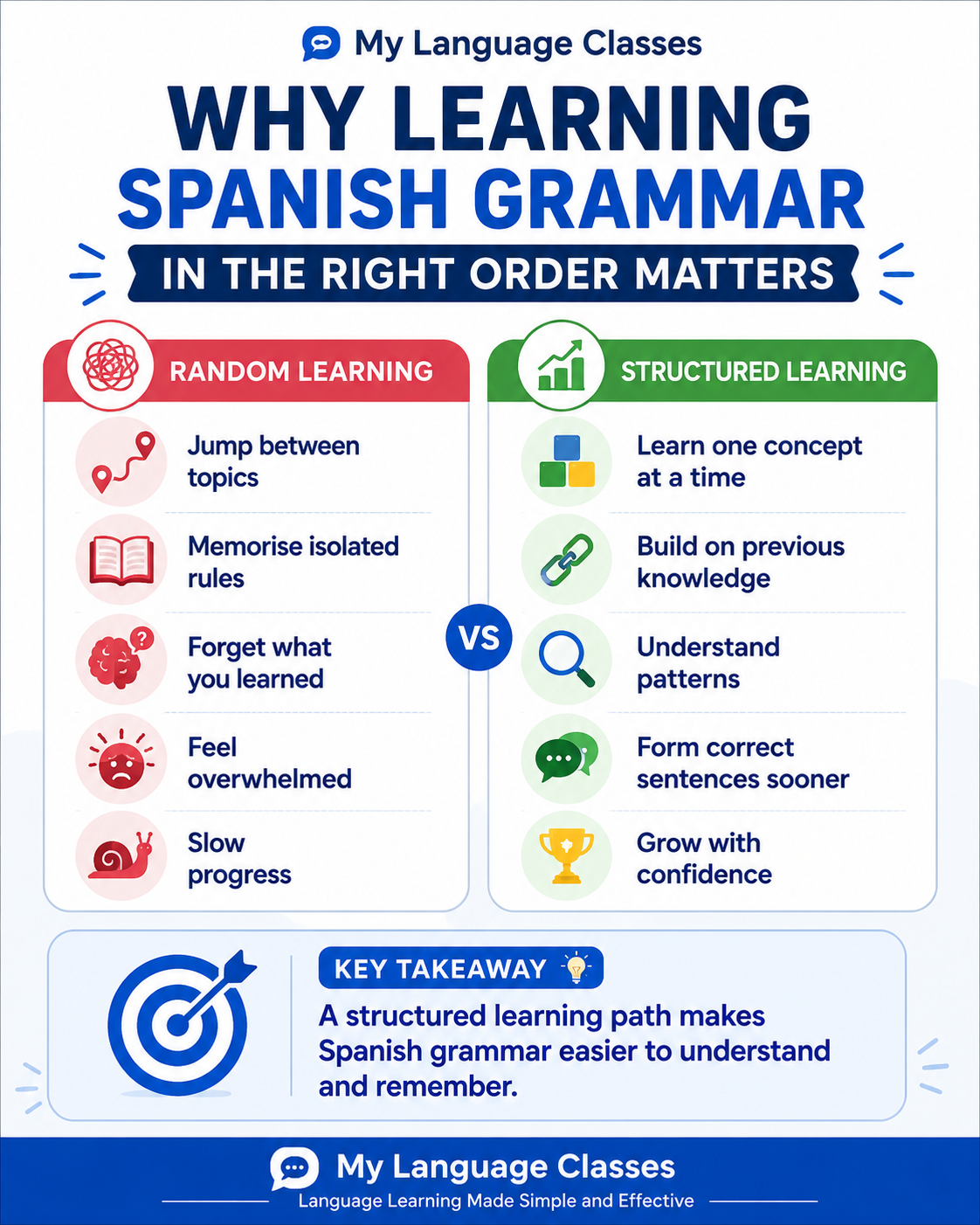
One of the biggest reasons beginners struggle with Spanish grammar is not because the language is too difficult. It is because they study grammar topics in a random order.
Many learners begin with whatever lesson appears first on YouTube or in a search result. One day they study present tense verbs. The next day they learn reflexive verbs. Later they move to prepositions, comparisons, or advanced sentence patterns without fully understanding the basics. Although they spend time studying, their knowledge develops in isolated pieces rather than as a connected system.
Spanish grammar is designed to work progressively. Every new concept depends on something you have already learned. Before you can use adjectives correctly, you need to understand nouns and grammatical gender. Before you can build accurate sentences, you need to know how present tense verbs work. Before you can understand more complex grammar, you must first feel comfortable with basic sentence structure.
Think of Spanish grammar like building a house. You begin with the foundation before adding walls, windows, and a roof. If the foundation is weak, everything built on top becomes unstable. Language learning works in much the same way. When you master the essentials first, every new topic becomes easier because it connects naturally with knowledge you already have.
Following the right learning order also reduces cognitive overload. Instead of trying to remember dozens of unrelated grammar rules, you focus on one concept at a time. This allows your brain to recognise patterns, understand relationships between topics, and retain information for much longer.
Another important benefit is confidence. Learners who follow a structured sequence begin creating correct Spanish sentences much earlier because every lesson reinforces the previous one. That steady progress creates motivation and makes it easier to stay consistent.
Learning Spanish grammar is not about studying the greatest number of topics as quickly as possible. It is about studying the right topics in the right sequence so that each lesson prepares you for the next.
Start with Spanish Pronunciation Before Grammar
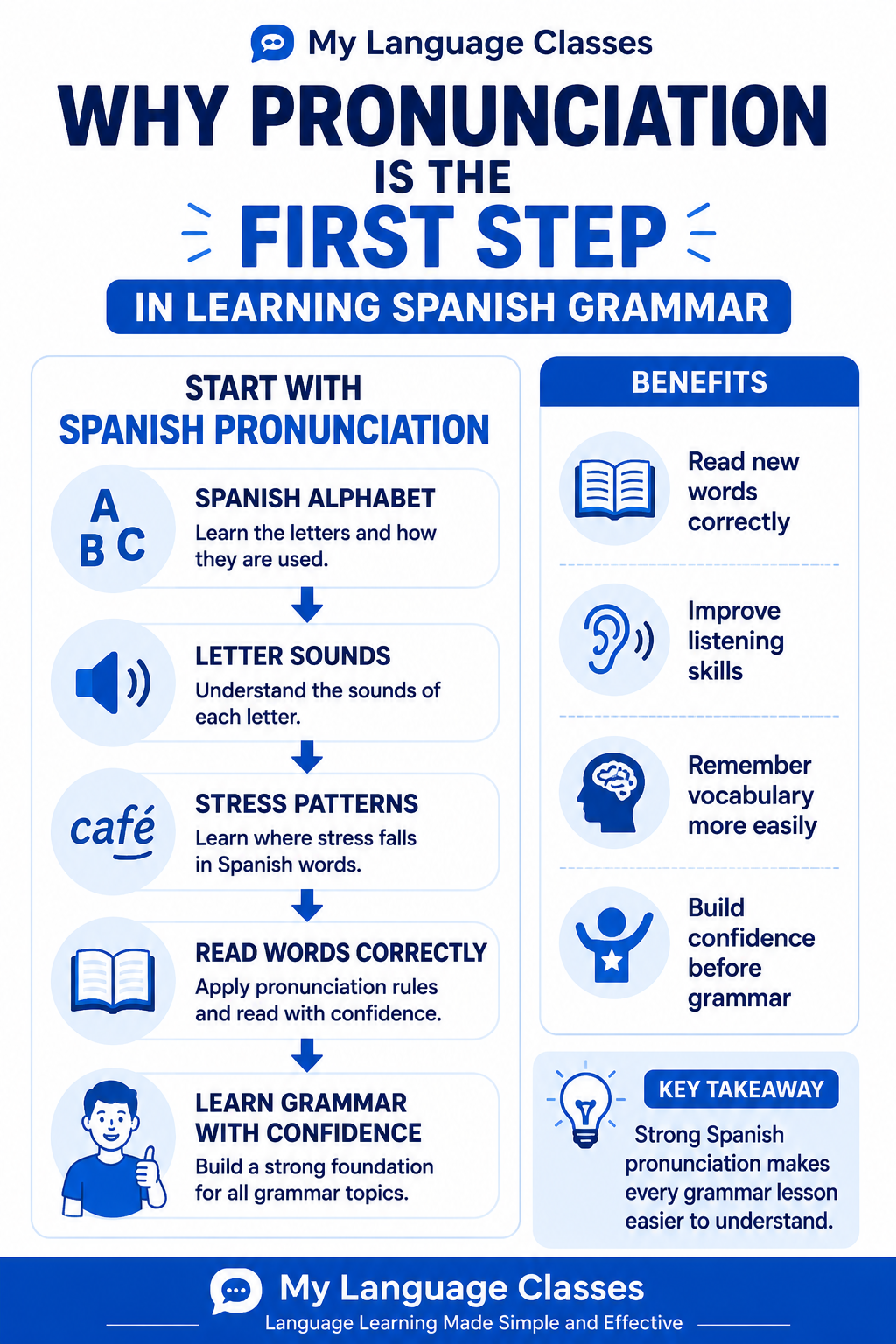
Many beginners are eager to begin learning grammar immediately, but the best starting point is actually pronunciation. Before you learn how Spanish sentences are formed, you need to understand how Spanish words are read and spoken.
Spanish pronunciation is one of the most consistent among major world languages. Most letters have predictable sounds, and once you understand the basic pronunciation rules, you can read thousands of Spanish words correctly, even if you have never seen them before.
Learning pronunciation first gives you several advantages. It helps you recognise vocabulary more easily when listening, improves your reading confidence, and makes it easier to remember new words because you know how they sound. It also prevents the formation of incorrect pronunciation habits that can become difficult to change later.
At this stage, your goal is not to achieve a perfect accent. Instead, focus on understanding the Spanish alphabet, common letter sounds, stress patterns, and pronunciation rules that appear in everyday words. This foundation will support every grammar topic you study afterwards.
Once you can confidently read simple Spanish words aloud, you are ready to begin learning the first grammar concepts. Grammar will feel much more natural because you are already comfortable recognising and pronouncing the language.
Many learners underestimate the value of pronunciation, but it is the first building block that supports vocabulary, grammar, listening, speaking, and reading. Spending time on pronunciation at the beginning saves time throughout the rest of your learning journey.
Learn Nouns, Gender, and Articles Together
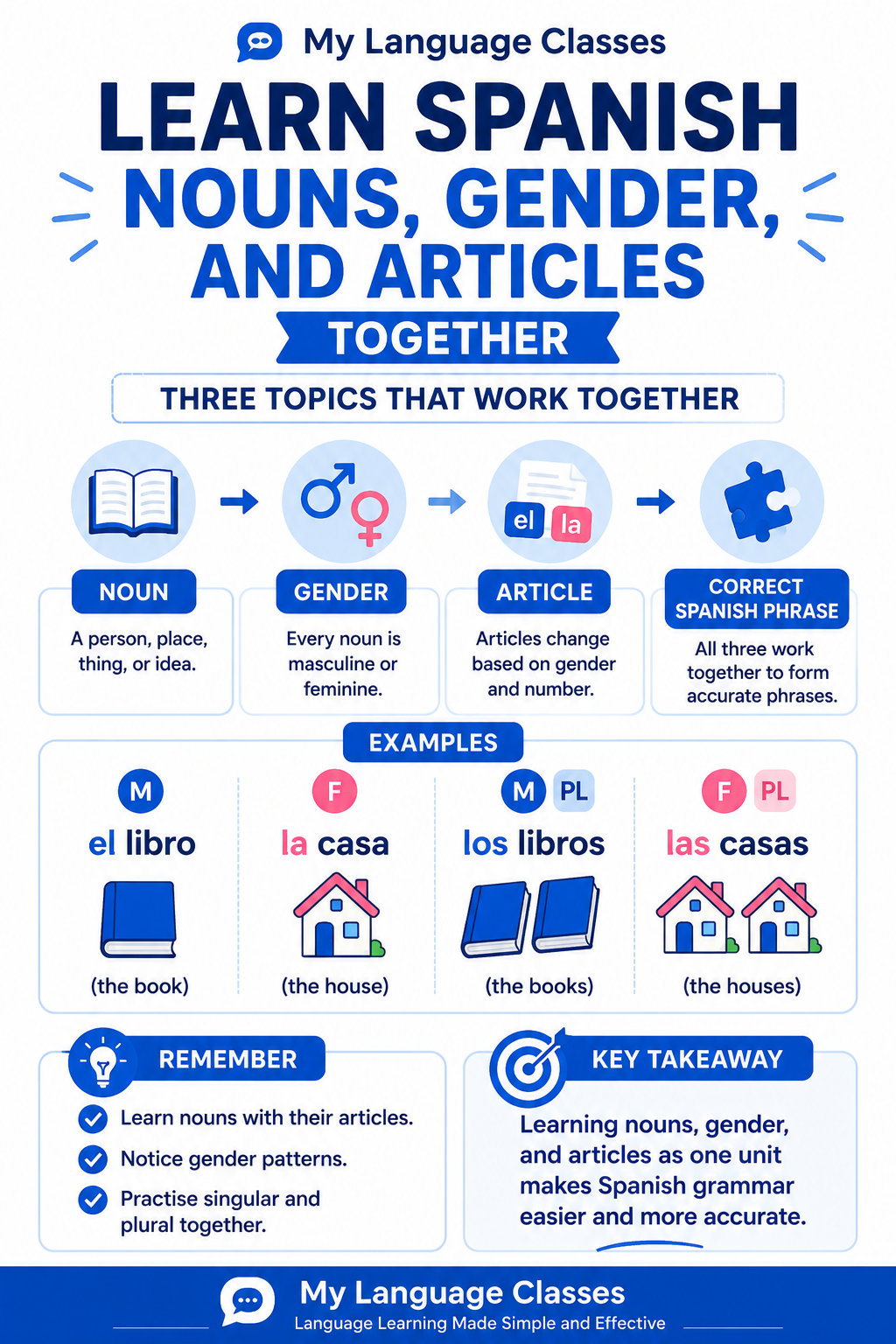
After becoming comfortable with Spanish pronunciation, the next step is learning nouns, grammatical gender, and articles. These three topics are closely connected, so studying them together helps you understand how Spanish sentences are built from the very beginning.
Unlike English, every Spanish noun has a grammatical gender. A noun is either masculine or feminine, and this affects the words that accompany it. For example, the article and adjective used with a noun must agree with its gender and number. Understanding this relationship early prevents many of the mistakes that beginners commonly make.
You’ll also learn that nouns can be singular or plural, and articles change accordingly. Instead of memorising individual words in isolation, it is much more effective to learn each noun together with its article. For example, learning “libro” as “el libro” and “casa” as “la casa” helps you remember the correct gender naturally.
This stage is also where you begin recognising patterns. Many masculine nouns end in -o, while many feminine nouns end in -a, although there are important exceptions. Rather than trying to memorise every exception immediately, focus on understanding the general rules first. As your vocabulary grows, recognising exceptions becomes much easier.
Learning nouns, gender, and articles together also improves sentence construction. Once you understand how these elements work together, adding adjectives, pronouns, and verbs later becomes much more straightforward because you already know how the basic parts of a sentence connect.
Many beginners skip this foundation because they want to start speaking quickly. In reality, investing time here makes speaking easier. You spend less time correcting mistakes and more time expressing your ideas accurately.
By the end of this stage, you should be able to recognise masculine and feminine nouns, use definite and indefinite articles correctly, form singular and plural nouns, and build simple noun phrases with confidence. These are essential skills that support every grammar topic you will study next.
Add Adjectives to Build Better Spanish Sentences
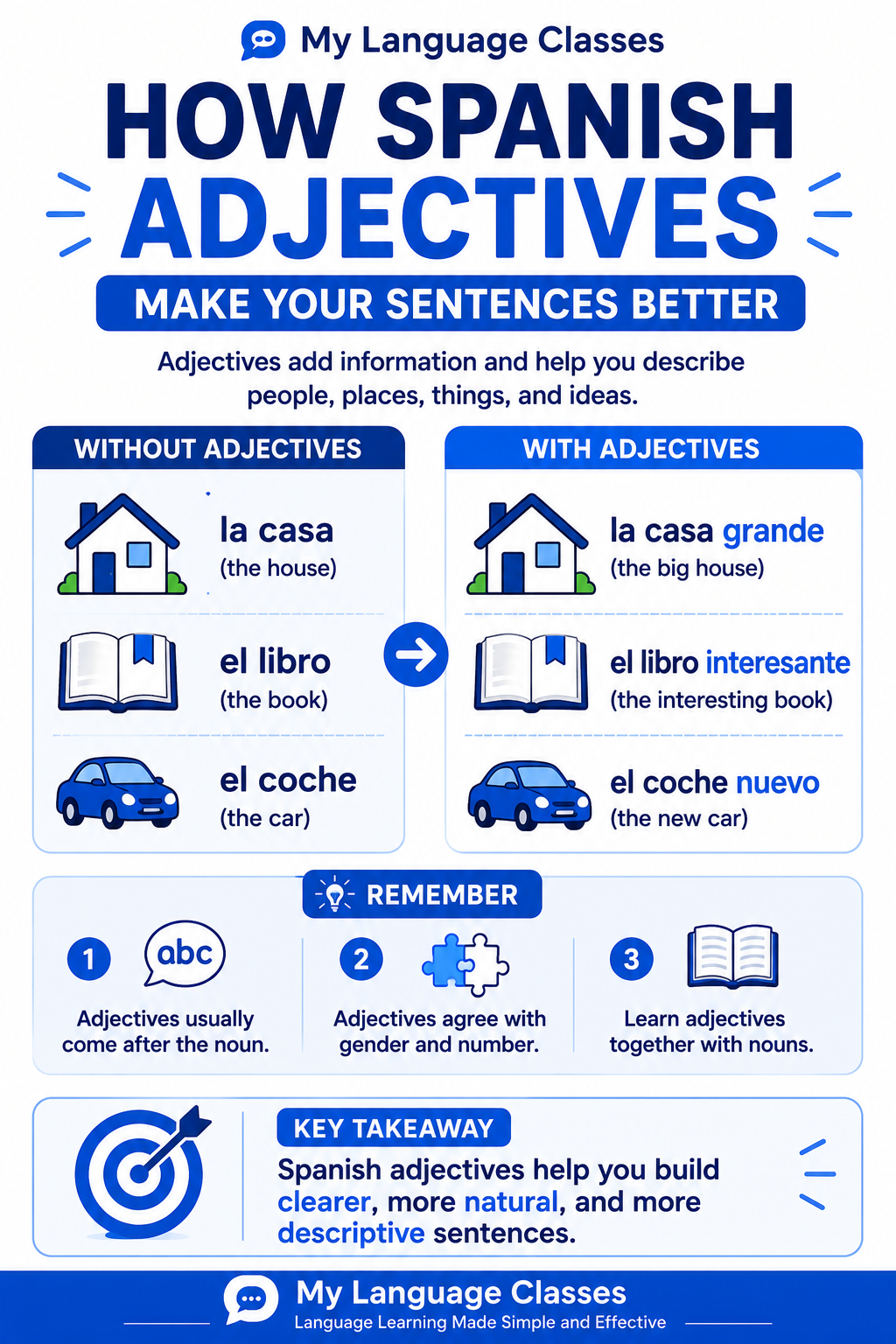
Once you understand nouns, gender, and articles, the next step is learning adjectives. Adjectives make your Spanish more descriptive by adding information about people, places, objects, and ideas. They transform simple sentences into meaningful communication.
Without adjectives, your sentences remain very basic. You can say “the house” or “the book,” but adjectives allow you to describe them as “the big house,” “the interesting book,” or “the beautiful city.” These small additions make conversations clearer and more engaging.
One important difference between English and Spanish is that adjectives must agree with the noun they describe. If the noun is masculine, feminine, singular, or plural, the adjective usually changes to match it. This agreement is one of the first grammar patterns that beginners need to understand because it appears constantly in everyday Spanish.
You will also notice that many Spanish adjectives come after the noun rather than before it. While there are exceptions, learning the most common adjective placement early helps you become familiar with natural Spanish sentence patterns.
This stage is also an opportunity to expand your vocabulary. Instead of memorising long word lists, learn adjectives alongside the nouns they commonly describe. This approach helps you remember both grammar and vocabulary together while making it easier to create complete sentences.
For example, instead of learning only the word “grande,” practise it in phrases such as “una casa grande” or “un libro grande.” Learning grammar in context makes it easier to remember and apply later in real conversations.
As you become comfortable with adjectives, you will notice that your ability to describe people, places, everyday objects, and personal experiences improves quickly. Even with a small vocabulary, adjective agreement allows you to express yourself with much greater precision.
By mastering adjectives at this stage, you are preparing yourself for more advanced sentence construction, where correct agreement becomes an essential part of speaking and writing accurate Spanish.
Learn Pronouns Before Verb Conjugation Becomes More Complex
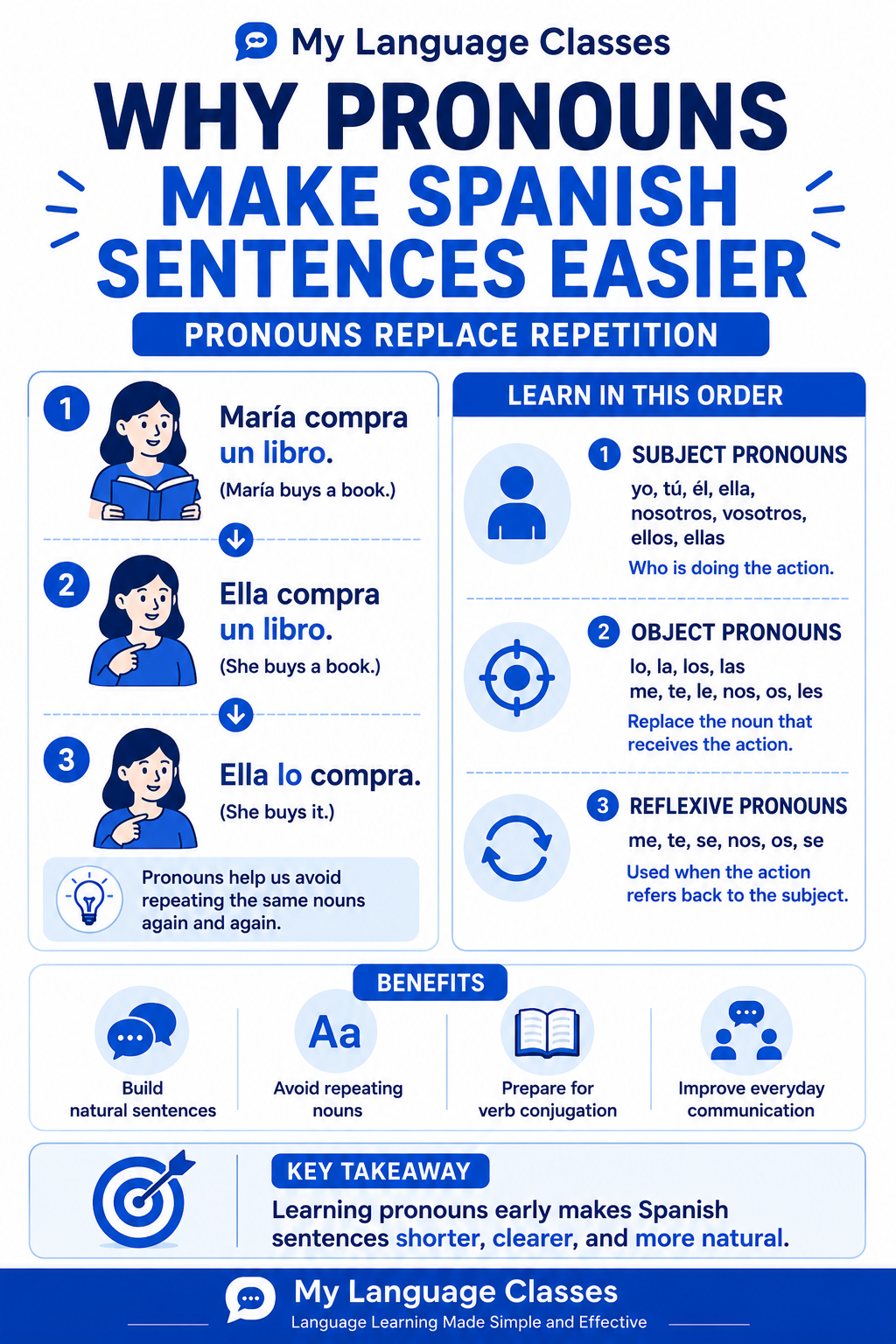
Once you understand nouns, articles, and adjectives, the next topic to learn is pronouns. Pronouns may seem like small words, but they play a major role in Spanish sentence construction. Learning them early helps you understand how Spanish speakers naturally communicate and prepares you for more advanced grammar later.
The first pronouns you should study are subject pronouns such as yo, tú, él, ella, nosotros, vosotros, and ellos. These pronouns identify who is performing the action in a sentence. Unlike English, Spanish often omits subject pronouns because the verb ending already shows who the subject is. Understanding this feature early makes Spanish sentences feel much more natural.
After becoming comfortable with subject pronouns, you can begin learning direct object pronouns and indirect object pronouns. These replace nouns in a sentence and help avoid unnecessary repetition. Although they may seem unfamiliar at first, they become much easier to understand once you already know how nouns and basic sentence structure work.
Reflexive pronouns are another important part of beginner Spanish. They are commonly used when talking about daily routines and personal activities, making them essential for everyday communication. Learning reflexive pronouns before moving into more advanced verb structures gives you a much stronger understanding of how Spanish sentences are formed.
Many learners try to memorise pronouns as isolated vocabulary. A better approach is to study them inside complete sentences. This allows you to see how they interact with verbs and how their position changes depending on the sentence. Learning grammar in context is always more effective than memorising lists of rules.
This is the same structured progression followed in The Complete Spanish DELE A1 Course, where every grammar lesson builds on the previous one and is immediately reinforced through extensive practice. Instead of introducing isolated grammar topics, the course helps learners understand how each concept connects with the next, making Spanish easier to learn and remember.
By mastering pronouns before tackling more complex verb structures, you will find that sentence building becomes more natural and your confidence grows with every lesson.
Master Present Tense Verbs Before Studying Other Tenses
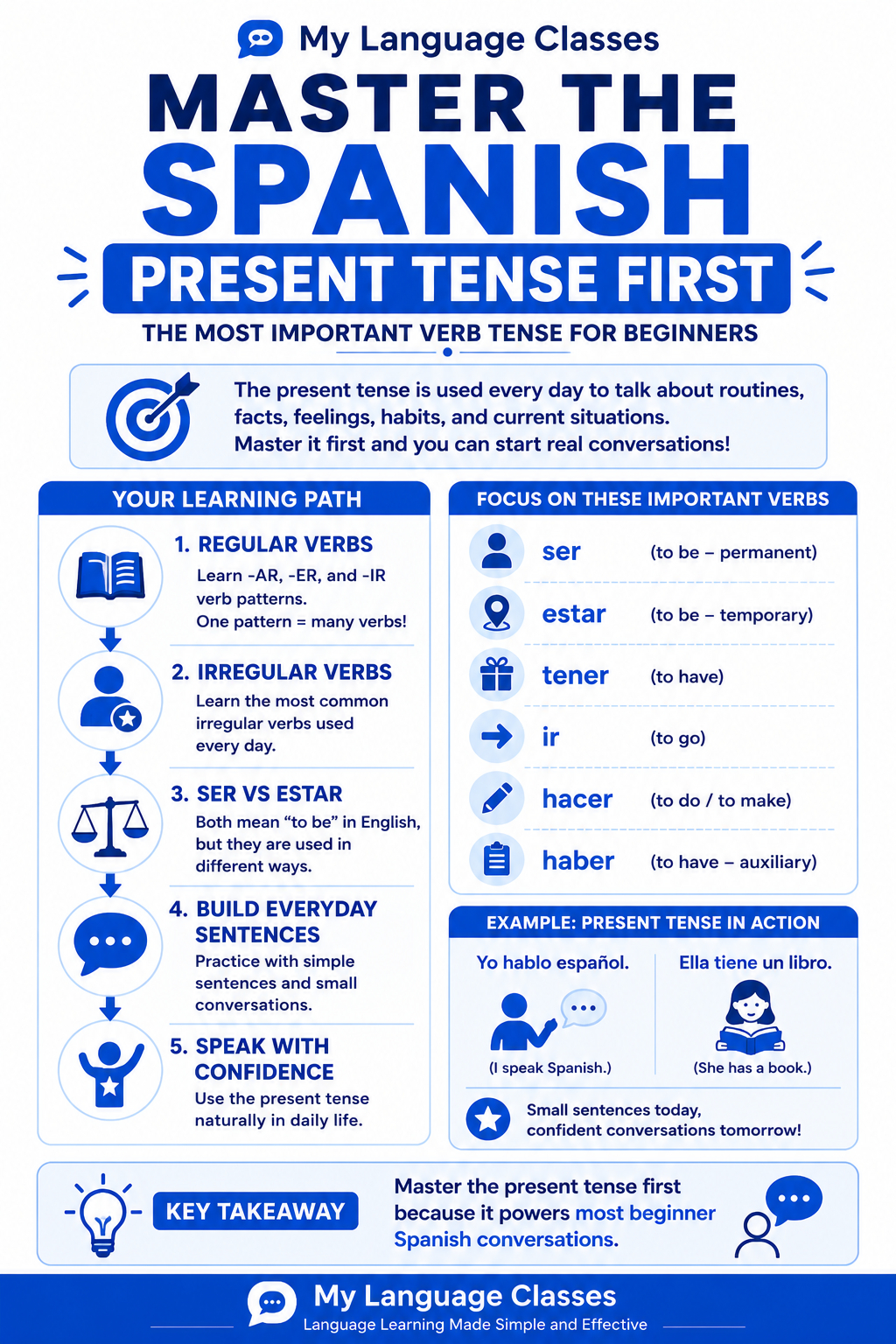
After building a foundation with pronunciation, nouns, adjectives, and pronouns, the next priority is the present tense. This is the most important verb tense for beginners because it allows you to talk about everyday life, describe routines, introduce yourself, ask questions, and understand basic conversations.
The present tense is used constantly in daily communication. Whether you are talking about your family, your job, your hobbies, your studies, or your plans for today, you will rely on present tense verbs. For this reason, becoming comfortable with the present tense gives you the greatest return on your study time.
Start by learning how regular verbs are conjugated. Spanish groups most verbs into three categories: -AR, -ER, and -IR verbs. Once you understand how these patterns work, you will notice that hundreds of verbs follow the same rules. Instead of memorising every verb individually, you begin recognising predictable patterns.
After learning the regular patterns, move on to the most common irregular verbs such as ser, estar, tener, ir, haber, and hacer. These verbs appear frequently in everyday Spanish and form the foundation of countless beginner conversations. Although they do not follow the regular conjugation patterns, repeated practice helps them become familiar surprisingly quickly.
One topic that deserves special attention is the difference between ser and estar. Both translate as “to be” in English, but they express different meanings. Learning this distinction early helps you avoid one of the most common mistakes made by beginners and improves the accuracy of your spoken and written Spanish.
The most effective way to learn verb conjugation is through repeated use rather than memorisation alone. Reading explanations is helpful, but real progress happens when you practise building complete sentences until the patterns become natural.
This is exactly how The Complete Spanish DELE A1 Course is structured. Every grammar lesson is followed by targeted practice, allowing you to apply what you have just learned before moving to the next topic. With 44 structured grammar lessons, more than 4,300 fill-in-the-blank practice exercises with answers and English translations, and over 2,000 carefully organized Spanish vocabulary words, the course helps beginners develop confidence through understanding and consistent practice instead of memorizing isolated rules.
Once you feel comfortable using the present tense, you will have everything you need to begin creating meaningful Spanish sentences and holding simple everyday conversations. More advanced verb tenses can come later because they build naturally on this strong foundation.
Learn Basic Sentence Structure Before Expanding Your Grammar
Once you can use present tense verbs, the next step is learning how to combine everything into complete Spanish sentences. This is where your grammar knowledge begins to turn into real communication.
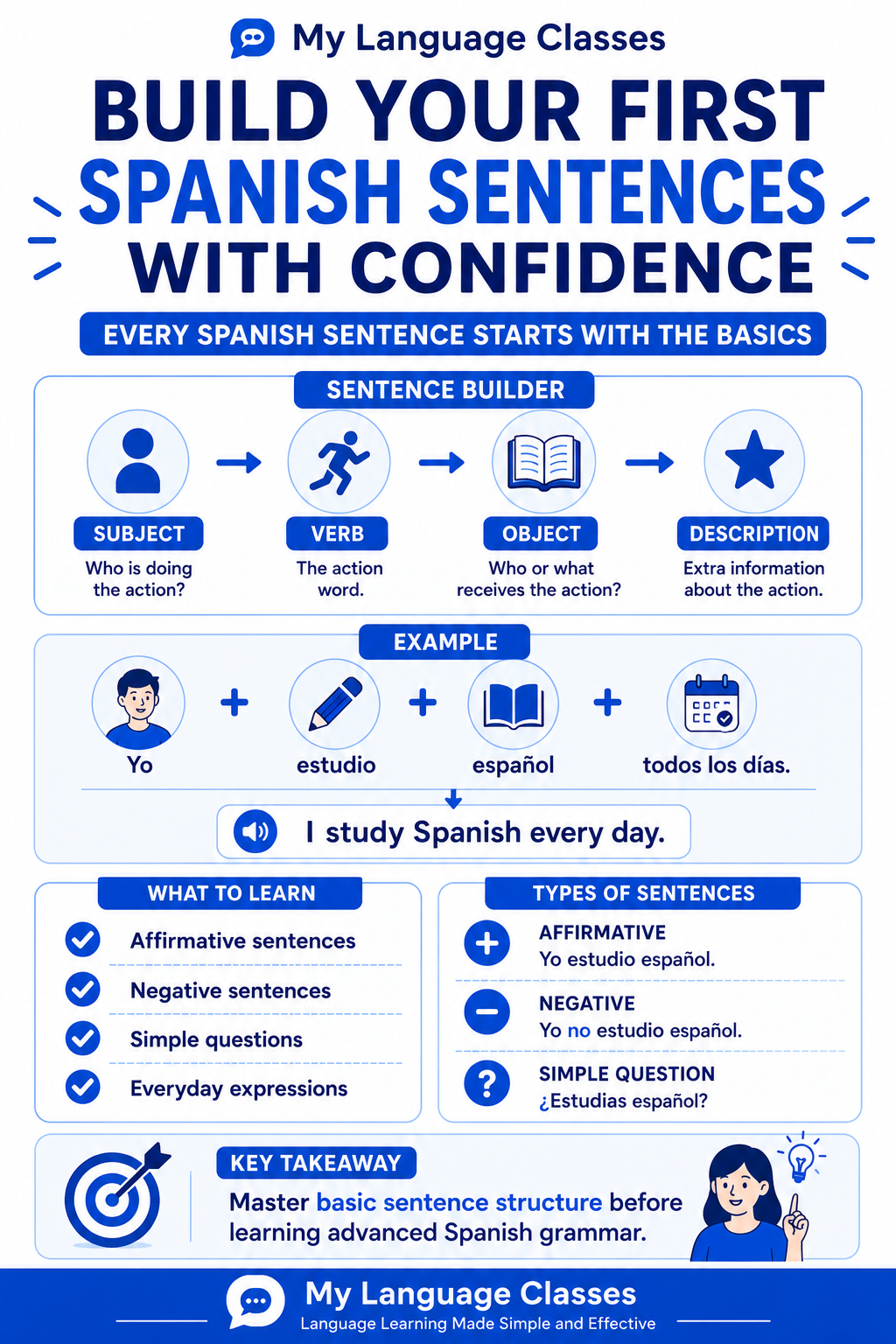
Spanish sentence structure is generally straightforward. Like English, many sentences follow the pattern of subject, verb, and object. However, because Spanish verb endings already indicate the subject, the subject pronoun is often omitted. Understanding this difference helps your Spanish sound more natural from the beginning.
At this stage, you should also learn how to form affirmative sentences, negative sentences, and simple questions. These three sentence types appear constantly in everyday conversations and allow you to ask for information, express opinions, describe your daily life, and respond confidently in common situations.
Another important concept is understanding the difference between expressing existence and expressing location. Beginners often confuse these structures because they seem similar in English. Learning them as part of sentence construction helps you avoid one of the most common grammar mistakes at the A1 level.
Rather than trying to memorise dozens of sentence patterns, focus on recognising the basic structure that connects nouns, pronouns, verbs, and adjectives. Once this pattern becomes familiar, creating new sentences becomes much easier because you are applying the same grammar in different situations.
This is also the stage where regular practice becomes especially important. Reading example sentences, writing your own short sentences, and speaking them aloud helps transform grammar rules into practical communication skills. The more complete sentences you build, the more naturally Spanish grammar begins to feel.
Many beginners believe they need to study advanced grammar before they can speak. In reality, a strong understanding of basic sentence structure allows you to communicate far more effectively than knowing isolated advanced grammar topics. Simple, accurate sentences always communicate better than complicated sentences filled with mistakes.
By mastering basic sentence construction before moving on to more advanced grammar, you build the confidence needed for real conversations while creating a solid foundation for every future stage of your Spanish learning.
Grammar Topics That Can Wait Until Later
One of the most common mistakes beginners make is believing they need to learn every grammar topic before they can communicate in Spanish. This often leads to frustration because they spend time studying concepts they are unlikely to use during their first conversations.
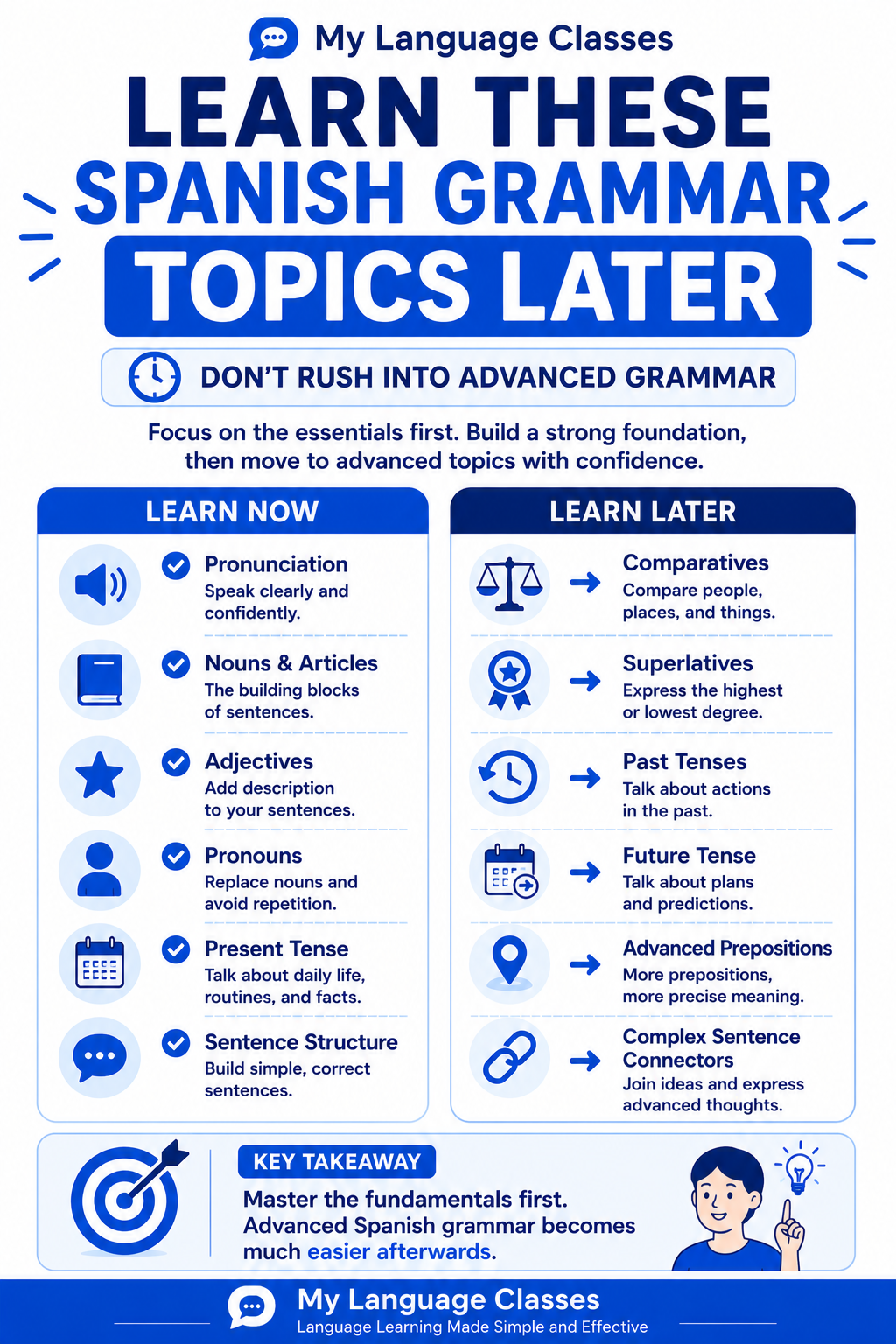
The truth is that you do not need advanced grammar to reach the A1 level or to begin speaking confidently. Once you have learned pronunciation, nouns, articles, adjectives, pronouns, present tense verbs, and basic sentence structure, you already have the foundation needed to understand and produce a wide range of everyday Spanish.
More advanced topics such as comparatives and superlatives, complex preposition usage, advanced verb constructions, multiple past tenses, the future tense, and higher-level sentence connectors can safely be studied after you have mastered the essentials. These topics become much easier because they build on grammar patterns you already understand.
Trying to study advanced grammar too early usually creates unnecessary confusion. For example, learning the different past tenses before becoming comfortable with the present tense often results in memorising conjugation tables without understanding when or why they are used. Likewise, studying complex sentence connectors before mastering simple sentence construction can make learning feel much more difficult than it needs to be.
A better approach is to focus on mastering one stage before moving to the next. When your foundation is strong, advanced grammar no longer feels like a collection of unrelated rules. Instead, it becomes a natural extension of what you already know.
This progressive approach is also reflected in the Complete Spanish DELE A1 Course Series (3 book series), where the material is organized into a logical sequence that allows learners to build their knowledge gradually. Rather than presenting advanced concepts too early, the series develops grammar step by step so that each lesson prepares you for the next stage of learning.
Remember that language learning is not a race. Your goal is not to finish every grammar topic as quickly as possible. Your goal is to understand each topic well enough to use it confidently before moving forward. That approach leads to better retention, greater confidence, and far more enjoyable progress.
Common Mistakes Beginners Make When Choosing Spanish Grammar Topics
Learning Spanish grammar is much easier when you avoid a few common mistakes that slow down progress. Most beginners do not struggle because they lack ability. They struggle because they follow an ineffective study method.
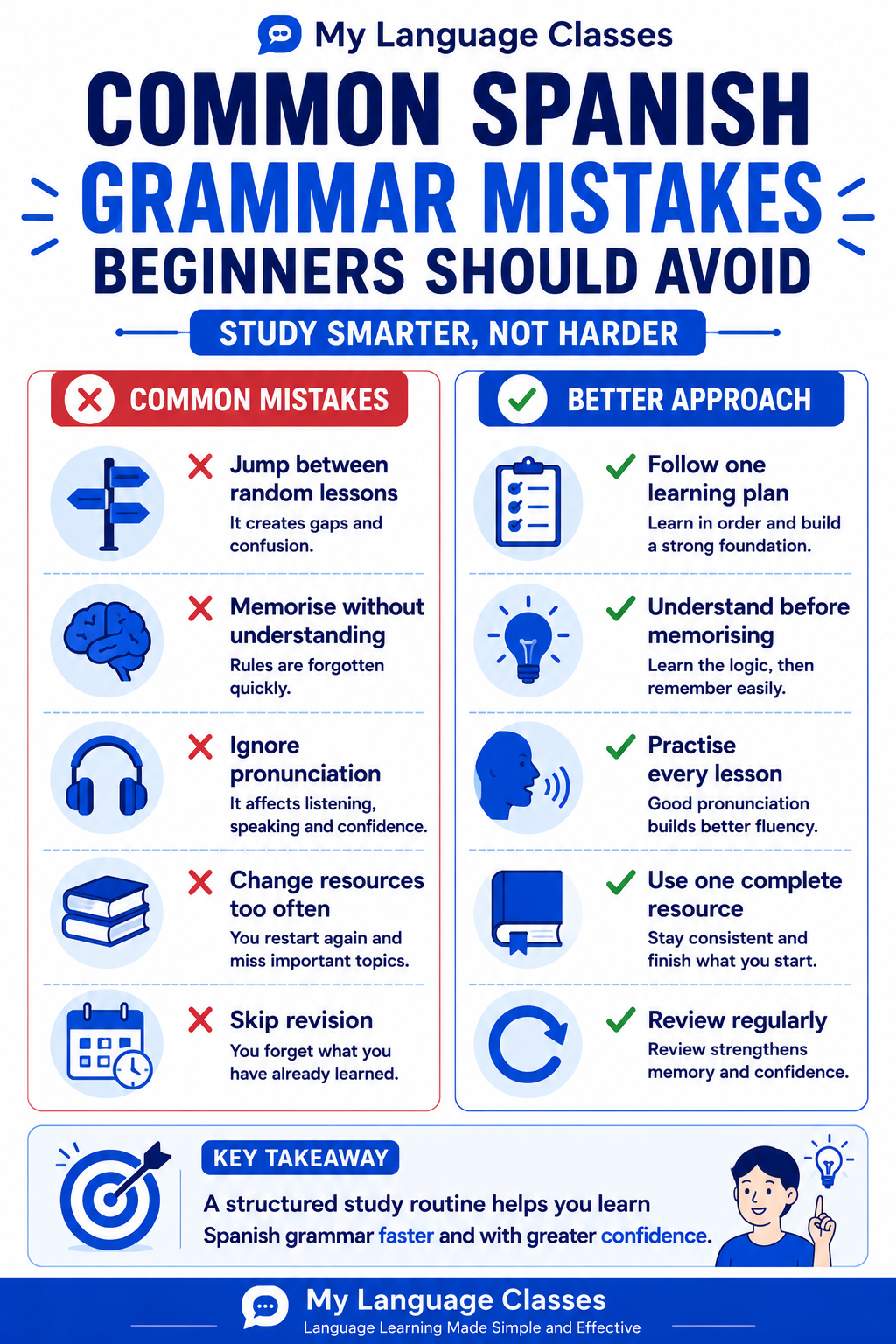
One of the biggest mistakes is studying random grammar topics without following a structured plan. It is tempting to watch whichever lesson appears next on YouTube or to switch between different apps, websites, and books. Although this feels productive, it often creates gaps in your understanding because important concepts are learned out of sequence.
Another common mistake is trying to memorise grammar rules instead of understanding how they work. Memorisation has its place, but grammar becomes meaningful only when you use it in complete sentences. Reading examples, completing exercises, and creating your own sentences help you remember grammar far more effectively than repeatedly reviewing rule tables.
Many beginners also ignore pronunciation after their first few lessons. Good pronunciation supports listening, reading, vocabulary retention, and speaking confidence. Continuing to practise pronunciation while learning grammar helps you recognise patterns more quickly and communicate more naturally.
Another habit that slows progress is constantly changing learning resources. Every course or book follows a slightly different teaching order. Moving from one resource to another every few weeks often means repeating familiar topics while missing important ones. Following one structured programme from beginning to end usually produces much better results.
Regular review is another area that many learners overlook. New grammar concepts are easy to forget if they are never revisited. Spending a few minutes reviewing previous lessons each week strengthens long-term memory and helps grammar become automatic.
This structured approach is exactly what the Complete Spanish DELE A1 Course Series (3 book series) is designed to support. Each volume builds naturally on the previous one, helping learners strengthen their understanding before introducing new concepts. Instead of learning disconnected grammar rules, you develop a complete beginner foundation that prepares you for continued progress.
Remember that mistakes are a normal part of learning Spanish. The goal is not to avoid mistakes completely. The goal is to build a study routine that helps you recognise, understand, and correct them as your confidence grows.
A Simple Study Plan for Your First Weeks of Spanish Grammar
Knowing which grammar topics to learn is only part of the process. The next step is turning that knowledge into a practical study routine that you can follow consistently. Many beginners fail because they try to study for several hours one day and then stop practising for the rest of the week. Short, regular study sessions are far more effective than occasional long sessions.
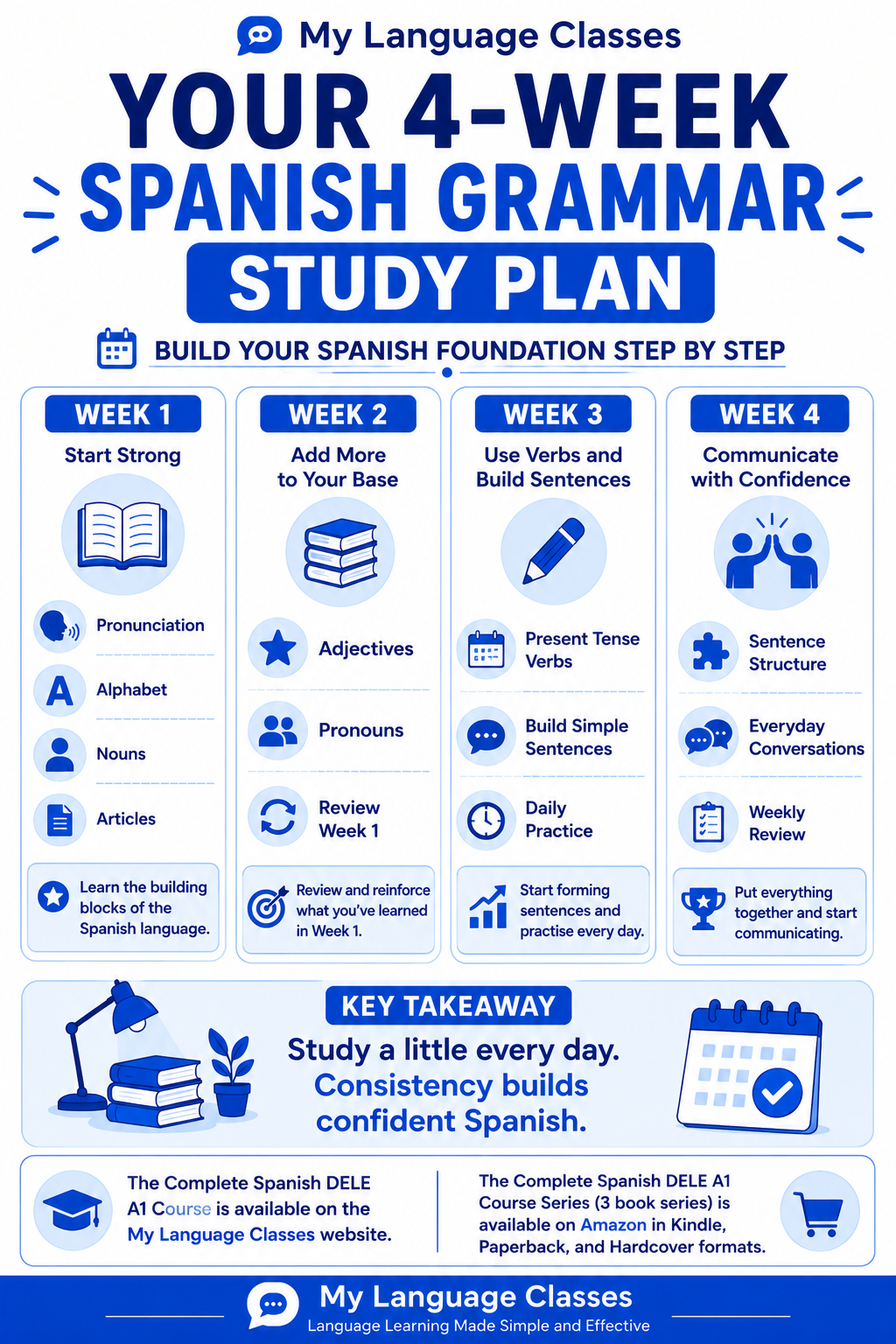
During your first week, focus on Spanish pronunciation, the alphabet, nouns, grammatical gender, and articles. Spend time reading words aloud, recognising masculine and feminine nouns, and practising simple noun phrases. Do not worry about learning hundreds of vocabulary words. Instead, aim to understand how the language is organised.
In the second week, begin learning adjectives and pronouns while continuing to review everything you studied during the first week. Regular revision is essential because every new grammar topic builds on earlier lessons. By revisiting previous concepts, you strengthen your understanding and make new lessons easier to learn.
The third week is the ideal time to begin studying present tense verbs. Learn the regular verb patterns first before introducing the most common irregular verbs. At the same time, practise writing short sentences using the nouns, adjectives, and pronouns you have already learned. This helps you see how every grammar topic connects naturally.
During the fourth week, shift your attention towards sentence construction and everyday communication. Practise asking and answering simple questions, writing short paragraphs, and reading beginner Spanish texts. At this stage, your goal is no longer to memorise grammar rules but to use them confidently in real situations.
If you are following a structured program, your learning plan becomes much easier because you do not need to decide what to study next. The Complete Spanish DELE A1 Course is designed to guide beginners through exactly this progression, combining 44 structured grammar lessons, more than 4,300 fill-in-the-blank practice exercises with answers and English translations, and over 2,000 carefully organized Spanish vocabulary words into one complete learning system.
The Complete Spanish DELE A1 Course is available on the My Language Classes website. If you enjoy learning from printed or digital books, the Complete Spanish DELE A1 Course Series (3 book series) is available on Amazon in Kindle, Paperback, and Hardcover formats.
Remember that consistency matters far more than speed. Studying a little every day, reviewing regularly, and following a logical sequence will produce much better results than trying to master every grammar topic in a few weeks. A strong foundation is built through steady progress, not rushed learning.
Build Your Spanish Foundation One Step at a Time
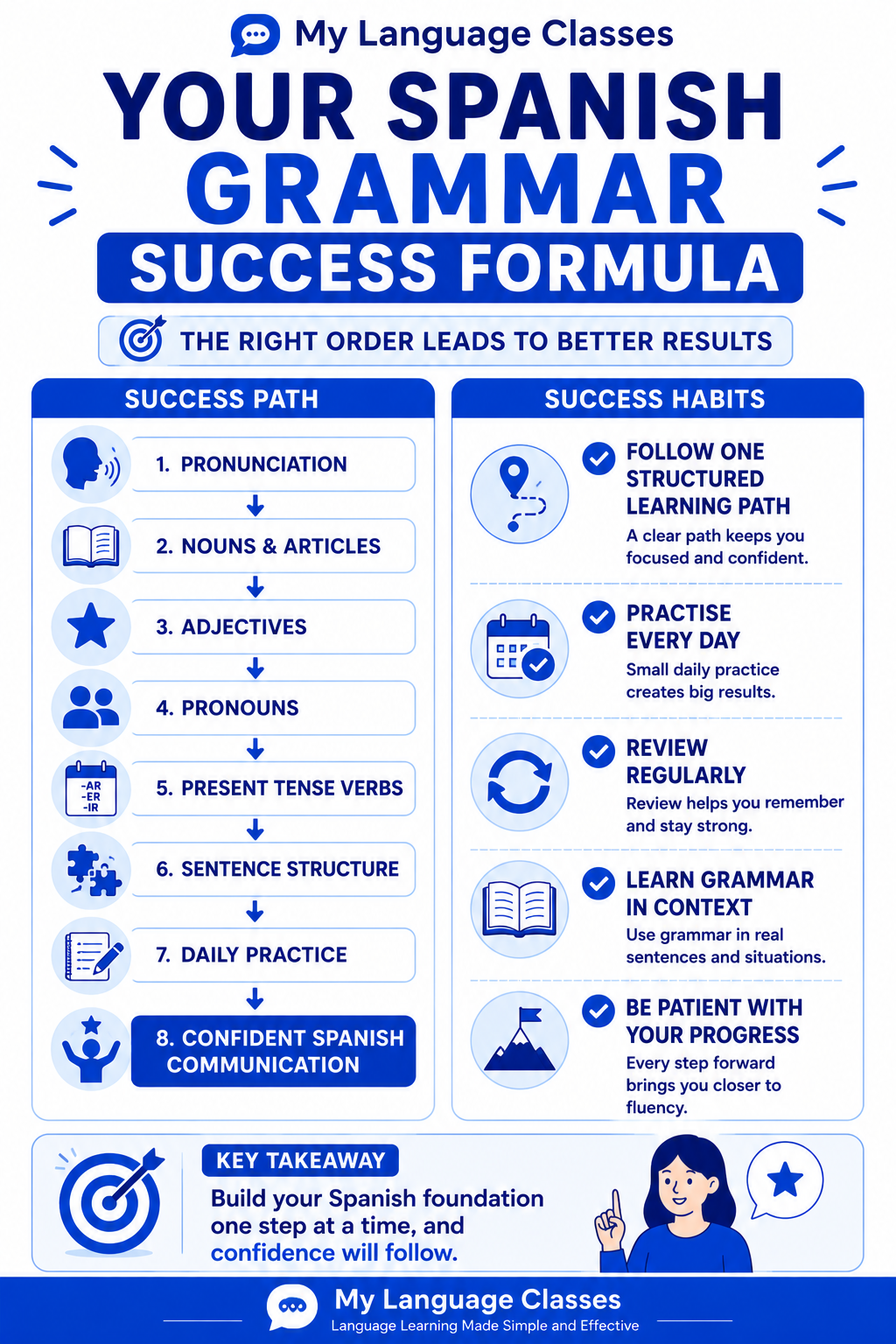
Learning Spanish grammar does not have to feel confusing or overwhelming. The key is not studying more topics but studying the right topics in the right order.
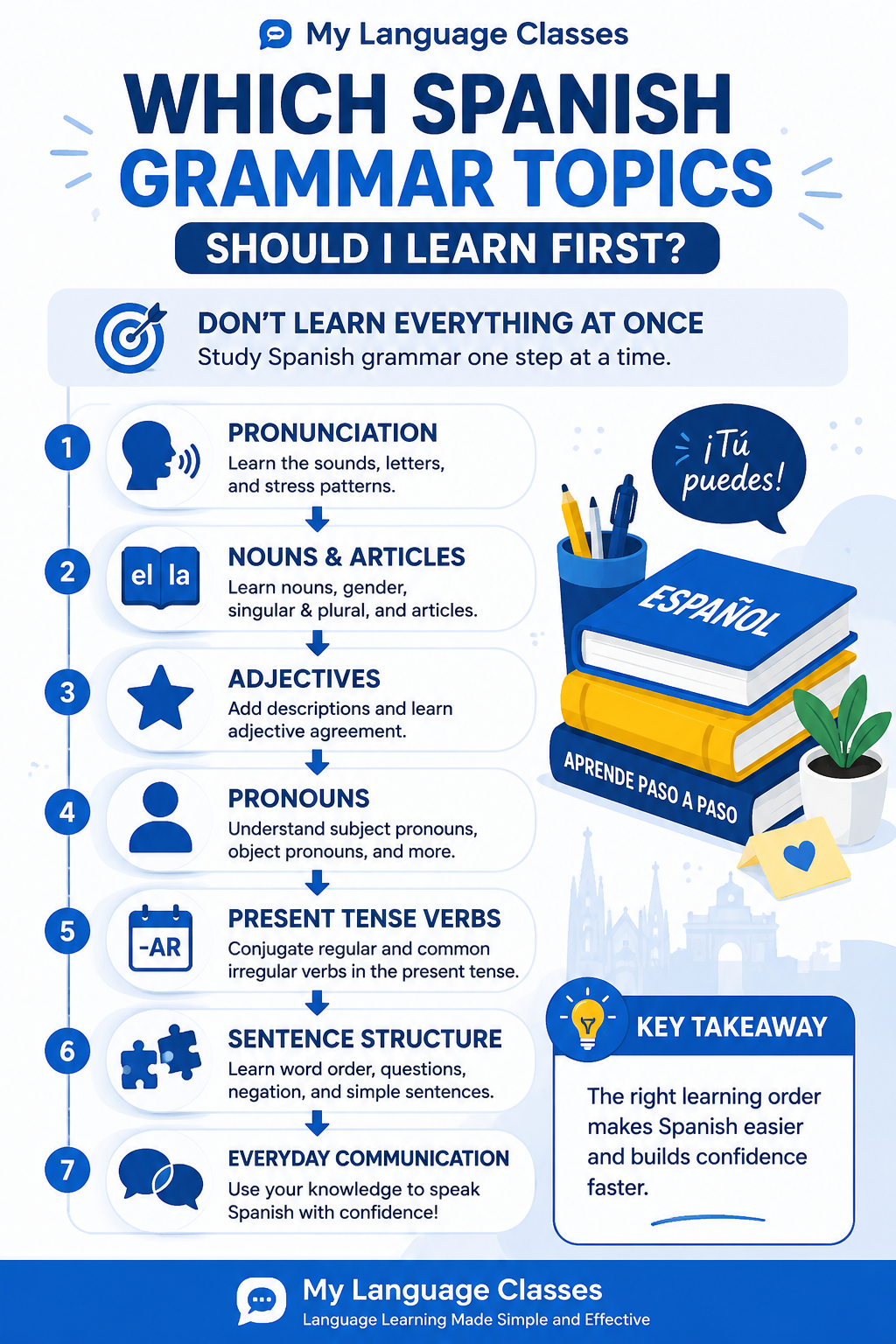
A strong foundation begins with pronunciation. From there, you move to nouns, gender, and articles, followed by adjectives, pronouns, present tense verbs, and basic sentence structure. Each topic builds naturally on the previous one, making grammar easier to understand and much easier to remember.
Once these essentials become familiar, you will already have the skills needed to read simple Spanish, understand everyday conversations, write basic sentences, and communicate with growing confidence. Advanced grammar can come later because it will build upon the knowledge you have already developed.
Following a structured learning path also makes it easier to stay motivated. Instead of wondering what to study next or jumping between unrelated lessons, you can focus on steady progress and see your confidence grow with every new concept you master.
If you want a complete beginner program that follows this exact progression, The Complete Spanish DELE A1 Course provides a step-by-step learning path through 44 structured grammar lessons, more than 4,300 fill-in-the-blank practice exercises with answers and English translations, and over 2,000 carefully organized Spanish vocabulary words for the DELE A1 level.
The Complete Spanish DELE A1 Course is available on the My Language Classes website. If you prefer learning from books, the Complete Spanish DELE A1 Course Series (3 book series) is available on Amazon in Kindle, Paperback, and Hardcover formats.
No matter which learning method you choose, remember that consistency always beats intensity. Study regularly, review what you have learned, practise using Spanish every day, and allow each grammar topic to become part of your communication before moving to the next one.
A strong Spanish foundation is not built in a single week. It is built one lesson, one sentence, and one conversation at a time. With the right learning order and consistent practice, you’ll be well prepared for the DELE A1 level and every stage of your Spanish learning journey that follows.

Vikas Kumar is the founder of My Language Classes, a language learning platform dedicated to helping learners develop practical communication skills in Spanish, Japanese, and English through comprehensive grammar guides, structured learning resources, books, and evidence-informed educational content.
At My Language Classes, we believe that successful language learning is built on clarity, consistency, meaningful practice, and a deep understanding of how languages work. Every article is carefully researched and created to simplify complex concepts, provide practical guidance, and help learners develop confidence through real-world communication.
Inspired by the principles behind How Language Learning Really Works, our mission is to make high-quality language learning accessible to learners around the world by providing accurate, trustworthy, and comprehensive resources that support lasting progress, lifelong learning, and meaningful communication.
Leave a Reply