

Learning contractions in Spanish
Learning contractions in Spanish is one of the simplest steps you can take to make your Spanish sound natural, smooth, and confident. These tiny combinations of words appear everywhere—in stories, daily conversations, music, and even in children’s books. When you understand how they work, reading and speaking Spanish becomes easier and more enjoyable.
In this guide, you’ll discover what Spanish contractions are, why they matter, and how to use them correctly with lots of examples written in clear, simple English. Whether you’re a beginner or a more advanced learner, this lesson will give you everything you need to understand and use Spanish contractions with ease.
What Are Contractions in Spanish?
Contractions in Spanish are formed when two words join to create a shorter, smoother expression. English does this often with words like don’t, can’t, and I’ll. Spanish also uses contractions, but far fewer—and they follow strict rules.
There are only two mandatory contractions in Spanish:
- a + el → al
- de + el → del
Both appear in thousands of sentences because the words a (to) and de (of/from) are extremely common. When they are followed by el (the), Spanish always joins them.
Why do these contractions matter?
Because they:
- Make your Spanish sound natural
- Improve reading flow
- Prevent grammar mistakes
- Help you understand native speakers faster
You’ll run into them often, especially in books, news, signs, and everyday conversation.
“Al” – The Spanish Contraction for “A + El”
The contraction al comes from joining a (to) and el (the). If you want to say “to the,” and the noun is masculine and singular, you must use al.
Examples of “al” in real sentences
- Voy al supermercado.
I’m going to the supermarket. - Caminamos al parque.
We walk to the park. - Ella llamó al doctor.
She called the doctor. - Él va al cine esta noche.
He is going to the cinema tonight.
When NOT to use “al”
If the article is la, los, or las, no contraction is made.
Examples:
- Voy a la escuela.
- Caminamos a los hoteles.
- Ella viajó a las montañas.
Only a + el becomes al.
“Del” – The Spanish Contraction for “De + El”
The contraction del is used when de (of/from) comes before el (the). This also appears in daily Spanish very often.
Examples of “del” in real sentences
- El libro es del niño.
The book is the boy’s. - Vengo del aeropuerto.
I’m coming from the airport. - La casa está al lado del parque.
The house is next to the park. - Esa es la voz del cantante.
That is the singer’s voice.
When NOT to use “del”
No contraction happens with de la, de los, or de las.
Examples:
- Vengo de la oficina.
- El color de las flores es hermoso.
- La familia de los amigos llegó temprano.
Again, only de + el becomes del.
Important Note: “El” vs. “Él”
Many learners confuse el (the) and él (he). Spanish only makes contractions with el (without accent).
Quick guide:
- el = the → joins to form al, del
- él = he → never joins
Examples:
- Voy al parque. (Correct)
- Hablé de él. (No contraction)
Do Other Spanish Contractions Exist?
Yes, but they are not mandatory, and some are used mostly in older literature, poetry, or very formal writing.
Traditional or literary contractions:
- a + el = al (only mandatory one)
- de + el = del (only mandatory one)
- para + el = pa’l / pal (very informal, mostly in speech)
- por + el = pel (rare and archaic)
- a + ello = aello (not used today)
- de + ello = dello (old Spanish)
Modern Spanish only requires al and del. The rest appear in songs, poems, rural speech, or historical texts.
If you see forms like pa’ or pa’l, they usually come from informal pronunciations of para. Many native speakers say them in conversation, but they are not used in formal writing.
Example:
- Vamos pa’l cine.
We’re going to the movies. (Very informal)
Why Spanish Contractions Are So Important
Even though Spanish has only two required contractions, they show up everywhere. Missing them can make your sentences sound unnatural or even change the meaning.
Here’s why they matter:
- They help you speak more smoothly.
- They make your writing look correct and polished.
- They prevent confusion between different structures.
- They help you understand native-level Spanish content.
You’ll hear al and del in music, news reports, daily speech, and even children’s shows—sources such as educational programs like RTVE Clan often use them clearly, making it easy for learners to recognize them.
Common Mistakes Learners Make
Here are mistakes beginners make and how to fix them:
❌ Mistake 1: Forgetting to use “al”
- Incorrect: Voy a el cine.
- Correct: Voy al cine.
❌ Mistake 2: Confusing “el” and “él”
- Incorrect: Hablé del.
- Correct: Hablé de él.
❌ Mistake 3: Using contractions where they don’t belong
- Incorrect: Voy al la playa.
- Correct: Voy a la playa.
❌ Mistake 4: Overusing informal forms in writing
- Incorrect: Voy pa’l trabajo.
- Correct: Voy para el trabajo. (formal)
Practice: Try These Yourself
Rewrite the sentences with the correct contractions:
- Voy a el banco.
- La casa está cerca de el río.
- Caminamos a el museo.
- El perro viene de el jardín.
Answers
- Voy al banco.
- La casa está cerca del río.
- Caminamos al museo.
- El perro viene del jardín.
Useful Tip for Faster Learning
Each time you see a or de, quickly check if the next word is el.
If yes → use a contraction.
If not → keep them separate.
This simple habit will help you master contractions naturally.
Quick Reference Table
| Combination | Contraction | Meaning |
|---|---|---|
| a + el | al | to the |
| de + el | del | of the / from the |
| a + la | — | to the |
| de + la | — | of the |
| a + los | — | to the |
| de + los | — | of/from the |
| a + las | — | to the |
| de + las | — | of/from the |
Key Takeaways
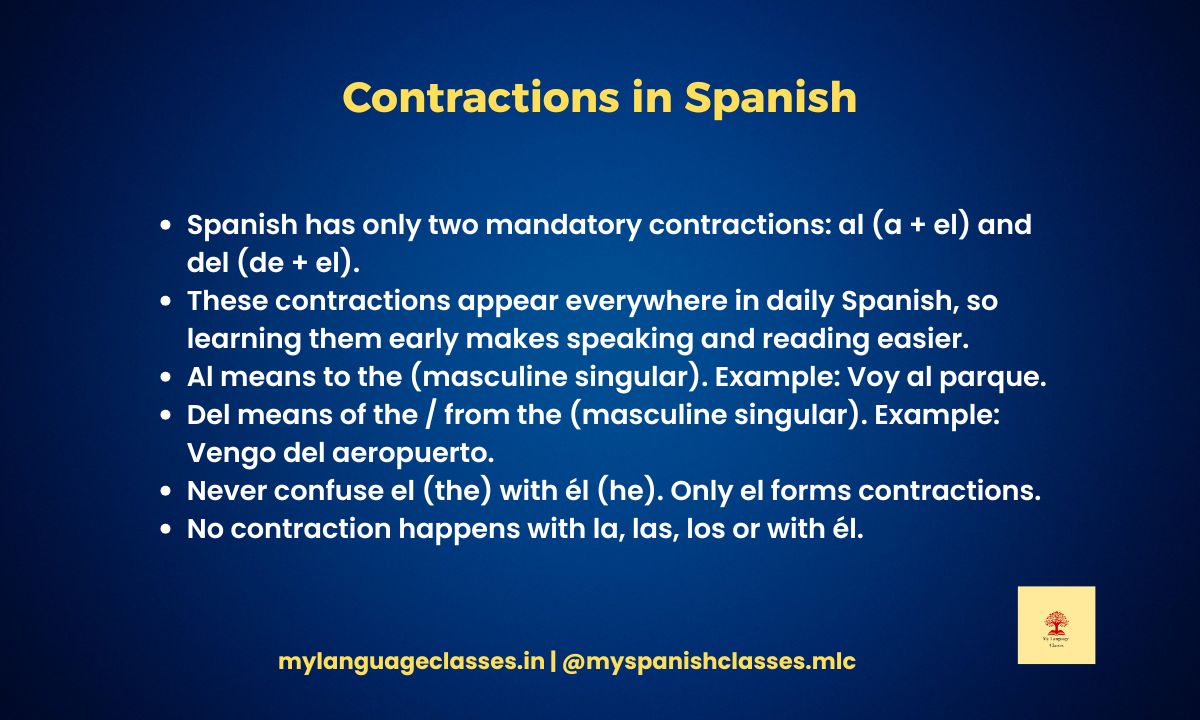
- Spanish has only two mandatory contractions: al (a + el) and del (de + el).
- These contractions appear everywhere in daily Spanish, so learning them early makes speaking and reading easier.
- Al means to the (masculine singular). Example: Voy al parque.
- Del means of the / from the (masculine singular). Example: Vengo del aeropuerto.
- Never confuse el (the) with él (he). Only el forms contractions.
- No contraction happens with la, las, los or with él.
- Informal forms like pa’l appear in speech but should not be used in formal writing.
- Using contractions correctly makes your Spanish sound natural, smooth, and confident.
- Always check the word after a or de. If it is el, use a contraction.
- With regular practice, these forms become automatic and help you understand native speakers faster.
Final Thoughts
Spanish contractions may be small, but they are powerful. With just two required forms—al and del—you can make your sentences smoother, clearer, and more natural. The more you read and listen to Spanish, the more these forms will appear. Soon they’ll feel automatic.

Vikas Kumar is the founder of My Language Classes, a language learning platform dedicated to helping learners develop practical communication skills in Spanish, Japanese, and English through comprehensive grammar guides, structured learning resources, books, and evidence-informed educational content.
At My Language Classes, we believe that successful language learning is built on clarity, consistency, meaningful practice, and a deep understanding of how languages work. Every article is carefully researched and created to simplify complex concepts, provide practical guidance, and help learners develop confidence through real-world communication.
Inspired by the principles behind How Language Learning Really Works, our mission is to make high-quality language learning accessible to learners around the world by providing accurate, trustworthy, and comprehensive resources that support lasting progress, lifelong learning, and meaningful communication.
Leave a Reply