

What Are Homophones?
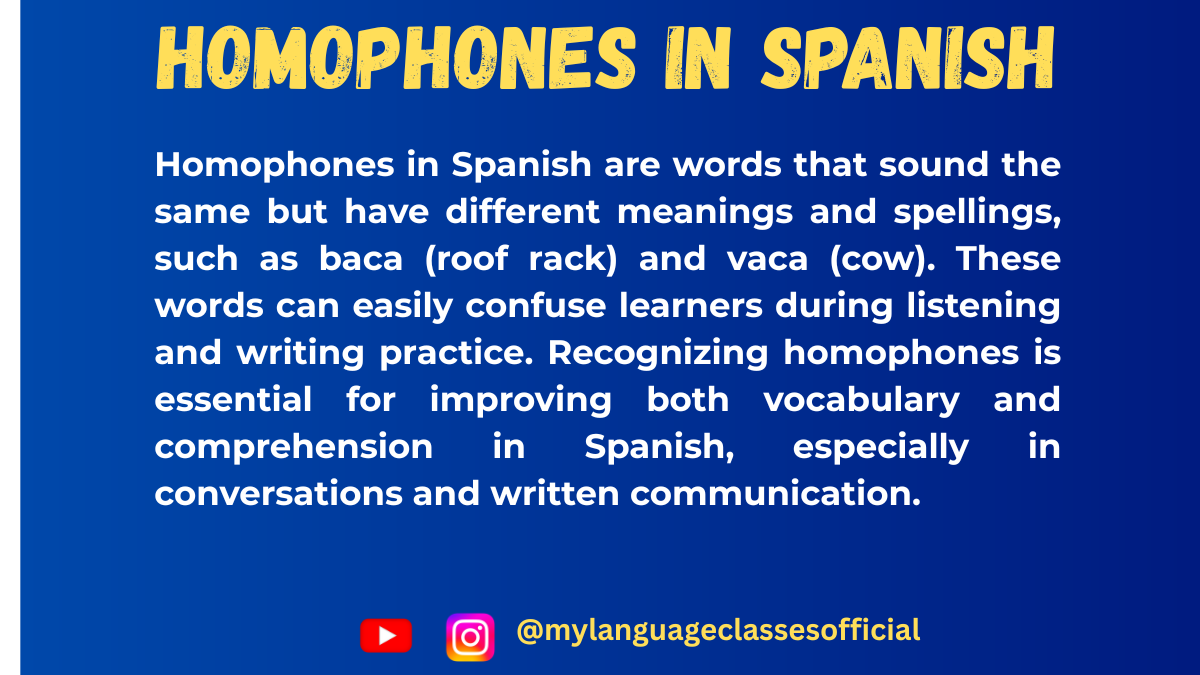
Homophones are words that sound the same but have different meanings and spellings. In Spanish, many homophones exist due to the presence or absence of accent marks (tildes), which change the meaning of a word entirely. Understanding these differences is crucial for mastering Spanish grammar and avoiding misunderstandings in writing and speech.
Common Homophones in Spanish
Below is a list of frequently confused homophones in Spanish, along with their meanings and example sentences.
| Homophones | Meaning 1 | Meaning 2 | Example Sentence 1 | Example Sentence 2 |
|---|---|---|---|---|
| Tú / Tu | (Pronoun) You | (Possessive adjective) Your | Tú eres muy simpático. (You are very nice.) | Tu casa es grande. (Your house is big.) |
| Él / El | (Pronoun) He | (Article) The | Él es mi hermano. (He is my brother.) | El coche es rojo. (The car is red.) |
| Más / Mas | (Adverb) More | (Conjunction) But | Quiero más comida. (I want more food.) | Quise ir, mas no pude. (I wanted to go, but I couldn’t.) |
| Sí / Si | (Adverb) Yes | (Conjunction) If | Sí, quiero ir. (Yes, I want to go.) | Si tienes tiempo, llámame. (If you have time, call me.) |
| Dé / De | (Verb) Give (subjunctive) | (Preposition) Of, from | Quiero que me dé la llave. (I want him to give me the key.) | La casa de mi madre es grande. (My mother’s house is big.) |
| Té / Te | (Noun) Tea | (Pronoun) You (object) | Me gusta el té verde. (I like green tea.) | Te quiero mucho. (I love you very much.) |
| Aún / Aun | (Adverb) Still, yet | (Adverb) Even | Aún no he terminado. (I haven’t finished yet.) | Aun los niños pueden hacerlo. (Even the children can do it.) |
| Solo / Sólo | (Adjective) Alone | (Adverb) Only (obsolete accent) | Me siento solo. (I feel alone.) | Sólo quiero una respuesta. (I only want an answer.) |
| Porque / Por qué | (Conjunction) Because | (Interrogative phrase) Why | No fui porque estaba enfermo. (I didn’t go because I was sick.) | ¿Por qué estás triste? (Why are you sad?) |
| Qué / Que | (Interrogative) What | (Conjunction) That | ¿Qué quieres? (What do you want?) | Dijo que vendría mañana. (He said that he would come tomorrow.) |
More Example Sentences
- Tú puedes venir, pero tu hermano no. (You can come, but your brother can’t.)
- Él dijo que el problema está resuelto. (He said that the problem is solved.)
- Quiero más, mas ya no hay comida. (I want more, but there’s no food left.)
- Sí voy a la fiesta, pero si tú vas también. (Yes, I will go to the party, but only if you go too.)
- Es importante que me dé una oportunidad para explicar de qué hablo. (It’s important that he gives me a chance to explain what I’m talking about.)
- Té caliente o frío, como prefieras, pero te recomiendo el de menta. (Hot or cold tea, as you prefer, but I recommend the mint one.)
- Aún estás aquí? No puedo creer que aun después de todo no te hayas ido. (Are you still here? I can’t believe that even after everything, you haven’t left.)
- Está solo en casa, pero sólo hasta las cinco. (He is alone at home, but only until five.)
- No entiendo por qué estás tan cansado, porque dormiste bien. (I don’t understand why you’re so tired, because you slept well.)
- Qué bonito día! No sabía que te gustaba la primavera. (What a beautiful day! I didn’t know that you liked spring.)
Things to Keep in Mind
- Accent marks matter: In Spanish, accents are not optional; they change the meaning of words entirely.
- Articles and gender: Be mindful of definite articles (el, la, los, las) and their relation to nouns.
- Pronouns vs. adjectives/articles: Many homophones differ between being pronouns and adjectives/articles (e.g., tú vs. tu).
- Conjunctions and adverbs: Words like mas and más or aún and aun play different grammatical roles.
Fill in the Blanks
- No sé _______ hacer. (Qué / Que)
- No quiero _______ me hables así. (que / qué)
- _______ tiempo hace hoy? (Qué / Que)
- Me gusta _______ café de tu casa. (el / él)
- _______ quiere ir al cine. (El / él)
- Tienes que _______ las gracias. (dé / de)
- Todavía no lo he visto. Está _______ ocupado. (aún / aun)
- Prefiero tomar _______ en la mañana. (té / te)
- Me gusta mucho _______ casa. (tu / tú)
- _______ es muy simpática. (Tú / Tu)
Answers:
- Qué 2. que 3. Qué 4. el 5. él 6. dé 7. aún 8. té 9. tu 10. Tú
Conclusion
Mastering Spanish homophones is essential for both speaking and writing correctly. Paying attention to accent marks, sentence context, and grammatical functions will help avoid misunderstandings. Keep practicing, and soon differentiating these words will become second nature!

Vikas Kumar is the founder of My Language Classes, a language learning platform dedicated to helping learners develop practical communication skills in Spanish, Japanese, and English through comprehensive grammar guides, structured learning resources, books, and evidence-informed educational content.
At My Language Classes, we believe that successful language learning is built on clarity, consistency, meaningful practice, and a deep understanding of how languages work. Every article is carefully researched and created to simplify complex concepts, provide practical guidance, and help learners develop confidence through real-world communication.
Inspired by the principles behind How Language Learning Really Works, our mission is to make high-quality language learning accessible to learners around the world by providing accurate, trustworthy, and comprehensive resources that support lasting progress, lifelong learning, and meaningful communication.
Leave a Reply